
Natural Perfume for a Health-Conscious Friend: Best Picks
The clearest recommendation for a health-conscious, introspective gift: Maison Voyageur’s The Inner Trip · Seven Archetypes Method. Composed in Madrid with 98% natural ingredients, full INCI disclosure, and small-batch artisanal production, it fits the brief precisely. When you select a natural perfume for a health-conscious friend, this collection offers something most gifts cannot: a scent chosen for who they actually are, not just how they want to smell.
Three reasons it works as a gift:
- a high natural formulation with published ingredient lists, so your friend knows exactly what touches their skin
- Full INCI transparency rather than the vague “fragrance” catch-all that hides synthetics and allergens
- Small-batch, slow-craft production that prioritizes quality over volume
How to order it well:
- Start with a travel size or sampler set to let your friend test before committing to a full bottle.
- Add a guided scent note card explaining the archetype behind the fragrance.
- Use Maison Voyageur’s gifting option at checkout for presentation that matches the intention.
Pro Tip: If you are unsure which archetype fits your friend, the sampler set lets them discover their own. That uncertainty is part of the gift.
Table of Contents
- What should you check before buying a natural perfume as a gift?
- Which Mediterranean scent archetype suits your friend’s personality?
- How do you decode a perfume label and spot red flags?
- How do you sample and gift a natural perfume safely?
- Why Maison Voyageur fits this brief better than most options
- Key Takeaways
- What gifting a scent for wellness actually asks of you
- The simplest way to order the right gift from Maison Voyageur
- Trusted references for further reading
What should you check before buying a natural perfume as a gift?
Choosing a natural perfume for a wellness-minded friend means reading past the marketing. Here is a compact checklist.
Ingredient transparency
- Look for a full INCI list on the product page or bottle. A label that says only “fragrance” or “parfum” can hide phthalates and other synthetics your friend may be actively avoiding.
- Verify the percent-natural claim. “98% natural” means the vast majority of the formula comes from botanical or mineral sources. Anything below 80% with no certification warrants scrutiny.
Allergen and sensitizer disclosure
- Common essential-oil allergens include linalool, limonene, geraniol, and eugenol. A transparent brand lists these individually.
- Always include patch-test instructions with the gift. Natural does not mean hypoallergenic.
Vegan and cruelty-free signals
- Brands often hide animal-derived ingredients under “fragrance.” Look for certified vegan logos or explicit ingredient confirmation.
Sourcing and sustainability
- Small-batch production notes, fair-trade ingredient sourcing, and organic certification are meaningful signals. They indicate a brand that tracks where materials come from.
- IFRA conformity (International Fragrance Association standards) shows the formula meets safety benchmarks for skin contact.
Price and sizing
- Artisanal natural perfumes typically range from $60–$180 for a full bottle (30–50 ml). Travel sizes are usually less expensive and are the smarter gift choice when you are unsure of preference.
Pro Tip: Even on retailer-curated “clean” pages, verify ingredient lists at the manufacturer level. Retailer labels are a starting point, not a guarantee.
Which Mediterranean scent archetype suits your friend’s personality?
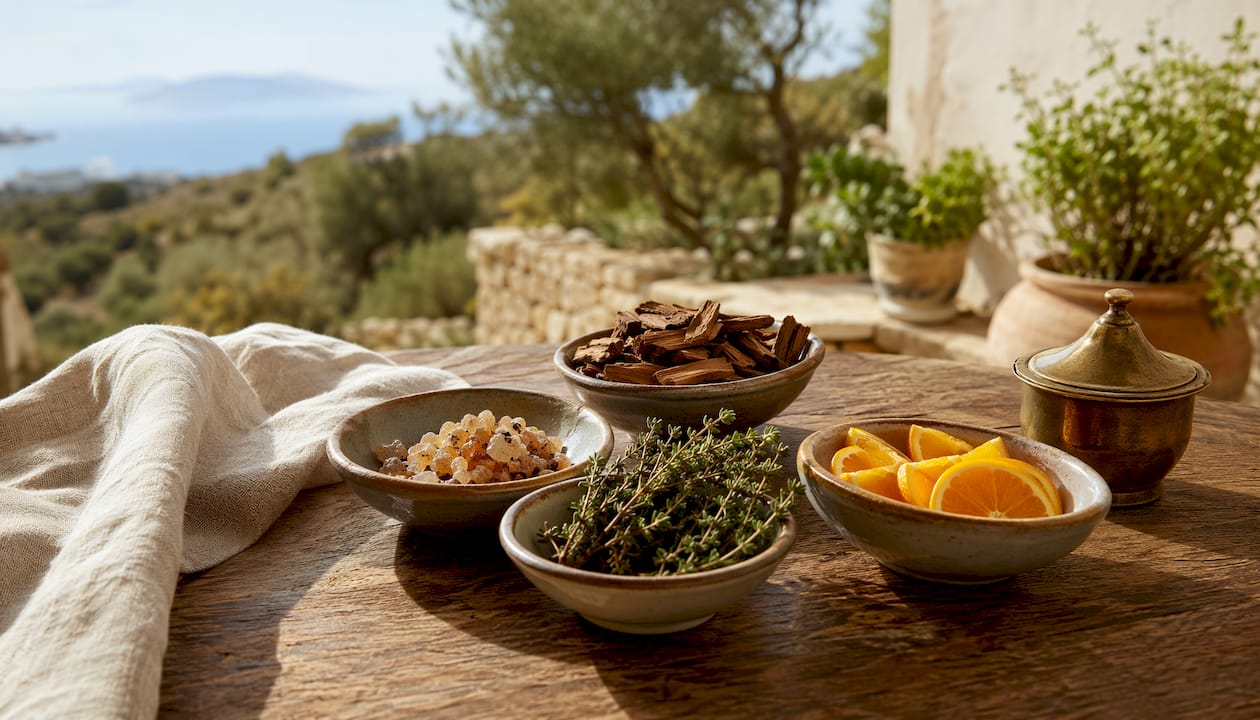
Mediterranean perfumery draws from a specific emotional geography: sun-warmed stone, salt air, dry herbs, and the particular stillness of late afternoon light. Matching the right archetype to your friend’s temperament makes the gift feel considered rather than generic. Maisonvoyageurparfum’s botanical complexity is built around exactly these profiles.
| Archetype | Core notes | Emotional tone | Best for |
|---|---|---|---|
| Coastal citrus-herbal | Bergamot, rosemary, sea salt | Bright, clarifying, open | The early riser, the outdoor thinker |
| Dry resinous wood/amber | Cedarwood, labdanum, cistus | Grounded, warm, contemplative | The quiet reader, the slow-living devotee |
| Sun-drenched floral | Neroli, jasmine, orange blossom | Radiant, soft, memory-laden | The convivial host, the nostalgic romantic |
| Late-evening tobacco/fig | Fig leaf, tobacco absolute, vetiver | Dusky, introspective, sensual | The twilight romantic, the creative night owl |
For wellness-minded recipients, lean toward the subtler skin-close profiles: coastal citrus-herbal and dry resinous wood. These wear quietly and tend to feel less intrusive than heavier gourmand or amber-dominant blends. A friend who practices mindfulness or values stillness will often respond more deeply to a scent that evolves slowly on the skin rather than announces itself.
Pro Tip: Ask yourself one question: does your friend seek clarity or depth? Citrus-herbal archetypes offer the former; resinous wood and amber offer the latter. Both are introspective. The difference is the direction.
How do you decode a perfume label and spot red flags?
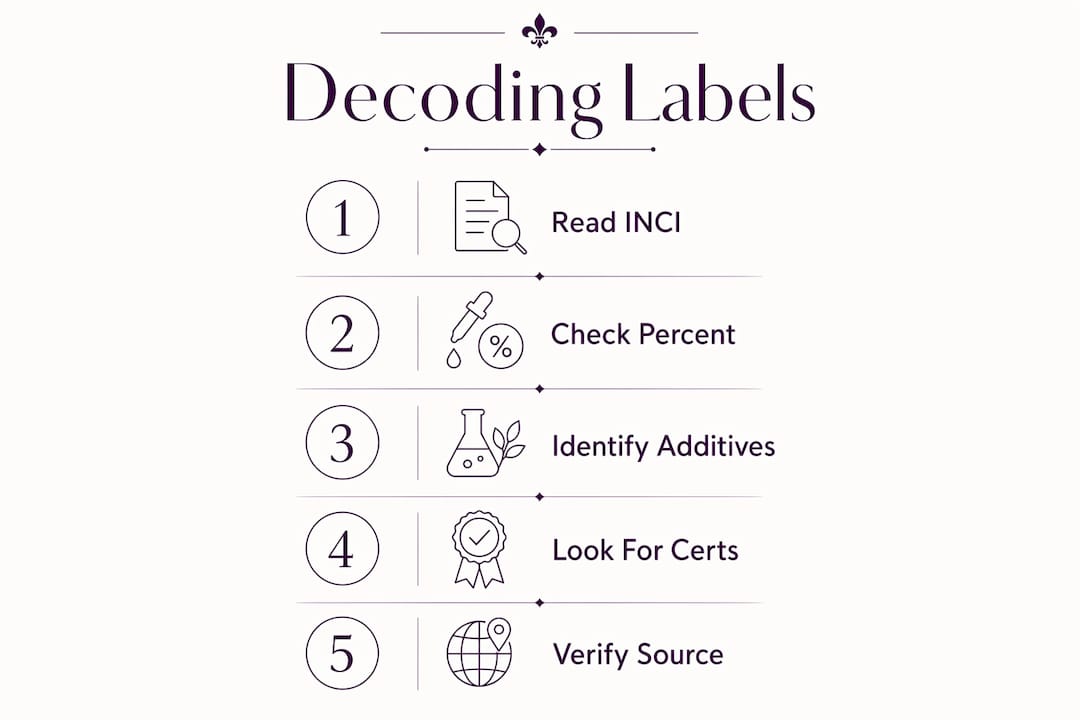
Reading a perfume label is a skill. Most buyers skip it. For a health-conscious recipient, it matters more than the bottle design.
What INCI means
INCI stands for International Nomenclature of Cosmetic Ingredients. It is the standardized system for listing every ingredient in a cosmetic product. A brand that publishes a full INCI list is telling you exactly what is in the formula. One that lists only “parfum” is not.
Common misleading labels
- “Natural” with no percentage or certification attached is a marketing claim, not a standard.
- “Hypoallergenic” has no regulated definition in the U.S. It signals nothing about allergen content.
- “Clean” varies by retailer. Sephora’s Clean Fragrance designation curates safer options but does not replace manufacturer-level verification.
Red-flag ingredients to know
- Phthalates (often listed as “diethyl phthalate” or hidden in “fragrance”): used as fixatives, linked to endocrine disruption concerns.
- Certain parabens (methylparaben, propylparaben): preservatives with contested safety profiles for sensitive individuals.
- Unspecified musks: synthetic musks vary widely in safety; without INCI specificity, there is no way to assess them.
What credible transparency looks like: a full INCI list on the product page, a stated percent-natural figure, and ideally a reference to IFRA conformity or third-party verification. Eco-conscious buying guides consistently flag packaging, transparency, and IFRA conformity as the three non-negotiable signals.
How do you sample and gift a natural perfume safely?
Natural perfumes behave differently from synthetic ones. They evolve faster on skin, interact with body chemistry more noticeably, and can contain potent botanical allergens. Sampling before gifting a full bottle is the responsible choice.
Patch-test protocol
- Apply a small amount to the inner wrist or inner elbow.
- Wait 24 hours before assessing for redness, itching, or irritation.
- If no reaction, wear the scent for a full day to observe how it develops across top, heart, and base notes.
- Natural top notes (citrus, light herbs) fade within 1–2 hours; the heart and base reveal the true character of the fragrance.
Sampling vs. full bottle for gifts
- Travel sizes (5–10 ml) let your friend test without pressure. They are also easier to carry and less wasteful if the scent turns out not to be right.
- Sampler sets covering multiple archetypes give a health-conscious recipient the agency to choose their own fit.
- Full bottles make sense only when you are confident in the match, or when the recipient has already tested the scent.
Gifting logistics
- Order at least 7–10 days before the occasion to allow for standard shipping on artisanal products.
- Include a printed patch-test note with the gift. It shows care, not caution.
- Presentation matters: a minimal card explaining the archetype and the ingredient philosophy adds meaning without adding cost.
Pro Tip: Pair the travel size with a handwritten note naming the archetype and why you chose it for them. That specificity is what separates a thoughtful gift from a beautiful one.
Why Maison Voyageur fits this brief better than most options
The case for Maisonvoyageurparfum’s The Inner Trip · Seven Archetypes Method rests on four concrete things, not marketing language.
- 98% natural formulation: the brand documents what that percentage means for scent evolution and fixative choices, rather than using it as a badge.
- Full INCI disclosure: ingredient lists are available, not buried. That is still uncommon in artisanal perfumery.
- Small-batch Madrid composition: each fragrance is made slowly, with botanical materials chosen for emotional resonance rather than cost efficiency.
- Seven Archetypes Method: the collection maps directly to the Mediterranean personality profiles described above, giving you a structured way to match scent to recipient.
For a quiet contemplative, the dry resinous wood archetype from the collection offers grounded depth. For a convivial friend who fills a room with warmth, the sun-drenched floral profile is the closer fit. The travel-size options make the gifting decision low-risk.
The conscious shopping guidance Maisonvoyageurparfum publishes reflects the same values the collection embodies: sourcing transparency, small-batch integrity, and the belief that a fragrance should mean something.
Pro Tip: When ordering as a gift, select the sampler configuration and add the guided scent note. It turns the unboxing into a small act of self-discovery.
Key Takeaways
Choosing a natural perfume for a health-conscious friend comes down to three things: ingredient transparency, a verified percent-natural claim, and a scent archetype matched to who they actually are.
| Point | Details |
|---|---|
| Verify ingredient transparency | Insist on a full INCI list; “fragrance” alone can hide phthalates and allergens. |
| Check the percent-natural claim | A stated figure like 98% natural, with explanation, is a meaningful trust signal. |
| Match archetype to personality | Coastal citrus-herbal suits clarity seekers; dry resinous wood suits contemplative types. |
| Start with a travel size | Sampling before a full bottle protects a health-conscious recipient from unwanted reactions. |
| Maisonvoyageurparfum’s recommendation | The Inner Trip · Seven Archetypes Method offers 98% natural formulation, INCI disclosure, and travel-size gifting options. |
What gifting a scent for wellness actually asks of you
There is a version of this gift that is purely aesthetic: a beautiful bottle, a pleasant smell, a ribbon. That version is fine. But when the recipient is genuinely health-conscious, the gift asks something more of the giver.
It asks you to read the label. To think about what “natural” actually means on a product page. To consider whether the scent you are choosing reflects something true about the person receiving it, or just something you found appealing in a store.
The intentional use of fragrance for wellness is not a trend. It is a practice with real roots in how scent interacts with memory, mood, and the nervous system. A perfume chosen for introspection, made with transparent ingredients, and matched to a personality archetype is a different kind of gift entirely. It is one that keeps offering something each time it is worn.
For a health-conscious friend, the most generous thing you can do is prioritize transparency and sampling over presentation. The bottle matters less than what is inside it.
The simplest way to order the right gift from Maison Voyageur
For a health-conscious friend who values what goes on their skin, Maisonvoyageurparfum’s The Inner Trip · Seven Archetypes Method is the most considered option available. The formulation is 98% natural, the ingredients are disclosed, and the collection is built around the Mediterranean archetypes that make a scent feel personal rather than generic.

Order the Seven Archetypes sampler to give your friend the experience of discovering their own archetype. Choose insured shipping, allow 7–10 days for delivery, and include a short patch-test note with the gift. If you want to go further, add the guided scent note card at checkout. It explains the archetype, the ingredients, and the intention behind the fragrance.
That is a gift worth giving.
Trusted references for further reading
The sources below back the safety, transparency, and gifting guidance in this article.
- Maison Voyageur: How to Read Natural Fragrance Ingredient Labels — step-by-step INCI guide and label red flags. Read it here.
- Maison Voyageur: What Is a Fair Trade Perfume Ingredient? — traceability and responsible sourcing explained. Read it here.
- Maison Voyageur: Harmful Chemicals in Mass Perfumes — a primer on phthalates, parabens, and synthetic musks. Read it here.
- The Good Trade: Natural Perfumes That Actually Smell Good — editorial review of clean fragrance options with transparency criteria. Read it here.
- Ethical Consumer: Ethical Perfume & Aftershave — vegan, cruelty-free, and organic certification guidance for fragrance buyers. Read it here.
- Conscious Life and Style: Eco-Friendly Perfume Brands — packaging, IFRA conformity, and sustainability signals for conscious buyers. Read it here.
Recommended
- Harmful Chemicals in Mass Perfumes: What to Avoid – Maison Voyageur
- How to Shop Consciously for Luxury Fragrances – Maison Voyageur
- Offrir un parfum naturel : pourquoi choisir – Maison Voyageur
- Ingredientes tóxicos en perfumes convencionales: guía 2026 – Maison Voyageur
Les sept fragrances Maison Voyageur
- Manifesting · unisexe (69,99 €)
- Intuition · femme (69,99 €)
- Certainty · femme (69,99 €)
- Expansion · femme (69,99 €)
- Release · homme (69,99 €)
- Presence · homme (69,99 €)
- Inner Fire · homme (69,99 €)
Nouvelle ici ? Commence par le Discovery Set · les 7 fragrances en format voyage (40 €).