
What Is a Fair Trade Perfume Ingredient?
A fair trade perfume ingredient is a raw material sourced under a verified ethical framework that guarantees fair wages, safe working conditions, and democratic representation for the farmers and harvesters who produce it. The industry term is “ethically sourced ingredient,” but “fair trade” signals a specific, third-party verified standard. Certifications like Fairtrade, Fair for Life, and SA8000 define what that standard looks like in fragrance supply chains. Knowing what is a fair trade perfume ingredient separates genuine ethical sourcing from vague marketing language. It also tells you something real about the people behind the scent you wear.
Which perfume ingredients are commonly fair trade?
The most labor-intensive ingredients in perfumery carry the highest ethical risk. Rose, jasmine, and patchouli are all hand-harvested, meaning their quality depends entirely on human labor performed under conditions that vary widely by region and season. Rose and jasmine require fair trade verification precisely because their hand-harvested nature creates direct exposure to labor exploitation. A single kilogram of rose absolute can require thousands of hand-picked blossoms, making the work both physically demanding and economically precarious for harvesters.
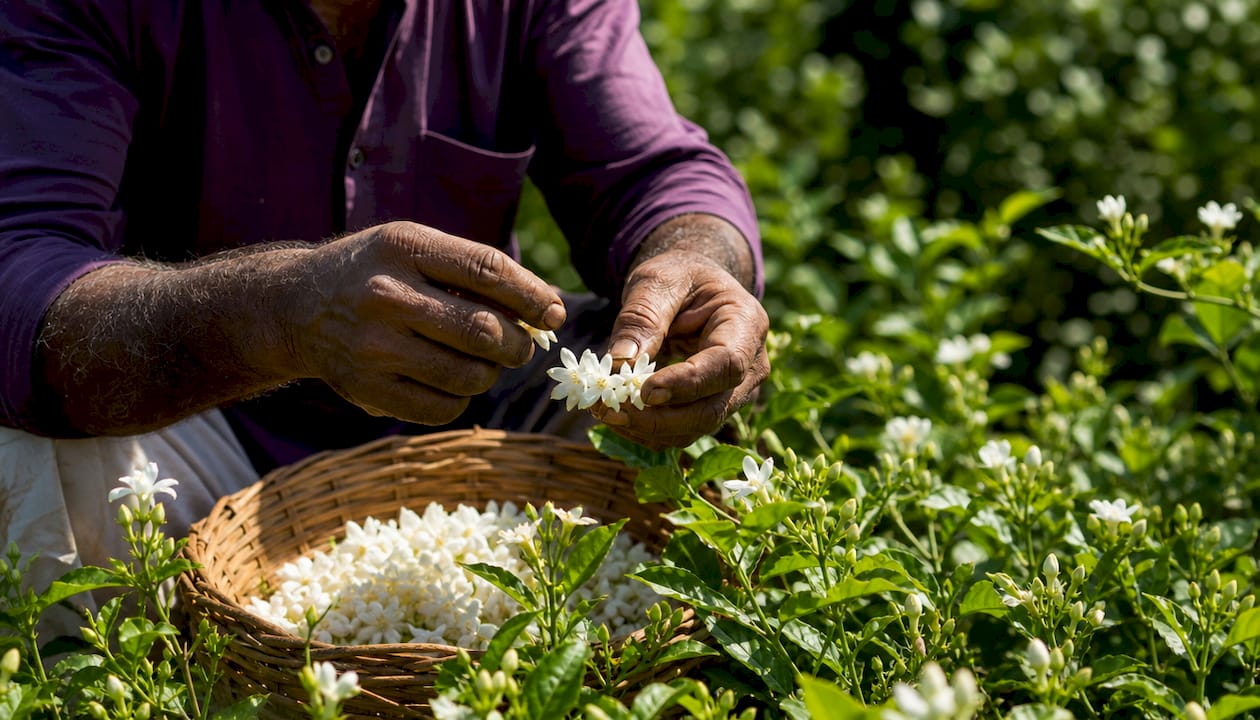
Oud and sandalwood present a different kind of ethical challenge. Both face overharvesting and trafficking risks, which means certification and provenance clarity are critical for these endangered botanicals. Responsible brands source oud from certified plantations or use lab-grown alternatives that reduce pressure on wild populations.
Fair trade initiatives address these risks through cooperative models and direct price premiums paid to farming communities. Those premiums fund practical investments: nurseries, sustainable agricultural training, and community infrastructure. The result is a supply chain where the farmer has a stake in the outcome, not just a wage.
- Rose: Grown primarily in Bulgaria, Turkey, and Morocco; hand-picked at dawn; cooperative models protect harvesters from wage suppression.
- Jasmine: Sourced heavily from India and Egypt; night-harvested for peak fragrance; fair trade premiums support women-led farming collectives.
- Patchouli: Cultivated across Indonesia; drying and distillation are labor-intensive; ethical sourcing programs focus on safe processing conditions.
- Sandalwood: Australian and Indian varieties face supply pressure; certified plantation sourcing is the standard for responsible brands.
- Oud: Wild agarwood is critically endangered; lab-grown and plantation-certified alternatives are the ethical choice.
Pro Tip: When a brand lists a specific country of origin for rose or jasmine, that specificity is a positive signal. Vague descriptions like “floral extract” with no origin are a reason to ask more questions.
How do fair trade certifications work in the perfume industry?
Certification frameworks give fair trade claims their credibility. Each operates differently, and understanding those differences helps you read a label accurately.
- Fairtrade: Covers price floors, premiums paid to producer organizations, and democratic governance of farming cooperatives. Strong on social standards; primarily covers agricultural commodities.
- Fair for Life: A broader standard covering farms, processing facilities, and trading relationships. Audits assess wages, working hours, freedom of association, and environmental practices.
- SA8000: Focuses on labor rights in manufacturing and processing. Based on International Labour Organization conventions. Covers child labor, forced labor, health and safety, and working hours.
- Rainforest Alliance: Weighted toward environmental sustainability, including biodiversity and water use. Social criteria exist but are less central than in Fairtrade or Fair for Life.
- Organic certifications: Verify agricultural practices but say nothing about labor conditions. A perfume can be certified organic and still involve exploitative labor.
Certifications vary greatly in their social versus environmental focus, cost, and transparency level. That variation matters because a Rainforest Alliance logo on a bottle does not confirm fair wages. A Fairtrade logo does not confirm environmental best practice. Smaller brands sometimes use bespoke audits and publish supplier maps as alternatives to formal certifications.
“Leading brands move beyond labels by committing to living wages and publishing detailed sustainability reports and geographic supplier maps. Transparency through audits and direct impact disclosures builds the kind of trust that a logo alone cannot.”
The scope limitation of certifications is the most important thing to understand. Third-party certifications often apply to specific segments of supply chains. A certification logo does not guarantee every ingredient in the perfume is fair trade. A brand might source its rose absolute from a Fairtrade cooperative while purchasing its synthetic base notes from an uncertified supplier. Transparency practices, including published supplier lists, origin maps, and batch traceability, fill the gaps that certification logos leave open.
Living wage commitments and published sustainability reports represent the next level of accountability beyond certification. Brands that publish audited reports and geographic sourcing data give you something to verify, not just trust.
What is the difference between fair trade, natural, clean, and sustainable ingredients?
These four terms overlap in marketing but describe distinct things. Confusing them is the most common mistake conscious consumers make.
| Term | Primary focus | What it does NOT guarantee |
|---|---|---|
| Fair trade | Labor rights, fair wages, producer welfare | Environmental impact, ingredient purity |
| Natural | Ingredient origin (plant or animal derived) | Labor conditions, environmental impact |
| Clean | Absence of specific synthetic chemicals | Ethical sourcing, environmental sustainability |
| Sustainable | Long-term environmental viability | Fair wages, labor rights |
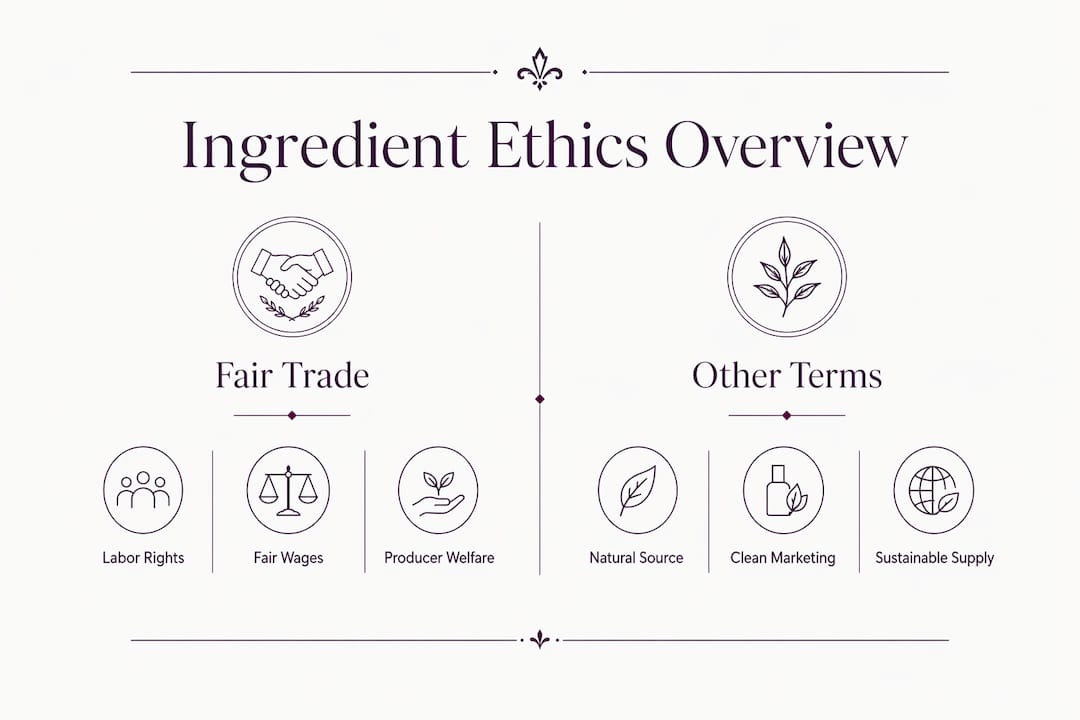
Natural fragrance ingredients can have high environmental impacts. Ethical sourcing requires a full lifecycle assessment covering land use, water consumption, and labor conditions. A jasmine absolute labeled “100% natural” tells you nothing about whether the harvesters were paid fairly or whether the farmland was managed responsibly.
Clean beauty is a marketing category, not a regulated standard. It typically means a brand has excluded certain synthetic ingredients from its formulas. It says nothing about the people who grew the raw materials or the ecological cost of production.
Sustainable sourcing addresses the long-term viability of an ingredient’s supply. It asks whether the plant population can support continued harvesting without degradation. That is an environmental question, not a social one.
Fair trade is the only term among the four that directly addresses producer welfare. It is also the only one with a defined third-party verification process when backed by a recognized certification body.
Biotech and synthetic ingredients complicate the picture further. A lab-grown sandalwood molecule eliminates overharvesting pressure and reduces land use. Biotech synthetics can reduce environmental pressure but still need transparency on sourcing and production impacts. The ethical case for synthetics is real, but it requires the same honest disclosure that natural ingredients demand.
Pro Tip: Read fragrance labels by asking two separate questions: “Where did this ingredient come from?” and “Who produced it, and under what conditions?” Natural and fair trade answer different questions. You need both.
How can you identify fair trade perfume ingredients when shopping?
The most reliable approach is to ask direct questions before you buy. Brands that refuse to provide origin details or audited reports often lack supply chain transparency, and that silence is itself informative. A brand confident in its sourcing will answer clearly.
- Ask about certifications by name. Request the specific certification body, not just the claim. “We use ethical ingredients” is not the same as “Our rose absolute is Fairtrade certified by FLO-CERT.”
- Look for traceability details. Batch numbers, farm names, and country of origin are signs of a brand that tracks its supply chain. Batch numbers and farm names published by brands indicate genuine supply chain accountability.
- Check for published supplier lists or origin maps. These are voluntary disclosures that go beyond certification requirements. They are the clearest signal of a brand committed to transparency.
- Distinguish certification from aspiration. Phrases like “responsibly sourced” or “ethically inspired” carry no verified meaning. Look for logos from recognized bodies: Fairtrade, Fair for Life, SA8000, or Rainforest Alliance.
- Understand the price. Fair trade fragrances carry higher price points versus mass-market alternatives because they reflect the real costs of certified labor, small-batch processing, and community investment. A premium price is not proof of fair trade, but a suspiciously low price for a “fair trade” product is a red flag.
Learning how to shop consciously for fragrance means treating sourcing transparency as a baseline requirement, not a bonus feature. The brands worth supporting are the ones that make verification easy.
Pro Tip: Search a brand’s website for the words “supplier,” “audit,” or “sourcing report.” If those words appear nowhere, the brand has not prioritized transparency. If they link to published documents, that is a meaningful commitment.
Key Takeaways
Fair trade perfume ingredients are the only fragrance sourcing category that directly verifies producer welfare through third-party certification, making them the clearest standard for ethical fragrance purchasing.
| Point | Details |
|---|---|
| Fair trade defined | Verified ethical frameworks cover fair wages, safe conditions, and producer representation. |
| Key ingredients at risk | Rose, jasmine, patchouli, oud, and sandalwood carry the highest labor and environmental risks. |
| Certification scope matters | A logo covers only part of a supply chain; published supplier lists fill the transparency gap. |
| Fair trade vs. natural | Natural describes ingredient origin; fair trade describes producer welfare. They are not the same. |
| How to verify | Ask for certification names, batch numbers, and published sourcing reports before purchasing. |
Why transparency matters more than the label
I have spent years reading sustainability reports and asking brands uncomfortable questions about their supply chains. The pattern I keep seeing is this: the brands with the most confident marketing language are often the ones with the least to show when you ask for documentation.
Certification logos are a starting point, not a finish line. The Fairtrade mark on a bottle tells you that one ingredient, sourced from one certified cooperative, met a defined standard at the time of audit. It does not tell you about the other fifteen ingredients in that formula. That gap is where most ethical claims quietly collapse.
What I find genuinely encouraging is the shift toward published sourcing data. Brands that release geographic supplier maps and annual impact reports are doing something harder than getting certified. They are making their claims verifiable. That is the standard I think conscious consumers should hold every brand to.
The balance between environmental and social criteria is also underappreciated. A brand can score well on carbon footprint while paying harvesters below a living wage. The reverse is also true. Real ethical sourcing requires both dimensions, and the brands that acknowledge that tension honestly are the ones worth trusting. Reading ingredient label claims carefully is where that evaluation begins.
— Celeste
Maisonvoyageurparfum and the practice of slow, ethical sourcing
Maisonvoyageurparfum was built on a different premise than mass-market perfumery. Each fragrance is crafted slowly, with 98% natural ingredients selected for their origin and integrity, not just their scent profile.

The slow luxury philosophy at Maisonvoyageurparfum means sourcing decisions are made with the same care given to the final formula. Transparency is not a marketing layer. It is part of how each scent is built. For those who want a fragrance that reflects genuine values, Maisonvoyageurparfum’s Mediterranean collections offer a place to begin. Real luxury takes time. So does ethical sourcing. At Maisonvoyageurparfum, the two are the same thing.
FAQ
What is a fair trade perfume ingredient?
A fair trade perfume ingredient is a raw material sourced under a verified ethical standard that guarantees fair wages, safe working conditions, and fair treatment for producers. Recognized certifications include Fairtrade, Fair for Life, and SA8000.
Does “natural” mean the same as “fair trade” in perfume?
No. Natural describes where an ingredient comes from (a plant or animal source). Fair trade describes how the people who produced it were treated. An ingredient can be 100% natural and still involve exploitative labor.
Which perfume ingredients most need fair trade certification?
Rose, jasmine, patchouli, oud, and sandalwood carry the highest risk because they are hand-harvested or face overharvesting pressure. These ingredients benefit most from certified ethical sourcing frameworks.
How can I tell if a perfume brand is genuinely fair trade?
Ask for the specific certification body and look for published supplier lists, origin maps, or audited sustainability reports. Brands that cannot provide these details have not verified their supply chain claims.
Why do fair trade perfumes cost more?
Fair trade fragrances reflect the real costs of certified labor, small-batch processing, and direct community investment such as cooperative premiums and sustainable farming programs. That price premium funds the ethical standard itself.
Recommended
- Transparencia en ingredientes de perfume: qué significa – Maison Voyageur
- Cómo se produce perfume de forma ética – Maison Voyageur
- Ingrédients naturels parfum 98 pourcent : guide 2026 – Maison Voyageur
- Traçabilité ingrédients parfum naturel : guide 2026 – Maison Voyageur
Les sept fragrances Maison Voyageur
- Manifesting · unisexe (69,99 €)
- Intuition · femme (69,99 €)
- Certainty · femme (69,99 €)
- Expansion · femme (69,99 €)
- Release · homme (69,99 €)
- Presence · homme (69,99 €)
- Inner Fire · homme (69,99 €)
Nouvelle ici ? Commence par le Discovery Set · les 7 fragrances en format voyage (40 €).