
Why Perfume Tells Your Story: Scent, Memory, and Identity
Perfume is defined as a personal narrative medium, one that speaks through the brain’s oldest and most direct sensory pathway. When you wear a fragrance, you are not simply choosing a pleasant smell. You are activating the olfactory and limbic systems, the brain regions responsible for emotion and memory, in ways no other sense can replicate. This is why perfume tells your story more precisely than the clothes you wear or the words you choose. The scent you reach for each morning is a living record of who you are, what you have felt, and where you have been.
Why does perfume tell your story through the brain?
Scent reaches the brain differently than every other sense. Olfactory signals travel directly to the piriform cortex and lateral entorhinal cortex, which connects straight into the hippocampus. No other sense takes this shortcut. Vision, sound, and touch all pass through the thalamus first, a kind of rational filter that slows and organizes the signal. Smell bypasses that filter entirely. The result is an immediate, unguarded emotional response.
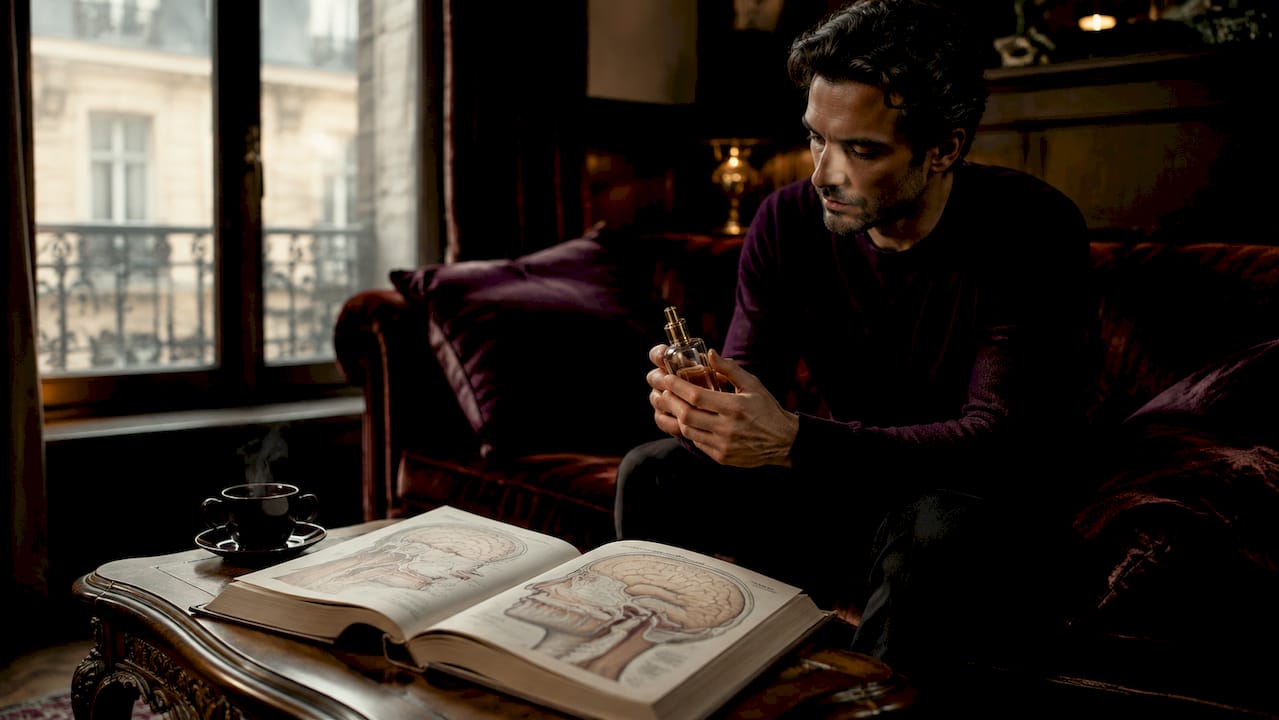
This direct pathway explains why a single inhale can drop you into a memory with startling clarity. The hippocampus stores episodic context, the who, where, and when of your life. When a scent arrives there without the thalamic delay, it pulls those episodes forward with emotional force intact. Neuroscience research shows that odor representations transform progressively as they travel from the olfactory cortex to the hippocampus, meaning the brain is actively shaping the emotional meaning of a scent as it processes it.
The amygdala and ventral prefrontal cortex add another layer. Research using fMRI responses to 160 odors found that odor pleasantness is coded separately in the piriform cortex and amygdala, then integrated into a continuous emotional value in the ventral prefrontal cortex. That integration is what gives a fragrance its emotional tone, the feeling of warmth, confidence, or calm that you associate with a particular scent.
- The olfactory bulb projects directly to memory and emotion centers, with no thalamic delay.
- The amygdala encodes the emotional weight of a scent, pleasant or aversive.
- The hippocampus ties that emotion to specific episodes and contexts.
- The ventral prefrontal cortex integrates pleasantness into a unified emotional signal.
Pro Tip: When testing a new fragrance, wear it for a full day in a context that matters to you. Your brain needs real emotional input, not just a strip of paper, to begin building a personal association.
What makes scent a stronger storytelling tool than other senses?
The absence of a thalamic relay is not a minor anatomical detail. It is the reason olfaction couples so tightly to episodic memory and intense emotional recall, in a way that vision and hearing simply cannot match. When you hear a song from your past, the memory arrives with some emotional distance. When you smell the same perfume you wore on a significant night, the memory arrives as if the distance collapsed entirely.
“Almost every involuntary autobiographical memory is triggered by a specific environmental cue, and smell is among the most precise of those cues.” — Research on Proustian memory triggers
This is the Proustian effect, named for Marcel Proust’s famous passage in In Search of Lost Time, where the smell of a madeleine dipped in tea floods the narrator with a complete, involuntary childhood memory. Modern neuroscience confirms the mechanism. Scent cues trigger vivid emotional episodes with a specificity that other senses rarely achieve.
The table below shows how scent compares to other senses as a storytelling medium.
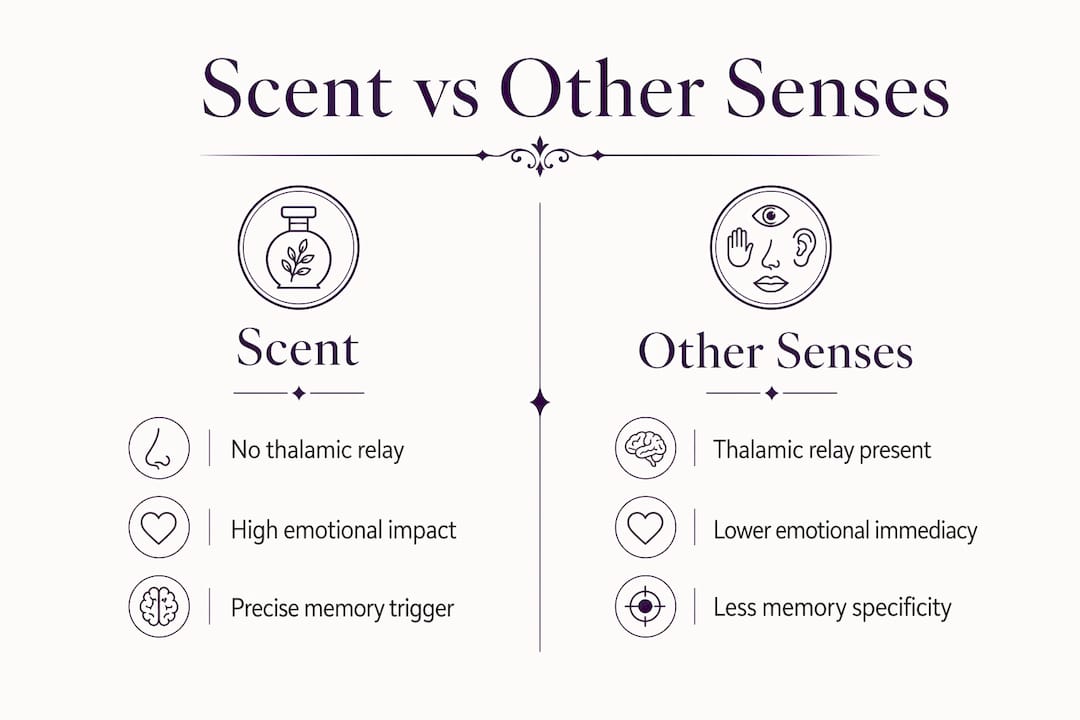
| Sense | Thalamic relay | Emotional immediacy | Memory specificity |
|---|---|---|---|
| Smell | None | Very high | Very high |
| Hearing | Yes | High | Moderate |
| Vision | Yes | Moderate | Moderate |
| Touch | Yes | Moderate | Low |
Two people can wear the same perfume and carry entirely different stories within it. Scent meaning varies between individuals because emotional learning histories differ. A sandalwood fragrance might feel like safety to one person and grief to another, depending on which memories the brain has paired with that scent over time. This subjectivity is not a flaw in perfume. It is precisely what makes fragrance as personal narrative so powerful.
How do personal experience and culture shape what your perfume says about you?
Your emotional history writes itself into your nose. Every time you wear a scent during a meaningful moment, the brain strengthens the synaptic connections between that odor and its emotional context. Wear the same fragrance on every first date, every quiet Sunday morning, or every high-stakes presentation, and the scent becomes a reliable emotional anchor. The story it tells deepens with each repetition.
Culture shapes this process too. A significant post-Covid shift has changed what people want from fragrance. Contemporary buyers seek perfumes that make them feel things, not just smell pleasant. The conversation has moved from note descriptions, bergamot, vetiver, musk, to emotional narratives. Perfumers and buyers alike now talk about what a scent does to you, not just what it contains.
- Repeated scent-context pairing builds stronger emotional anchors over time.
- Cultural references layered into a fragrance’s story add shared meaning beyond personal memory.
- Smell-triggered memories are emotionally reconstructed, not exact replays. Context, mood, and learning history all shape what you feel when a scent returns.
Pro Tip: Keep a brief scent journal. Note where you were and what you felt the first time a fragrance moved you. Revisiting those notes months later reveals how your personal narrative has shifted.
The importance of scent in storytelling extends beyond the individual. Cultures across the Mediterranean, the Middle East, and East Asia have used fragrance in ritual for centuries, embedding collective memory into specific aromas. When Maisonvoyageurparfum draws on Mediterranean ingredients and landscapes, it is tapping into that layered cultural resonance, giving each fragrance a story that exists before you even wear it.
How to choose a signature scent that expresses your personal narrative
Choosing a fragrance that genuinely reflects your identity requires a different approach than reading a list of notes. The brain encodes fragrance as emotional value more than as chemical composition. A perfume that lists oud, rose, and amber tells you very little about how it will feel on your skin and in your memory.
Follow these steps to build a scent that tells your story.
- Reflect on emotional associations first. Before you smell anything, think about the feelings you want to carry. Calm and grounded? Alive and present? Warm and connected? Let that emotional intention guide your search.
- Test in real contexts, not just at the counter. Wear a sample during a walk, a meal, or a quiet evening. Your brain needs lived experience to begin forming a narrative around a scent.
- Notice pleasantness and salience, not just complexity. The ventral prefrontal cortex integrates these signals into your emotional response. If a fragrance feels right in your body, that feeling is neurologically real.
- Build ritual around your chosen scent. Applying the same fragrance before the same activity, whether that is writing, meditating, or meeting someone you love, stabilizes the scent’s emotional power through repeated olfactory-limbic pairing.
- Let the story evolve. Smell-triggered memories are reconstructed each time, shaped by your current mood and context. A fragrance you chose at 25 may tell a richer, different story at 35. That is not inconsistency. That is growth.
Maisonvoyageurparfum’s approach to conscious fragrance selection reflects this philosophy directly. Each scent is crafted slowly, with 98% natural ingredients, to evoke sensation and meaning rather than simply to smell appealing. The goal is a fragrance that grows with you.
Key Takeaways
Perfume tells your story because the brain encodes scent as emotional value, not as chemistry, making fragrance the most direct sensory path to memory, identity, and personal meaning.
| Point | Details |
|---|---|
| Scent bypasses rational filters | Olfactory signals reach the hippocampus and amygdala directly, creating immediate emotional responses. |
| Fragrance meaning is personal | The same perfume can evoke comfort for one person and grief for another, based on individual emotional learning. |
| Ritual deepens the story | Wearing a scent repeatedly in meaningful contexts strengthens its emotional anchor in the brain. |
| Emotional value matters more than notes | Choose fragrance by how it feels, not by its ingredient list. The brain encodes pleasantness, not chemistry. |
| Culture adds shared narrative layers | Mediterranean, Middle Eastern, and other fragrance traditions embed collective memory into specific aromas. |
Scent as autobiography: what I have learned from years with fragrance
I used to choose perfume the way most people do. I read the notes, smelled the strip, and bought what seemed sophisticated. It took years before I understood that I was shopping for a label, not a story.
The shift happened when I noticed that a particular fragrance, one I had worn through a difficult and ultimately clarifying period of my life, stopped smelling like bergamot and cedar to me. It smelled like that time. The scent had absorbed the emotional weight of months of experience. That is when I stopped reading ingredient lists and started paying attention to what a fragrance did to my chest when I inhaled it.
What I find most underappreciated is how scent promotes genuine introspection. A fragrance worn with intention becomes a tool for self-awareness, not just self-expression. The people I know who wear their scent most confidently are not the ones who followed trends. They are the ones who sat with a fragrance long enough to let it mean something.
The cultural shift toward perfume as emotional storytelling is real and overdue. Fragrance deserves the same thoughtfulness we give to the music we return to or the places we call home.
— Celeste
Fragrances that carry your story, from Maisonvoyageurparfum
Maisonvoyageurparfum was built on the belief that a fragrance should do more than smell beautiful. Each scent is crafted slowly in Madrid, using 98% natural ingredients drawn from Mediterranean landscapes, with the intention of evoking emotion, memory, and personal meaning.

For those ready to find a fragrance that genuinely reflects who they are, the scent archetype quiz offers a thoughtful starting point. For something deeply personal, the personalized soy candle from the Manifesting collection is crafted to hold your specific story in scent and light. Real luxury is time to explore within yourself.
FAQ
Why does perfume trigger such strong memories?
Scent signals travel directly to the hippocampus and amygdala without a thalamic relay, creating an immediate link between odor and emotional memory. No other sense has this direct pathway, which is why a fragrance can return a vivid memory in an instant.
Can two people smell the same perfume differently?
Yes. Scent-triggered emotional learning varies between individuals based on their unique emotional histories. The same fragrance can feel comforting to one person and unsettling to another.
How do I choose a signature scent that reflects my personality?
Focus on how a fragrance makes you feel rather than on its listed notes. The brain encodes scent as emotional value, so wear samples in real contexts and notice which fragrance consistently produces the feeling you want to carry.
What does my perfume say about me to others?
Fragrance communicates mood, memory, and intention nonverbally. Post-Covid cultural research shows that buyers now choose scents to express emotional states rather than social status, making your perfume a direct signal of your inner world.
How can I make a fragrance more personal over time?
Wear it consistently during meaningful rituals or contexts. Repeated scent-context pairing strengthens olfactory-limbic connections in the brain, making the fragrance a more precise and powerful emotional anchor with each use.
Recommended
- Why Certain Smells Feel Like Home – Maison Voyageur
- How Fragrance Promotes Introspection: A Science Guide – Maison Voyageur
- Why Natural Perfume Smells Complex: The Real Science – Maison Voyageur
- Journal – Maison Voyageur
Les sept fragrances Maison Voyageur
- Manifesting · unisexe (69,99 €)
- Intuition · femme (69,99 €)
- Certainty · femme (69,99 €)
- Expansion · femme (69,99 €)
- Release · homme (69,99 €)
- Presence · homme (69,99 €)
- Inner Fire · homme (69,99 €)
Nouvelle ici ? Commence par le Discovery Set · les 7 fragrances en format voyage (40 €).