
Por qué el perfume natural huele complejo: la ciencia real
El perfume natural tiene un olor complejo porque sus ingredientes botánicos contienen cientos de compuestos químicos distintos que interactúan con la química única de tu piel y luego se evaporan en etapas, durante horas. Este proceso de evaporación en capas, conocido en perfumería como la estructura de notas de salida, corazón y fondo, es la base de lo que hace que una fragancia natural se sienta viva en lugar de plana. A diferencia de las fórmulas sintéticas diseñadas para la uniformidad, un aroma natural cambia, se profundiza y se revela lentamente. Comprender por qué el perfume natural huele complejo significa comprender tanto la química de las plantas como la biología de la persona que lo lleva.
Por qué el perfume natural huele complejo: la química detrás de ello
La riqueza molecular de los extractos botánicos naturales es la primera razón por la que los perfumes naturales tienen tanta profundidad. Un solo ingrediente como el absoluto de rosa contiene más de 400 compuestos naturales. Eso significa que un solo ingrediente introduce cientos de variables aromáticas en una fórmula antes de que un perfumista añada cualquier otra cosa.

Las moléculas de fragancia sintéticas, por el contrario, suelen aislarse o crearse en laboratorio para representar un carácter de aroma específico. Una nota de rosa sintética podría contener entre 10 y 20 compuestos. La diferencia en la densidad molecular no es sutil. Es la diferencia entre un acorde tocado por una orquesta completa y el mismo acorde tocado por un solo instrumento.
Esta riqueza crea tanto la belleza como el desafío de trabajar con productos naturales:
- Profundidad y resonancia: Los perfiles químicos superpuestos producen dimensiones olfativas que se desarrollan con el tiempo en lugar de presentarse todas a la vez.
- Variabilidad: Dos lotes del mismo aceite esencial de diferentes cosechas pueden oler notablemente distinto, porque las condiciones de cultivo alteran las proporciones de los compuestos.
- Dificultad de mezcla: Las mezclas florales sin estructura provocan aromas turbios cuando se combinan botánicos densos sin una jerarquía de notas clara. Los perfumistas novatos se encuentran con esto con frecuencia.
- Potencial de interacción: Las moléculas naturales reaccionan con los aceites de la piel, la luz y el aire de formas que las moléculas sintéticas están específicamente diseñadas para resistir.
Consejo profesional: Al oler un perfume natural por primera vez, espera al menos 20 minutos después de la aplicación antes de formarte una opinión. Las notas de salida son solo el comienzo de la historia.
La complejidad de la fragancia del perfume natural que experimentas no es accidental. Es el resultado directo de la química botánica que ningún compuesto de laboratorio puede replicar.
¿Cómo las notas de salida, corazón y fondo dan forma a las capas de la fragancia?
El proceso de evaporación estructurado es el marco arquitectónico que evita que la riqueza molecular del perfume natural se convierta en ruido. La evaporación en múltiples etapas utilizando notas de salida, corazón y fondo es el método estándar para preservar tanto la claridad como la complejidad en una fórmula natural.
Cada nivel de notas tiene un propósito distinto:
- Las notas de salida son las moléculas más ligeras y volátiles. Los aceites cítricos como la bergamota, el limón y el petitgrain se evaporan en los primeros 15 a 30 minutos. Crean la primera impresión, el aliento inicial de la fragancia.
- Las notas de corazón emergen a medida que las notas de salida se desvanecen. Florales como el jazmín, el neroli y el absoluto de rosa, junto con especias y hierbas, forman el núcleo emocional del perfume. Duran de 2 a 4 horas.
- Las notas de fondo son los materiales más pesados y de evaporación más lenta. Resinas como el ládano, maderas como el sándalo y el cedro, y almizcles anclan la fragancia y le dan longevidad. Pueden permanecer durante 6 a 8 horas o más.
La siguiente tabla muestra cómo cada nivel contribuye a la experiencia olfativa general:
| Nivel de nota | Materiales típicos | Papel en la complejidad |
|---|---|---|
| Salida | Bergamota, limón, petitgrain | Primera impresión, brillante y fugaz |
| Corazón | Rosa, jazmín, neroli, cardamomo | Corazón emocional, el más rico en carácter |
| Fondo | Sándalo, ládano, cedro | Profundidad, calidez y presencia duradera |
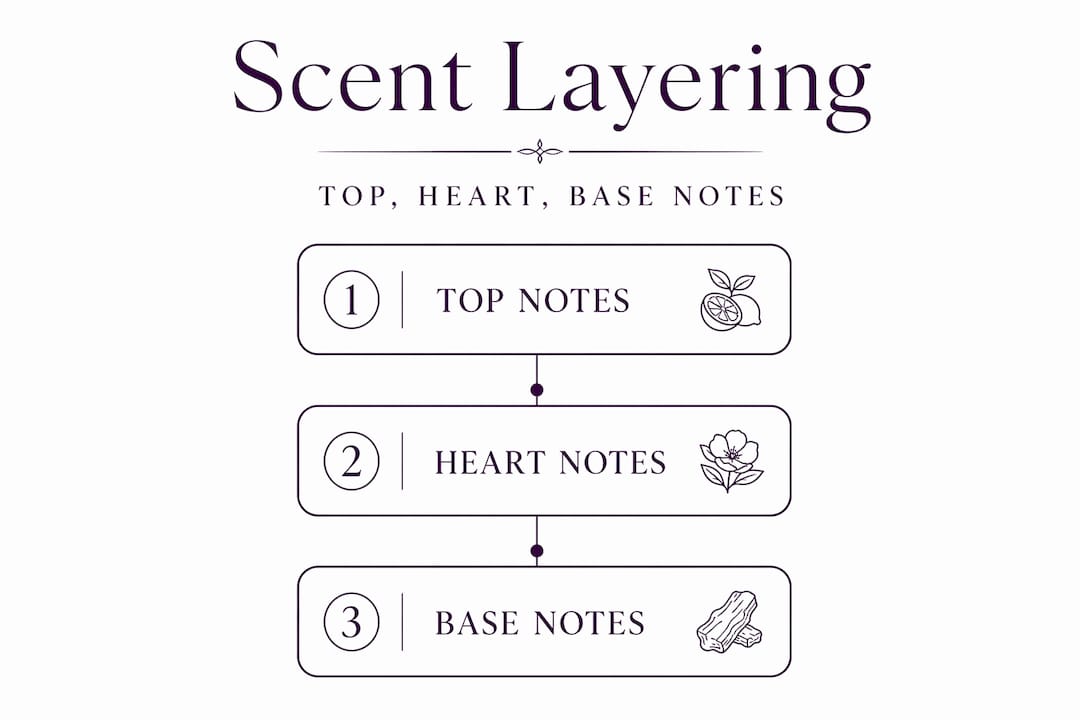
Esta estructura es la razón por la que los perfumes naturales parecen contar una historia. Puedes explorar más sobre cómo los niveles de concentración afectan esta estratificación en la guía de concentración de perfume de Maisonvoyageurparfum.
Consejo profesional: Aplica perfume natural en los puntos de pulso como la parte interna de la muñeca y el cuello. El calor corporal acelera la evaporación en estos puntos, ayudando a que cada nivel de notas se revele en secuencia.
¿La química de tu piel cambia el olor de un perfume?
Tu piel no es una superficie neutra. Es un entorno bioquímico activo, y transforma cada perfume natural que toca. El pH de la piel varía de 4.5 a 6.5 entre individuos, y ese rango altera directamente cómo se expresan las notas del perfume. La piel ácida tiende a amplificar las notas cítricas brillantes de salida. La piel más alcalina realza las resinas cálidas de fondo y las maderas.
Por eso, el perfume natural se siente diferente en cada persona que lo usa. La misma botella puede oler agria y verde en una persona y profunda y resinosa en otra. La fórmula no ha cambiado. La piel sí.
Los factores que dan forma a tu perfil olfativo personal incluyen:
- Microbioma de la piel: Las bacterias de tu piel metabolizan activamente los compuestos aromáticos, produciendo moléculas de aroma secundarias únicas para el ecosistema microbiano de tu cuerpo.
- Hidratación de la piel: La piel bien hidratada retiene la fragancia por más tiempo, permitiendo el desarrollo completo de notas naturales complejas en lugar de una experiencia truncada.
- Dieta, hormonas y estrés: Factores bioquímicos personales como la dieta, las hormonas y la medicación dan forma sutilmente a cómo los perfumes naturales evolucionan en la piel a lo largo del día.
- Aceites de la piel: La producción natural de sebo interactúa con las moléculas del perfume, amplificando o suavizando ciertas facetas aromáticas.
"El aroma es profundamente personal y cambia con la química del usuario." Esto no es lenguaje poético. Es bioquímica. El mismo perfume se convierte genuinamente en una fragancia diferente en diferentes pieles.
Los perfumes sintéticos están diseñados para ser estables y resistir este tipo de interacción. Esa resistencia es una característica de los productos del mercado masivo que buscan consistencia. Para los perfumes naturales, la interacción es el objetivo. El aroma que experimentas es en parte la fórmula y en parte tú. Puedes leer más sobre esta conexión íntima en el artículo de Maisonvoyageurparfum sobre por qué ciertos olores se sienten como en casa.
Perfume natural vs. sintético: ¿qué es lo que realmente difiere?
El contraste entre la fragancia natural y la sintética no es simplemente una cuestión de ingredientes. Es una diferencia de filosofía, comportamiento y experiencia sensorial. La siguiente tabla captura las distinciones principales:
| Cualidad | Perfume natural | Perfume sintético |
|---|---|---|
| Complejidad molecular | Cientos de compuestos por ingrediente | Normalmente 10-20 compuestos por nota |
| Evolución del aroma | Cambia y se profundiza a lo largo de las horas | Permanece en gran medida uniforme desde la aplicación |
| Interacción con la piel | Activa, personal, variable | Resistente a la química de la piel por diseño |
| Proyección | Íntima, cercana a la piel, se revela gradualmente | Amplia, uniforme, consistente |
| Variación de lote | Presente debido a diferencias en la cosecha | Ausente, consistencia controlada en laboratorio |
Los perfumes naturales proyectan más cerca de la piel y se revelan gradualmente. Esto no es una debilidad. Crea una experiencia sensorial íntima que atrae a las personas más cerca en lugar de anunciarse a través de una habitación. Los perfumes sintéticos proyectan de forma amplia y uniforme. Esa cualidad se adapta a ciertos contextos. No se adapta a la introspección personal.
Lo que hace único al perfume natural es la dimensión emocional que crea esta intimidad. Un aroma que cambia con tu cuerpo, que se profundiza a lo largo de la tarde y que huele ligeramente diferente en ti que en cualquier otra persona no es solo una fragancia. Es una firma personal. El diario de Maisonvoyageurparfum sobre el aroma y la estratificación explora esta relación en profundidad.
Puntos clave
El perfume natural huele complejo porque sus ingredientes botánicos contienen cientos de compuestos químicos que interactúan con el pH, el microbioma y la hidratación de tu piel para crear un aroma que es exclusivamente tuyo.
| Punto | Detalles |
|---|---|
| Densidad molecular botánica | El absoluto de rosa solo contiene más de 400 compuestos, creando una profundidad inherente que ninguna molécula sintética individual puede igualar. |
| Jerarquía de notas estructurada | Las notas de salida, corazón y fondo evitan mezclas turbias y permiten que la complejidad se desarrolle en etapas cronometradas. |
| La química de la piel transforma el aroma | El pH que varía de 4.5 a 6.5 y tu microbioma alteran activamente cómo se expresa un perfume natural en tu cuerpo. |
| Proyección natural vs. sintética | Los perfumes naturales evolucionan íntimamente cerca de la piel; los sintéticos proyectan uniformemente y resisten la interacción personal. |
| La hidratación prolonga la complejidad | La piel hidratada permite que el arco completo de las notas naturales se desarrolle en lugar de acortar la experiencia. |
Lo que he aprendido de usar perfume natural durante años
Por Celeste
La mayoría de la gente huele un perfume natural en una tira de papel y se va con una imagen incompleta. La tira captura las notas de salida y nada más. Las notas de corazón y fondo aún están esperando. Esta es la razón más común por la que la gente subestima la complejidad de las fragancias naturales.
Mi observación honesta después de años de explorar perfumes naturales: los que al principio parecen discretos suelen ser los más gratificantes. Una nota de fondo resinosa de ládano o sándalo añejo necesita tiempo y calor corporal para abrirse por completo. Acelerar ese proceso es como irse de una película antes del tercer acto.
La otra cosa que he llegado a creer es que el perfume natural es una de las pocas experiencias de lujo que realmente cambia contigo. Tus niveles de estrés, lo que comiste, la estación, la hidratación de tu piel en un día determinado. Todo ello moldea lo que hueles. Eso no es inconsistencia. Eso es intimidad.
Regalar perfume es genuinamente arriesgado por esta razón. Un aroma que es extraordinario en una persona puede resultar insípido en otra debido solo a la química de la piel. Los sets de descubrimiento existen precisamente para resolver esto. Permiten al destinatario probar en su propia piel, con el tiempo, antes de comprometerse. Esa paciencia es parte de la experiencia.
Si eres nuevo en las fragancias naturales, resiste la tentación de decidir rápidamente. Úsalo durante todo un día. Observa lo que cambia. Esa evolución es el objetivo principal.
— Celeste
Explora la complejidad del perfume natural con Maisonvoyageurparfum
Maisonvoyageurparfum elabora cada fragancia lentamente, utilizando un 98% de ingredientes naturales cuidadosamente seleccionados, y estructura cada aroma alrededor de una arquitectura deliberada de notas de salida, corazón y fondo. El resultado es un perfume que no se limita a permanecer en tu piel. Se despliega.

Para aquellos que son nuevos en la fragancia natural, la colección completa de perfumes ofrece una gama de composiciones de inspiración mediterránea diseñadas para revelar su complejidad durante horas de uso. Si quieres encontrar el aroma que más resuene con la química de tu piel, el cuestionario de arquetipos olfativos es el lugar para empezar. Cada fragancia es una invitación lenta a explorar en tu interior.
Preguntas frecuentes
¿Por qué el perfume natural huele diferente en cada persona?
El pH de la piel, el microbioma y la hidratación alteran activamente la forma en que se expresan las moléculas de perfume natural. La misma fórmula produce genuinamente un aroma diferente en diferentes personas porque la química de la piel transforma los compuestos aromáticos.
¿Qué son las notas de salida, corazón y fondo en el perfume natural?
Las notas de salida son los ingredientes más ligeros y volátiles que aparecen primero y se desvanecen en 30 minutos. Las notas de corazón forman el núcleo emocional y duran varias horas, mientras que las notas de fondo son los materiales más pesados que anclan la fragancia y perduran más tiempo.
¿Cómo sé si un perfume es realmente natural?
Busca un alto porcentaje de ingredientes naturales listados en la etiqueta, como aceites esenciales, absolutos y resinas, y busca certificaciones de organismos como COSMOS o ECOCERT. Maisonvoyageurparfum utiliza un 98% de ingredientes naturales y divulga abiertamente su filosofía de formulación.
¿Por qué el perfume natural proyecta menos que la fragancia sintética?
Los perfumes naturales proyectan íntimamente cerca de la piel porque sus moléculas interactúan y son parcialmente absorbidas por la química de la piel en lugar de proyectarse uniformemente hacia afuera. Las moléculas sintéticas están diseñadas para resistir esta interacción, lo que produce una proyección más amplia y consistente.
¿Es el perfume natural un regalo mejor que el sintético?
El perfume natural es un regalo más personal, pero también más arriesgado. Debido a que el aroma evoluciona de manera diferente en la piel de cada persona, los sets de descubrimiento reducen el riesgo de regalar, al permitir que el destinatario encuentre su propia compatibilidad antes de comprometerse con un frasco completo.