
Microplastics in Synthetic Fragrance: What You Need to Know
Yes, microplastics can be present in synthetic fragrance products. Specifically, solid synthetic polymer microparticles are used in fragrance encapsulation, where a polymer shell (often polyurea or polyacrylate) surrounds a scent molecule to control its release and extend wear. The EU’s REACH Annex XVII/Entry 78 formally defines these as “synthetic polymer microparticles” and is phasing them out of cosmetics, including leave-on fragrances, by October 17, 2029. U.S. regulation has not yet matched that pace, which means American consumers need to ask brands directly.
Three things you can do right now:
- Ask any fragrance brand whether their formula uses polymer-shell encapsulates, and what shell material they use.
- Favor brands that disclose a full ingredient list rather than hiding everything under “fragrance” or “parfum.”
- Choose formulas built on disclosed natural ingredients, which tend to avoid encapsulation technology by design.
Table of Contents
- What are microplastics in synthetic fragrance, exactly?
- How do polymer microparticles move from your fragrance into the environment?
- What does science say about the health and environmental risks?
- Why does a U.S. label often hide whether microplastics are present?
- How can you reduce your exposure to microplastics in fragrances?
- Where is the fragrance industry heading on this?
- Key Takeaways
- The ingredient question most fragrance buyers never think to ask
- A quieter kind of fragrance
- Useful sources for further reading
What are microplastics in synthetic fragrance, exactly?
The everyday word “microplastics” covers a lot of ground. Regulators deliberately use the more precise phrase synthetic polymer microparticles to mean solid, insoluble, non-biodegradable polymer particles smaller than 5 mm. That precision matters because it excludes liquid plasticizers like phthalates, which are a separate concern entirely.
Many consumers conflate phthalates with microplastics. Phthalates are persistent organic chemicals, not solid particles, and they raise different health questions. Knowing the difference helps you ask the right questions.
In fragrance formulation, synthetic polymer microparticles appear in three main roles:
| Role | How it works | Common polymer types |
|---|---|---|
| Microcapsule shell | Encases scent molecules; ruptures on friction or heat to release fragrance | Polyurea, polyacrylate, urea-formaldehyde condensate |
| Film-former | Creates a thin polymer layer on skin or fabric to anchor scent | Acrylate copolymers |
| Fixative | Slows evaporation of volatile aromatic compounds | Various synthetic resins |
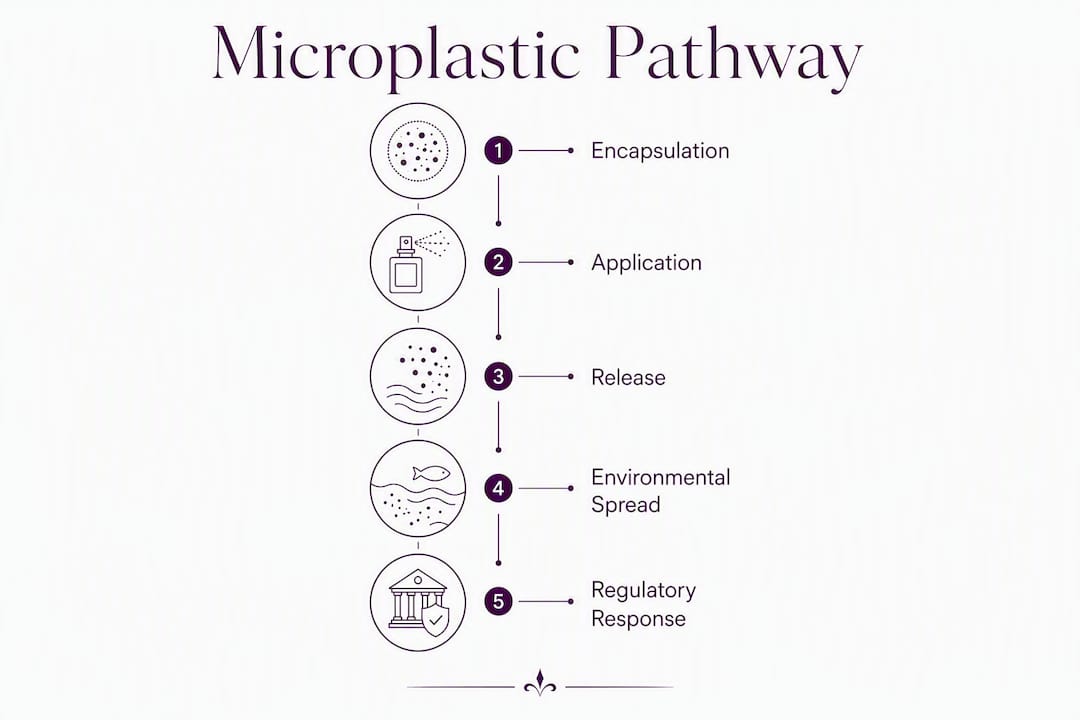
Encapsulation is the primary use-case that regulators have targeted, because those shells are released intact into the environment after the scent is spent.
Pro Tip: When contacting a brand, ask specifically: “Do you use polymer-shell encapsulates in your fragrances? If so, what is the shell material, and do you have a biodegradability test report?” A brand that answers with detail is one that has genuinely looked at the question.
How do polymer microparticles move from your fragrance into the environment?
The path from bottle to ecosystem is shorter than most people expect. Here is how it unfolds, step by step:
- Application. You spray a fragrance on skin or fabric. Encapsulate shells land on the surface and wait for friction or warmth to rupture them.
- Airborne dispersal. Aerosol formats release fine droplets that carry polymer particles into indoor air, where they settle on surfaces or are inhaled.
- Wash-off. Laundering scented fabrics or rinsing skin sends intact shells down the drain. Wastewater treatment plants are not designed to capture particles at this scale.
- Sludge accumulation. Particles that survive treatment concentrate in sewage sludge, which is often applied to agricultural land, re-entering soil and water systems.
- Food-web uptake. Aquatic organisms ingest microparticles; research published in environmental toxicology journals documents bioaccumulation across trophic levels.
Leave-on products like eau de parfum and scented lotions pose a longer skin-contact window than rinse-off products like scented body wash. Air-care formats (sprays, diffusers) add an inhalation route that rinse-off products do not. Regulators have set different compliance deadlines partly because of these distinctions in exposure profile.

What does science say about the health and environmental risks?
Environmental persistence is the most firmly established concern. EU Commission findings underpinning the REACH restriction state that microplastic emissions are practically impossible to remove once released, which is the core justification for restricting them at the source rather than trying to clean them up downstream.
Ecological harm from microplastics is documented in lab and field studies: physical ingestion by marine organisms, interference with feeding behavior, and chemical leaching from particle surfaces. The WHO’s review of microplastics in drinking water acknowledged environmental ubiquity while calling for more research on human health effects specifically.
“Microplastic particles are persistent, practically impossible to remove from the environment once emitted, and accumulate across ecosystems. The precautionary case for restricting intentional additions is strong even where human causation data remains incomplete.” — EU Commission rationale, REACH Annex XVII/Entry 78 restriction dossier
For human health, the picture is less settled. Skin contact with encapsulate shells in a leave-on fragrance is a real exposure route, but dermal absorption of solid particles is limited by particle size. Inhalation of aerosol-dispersed particles is a more open question, particularly for people who use spray fragrances in enclosed spaces regularly. Longitudinal human data on fragrance-specific polymer exposure simply does not exist yet, and particle size variability across products makes generalization difficult.
What is clear: synthetic fragrance is identified as a notable vector for both microplastics and persistent chemicals in personal care, which is reason enough for cautious consumers to pay attention.
Why does a U.S. label often hide whether microplastics are present?
Under U.S. cosmetic labeling rules, “fragrance” or “parfum” is permitted as a single umbrella term on an ingredient list. This trade-secret convention can conceal dozens of undisclosed components, including polymer encapsulants, without any legal violation. The FDA does not currently require fragrance brands to disclose individual fragrance ingredients, including shell polymers.
The EU’s REACH restriction offers a useful contrast. It sets a concentration threshold of 0.01% by weight for synthetic polymer microparticles and mandates phased removal from cosmetic products, with encapsulated fragrances in leave-on products required to comply by October 17, 2029. The U.S. has no equivalent rule in force.
Practical steps for U.S. consumers:
- Request a full ingredient disclosure directly from the brand, in writing if possible.
- Ask specifically whether the formula contains encapsulated fragrance and what the shell composition is.
- Look for third-party transparency certifications (such as EWG Verified or MADE SAFE) that require ingredient-level disclosure beyond the label.
- Reference the IFRA standards documentation as a benchmark for what responsible fragrance industry disclosure looks like.
- Treat any brand that cannot answer the encapsulate question as one that has not yet examined it.
Pro Tip: The REACH regulatory dossier is publicly available and defines exactly which polymer types fall in scope. If a brand claims their encapsulates are exempt, ask them to cite the biodegradability test that supports that claim.
How can you reduce your exposure to microplastics in fragrances?
Start with the highest-impact, lowest-effort actions. You do not need to overhaul your entire routine at once.
- Choose disclosed-ingredient brands. If a brand publishes a full ingredient list and can answer questions about encapsulation, that transparency itself signals a different approach to formulation. A guide to reading natural fragrance ingredient labels can help you interpret what you find.
- Prefer leave-on natural formulas over aerosol formats. Spray formats disperse particles into air; natural oil-based or alcohol formulas without encapsulates do not carry the same polymer load.
- Ventilate when spraying. If you use a conventional spray fragrance, apply it in a well-ventilated space to reduce inhalation of airborne particles.
- Reduce frequency of synthetic air-care products. Room sprays and plug-in diffusers with synthetic fragrance are a high-emission format with no skin-contact benefit to offset the exposure.
- Ask before you buy. The question “Do you use polymer-shell encapsulates?” takes thirty seconds and tells you immediately whether a brand has thought about this.
Pro Tip: Third-party certifications are not all equal. MADE SAFE screens for known harmful substances including certain synthetic polymers. EWG Verified requires full ingredient disclosure. Neither guarantees zero microplastic risk, but both require more transparency than a standard U.S. label does.
Natural fragrance longevity can be achieved without polymer shells. Natural fixatives and skin-chemistry interaction are how well-formulated natural perfumes hold their character over time.
Where is the fragrance industry heading on this?
The direction is clear, even if the pace varies. Henkel has publicly described active development work on replacing polymer-shell encapsulations with biodegradable alternatives, citing both regulatory pressure and consumer expectations. Other suppliers are in similar positions, though public commitments vary in specificity.
The EU’s phased deadlines are the primary driver of global supply-chain change, because multinational brands cannot maintain separate formulations indefinitely. Care Europe’s industry guidance outlines the reformulation timelines regulators and industry negotiated together.
| Product category | EU REACH compliance deadline |
|---|---|
| Rinse-off cosmetics (general) | October 17, 2029 |
| Leave-on cosmetics with encapsulated fragrance | October 17, 2029 |
The technical challenge is real. Biodegradable shell materials must match the controlled-release performance of polyurea or polyacrylate, and some suppliers report only partial market replacements so far. Moving away from polymer shells entirely often means reformulating with natural fixatives or different delivery formats, which requires collaboration across fragrance houses, formulators, and raw-material suppliers. That is slow, deliberate work. But it is happening.
Key Takeaways
Synthetic polymer microparticles in fragrance encapsulates are a real, regulated concern, and U.S. consumers must ask brands directly because domestic labeling rules do not require disclosure.
| Point | Details |
|---|---|
| Microplastics are present in some fragrances | Polymer-shell encapsulates (polyurea, polyacrylate) qualify as synthetic polymer microparticles under REACH. |
| U.S. labels hide the detail | “Fragrance” on a U.S. label can conceal polymer encapsulants; ask brands for full ingredient disclosure. |
| EU deadlines drive global change | Leave-on fragrances with encapsulated scent must comply with REACH restrictions by October 17, 2029. |
| Highest-impact consumer action | Ask brands specifically about shell composition and biodegradability testing before purchasing. |
| Maisonvoyageurparfum’s approach | Formulated with natural ingredients, avoiding polymer encapsulation by design, with ingredient transparency as a core brand value. |
The ingredient question most fragrance buyers never think to ask
Most of the conversation about synthetic fragrance and health focuses on allergens or synthetic musks. Microplastics, specifically the polymer shells used to make a scent last longer on your skin or fabric, rarely come up. That gap is worth examining.
The encapsulation technology is genuinely clever. A shell the size of a dust particle holds a fragrance molecule until friction or warmth breaks it open. The problem is not the scent. The problem is what happens to the shell afterward. It does not disappear. It washes off, goes down the drain, and joins a growing inventory of particles that wastewater systems were not built to handle.
What strikes me about this issue is how much of it is invisible by design, not by accident. The “fragrance” label convention was created to protect trade secrets, and it does that effectively. But it also means that a consumer who cares about what they are putting on their body, and what leaves their body and enters the water supply, has almost no way to know from a label alone. The only path to clarity is asking. And most brands, when asked directly, reveal quickly whether they have genuinely examined their own formulas.
The industry is moving. Slowly, deliberately, as it tends to. Biodegradable shells are in development. Reformulation timelines are set. But the consumer who wants to make a considered choice today cannot wait for 2029. They need to ask now, choose disclosed formulas now, and understand that a brand’s willingness to answer is itself a meaningful signal.
A quieter kind of fragrance
If you have read this far, you already know that the question “what is in my fragrance?” deserves a real answer, not a trade-secret umbrella term.

Maisonvoyageurparfum was built around a different premise. Each scent is composed slowly in Madrid with predominantly natural ingredients, without relying on polymer-shell encapsulation to extend wear. The longevity comes from the quality of the materials and how they interact with your skin’s own chemistry. That means no polyurea shells washing off into your drain, and no “fragrance” label hiding a list of undisclosed components.
The Slow Luxury philosophy behind every Maisonvoyageurparfum scent is precisely this: fewer, better ingredients, made with patience, disclosed with honesty. If you want to verify the approach before purchasing, the ingredient philosophy is explained in full on the site. Start there, ask questions, and let the scent speak for itself.
Useful sources for further reading
- WHO: Microplastics in Drinking Water — WHO review of environmental ubiquity and the state of human health evidence; regulatory reference, not advocacy.
- EU Microplastics Restriction for Cosmetics: REACH Rules and Compliance Guide — industry-facing compliance summary covering encapsulation use-cases, labeling implications, and brand action steps.
- Plastic Detox: Microplastics in Cosmetics and Personal Care — NGO analysis identifying fragrance as a notable microplastic vector; advocacy perspective, useful for consumer context.
- IFRA Standards Documentation — industry self-regulatory framework for fragrance ingredient safety; benchmark for what responsible disclosure looks like.
- Environmental Health Perspectives: Microplastics research — peer-reviewed environmental health research; primary scientific literature.