
How Perfume Longevity Works Naturally on Your Skin
Perfume longevity is the measure of how long a fragrance remains detectable on your skin after application. How perfume longevity works naturally comes down to three forces: your skin’s hydration level, its oil content, and the molecular weight of the fragrance itself. A Parfum concentration carries up to 40% aromatic oil, while an Eau de Cologne holds just 2–4%. That gap in concentration directly predicts how many hours a scent stays with you. Natural perfumes, crafted without synthetic fixatives, rely on base notes like woods, resins, and musks to anchor the scent. Understanding these forces lets you wear fragrance with intention, not guesswork.
How perfume longevity works naturally through skin chemistry
Your skin is not a neutral surface. It is an active participant in how a fragrance performs, and its chemistry shapes every stage of the scent’s life on your body.
Hydration and lipid levels
Hydrated skin anchors lipophilic fragrance molecules far more effectively than dry skin does. Lipophilic molecules are oil-loving compounds that bind to the fatty layer on the skin’s surface. When that layer is thin or absent, molecules evaporate quickly and the scent fades within the first hour. Dry skin also loses water through a process called trans-epidermal water loss, which accelerates evaporation at the surface. Applying an unscented moisturizer before your fragrance creates a lipid-rich base that holds those molecules in place.

Oily skin retains fragrance molecules longer by trapping lipophilic components near the surface. This is why the same perfume can last six hours on one person and two hours on another. Skin type is one of the most underappreciated variables in natural fragrance longevity.
pH, temperature, and individual chemistry
Skin pH influences how fragrance molecules interact with the surface. A slightly acidic pH, which is normal for healthy skin, supports stable molecular adhesion. Higher pH levels, caused by alkaline soaps or certain skin conditions, can accelerate the breakdown of lighter aromatic compounds.
Body temperature matters too. Warmer skin speeds up molecular diffusion, which increases projection but also shortens wear time. Individual skin chemistry, including hormones and medications, causes fragrance to unfold differently on each person. A scent that lasts all day on one person may fade by noon on another. This is not a flaw in the perfume. It is the nature of a living formula meeting a living body.
- Dry skin: fragrance evaporates faster, wear time shortens
- Oily skin: molecules bind longer, projection stays closer to the skin
- High body temperature: increases diffusion and initial projection
- Hormonal shifts: alter how top and heart notes develop over time
- Medications: can change skin pH and affect scent character
Pro Tip: Apply a thin layer of unscented body lotion or a neutral oil like jojoba to pulse points before spraying. This single step can noticeably extend how long your fragrance stays detectable.
What is the volatility curve and why does it matter?
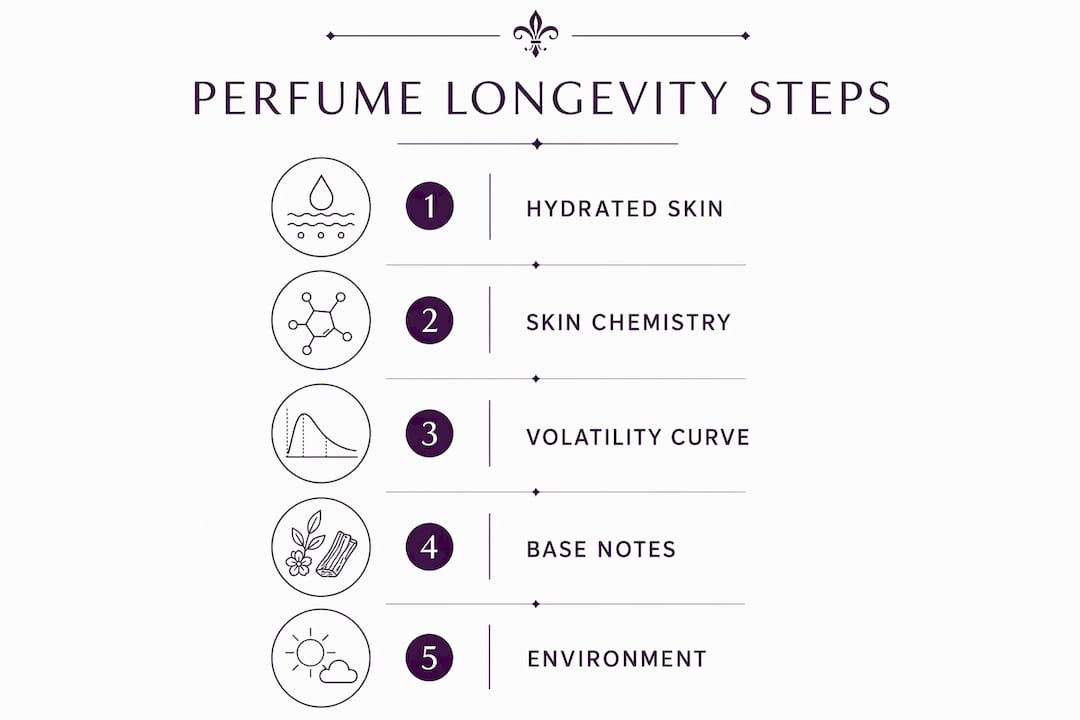
The volatility curve is the industry term for how a perfume’s aromatic layers evaporate in sequence over time. Perfumers structure every fragrance around three note tiers, and each tier has a different molecular weight that determines how quickly it leaves the skin.
Top notes evaporate within 15–30 minutes. They are the first impression: bright citrus, green herbs, or light florals. Heart notes follow, lasting 1–4 hours. These form the core character of the fragrance, typically florals, spices, or softer woods. Base notes are the foundation. They can linger 6 or more hours because their molecules are heavier and bond more firmly to skin.
| Note tier | Typical ingredients | Evaporation time |
|---|---|---|
| Top notes | Citrus, herbs, light florals | 15–30 minutes |
| Heart notes | Rose, jasmine, spice, soft woods | 1–4 hours |
| Base notes | Sandalwood, oud, resins, musks | 6+ hours |
Natural perfumes rely almost entirely on this structure for their lasting power. Base notes like woods, resins, and balsams provide most of the longevity in natural formulas, replacing the synthetic fixatives that mass-market perfumes use. This is why a well-crafted natural fragrance feels like it deepens over time rather than simply fading. The lighter molecules leave, and the richer, heavier ones take center stage.
Some natural perfumers also use natural isolates like Hedione and Iso E Super to add diffusion and extend lighter notes without overwhelming the scent profile. These materials support the fragrance’s arc without introducing harsh synthetic fixatives. Understanding the complexity behind natural scents helps explain why no two wearings of the same bottle feel identical.
Pro Tip: When choosing a natural perfume for lasting power, read the ingredient list and look for base note materials in the top three or four listed ingredients. Their prominence signals a formula built to last.
How do environment and storage affect natural fragrance longevity?
External conditions shape how a fragrance performs from the moment you spray it to the moment you store the bottle. Heat, humidity, and air exposure each play a distinct role.
Heat increases the rate at which fragrance molecules evaporate from the skin. A warm summer day amplifies projection in the first hour but shortens the overall wear time. Humidity has the opposite effect on projection: moisture in the air keeps scent molecules close to the skin rather than diffusing outward, which can make a fragrance feel quieter but longer-lasting.
Heat, light, and air exposure accelerate oxidation and evaporation inside the bottle, shortening the perfume’s life and altering its scent profile. Every time you spray, a small amount of air enters the bottle. Over months, that cumulative oxidation subtly changes the character of the fragrance. This explains why a store tester, opened and sprayed dozens of times, smells different from a fresh bottle of the same perfume.
Storage best practices for natural perfumes:
- Keep bottles in a cool, dark place away from direct sunlight
- Avoid storing perfume in bathrooms where heat and humidity fluctuate
- Keep the cap on when not in use to minimize air exposure
- Store upright to reduce the surface area exposed to the air pocket inside
- Use smaller decant bottles for daily wear to protect the main bottle
These habits preserve the integrity of natural ingredients, which are more sensitive to environmental stress than synthetic compounds.
Practical tips to make your natural perfume last longer
Perfume retention improves most when you address both the skin and the application method. These two variables are entirely within your control.
-
Moisturize before you apply. Hydrated skin holds fragrance molecules longer. Use an unscented lotion or a light natural oil on the areas where you plan to spray. Let it absorb for one to two minutes before applying your perfume.
-
Target warm pulse points. Applying to pulse points like the wrists, neck, and inner elbows supports molecular diffusion and scent projection. These areas have blood vessels close to the surface, which gently warm the fragrance and activate its aromatic compounds continuously.
-
Do not rub after spraying. Rubbing the wrists together is one of the most common mistakes in fragrance application. It breaks apart the molecular structure of top notes and accelerates their evaporation, collapsing the opening of the scent before it has a chance to develop.
-
Layer your fragrance. Use a matching or complementary scented body product under your perfume. Fragrance layering techniques build depth and extend wear time by adding multiple aromatic layers that evaporate at different rates.
-
Choose higher concentration formulas. Fragrance concentration directly correlates to lasting power. A Parfum or Extrait de Parfum carries more aromatic oil per spray than an Eau de Toilette, which means fewer applications and longer wear.
-
Select base-note-rich formulas. When evaluating a natural perfume, prioritize those with prominent base notes. Sandalwood, vetiver, oud, labdanum, and ambergris all anchor a fragrance for hours. The longevity of natural perfumes is predominantly determined by these heavier materials, not by synthetic fixatives.
Key Takeaways
Natural perfume longevity is determined by skin hydration, molecular weight, fragrance concentration, and base note composition working together.
| Point | Details |
|---|---|
| Skin hydration is foundational | Moisturized skin anchors lipophilic molecules and significantly extends wear time. |
| Base notes carry the lasting power | Woods, resins, and musks linger 6+ hours and define a natural perfume’s longevity. |
| Concentration predicts duration | Parfum holds up to 40% aromatic oil; Eau de Cologne holds just 2–4%, with a proportional difference in wear time. |
| Environment shapes performance | Heat boosts projection but shortens wear; cool, dark storage preserves the fragrance’s character over time. |
| Application method matters | Pulse points, no rubbing, and layering all extend how long a fragrance stays detectable on skin. |
What I’ve learned about fragrance that most articles skip
The most important thing I’ve come to understand about natural perfume longevity is that fragrance is not static. It is a living formula. Perfumes interact uniquely with each wearer’s skin chemistry, hormones, stress levels, and even diet. A scent you loved on a friend may open entirely differently on your skin. That is not a problem to solve. It is the point.
What I find most rewarding is watching how a well-built natural fragrance evolves across a full day. The bright citrus of the opening gives way to a warmer floral heart, and by evening, the base notes settle into something quieter and more personal. That arc is the perfumer’s craft made visible. Synthetic fixatives can hold a scent flat for hours, but they cannot replicate that movement.
My practical advice: stop chasing longevity as a number of hours and start paying attention to which phase of the fragrance you love most. Then build your application ritual around extending that phase. Hydrate your skin, choose a base-note-rich formula, and apply to warm skin. The science supports all of it, and the experience will follow.
— Celeste
Artisanal natural fragrance, crafted to last

Maisonvoyageurparfum was built on one conviction: that a fragrance should do more than smell good. Each scent in the Mediterranean collection is slowly made with 98% natural ingredients, chosen for their depth, their base note richness, and their ability to evolve on the skin over hours. The formulas are designed with the volatility curve in mind, so what you experience at noon is different from, and as beautiful as, what you wore in the morning. For those who want to extend the sensory experience beyond fragrance, the personalized soy candle brings the same natural ingredient philosophy into your space.
FAQ
Why does perfume fade faster on some people?
Skin chemistry, including hydration levels, oil content, pH, hormones, and medications, causes fragrance to evaporate at different rates on different people. Dry skin and higher body temperature are the two most common reasons a scent fades faster than expected.
What makes natural perfumes last as long as synthetic ones?
Natural perfumes rely on base note materials like sandalwood, vetiver, and labdanum for lasting power. These heavier molecules bond firmly to skin and can linger 6 or more hours, matching the performance of synthetic fixatives without using them.
Where should you apply perfume for the longest wear?
Pulse points on the wrists, neck, and inner elbows are the most effective application spots. These areas are warmer because blood vessels sit close to the surface, which activates fragrance molecules continuously and supports scent projection throughout the day.
Does fragrance concentration affect how long a scent lasts?
Yes. A Parfum carries up to 40% aromatic oil per spray, while an Eau de Cologne holds just 2–4%. Higher concentration means more aromatic material on the skin, which directly extends how long the fragrance remains detectable.
How should you store natural perfume to preserve its quality?
Store natural perfume in a cool, dark place with the cap on to minimize air exposure and oxidation. Avoid bathrooms and windowsills, where heat and light fluctuate and degrade the fragrance’s natural ingredients over time.
Recommended
- Why Natural Perfume Smells Complex: The Real Science – Maison Voyageur
- Fragrance Layering Techniques for Enthusiasts: Expert Guide – Maison Voyageur
- Harmful Chemicals in Mass Perfumes: What to Avoid – Maison Voyageur
- How to Read Natural Fragrance Ingredient Labels – Maison Voyageur
Les sept fragrances Maison Voyageur
- Manifesting · unisexe (69,99 €)
- Intuition · femme (69,99 €)
- Certainty · femme (69,99 €)
- Expansion · femme (69,99 €)
- Release · homme (69,99 €)
- Presence · homme (69,99 €)
- Inner Fire · homme (69,99 €)
Nouvelle ici ? Commence par le Discovery Set · les 7 fragrances en format voyage (40 €).