
How Fragrance Maps Your Emotional Landscape
Fragrance maps the emotional landscape by connecting scent directly to the brain’s emotional centers, triggering vivid feelings and memories before conscious thought even registers. This happens because scent bypasses the thalamus entirely, routing straight to the amygdala and hippocampus. No other sense works this way. The result is an immediate, unfiltered emotional response. Understanding this mechanism turns fragrance from a simple pleasure into a precise tool for self-awareness, introspection, and personal growth.
How fragrance maps emotional landscape through the brain
The olfactory system is the oldest sensory pathway in the human brain. Scent evolved as a survival sense for detecting danger and sustenance long before language or logic developed. That ancient wiring is exactly why a single smell can stop you cold with feeling.
When you inhale a fragrance, olfactory receptors in the nasal cavity fire signals directly to the olfactory bulb. From there, the signal travels to the amygdala, which processes emotion, and the hippocampus, which stores memory. Every other sense routes through the thalamus first, a kind of cognitive relay station that filters and categorizes input. Scent skips that step entirely. The emotional response arrives before your mind has time to interpret it.
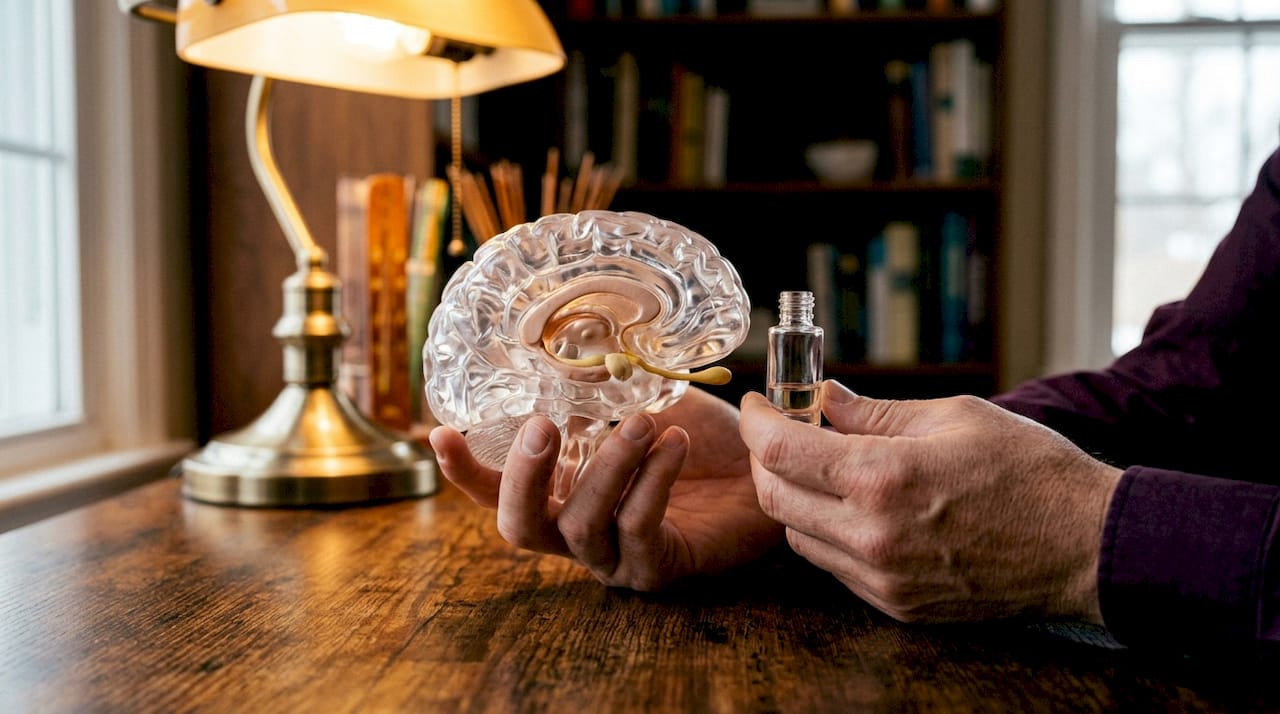
The speed of this process is measurable. Limbic activation from scent occurs within 3–10 seconds of inhalation. Thirty seconds of deliberate sniffing lowers heart rate and lifts mood. That is faster than any visual or auditory stimulus achieves the same physiological effect.
Pro Tip: Try slow, deliberate inhalation for 30 seconds when you first apply a fragrance. You are not just smelling. You are actively engaging the limbic system.
The key implications of this pathway are worth naming clearly:
- The emotional response to scent is pre-cognitive, meaning it arrives before rational thought.
- Scent activates both emotion (amygdala) and memory (hippocampus) simultaneously.
- Physiological changes, including heart rate and mood, follow within seconds.
- No other sensory input reaches emotional brain centers this directly or this fast.
How do fragrances anchor specific emotional states and memories?
The Proustian effect is the recognized term for scent’s ability to trigger vivid, emotionally charged memories. Marcel Proust described it in literature, but neuroscience has since confirmed the mechanism. Olfactory memory outlasts visual memory in both emotional vividness and longevity. The reason is structural: scent-related memories are replayed rather than reconstructed, which means they degrade far more slowly than memories formed through other senses.
The hippocampus does not distinguish between a natural memory and one built through repeated association. This means you can deliberately create new emotional anchors using fragrance. The process is called olfactory anchoring, and it works through conditioned neural pathways. Using a fragrance exclusively during a specific emotional state builds a reliable association over time. The scent becomes a shortcut to that state.
Olfactory anchoring works best when you follow a consistent method:
- Choose one fragrance for one targeted emotional state. Do not use the same scent across multiple contexts.
- Pair consistently by applying the fragrance only when you are already in or moving toward the desired state, such as calm focus or creative openness.
- Repeat over weeks to strengthen the neural association. Consistency is what builds the anchor.
- Test the anchor by applying the fragrance in a neutral state and observing whether the emotional shift follows.
Tracking this process matters. An olfactory diary logs the fragrance used, the time of day, and your emotional state before and after each application. Over weeks, patterns emerge that pure intuition would miss. You begin to see which scents reliably shift your state and which ones simply smell pleasant without deeper effect.
Pro Tip: Keep your olfactory diary entries brief. Three lines: the scent, your emotional state before, and your emotional state after. Brevity makes the habit sustainable.
The science of scent and memory formation shows that these associations are not superficial. They are encoded at the same neural depth as formative life memories.
How do emotional landscapes emerge from complex fragrance compositions?
A single fragrance note does not create an emotional landscape. It creates a signal. Complex emotions like nostalgia or isolation require relationships between multiple fragrance materials, not a single dominant note. A skilled perfumer works the way a composer works: contrast, tension, and resolution across layers.
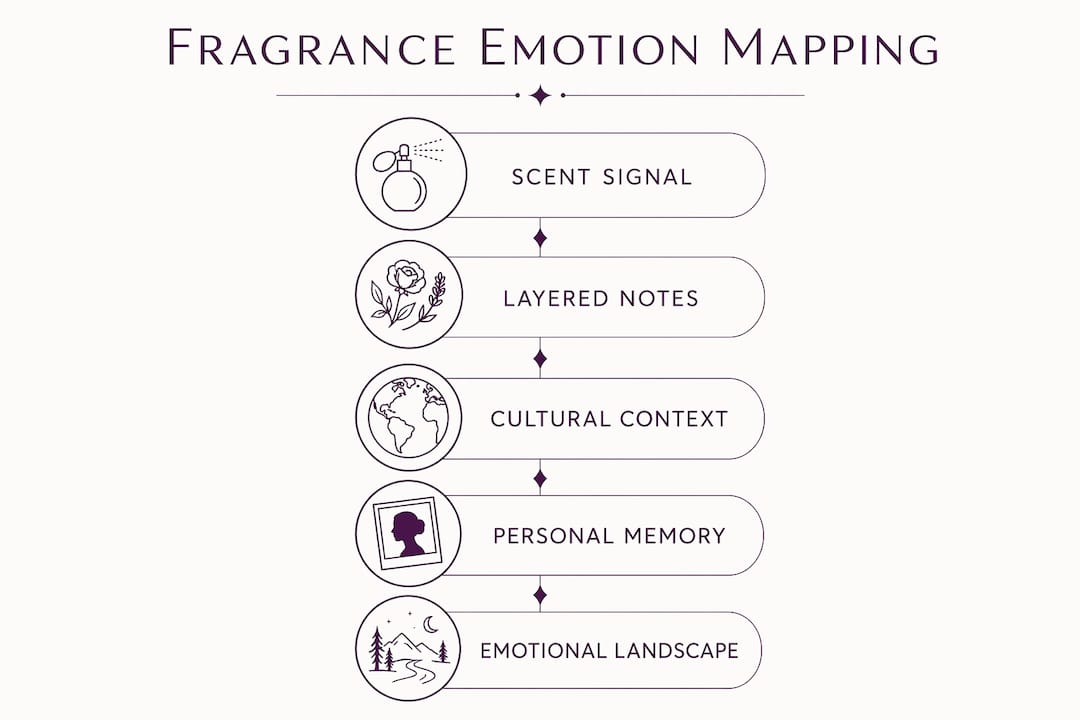
Consider how this plays out in practice. A fragrance built on warm amber alone reads as comfort. Add a cold, mineral accord and the comfort becomes tinged with distance. That tension is what produces nostalgia, the feeling of warmth remembered rather than warmth present. The emotional complexity comes from the friction between elements, not from any one ingredient.
Cultural and personal context shape how these compositions land. The same fragrance reads differently depending on what memories a person carries. This is why fragrance promotes introspection in ways that are genuinely personal. Two people wearing the same scent may access entirely different emotional territories.
The limits of algorithmic approaches are real here. AI can assist fragrance discovery but cannot replace the human sensibility required to create emotional meaning through scent. Algorithms identify preference patterns. They do not understand grief, longing, or the particular quality of a childhood afternoon. Artisanal perfumers work with that understanding as their primary material.
The contrast between approaches is clear:
- Layered compositions produce nuanced emotional states by combining contrasting and harmonizing elements.
- Single-note or simple blends produce clear, immediate signals but limited emotional depth.
- Artisanal craft accounts for cultural context, personal resonance, and emotional intention.
- Algorithmic tools optimize for preference data but cannot encode emotional meaning.
A curated artisanal fragrance wardrobe built around this understanding gives you access to a range of emotional territories rather than a single repeated mood.
How can you use fragrance to map your own emotional landscape?
Using scent intentionally for emotional self-awareness is a practice, not a one-time experiment. The goal is to build a personal map: a set of scent associations that reflect and support your inner life. Perfume connects to emotion in a way that bypasses logic, which makes it a uniquely direct tool for self-knowledge.
The following method builds that map over time:
- Start with observation. Spend one week noticing your emotional responses to scents you already encounter. No new fragrances yet. Just attention.
- Select a fragrance with intention. Choose a scent that already carries some emotional weight for you. Avoid choosing based on what smells pleasant in the abstract.
- Assign it a context. Decide which emotional state or daily ritual this fragrance will accompany. Morning reflection, focused work, or evening stillness are all valid contexts.
- Apply consistently for three weeks. Wear it only in that context. The neural association builds through repetition.
- Log your responses. Use an olfactory diary to record shifts in mood, memory, or awareness after each application.
- Expand gradually. Once one anchor is established, introduce a second fragrance for a different emotional context.
The mood shifts possible through this practice are concrete. Citrus and green accords reliably produce alertness. Woody and resinous compositions tend toward grounding. Floral and soft musks often support emotional openness. These are tendencies, not rules. Your personal history with each scent shapes the outcome.
Pro Tip: Apply your anchor fragrance before a meditation or journaling session, not after. The scent primes the emotional state rather than simply accompanying it.
Scent rituals work best when they are slow. The practice of scent-based self-discovery is not about efficiency. It is about creating a pause in the day where inner attention is possible. That pause is where the real mapping happens.
The connection between scent, memory, and identity deepens over time. Fragrances you wear consistently during meaningful periods of your life become part of your personal narrative. They hold the emotional texture of those periods in a form you can revisit.
Key Takeaways
Fragrance maps the emotional landscape by engaging the limbic system directly, creating scent-emotion associations that outlast and outperform those formed through any other sense.
| Point | Details |
|---|---|
| Scent bypasses cognitive filters | Olfactory signals reach the amygdala and hippocampus before conscious thought, producing immediate emotional responses. |
| Olfactory memory is the most durable | Scent memories are replayed rather than reconstructed, making them more vivid and longer-lasting than visual memories. |
| Emotional anchoring requires consistency | Pairing a fragrance exclusively with one emotional state over weeks builds a reliable neural association. |
| Complex emotions need layered compositions | Nuanced feelings like nostalgia emerge from contrasting fragrance elements, not single notes. |
| An olfactory diary accelerates self-awareness | Logging scent use and emotional states reveals patterns that intuition alone cannot map. |
Scent as a map, not just a mood
I have spent years paying attention to how fragrance moves through people, and the thing that still surprises me is how little time it takes. You apply a scent, and within seconds something shifts. Not a thought. A feeling. That immediacy is what separates fragrance from every other form of self-care or introspective practice.
What I find most people miss is the difference between using fragrance to feel better and using it to understand yourself. The first is valid. The second is rarer and more interesting. When you start tracking your responses with real attention, you begin to notice that certain scents do not just lift your mood. They surface things. A particular woody note might consistently bring up a quality of solitude you did not know you were carrying. That is not mood management. That is self-knowledge.
The artisanal approach to perfumery matters here because it takes this seriously. A fragrance made slowly, with intention and natural materials, carries more emotional information than one built for mass appeal. Maisonvoyageurparfum works from this premise. The scents are not designed to please everyone. They are designed to mean something.
My honest recommendation: resist the urge to collect fragrances before you have learned to listen to one. Depth comes before breadth. One scent, worn with attention, over time, will teach you more about your emotional life than a dozen worn casually.
— Celeste
Artisanal fragrance for emotional self-discovery
Maisonvoyageurparfum crafts each fragrance slowly, using 98% natural ingredients, with emotional depth as the primary intention. The scents are not accessories. They are tools for inner attention.

The personalized soy candle collection is designed specifically for emotional anchoring and manifestation rituals. Each candle supports a specific mood or intention, making it a natural starting point for building your own scent practice. For those ready to go deeper, the Seven Archetypes Method offers a structured framework for using fragrance as a tool for self-exploration. Real luxury, as Maisonvoyageurparfum defines it, is time to explore within yourself.
FAQ
What is the Proustian effect in fragrance?
The Proustian effect describes scent’s ability to trigger vivid, emotionally charged memories instantly. It occurs because olfactory signals connect directly to the hippocampus and amygdala, the brain’s memory and emotion centers.
How does fragrance anchor emotional states?
Wearing a fragrance exclusively during a specific emotional state builds a conditioned neural pathway over time. The scent becomes a reliable trigger for that state through repeated association.
Why do scent memories last longer than visual memories?
Scent memories are replayed by the brain rather than reconstructed, which means they degrade more slowly. The hippocampus encodes olfactory associations at the same depth as formative life experiences.
Can a single fragrance note create emotional complexity?
A single note produces a clear signal but limited emotional depth. Complex feelings like nostalgia or longing require layered compositions that combine contrasting fragrance materials in relationship with each other.
How do I start mapping my emotional landscape with scent?
Begin by observing your existing emotional responses to familiar scents for one week. Then select one fragrance, assign it a specific daily context, and log your emotional states before and after each application for three weeks.
Recommended
- How Fragrance Promotes Introspection: A Science Guide – Maison Voyageur
- How Fragrance Connects Past and Present: The Science – Maison Voyageur
- Why Certain Smells Feel Like Home – Maison Voyageur
- Why Perfume Tells Your Story: Scent, Memory, and Identity – Maison Voyageur
Les sept fragrances Maison Voyageur
- Manifesting · unisexe (69,99 €)
- Intuition · femme (69,99 €)
- Certainty · femme (69,99 €)
- Expansion · femme (69,99 €)
- Release · homme (69,99 €)
- Presence · homme (69,99 €)
- Inner Fire · homme (69,99 €)
Nouvelle ici ? Commence par le Discovery Set · les 7 fragrances en format voyage (40 €).