
Olfactory Fatigue: What It Is and How to Overcome It
Olfactory fatigue, known in Spanish as fatiga olfativa, is a normal, temporary desensitization to a constant scent — your nose hasn’t broken; it has simply adapted. The moment you notice a fragrance you were just smelling has gone quiet, step away from the source, breathe neutral outdoor air for a few minutes, drink a glass of water, and wait before sampling again. That reset is usually enough.
“Olfactory fatigue is a temporary, normal inability to distinguish a particular odor after prolonged exposure — sensitivity returns once the stimulus is removed.” Olfactory fatigue, Wikipedia
Immediate action checklist:
- Leave the scented room or step outside.
- Breathe slowly through your nose for 2–3 minutes in neutral, unscented air.
- Drink water and rest your nose for at least 10 minutes before sampling again.
- Avoid switching immediately to another strong fragrance.
- Record your impressions before stepping away — memory fades faster than the scent does.
Pro Tip: If you are mid-session and cannot leave the space, cup your hands over your nose and breathe your own skin’s neutral scent from the inside of your elbow. It is not as effective as fresh air, but it offers a brief perceptual reset.
One red flag worth knowing: if your smell loss is sudden, total, affects all odors equally, or comes with distorted smells (phantosmia) or neurological symptoms, that is not olfactory fatigue. Seek medical attention promptly. Research indexed on NCBI/PubMed distinguishes this temporary adaptation clearly from clinical anosmia.
Key Takeaways
Olfactory fatigue is a temporary, selective desensitization caused by neural adaptation at the receptor level — it reverses with rest and fresh air, and it is entirely preventable with paced protocols.
| Point | Details |
|---|---|
| Definition and reversibility | Olfactory fatigue is temporary desensitization to one specific odor; sensitivity returns after leaving the source. |
| Immediate reset steps | Step outside, breathe neutral air for 2–3 minutes, hydrate, and wait 10–20 minutes before sampling again. |
| Session limits | Cap each evaluation round at 3–4 samples; take a 10–15 minute unscented break between rounds. |
| Coffee beans are a myth | Controlled studies show coffee beans are not reliably better than neutral air for resetting olfactory sensitivity. |
| Safety red flag | Sudden, total smell loss or distorted smells require medical evaluation — they are not simple fatigue. |
Table of Contents
- What does “olfactory fatigue” actually mean?
- How does olfactory fatigue happen in your brain?
- How do you know it’s nose blindness and not something more serious?
- How long does olfactory fatigue last?
- What actually works for preventing and reducing smell fatigue?
- Why olfactory fatigue is a genuine safety concern
- A practical protocol for professional evaluators and serious enthusiasts
- A note on slow discovery, from Maisonvoyageurparfum
- Sources
What does “olfactory fatigue” actually mean?
The term travels under several names. Olfactory adaptation is the scientific label. Habituation describes the broader behavioral pattern. Nose blindness is the consumer-friendly phrase you will see on health sites. All three point to the same phenomenon: your sensory system stops reporting a smell that has been present for too long.
Common synonyms at a glance:
- Olfactory adaptation — the preferred scientific term, used in peer-reviewed literature.
- Habituation — a broader neurological term covering any sensory channel.
- Nose blindness — casual, widely used in consumer and retail contexts.
- Nasal fatigue — sometimes used in occupational health settings.
The contexts where this matters most are surprisingly varied. Walk into a restaurant kitchen and the staff genuinely cannot smell the garlic anymore. A wine professional testing their twelfth sample of the afternoon loses the ability to distinguish subtle notes. A retail fragrance consultant who has spritzed a dozen bottles finds every new scent blurring into the last. Someone who has burned the same candle every evening stops noticing it within minutes of lighting it.
For fragrance enthusiasts and sensory professionals, the stakes are practical: olfactory adaptation is an expected response in product testing, and ignoring it leads to false readings, misjudged formulas, and purchasing decisions made on a fatigued nose. Understanding the term is the first step toward managing it deliberately.
How does olfactory fatigue happen in your brain?
The mechanism is elegant, not a flaw. Your nervous system is wired to prioritize new information. A constant stimulus carries no new data, so the brain turns down its volume.
At the receptor level, prolonged exposure to an odorant keeps olfactory receptor neurons (ORNs) firing continuously. That sustained activity triggers a Ca²⁺/cAMP-mediated feedback loop: rising intracellular calcium activates calmodulin kinase (CaMK), which in turn activates phosphodiesterase enzymes that break down cAMP. Lower cAMP means the ion channels in the ORN close more readily, reducing the neuron’s responsiveness to the same stimulus. The primary-science evidence for this receptor-level mechanism is well-documented in neurophysiology literature, and the broader sensory-adaptation research situates olfaction within a wider pattern seen across all sensory systems.
What happens at each stage:
- Stimulus arrives — odorant molecules bind to ORN receptors, triggering cAMP production and an electrical signal.
- Sustained exposure — continuous binding raises intracellular Ca²⁺, activating the CaMK/phosphodiesterase pathway.
- Desensitization — cAMP drops, ion channels close, and the neuron’s signal weakens or stops.
- Recovery — once the odorant is removed, Ca²⁺ normalizes, cAMP rebuilds, and receptor sensitivity returns.
Key insight: The system adapts to specific odorants, not to smell in general. Your nose remains fully sensitive to new or different molecules even while it is blind to the one it has been processing. That selectivity is what makes olfactory fatigue manageable rather than debilitating.
This selectivity also explains why rotating scents during a sampling session works: each new molecule engages a fresh receptor population. Electrophysiological research archived in the Journal of Neurophysiology documents this adaptation and recovery pattern at the neuron level.
How do you know it’s nose blindness and not something more serious?
The defining feature of olfactory fatigue is its selectivity and reversibility. You lose sensitivity to one specific, constant odor. Everything else smells normal. And the moment you step away from the source, sensitivity returns within minutes to hours.
Typical olfactory fatigue symptoms:
- You can no longer detect a scent you were smelling moments ago.
- Other, different odors remain fully perceptible.
- Sensitivity returns after a break in fresh air.
- The onset is gradual, tied to continuous exposure.
Red flags that point to something clinical:
- Sudden, total loss of smell across all odors.
- Distorted smells (things smell burned, rotten, or chemical when they should not).
- Phantom smells with no source (phantosmia).
- Smell loss accompanied by headache, facial pain, or neurological changes.
- Loss that persists for days without any improvement.
“Nose blindness is temporary and differs from anosmia, which is a persistent or permanent inability to smell. If smell loss is sudden, total, or accompanied by other symptoms, consult a healthcare provider.” Healthline — Nose blindness
A quick self-check: after 15 minutes of fresh air, can you detect a strong, familiar scent like coffee or citrus peel? If yes, you were experiencing adaptation. If not, or if the loss feels total and unfamiliar, an ENT or general practitioner visit is the right next step. Post-viral smell changes, in particular, warrant professional evaluation rather than a wait-and-see approach.
How long does olfactory fatigue last?
Recovery is usually faster than people expect. The Healthline summary on nose blindness confirms that sensitivity typically returns once you leave the odor source, and most people notice improvement within minutes.
Recovery timeline:
- 0–5 minutes in fresh air — partial recovery begins; strong, distinct odors become detectable again.
- 10–20 minutes — most people regain near-normal sensitivity to the specific odorant that caused fatigue.
- 30–60 minutes — full recovery for moderate exposure; longer for very intense or prolonged exposure.
- Overnight — after a heavy professional session (multiple hours, high-concentration materials), a full night’s rest restores baseline sensitivity reliably.
What lengthens recovery? Intensity of the original exposure matters most. A brief spritz on a blotter fades quickly; prolonged skin contact with a concentrated material takes longer. Individual sensitivity varies too: some people adapt faster and recover faster; others are slower in both directions. Repeated same-day sessions without adequate breaks compound the effect, leaving the nose progressively less reliable as the day goes on.
Pro Tip: Schedule your most critical evaluations in the morning, before any other fragrance exposure. Your nose is at its most objective then. If you must do an afternoon session, allow at least 90 minutes of unscented time beforehand.
What actually works for preventing and reducing smell fatigue?
The professional approach treats olfactory adaptation as a given, not a problem to solve after the fact. The goal is to structure sessions so fatigue never accumulates to the point of distortion.
Session protocol (numbered for reproducibility):
- Prepare blotters in advance and label them blind if possible.
- Limit each round to 3–4 samples maximum before a break.
- Allow 2–3 minutes of neutral air between each sample, not just between rounds.
- Take a 10–15 minute break in unscented air after each round.
- Hydrate throughout — dry mucous membranes reduce olfactory sensitivity.
- Test on skin only after narrowing choices to 1–2 finalists on blotter.
- Record impressions immediately after each sample, before moving to the next.
Myth vs. evidence: the coffee bean question
The jar of coffee beans on the perfume counter is one of the most persistent rituals in fragrance retail. The idea is that sniffing coffee “resets” the nose between samples. Controlled studies summarized by Wikipedia’s olfactory fatigue entry tell a different story: coffee beans were not reliably superior to neutral air or lemon slices in restoring detection performance. The coffee itself is a strong odorant, and overuse can contribute to its own adaptation. Fragrance sampling guides used by professional testers confirm this: neutral air remains the most reliable and accessible reset.
Supporting measures that do help:
- Ventilate the testing space between rounds (open a window or door).
- Use blotter strips rather than skin for initial rounds to limit cumulative exposure.
- Keep application amounts small and consistent.
- Avoid wearing fragrance yourself during a serious evaluation session.
One practical note for anyone sampling heavy resinous materials like oud: dense, potent scent families accelerate adaptation faster than lighter florals or citrus. Shorten your rounds and extend your breaks accordingly.
Why olfactory fatigue is a genuine safety concern
The sensory pleasure side of nose blindness is manageable. The safety side deserves more attention than it usually gets.
Real risks from olfactory fatigue:
- Failing to detect a gas leak, smoke, or spoiled food because the odor has become background noise.
- Occupational overexposure: workers in fragrance labs, paint facilities, or chemical plants who adapt to hazardous compounds and underestimate their own exposure.
- Misjudging a fragrance’s concentration and over-applying it, because the nose has stopped registering its strength.
- Missing early warning signals in food production or storage environments.
The risk is not hypothetical. Olfactory adaptation to warning odors is a documented occupational concern, and the Netmeds health library summary notes workplace implications explicitly.
Practical safety steps:
- Install carbon monoxide and gas detectors in your home. Do not rely on smell alone.
- In professional environments, rotate workers away from high-concentration odor sources on a scheduled basis.
- Use ventilation and appropriate PPE when working with concentrated aromatic materials.
- If you work in a scent-heavy environment and notice your sensitivity declining over weeks rather than hours, consult an occupational health specialist.
The threshold for medical escalation is clear: adaptation that does not reverse after adequate rest, or that spreads to odors you were not exposed to, is no longer simple fatigue.
A practical protocol for professional evaluators and serious enthusiasts
Structure is what separates a reliable evaluation from a fatigued guess. Industry guidance from Perfumer & Flavorist frames adaptation as an expected, manageable variable — the professional’s job is to design around it.
Reproducible session protocol:
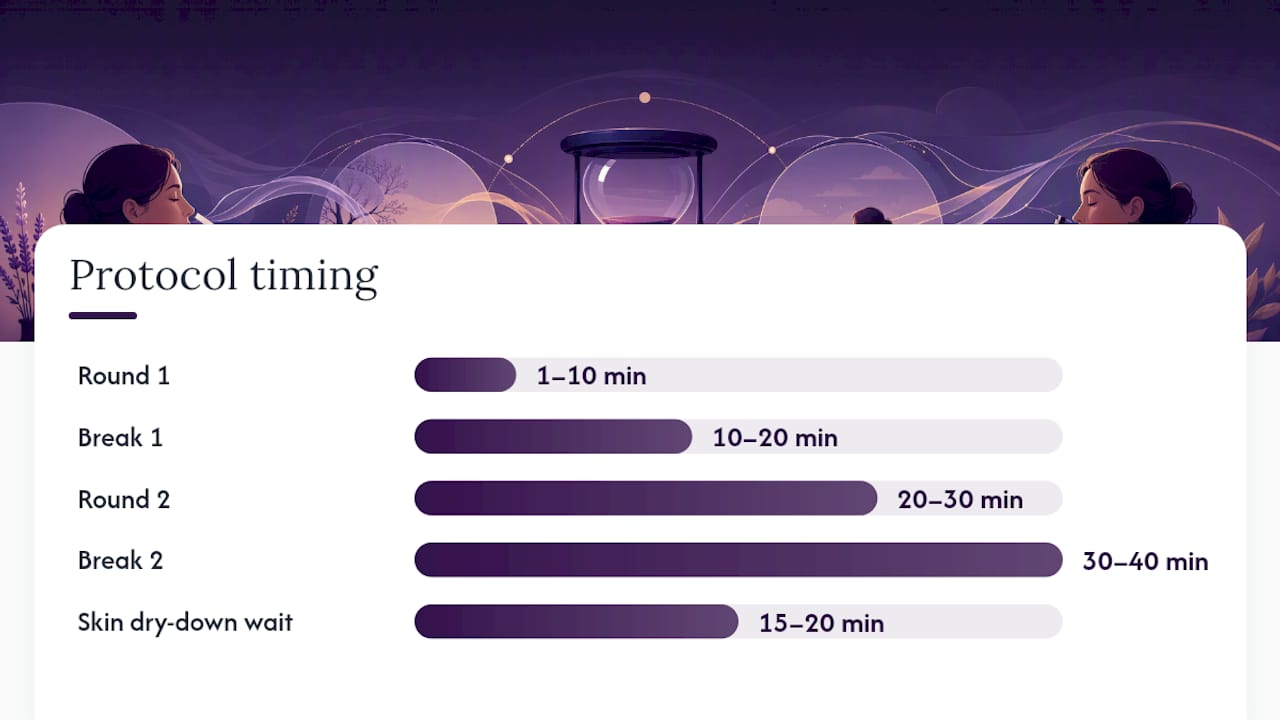
- Prep (0 min): Arrive unscented. Label blotters blind. Set out water and a neutral-air source (open window or fan).
- Round 1 (min 1–10): Evaluate 3 blotter samples, 2–3 minutes apart. Record impressions immediately after each.
- Break (min 10–20): Step outside or sit near the open window. No scented products. Hydrate.
- Round 2 (min 20–30): Evaluate 2–3 more blotters, or revisit finalists from Round 1.
- Break (min 30–40): Repeat neutral-air rest.
- Skin test (min 40+): Apply 1–2 finalists to skin only after blotter rounds have narrowed the field. Wait 15–20 minutes before evaluating dry-down.
Advanced practices for retaining objectivity:
- Use blind labels throughout to prevent expectation bias from influencing perception.
- Rotate panelists in group evaluations so no single evaluator carries the full fatigue load.
- Keep written notes on each sample before moving to the next — verbal memory of scent degrades within seconds.
Pro Tip: When building a fragrance wardrobe, limit new-scent evaluations to 3–4 per sitting. Spacing discovery sessions across several days gives your olfactory memory time to consolidate, and each session starts fresh.
Skin testing after blotter rounds matters because fragrance behaves differently on skin than on paper. Body heat, pH, and moisture all alter the dry-down. Blotter rounds filter the field; skin confirms the choice.
A note on slow discovery, from Maisonvoyageurparfum
At Maisonvoyageurparfum, we think about olfactory fatigue differently than most. The science is real and worth understanding. But the deeper truth is that nose blindness is what happens when we rush.
When you move through fragrances slowly, one at a time, with space between each encounter, your senses stay open. That is the philosophy behind every scent we compose in Madrid: not a collection to be tested all at once, but a set of invitations to be accepted one by one, over time. Rotating your signature scents across the week, rather than wearing the same one daily, keeps your perception alive. Scheduling a quiet discovery session, rather than sampling in a crowded store, changes what you are able to notice.
The ritual of slow fragrance discovery is not just aesthetically pleasing. It is neurologically sound. Your olfactory system rewards patience.
Sources
These are the primary sources behind the science and protocols in this guide:
- Olfactory fatigue - Wikipedia
- Olfactory fatigue: What it is and how to avoid it in product testing — Perfumer & Flavorist
- NCBI PMC article (olfactory research)
- Nose blindness, olfactory fatigue: What does it mean? — Healthline
- DOI reference — sensory adaptation / olfaction chapter
Recommended
- Cómo funciona la memoria olfativa: guía para perfumes – Maison Voyageur
- Cómo se percibe la evolución olfativa: guía esencial – Maison Voyageur
- Why Certain Smells Feel Like Home – Maison Voyageur
- Benefits of Intentional Fragrance Use for Wellness – Maison Voyageur
Les sept fragrances Maison Voyageur
- Manifesting · unisexe (69,99 €)
- Intuition · femme (69,99 €)
- Certainty · femme (69,99 €)
- Expansion · femme (69,99 €)
- Release · homme (69,99 €)
- Presence · homme (69,99 €)
- Inner Fire · homme (69,99 €)
Nouvelle ici ? Commence par le Discovery Set · les 7 fragrances en format voyage (40 €).