
Perfume Accords Explained for Fragrance Enthusiasts
A perfume accord is a balanced blend of two or more raw materials that fuse into a single, unified scent impression distinct from any of its individual components. Think of it as the structural DNA of a fragrance: the designed combination that gives a perfume its recognizable character before a single drop touches your skin.
Three things worth knowing right away:
- Simple or complex. Simple accords typically use 3–5 materials; complex accords may combine 6–10 or more, depending on the olfactive goal.
- They appear anywhere in the pyramid. A single accord can anchor the top, heart, or base of a fragrance, and most commercial perfumes are built from multiple major accords working together across all three layers.
- Modularity is the point. Accords give perfumers a reusable building block, one coherent scent unit they can place, adjust, or layer without rebuilding a formula from scratch.
The sections below cover how accords differ from notes, how perfumers build them, the major families you will encounter, and how to use that knowledge when choosing or layering your own scents.
Table of Contents
- What makes an accord different from a note?
- How do perfumers actually build an accord?
- Which accord families will you encounter most often?
- How perfumers and enthusiasts use accords every day
- Three simple accord recipes to study
- Key Takeaways
- Why accords are at the heart of everything we make
- Useful sources for going deeper
What makes an accord different from a note?
A single fragrance note is one raw material: a jasmine absolute, a vetiver extract, a synthetic musk molecule. An accord is what happens when two or more of those materials are deliberately combined until they stop smelling like themselves and start smelling like something new.
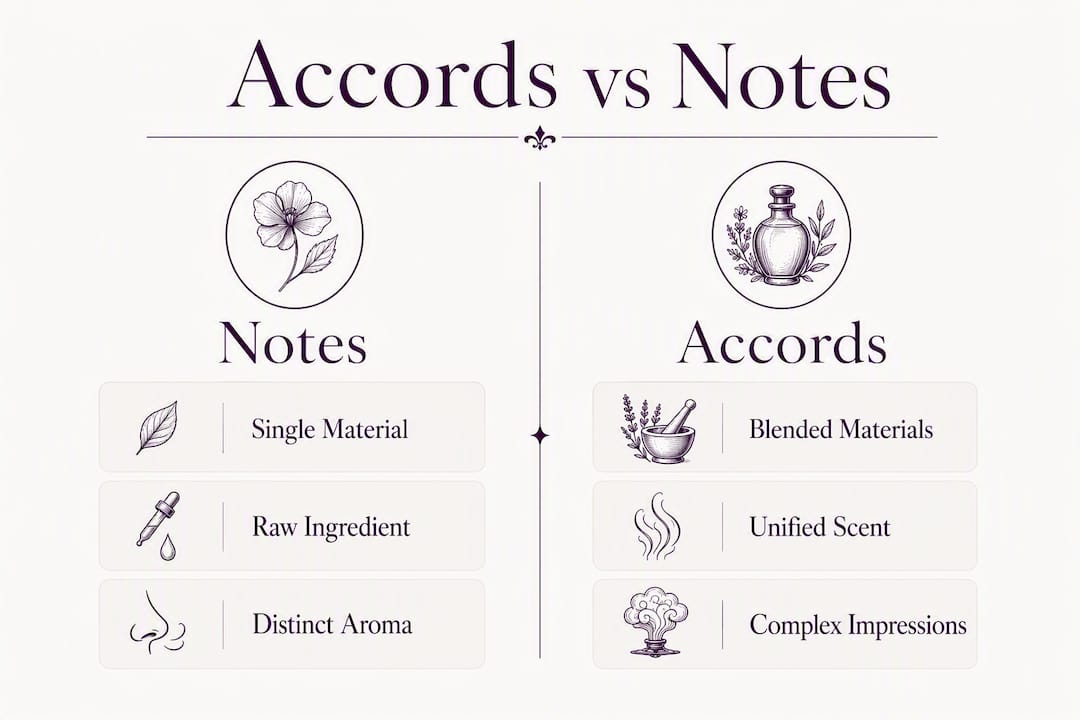
The music analogy is the clearest way in. A C-major chord is not C, E, and G played separately. It is a single sound with its own emotional quality, and you cannot pull the individual notes back out by ear. Accords work the same way.
Consider the difference in practice. A jasmine note in a formula is a single, identifiable ingredient. A rose accord, by contrast, might combine geranium, citronellol, and damascone in specific ratios until the result reads as “rose” without a drop of actual rose absolute. The components disappear into the impression.
- Note: one material, one identity, traceable on the blotter.
- Accord: multiple materials, one fused impression, components no longer individually recognizable.
One practical caution: marketing copy often uses “notes” and “accords” interchangeably, which blurs the distinction for collectors and formulators alike. When a brand lists “amber accord” in its notes pyramid, it is describing a designed blend, not a single ingredient. Keeping that distinction clear helps you read a formula with real precision.
How do perfumers actually build an accord?
The process is methodical, not intuitive. Most professional perfumers work from a structural framework before they ever open a bottle.
The Base / Modifier / Blender framework
Every well-built accord has three functional roles:
- Base — the foundation material, low volatility, long-lasting. It anchors the accord and gives it staying power on skin. Sandalwood, musks, and cedarwood often serve this role.
- Modifier — the character material. It defines the accord’s personality: the lavender in a fougère, the bergamot in a citrus accord. Higher volatility, more presence in the opening.
- Blender — the harmonizer. Its job is to smooth transitions between base and modifier so the accord reads as one thing rather than two competing materials. Linalool, benzyl acetate, and certain musks frequently fill this role.
A practical workflow
- Define your olfactive direction clearly before selecting any materials. “Warm, woody, slightly sweet” is a workable brief. “Nice” is not.
- Select 3–8 core materials that map to your Base, Modifier, and Blender roles.
- Decide whether you are building a horizontal accord (materials of similar volatility, easier to evaluate on a blotter) or a vertical accord (spanning top, heart, and base, requiring staged dry-down observation). Beginners are advised to start with horizontal accords because the interactions are cleaner to read.
- Test ratios systematically. The Jean Carles method pairs two materials in ratios like 1:1, 2:1, and 1:2 using numbered beakers, finds the ideal pair balance, then expands to a third material. It is thorough but material-intensive, so plan your tests before you open costly bottles.
- Dilute to your working concentration (typically 10% in ethanol for evaluation), test on blotters first, then on skin. Note the dry-down at 15 minutes, 1 hour, and 3 hours.
- Document everything. Ratios, impressions, and failures are equally useful.
Accords function as modular building blocks that give perfumers creative flexibility to construct coherent fragrance narratives rather than a linear list of ingredients. Luxe Ola Labs
Pro Tip: When a natural-only accord lacks stability or smells muddy after a week, a targeted synthetic is often the cleanest fix. Hybrid accords combining naturals with synthetics are standard in professional perfumery for exactly this reason. Always check IFRA guidelines for usage limits on any synthetic or sensitizing natural before scaling a formula.
Which accord families will you encounter most often?
Each major accord family is defined by a characteristic set of materials that produce a recognizable fused impression. Here are the ones you will meet most frequently, with their core building blocks:
- Fougère — lavender, coumarin, oakmoss (or a synthetic oakmoss substitute). The classic barbershop-to-aromatic family.
- Chypre — bergamot, labdanum, oakmoss. Earthy, mossy, and citrus-bright at once.
- Floral — rose, jasmine, ylang-ylang, or their synthetic equivalents. Can be simple (single-flower) or complex (bouquet).
- Citrus — bergamot, lemon, grapefruit, neroli. High volatility; often used in top-note accords that fade quickly but open beautifully.
- Amber / Oriental — benzoin, labdanum, vanilla, warm musks. Rich, resinous, and long-lasting on skin.
- Leather — birch tar, isobutyl quinoline, castoreum or its synthetic replacements. Smoky, animalic, dry.
- Gourmand — ethyl maltol, vanilla, heliotropin, caramel-type molecules. Edible and warm. This family depends almost entirely on synthetics for its characteristic sweetness.
- Marine — calone, ambroxan, sea salt accords. Entirely synthetic in origin; natural materials cannot reproduce the open-water effect that calone delivers.
Simple accords typically use 3–5 materials; complex accords may combine 6–10 or more. A fougère accord at its most stripped-back needs few ingredients. A sophisticated chypre might layer multiple components before it reads as coherent.
Synthetics expand what these families can express. Marine and gourmand accords exist because of aroma chemistry. Certain white-flower effects, like the creamy indolic quality of tuberose, are far more consistent and affordable in synthetic form than from the natural absolute.
How perfumers and enthusiasts use accords every day
For a perfumer, an accord is a reusable module. Once a rose accord is balanced and stable, it can be dropped into a floral, a chypre, or an oriental without rebuilding the rose effect from scratch each time. That modularity saves time and keeps a house’s signature consistent across different releases.
When designing or selecting an accord for a formula, a professional typically checks five things:
- Olfactive intention — does the accord’s character serve the fragrance concept?
- Volatility profile — will it behave as a top, heart, or base element?
- Solubility — does it dissolve cleanly in the intended carrier (ethanol, oil, wax)?
- IFRA constraints — are any materials restricted at the target concentration?
- Stability — does the accord hold its character after heat, light, and time exposure?
For enthusiasts rather than formulators, accord knowledge changes how you shop and how you layer fragrances. When you can identify the dominant accord in a scent, you can predict what will pair well with it. An amber accord on skin pairs naturally with a woody or leather accord layered on top. A citrus accord in the opening calls for something with more longevity underneath to carry the experience forward.
Pro Tip: Spray a fragrance on a blotter and smell it after 30 minutes, when the top notes have faded. What remains is usually the heart accord. That single impression tells you more about a perfume’s true character than the opening burst.
Wearing tips worth keeping:
- Apply the longer-lasting accord (amber, leather, woody) to pulse points first.
- Layer a lighter accord (citrus, floral) over it once the base has settled.
- Test any layered combination on skin, not just blotters, since skin chemistry shifts accord interactions in ways paper cannot predict. Explore artisanal fragrance wardrobe building for a structured approach to pairing.
Three simple accord recipes to study
These are educational illustrations, not commercial formulas. Treat them as starting points for your own ratio experiments.
-
Simple citrus accord — bergamot (50%), lemon (30%), neroli (20%). All top-note materials; a horizontal accord. Bright, clean, and easy to evaluate because all three evaporate at similar rates. Dilute to 10% in ethanol and smell at 5, 15, and 30 minutes.
-
Warm amber accord — benzoin resinoid (40%), labdanum absolute (35%), ethyl vanillin (25%). A vertical accord spanning heart and base. Expect the ethyl vanillin to read first, with labdanum deepening after 30 minutes. Skin testing is necessary here; this accord shifts considerably with body heat.
-
Fougère core accord — lavender (45%), coumarin (35%), oakmoss absolute or substitute (20%). The foundational trio of the fougère family. Coumarin adds the characteristic hay-like sweetness; oakmoss grounds it. Adjust the coumarin ratio up or down to move between sweet and dry.
Testing workflow for any of the above:
- Micro-blend at 0.5–1 ml total volume to conserve materials.
- Dilute to 10% in perfumer’s ethanol before evaluation.
- Smell on blotter immediately, at 15 minutes, and at 1 hour.
- Transfer to skin for the 3-hour dry-down observation.
- Adjust one variable at a time and document every change.
One important note: some materials in these families, including oakmoss absolute and certain citrus expressed oils, are IFRA-restricted at specific concentrations. Check current IFRA standards before working with any sensitizing ingredient.
For a broader look at how Middle Eastern perfumery traditions use accord-driven construction to produce regionally distinctive impressions, the Ard Al Zaafaran collection at OudHaven offers accessible examples of amber and oud accords in finished form.
Key Takeaways
A perfume accord is a designed blend of two or more materials that fuses into a single olfactory impression, giving perfumers a modular building block and giving wearers a coherent scent identity to recognize, layer, and explore.
| Point | Details |
|---|---|
| Core definition | An accord is two or more materials fused into one unified scent, distinct from any single ingredient. |
| Simple vs. complex | Simple accords use roughly 3–5 materials; complex accords combine 6–10 or more. |
| Building framework | The Base / Modifier / Blender structure balances foundation, character, and harmony in every accord. |
| Consumer application | Identify the heart accord after 30 minutes on a blotter to understand a fragrance’s true character. |
| Regulatory awareness | Always verify IFRA limits for sensitizing or restricted materials before scaling any formula. |
Why accords are at the heart of everything we make
There is a moment in the composition process, quiet and unhurried, when separate materials stop competing and become one thing. That is the accord taking shape. At Maisonvoyageurparfum, that moment is not rushed.
Working with 98% natural ingredients in our Madrid studio, we build each fragrance around a central accord that carries an emotional intention, not just an olfactive profile. The accord is where the story begins. Everything else, the top-note brightness, the base-note depth, is arranged around that core so the scent unfolds rather than simply fades.
What draws us to the accord as a concept is its patience. You cannot force two materials into harmony. You test, you wait, you observe the dry-down, and you adjust. That discipline mirrors what we believe about fragrance itself: that the most meaningful scents are slowly made, and that real luxury is the time to explore within yourself.
If you want to understand how we apply that philosophy to each composition, our slow luxury approach and the Seven Archetypes method show how accord design connects to something deeper than scent alone.
Useful sources for going deeper
These resources support the technical claims in this article and offer practical next steps for anyone who wants to move from understanding accords to building them.
- Karen Gilbert — What Is an Accord in Perfumery? A clear, practitioner-written definition with emphasis on the fusion principle. Good starting point for beginners.
- Karen Gilbert — How to Create a Perfume Accord Covers both the Jean Carles method and a simplified classroom approach. Useful for anyone ready to start ratio testing.
- Karen Gilbert — Different Types of Accords Explains horizontal vs. vertical accords with practical guidance on where to start.
- Luxe Ola Labs — Perfume Accords: A Technical Guide Covers the Base / Modifier / Blender framework, the Jean Carles method, and hybrid accord construction in detail.
- Scented Chemistry — Accord Glossary Concise, technically accurate definition with the chord analogy explained well.
- IFRA — International Fragrance Association The primary source for safety standards and usage limits on fragrance materials. Consult this before scaling any formula that includes restricted ingredients.
Recommended
- Fragrance Layering Techniques for Enthusiasts: Expert Guide – Maison Voyageur
- Perfume Concentration Differences: A Clear Guide – Maison Voyageur
- Aromatherapy vs Perfumery: A Guide for Connoisseurs – Maison Voyageur
- Why Natural Perfume Smells Complex: The Real Science – Maison Voyageur
Les sept fragrances Maison Voyageur
- Manifesting · unisexe (69,99 €)
- Intuition · femme (69,99 €)
- Certainty · femme (69,99 €)
- Expansion · femme (69,99 €)
- Release · homme (69,99 €)
- Presence · homme (69,99 €)
- Inner Fire · homme (69,99 €)
Nouvelle ici ? Commence par le Discovery Set · les 7 fragrances en format voyage (40 €).