
Scent Rituals as Sensory Practices for Personal Growth
Yes — intentional scent rituals can accelerate introspection and emotional shifts by pairing artisanal fragrances with repeatable, mindful practices. The olfactory nerve projects directly to the brain’s limbic regions, bypassing the thalamic relay that other senses must pass through. That anatomical shortcut means fragrance reaches emotion and memory faster than sight or sound. Three things you can do right now:
- Micro-reset (60 seconds): Uncap a natural fragrance, inhale slowly three times, and name one emotion you feel. No analysis needed.
- Scent journaling prompt (90 seconds): Write one sentence: “This scent reminds me of ___.” Let the memory surface without editing it.
- Focused inhale (30 seconds): Hold your wrist close, breathe in, and set a single intention for the next hour.
Maisonvoyageurparfum’s discovery sets are crafted for exactly this kind of entry point — slowly made, 98% natural, and designed to open something within you rather than simply smell beautiful.
Key Takeaways
Intentional scent rituals work because the olfactory system connects directly to the brain’s emotional and memory centers, making fragrance one of the most efficient sensory practices for personal growth available.
| Point | Details |
|---|---|
| Olfactory-limbic pathway | Scent bypasses the thalamus and reaches the amygdala and hippocampus directly, producing fast emotional responses. |
| Ritual consistency matters | Conditioning emerges over weeks to months; pair each scent with a fixed context and time of day. |
| Periodic re-exposure sustains memory | Re-expose yourself to a meaningful scent every few weeks to sustain its emotional association over time. |
| Patch test every new scent | Apply to the inner elbow, wait 24 hours, and watch for redness or irritation before broader use. |
| Maisonvoyageurparfum discovery sets | Travel-size sets spanning distinct scent families let you test emotional responses before choosing a full bottle. |
Table of Contents
- Why does scent reach emotion and memory so quickly?
- Five scent rituals you can start today
- How do you choose and safely test an artisanal scent for introspection?
- How a scent journal deepens your growth work over time
- Allergies, storage, and etiquette in shared spaces
- How pairing scent with breathwork and sound amplifies your practice
- What scent rituals have taught me about introspection
- Maisonvoyageurparfum discovery sets for your scent practice
- Sources
Why does scent reach emotion and memory so quickly?
The answer lives in anatomy. Olfactory receptor neurons connect almost directly to the amygdala and hippocampus, the brain’s centers for emotional processing and autobiographical memory. Every other sense routes through the thalamus first. Scent does not. That single structural difference explains why a cedar note can pull a specific afternoon from twenty years ago into sharp focus before you have consciously registered what you are smelling.
Research confirms that this direct olfactory-limbic pathway produces emotional and memory responses with a speed and intensity that other sensory inputs rarely match. Neuroimaging supports this: an fMRI study found significantly greater amygdala and hippocampal activation when participants recalled personally meaningful memories cued by odors compared to visual cues.
“Odors that evoke positive autobiographical memories can increase positive emotion, reduce negative mood, and lower physiological stress indicators — supporting their therapeutic use.” MDPI, Brain Sciences
One practical implication: the effect is durable. Because scent associations form through repeated pairing, a fragrance you use consistently during a morning ritual will eventually trigger that ritual’s emotional state on its own. The risk worth knowing is habituation — your nose adapts to a constant background scent within minutes. Brief, intentional exposures preserve the signal far better than all-day diffusion.
Five scent rituals you can start today
Each ritual below targets a distinct inner state. Time estimates are realistic minimums.
-
Grounding ritual (2–3 minutes, daily): Choose a woody or earthy scent — cedar, vetiver, or patchouli. Sit with both feet on the floor. Apply to wrists, inhale slowly for four counts, exhale for six. Name three physical sensations before moving on. Repeat each morning to build a conditioned calm response over weeks.
-
Creativity ritual (5 minutes, before creative work): Reach for something bright and green — citrus, black pepper, or a fresh herbal note. Apply lightly, then free-write or sketch for five minutes without stopping. The scent becomes a cue that signals “open mode” to your nervous system.
-
Emotional processing ritual (10 minutes, as needed): Resinous, warm scents — benzoin, vanilla, labdanum — tend to soften the edges of difficult emotions. Sit quietly, apply the fragrance, and let a specific memory or feeling surface. Write one sentence about it. No resolution required; the act of noticing is the practice.
-
Focus ritual (60–90 seconds, before deep work): A single clean note — vetiver, sandalwood, or a dry wood accord — applied to the pulse points. Take three slow breaths, then begin. Practitioners report that consistent pairing of a scent with a specific moment speeds associative conditioning, so the same scent used before every focused session becomes a reliable mental on-switch within weeks.
-
Nightly scent practice (60 seconds, before sleep): A soft, resinous or floral-musky note applied to the chest or pillow edge. Breathe in once, set a brief intention for tomorrow, and release it. A structured 7-day smell-training rotation using 2–3 scents with short nightly focus is one practitioner-recommended way to observe early mood and memory shifts within a single week.
Pro Tip: Pair each ritual with a consistent physical context — the same chair, the same time of day. Context anchors the association and accelerates conditioning far more than scent alone.
How do you choose and safely test an artisanal scent for introspection?
Start with two or three scents from distinct olfactory families rather than sampling six similar ones. Your nose fatigues quickly, and contrast helps you notice genuine emotional responses. Limit any single testing window to three or four scents, with a 30-minute gap between each.
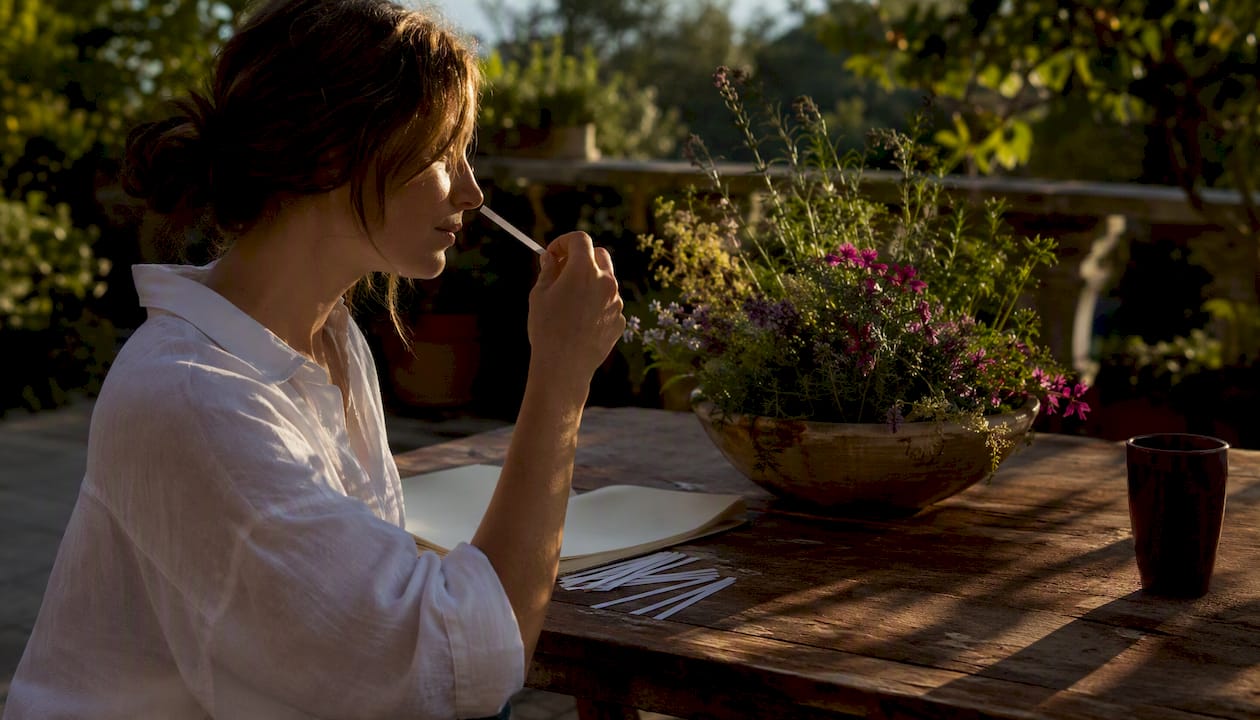
Reading a note list tells you more than the name does. Top notes (citrus, light herbs) are what you smell in the first five minutes — vivid but brief. Middle notes (florals, spice, green) carry the emotional body of the fragrance. Base notes (woods, resins, musks) are what linger on skin and form the lasting memory association. For introspective work, the base is what matters most. Woody and resinous bases tend to evoke groundedness and warmth; different scent families map to distinct emotional responses, which is worth exploring before committing to a full bottle.
For skin testing, apply a small amount to the inner wrist or elbow crease. Wait 24 hours and check for redness, itching, or swelling. If any of these appear, discontinue use. Beyond irritation, trust aversion: if a scent triggers an unpleasant physical sensation in the nose or throat (a sign of trigeminal activation rather than olfactory pleasure), it is not the right tool for introspective work regardless of how it smells on paper. Wear a sample for a full day before deciding — fragrance changes significantly over hours, and the dry-down is where the real character lives.
How a scent journal deepens your growth work over time
A journal transforms a pleasant ritual into a personal development practice. Use these fields for each entry:
| Field | What to record |
|---|---|
| Scent name | Exact fragrance and application point |
| Date and time | Including day of week and time of day |
| Context | Where you are, what preceded this moment |
| Intention | One word or phrase for the session |
| Physical sensations | Warmth, tension, ease — body-level observations |
| Emotions | Named feelings, not evaluations |
| Follow-up rating | 1–5: how present did you feel afterward? |
A brief example entry: “Saturday, 7:15 AM. Cedar-vetiver blend, wrists. Intention: steadiness. Chest feels open. Mild nostalgia, something like a childhood kitchen. Rating: 4.”
For cadence, daily practice during the first two weeks builds the initial association. After that, weekly intentional sessions sustain it. Periodic re-exposure matters more than most people expect: a PLOS Biology study found that early-life olfactory memories rely on repeated exposures, and that re-exposure roughly every few weeks helped sustain preference into adulthood. Scheduling a deliberate re-exposure around a personal milestone — a birthday, a season change, the anniversary of a significant decision — anchors the scent to that chapter of your life and makes future recalls richer. The benefits of intentional fragrance use compound precisely because memory and emotion reinforce each other with each return.
Allergies, storage, and etiquette in shared spaces
Patch testing and safety:
- Apply a small amount to the inner elbow; wait 24 hours before broader use.
- Signs to watch: redness, itching, hives, or a burning sensation at the application site.
- If symptoms appear, wash the area with mild soap and water. Seek medical attention if symptoms spread or breathing is affected.
- Natural ingredients are not automatically hypoallergenic — botanical extracts can trigger reactions just as synthetics can.
Storage to preserve quality:
- Keep bottles away from direct light and heat; a drawer or cabinet is better than a windowsill or bathroom shelf.
- Airtight caps and minimal air exposure slow oxidation, which degrades both scent quality and skin safety.
- Travel sizes are worth using for daily rituals; reserve full bottles for home use to limit temperature fluctuation.
Etiquette in shared spaces:
- Apply fragrance at least 30 minutes before entering a shared workspace, gym, or medical setting.
- One or two sprays is enough for personal ritual work; more is not more effective and can be intrusive.
- When offering a scent for someone else to try, apply to a paper strip rather than their skin — let them choose whether to wear it.
- Ask before diffusing in shared rooms. What grounds you may distract or irritate someone else.
How pairing scent with breathwork and sound amplifies your practice
Scent alone is powerful. Scent paired with another sensory input is faster and more durable. When you combine modalities, the brain encodes the experience through multiple neural pathways simultaneously, which strengthens the conditioned association more rapidly than any single cue could.
Three practical pairings:
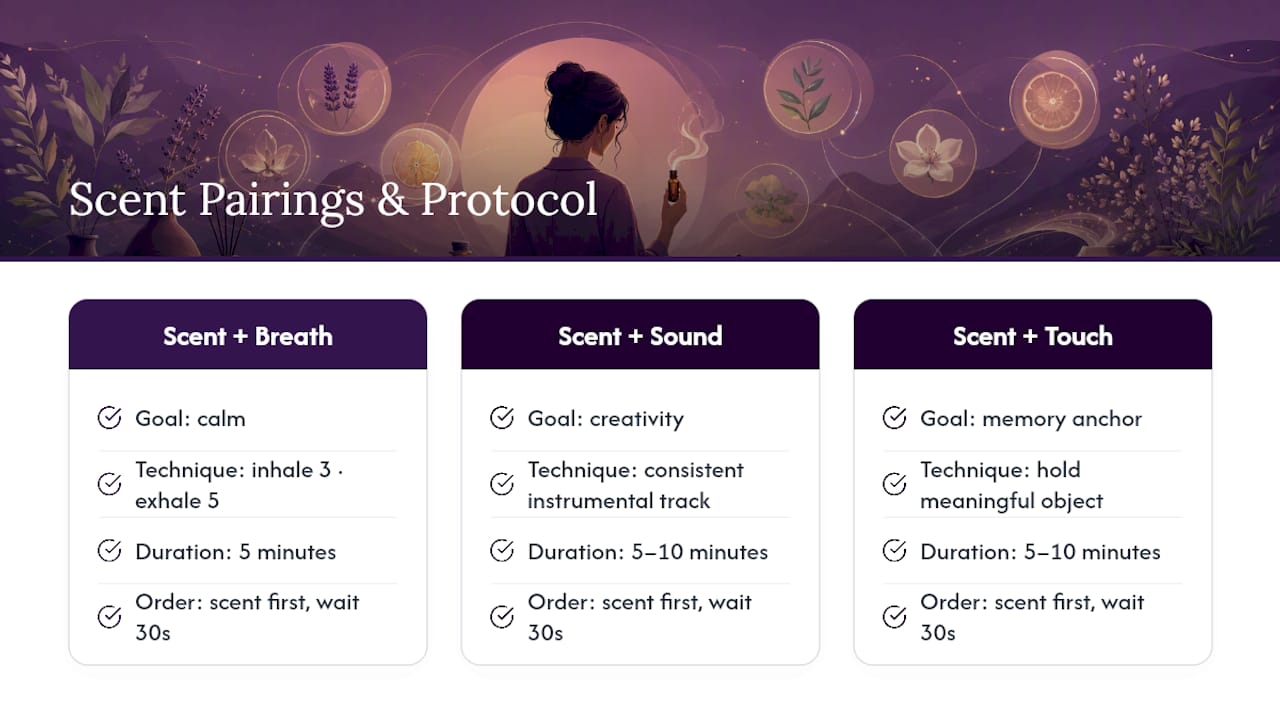
Scent and 3:5 breathing for calm. Apply a grounding scent, then inhale for three counts and exhale for five. The extended exhale activates the parasympathetic nervous system; the scent anchors the state. Five minutes is enough to feel a shift.
Scent and a focused playlist for creativity. A consistent instrumental track paired with your creativity scent trains both cues simultaneously. Over time, either one alone can cue the creative state.
Scent and a tactile object for memory anchoring. Hold a smooth stone, a piece of fabric, or any object with personal meaning while you inhale your chosen fragrance. Touch adds a third encoding channel, making the memory association more retrievable later.
“Combining scent with touch and sound supports stress relief and deeper sensory attention — the multisensory approach engages more of the brain’s associative network than any single modality alone.” Evergreen Bliss, Sensory Relaxation Guide
Keep the scent as the primary cue. Sessions of 5–10 minutes work well; longer is not necessary and risks habituation. Sequence matters: apply the fragrance first, let it settle for 30 seconds, then introduce the secondary input. That order preserves the scent’s primacy in the association.
What scent rituals have taught me about introspection
There is a common assumption that personal growth requires effort — journaling for an hour, meditating for thirty minutes, reading the right book. Scent rituals challenge that assumption quietly. The olfactory-limbic connection means that a single, well-chosen inhale can surface an emotional truth faster than a page of writing.
What most guides miss is the difference between passive use and intentional micro-resets. Wearing a beautiful fragrance is pleasurable. Using it as a deliberate cue — spray, breathe, name one feeling — is something else entirely. That distinction is where the introspective science of fragrance becomes a genuine personal development strategy rather than a wellness aesthetic.
The other underestimated factor is patience with the timeline. Conditioning emerges over weeks to months, not days. The readers who abandon scent rituals after a week are measuring the wrong thing. The question is not “did I feel different today?” but “what am I noticing now that I wasn’t noticing before?”
Maisonvoyageurparfum discovery sets for your scent practice

Maisonvoyageurparfum offers something specific to readers who have worked through these rituals: discovery sets composed of 98% natural ingredients, each scent slowly crafted in Madrid with introspection as the design intention. Rather than choosing blind from a full bottle, you begin with a curated set of travel sizes spanning distinct olfactory families — woody, resinous, citrus, floral — so you can test each against your own emotional responses before committing.
Three steps to get started: browse the Maisonvoyageurparfum discovery collection, select a set that spans at least two contrasting scent families, and use the journal template from this article for your first week of entries. Guided scent prompts are available on the brand’s editorial pages to support each ritual above. This is where the practice becomes personal.
Sources
- Source: PMC article on olfaction and limbic connectivity
- The Role of Odor-Evoked Memory in Psychological and Physiological Health — MDPI
- Positive early-life olfactory memory is rooted in the olfactory bulb and triggers large-scale changes beyond the olfactory system — PLOS Biology
- fMRI evidence for amygdala and hippocampal activation to odor-evoked autobiographical memory — ScienceDirect
- Your Brain on Scent: A 7-Day Smell Training Ritual for Memory, Mood & Neuroplasticity — Auratherapy
- How to Build a Scent Ritual for Nervous System Regulation — Aerchitect
- The Science Behind Pure Placid Rituals: How Scent Psychology Powers Reset, Comfort, Grounded — Pure Placid
Recommended
- Scent Rituals for Self-Discovery: A Practical Guide – Maison Voyageur
- How Fragrance Promotes Introspection: A Science Guide – Maison Voyageur
- How to Explore Personal Identity Through Scent – Maison Voyageur
- Scent-Triggered Emotional Journeys: Real Examples – Maison Voyageur
Les sept fragrances Maison Voyageur
- Manifesting · unisexe (69,99 €)
- Intuition · femme (69,99 €)
- Certainty · femme (69,99 €)
- Expansion · femme (69,99 €)
- Release · homme (69,99 €)
- Presence · homme (69,99 €)
- Inner Fire · homme (69,99 €)
Nouvelle ici ? Commence par le Discovery Set · les 7 fragrances en format voyage (40 €).