
EU Buyers: Confirm a Perfume Is Truly Vegan in Five Steps
A vegan perfume contains no animal-derived ingredients anywhere in the finished formula. No musk from a deer, no ambergris from a whale, no honey, no carmine. Cruelty-free is a separate promise entirely. It only speaks to whether the product was tested on animals. If both values matter to you, check both. Start by reading the ingredient list, then look for a trusted certification before you trust the label alone.
TL;DR:
- Vegan perfumes exclude all animal-derived ingredients, including carriers, fixatives, dyes, and preservatives, confirmed by ingredient lists or third-party certifications.
- Animal-based materials like ambergris, musk, civet, castoreum, beeswax, honey, lanolin, and carmine are largely replaced by synthetics, plant extracts, or biotech ingredients in modern formulations.
- The EU ban on animal testing means most European perfumes are legally cruelty-free, but verification of animal ingredient avoidance relies on certification and transparent sourcing.
- Checking for independent labels like the Vegan Trademark and reading full ingredient lists is essential, as vague terms like “fragrance” can hide animal-derived components.
- Slow-crafted, artisanal perfumes often offer better traceability, but certification and full transparency remain the most reliable proof of vegan sourcing.
Table of Contents
- Perfumes Veganos Significado: What the Term Actually Covers
- Animal-Derived Ingredients to Watch For, and What Replaces Them
- How Vegan Perfumes Get Made
- What Vegan Perfume Actually Gives You, and What It Doesn’t
- Vegan vs. Cruelty-Free: Why the EU Context Changes the Answer
- How to Verify a Perfume Is Actually Vegan
- How an Artisanal Perfumer Approaches Vegan Sourcing
- Why Clarity on Labels Matters More Than the Debate Itself
- An Artisanal Route Worth Exploring
- Where to Verify These Claims Yourself
- Sources
- FAQ
Perfumes Veganos Significado: What the Term Actually Covers
Vegan does not mean natural. It does not mean organic. It means one specific thing: nothing in the bottle came from an animal, at any stage of production.
That scope is wider than most shoppers assume. It is not just the perfume oil itself. Vegan status covers the carrier alcohol, the fixatives, the preservatives, and even the dyes that give a fragrance its color. And a perfume can market itself as “natural” while quietly containing beeswax or lanolin, which come straight from animals.
Brands sometimes blur this on purpose. A green leaf on the box, the word “botanical” in the name, an earthy bottle design. None of it confirms vegan status. The only reliable proof lives in three places:
- The full ingredient list, sometimes called the INCI, printed on the packaging or the product page
- A recognized third-party certification mark
- A direct sourcing statement from the brand itself
Animal-Derived Ingredients to Watch For, and What Replaces Them
Perfumery has leaned on animal materials for centuries, mostly for their ability to fix scent and add warmth. The classics worth knowing:
- Ambergris — a waxy substance from sperm whales, prized for its marine, amber depth
- Natural musk — harvested from musk deer glands
- Civet — from the civet cat, used historically for a musky, animalic base note
- Castoreum — from beaver glands, once common in leather and amber accords
- Beeswax and honey — used as fixatives and sweet notes
- Lanolin — sheep’s wool grease, common in softer, creamy formulas
- Carmine (C.I. 75470) — a red dye made from crushed cochineal insects
The good news: modern perfumery replaced nearly all of it. Synthetic musks, ambrette seed, and angelica root now recreate those same warm, skin-like tones without a single animal input, and biotech-derived molecules can mimic even the trickiest animalic notes.
Pro Tip: If a listing shows only the word “fragrance” or “parfum” with no breakdown underneath, that single word can legally hide dozens of individual components, some of them animal-derived. That is the moment to look for a certification instead of trusting the label alone.
How Vegan Perfumes Get Made
Synthetics are not a shortcut. They are often the reason a vegan perfume performs as well as a conventional one, holding a scent on skin for hours through what perfumers call fixation.
Perfumers building a vegan formula typically work with three toolkits:
- Synthetic aroma molecules, engineered to replace animal notes and stabilize the entire composition
- Plant materials extracted through steam distillation, cold pressing, or solvent extraction, isolating the exact aromatic compound needed
- Biotech-derived ingredients, grown through fermentation rather than harvested from a living creature
Verification happens at the sourcing level long before a bottle ships. Smaller, artisanal houses tend to track every raw material back to a named supplier. Larger brands lean on supplier audits and paperwork across a longer chain. Neither approach guarantees quality on its own, but shorter chains are generally easier to trace.
What Vegan Perfume Actually Gives You, and What It Doesn’t
The clearest reason to choose vegan is ethical: no animal was harmed to produce the scent on your skin. For a lot of people, that reason alone settles it.
The environmental case is murkier. A vegan perfume is not automatically greener. It depends entirely on how the synthetic or plant ingredients were sourced and manufactured, so the ethical win does not always come with an ecological one attached.
Two myths worth retiring:
- Vegan does not mean hypoallergenic. Plenty of plant extracts and synthetic molecules trigger sensitivities just as easily as animal ones did.
- Vegan does not guarantee better or worse longevity. Formulation skill, not ingredient origin, decides how long a scent lasts on skin.
Vegan vs. Cruelty-Free: Why the EU Context Changes the Answer
These two labels answer completely different questions, and treating them as synonyms is where most confusion starts.
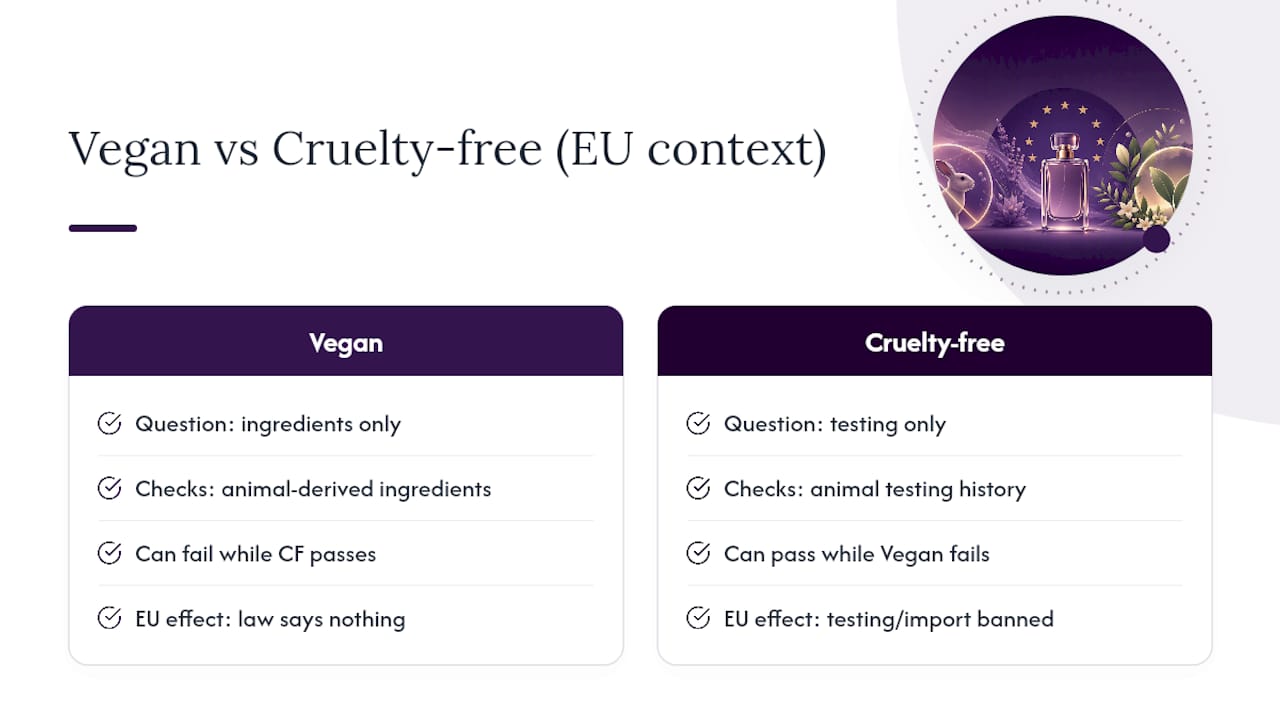
Vegan asks: does the finished product contain any animal-derived ingredient? Cruelty-free asks: was this product, or its ingredients, tested on an animal? A perfume can pass one test and fail the other. Something made entirely from synthetic molecules can still have been tested on an animal decades ago somewhere in its supply chain, and something made from lanolin or honey might never have touched a lab animal at all.
The European Union complicates the second question further. Since 2013, the EU has banned both testing cosmetic ingredients on animals and importing cosmetics tested on animals elsewhere, which means almost every perfume sold legally in Europe is functionally cruelty-free by law, not by brand virtue.
That legal reality makes a “not tested on animals” claim printed on a European bottle close to meaningless as a differentiator. It’s already the baseline requirement, not a bonus. What still separates one perfume from another is whether it contains animal-derived ingredients at all, which is a question the law does not answer for you.
Independent certification remains useful precisely because it checks the claim the law does not.
How to Verify a Perfume Is Actually Vegan
Marketing copy is not proof. A five-step check takes less time than reading a product review and gives you a far more reliable answer.
- Look for a certified logo, most notably the Vegan Trademark from The Vegan Society, which audits ingredient sourcing and confirms the brand did not commission animal testing.
- Read the full INCI list on the packaging or product page, not just the marketing summary above it.
- Learn a handful of Latin red flags: Cera alba (beeswax), Musk without a synthetic qualifier, and Lanolin are the most common giveaways.
- Check the brand’s transparency page for sourcing statements, since PETA notes that a single word like “fragrance” can conceal individual components that a general label won’t disclose.
- Cross-reference with a vegan database or app when a brand offers no transparency information at all.
Skip a step and you’re trusting a label. Complete all five and you’re trusting evidence.
How an Artisanal Perfumer Approaches Vegan Sourcing
Scale changes how traceable a supply chain can be.
That kind of slow-crafted process does not replace certification, but it does make sourcing statements easier to verify. When you’re evaluating any artisanal bottle, look for the same three things on the product page: a full ingredient list, a clear sourcing or origin statement, and a sample policy that lets you test the scent on skin before committing to a full bottle.
Why Clarity on Labels Matters More Than the Debate Itself
Most of the confusion around vegan perfume isn’t ideological. It’s semantic. People assume one word covers everything it doesn’t.
I care about precise labeling because vague labeling lets weaker products hide behind strong-sounding words. Once you know what to check, the ethics and the scent stop competing. You get to choose a fragrance for how it makes you feel and trust that its claims are accurate, not one or the other.
— Celeste
An Artisanal Route Worth Exploring
Maisonvoyageurparfum offers something most mass perfumers don’t attempt: fragrances composed slowly, in small batches, from Mediterranean ingredients chosen for how they make you feel rather than how they photograph on a shelf.

If the checklist above left you wondering where to start, browse the full-size 100ml perfume collection and read each product page closely. Check the ingredient notes, look at the sourcing language, and see which scent matches the moment you’re trying to create for yourself.
Where to Verify These Claims Yourself
Trust the primary sources, not secondhand summaries. The Vegan Trademark standards from The Vegan Society lay out exactly what certification requires. PETA’s explainer breaks down how “fragrance” can hide ingredients. Clean Beauty Collective offers a plain-language ingredient guide, and Ambientum covers the EU’s cruelty-free legal context in detail.
Sources
- What Is Vegan Perfume? | CLEAN Beauty Collective
- The Vegan Trademark standards — The Vegan Society
- Is perfume vegan? — PETA
- Perfumes veganos y cruelty free: ¿en qué se diferencian? — Ambientum
FAQ
Is a Vegan Perfume Better Than a Non-Vegan One?
Neither is automatically better. A vegan perfume avoids animal-derived ingredients, but performance, scent longevity, and skin compatibility depend on formulation quality, not on whether the ingredients came from a plant, a lab, or an animal.
What Exactly Makes a Fragrance Vegan?
A fragrance is vegan when every ingredient in the finished formula, including the alcohol base, fixatives, and dyes, comes from a non-animal source. Synthetic molecules and plant extracts both qualify, since vegan describes origin, not naturalness.
What Does It Mean When a Perfume Says It’s Not Vegan?
It means at least one ingredient, commonly natural musk, ambergris, beeswax, honey, or carmine, comes from an animal source. It says nothing about whether the product was tested on animals, since that’s a separate cruelty-free claim.
Which Perfumes Count as Vegan?
Any perfume whose full ingredient list contains no animal-derived materials qualifies, though the safest way to confirm it is a certification like the Vegan Trademark rather than a brand’s own label alone.
How Much Do Maisonvoyageurparfum’s Perfumes Cost?
The full-size 100ml perfumes are priced as one-time purchases; current prices are available on the client’s website.
Les sept fragrances Maison Voyageur
- Manifesting · unisexe (69,99 €)
- Intuition · femme (69,99 €)
- Certainty · femme (69,99 €)
- Expansion · femme (69,99 €)
- Release · homme (69,99 €)
- Presence · homme (69,99 €)
- Inner Fire · homme (69,99 €)
Nouvelle ici ? Commence par le Discovery Set · les 7 fragrances en format voyage (40 €).