
What Makes a Perfume Truly Luxurious and Natural?
A luxury natural perfume uses high-quality botanical raw materials, holds a real concentration of them (not a whisper of essential oil in a sea of alcohol), and comes from a brand willing to show you exactly what is inside the bottle. That last part matters most. Marketing language is cheap. A full ingredient list is not.
Before you spend on a bottle, run two checks:
- Does the brand publish its complete ingredient list, not just a curated “notes” pyramid?
- Does the packaging mention recycled materials or offer a refill option?
If both are missing, walk away. If both are present, request a sample or a discovery set before committing to a full bottle. Maison Voyageur, among others, offers guided scent discovery precisely so you can test the material quality on your own skin first.
Key Takeaways
A luxury natural perfume earns the label through transparent sourcing, real botanical concentration, and packaging choices that reduce waste rather than just claiming to.
| Point | Details |
|---|---|
| Demand full transparency | Reject any bottle that lists only “fragrance” instead of named botanical ingredients. |
| Sample before buying | Order a decant or discovery set and test over several hours before committing to a full bottle. |
| Check the packaging math | Look for stated recycled-glass content and refill options rather than vague eco-language. |
| Match format to lifestyle | Choose oil-based for intimacy and longevity on skin, alcohol-based for wider projection. |
| Consider Maison Voyageur | Its 98% natural formulas and Madrid-based artisan process offer a transparent starting point for discovery. |
Table of Contents
- What Qualifies as a Luxury Natural Perfume
- How Do You Verify Natural and Sustainability Claims?
- Why Packaging and Refill Systems Matter More Than They Seem
- How Should You Sample and Test a Luxury Natural Perfume?
- Maison Voyageur: Slow Craft, Full Transparency
- How Do You Make a Natural Perfume Last Longer?
- What Fragrance Connoisseurs Get Wrong About Natural Perfume
- Try Maison Voyageur’s Artisan Discovery Process
- Frequently Asked Questions
- Sources
What Qualifies as a Luxury Natural Perfume
Quality separates itself at the raw material level. Absolutes (concentrated botanical extracts drawn out with solvents) and concretes (waxy, highly aromatic extracts) cost far more to produce than the synthetic aroma chemicals that fill most commercial bottles. Enfleurage, an old French technique that captures scent using fat rather than heat or solvent, still shows up in small-batch perfumery because it preserves delicate florals like jasmine that degrade under distillation.
Concentration decides how the perfume behaves on skin. Parfum (the highest concentration of aromatic compounds) lasts longest and unfolds slowest. Eau de parfum sits a notch below. Perfume oils, without alcohol as a carrier, sink into skin and read as more intimate. Editorial coverage of natural perfumery notes that some of the best-performing natural perfumes lean on higher concentrations of botanical material specifically to compete with synthetic longevity.
What actually elevates a natural formula:
- Small-batch composition, where a perfumer can adjust a blend by feel rather than by industrial formula
- Extended maceration, letting raw materials rest and marry over weeks rather than days
- Traceable sourcing, so the jasmine or oud in the bottle has an origin story, not just a name on a label
How Do You Verify Natural and Sustainability Claims?
“Natural” is not a regulated term on a perfume label, which means the word alone verifies nothing. You need to check the sources behind it.
- Look for a full ingredient disclosure, ideally with botanical names, rather than vague marketing notes like “sea breeze” or “warm amber.”
- Cross-reference suspicious ingredients using a resource like EWG’s Skin Deep database, which screens for known irritants and undisclosed synthetics.
- Check for third-party verification: cruelty-free certification, Cradle to Cradle material health credentials, or a stated partnership with a conservation group.
- Confirm the packaging claims are specific. “Eco-friendly” means nothing. “40% recycled cardboard” means something.
Pro Tip: If a brand’s ingredient list stops at “fragrance” or “parfum” as a single catch-all term, that is the industry’s legal loophole for hiding dozens of undisclosed compounds. A luxury natural brand has no reason to hide behind it.
Premium natural perfume lines commonly report 15 to 25% recycled glass content in their bottles, a figure worth asking about directly if it is not listed on the product page. Brands genuinely committed to sourcing transparency also tend to name their partners. A stated relationship with an organization like World Land Trust signals a structured environmental commitment rather than a vague sustainability gesture.
Why Packaging and Refill Systems Matter More Than They Seem
Glass and cardboard rarely get discussed alongside jasmine and oud, but they carry real weight in what “luxury natural” actually costs the planet. Premium lines increasingly build in recycled content as standard, not as a limited-edition gesture.
The numbers, when brands disclose them, tend to cluster in a range:
- Roughly 15 to 25% recycled glass in the bottle itself
- Around 40% recycled cardboard in the outer box
- A growing number of refill programs, letting you replace the fragrance without replacing the vessel
Refill systems ask something of you in return: a little more planning, since you order concentrate rather than grabbing a new bottle on impulse. In exchange, you get a lower cost per use over time and a bottle that earns its place on a shelf rather than getting tossed after one season. That trade-off, patience for value, sits at the center of what slow luxury actually means.
How Should You Sample and Test a Luxury Natural Perfume?
Skip the impulse buy. Natural perfumes shift more on skin than synthetics do, evolving over hours as body chemistry interacts with the botanical material, so a single sniff off a paper strip tells you almost nothing about how a scent will actually live with you.
- Order a decant or sample vial before any full bottle. Curated natural perfume roundups consistently point to sample and decant programs as the smartest way to de-risk a purchase at this price point.
- Apply to pulse points, wait at least four hours, and check how the scent has changed by evening.
- Test oil-based and alcohol-based formats separately if the brand offers both. Oil sinks in and stays close to skin; alcohol-based eau de parfum projects further but can settle differently as it evaporates.
- Budget deliberately. Luxury natural perfumes generally run higher than mass-market alcohol-based fragrances because the raw material cost is higher, not because of brand markup alone. Put your money toward material quality and refillability first, packaging flourishes second.
Pro Tip: Test a new scent on a day you’re not wearing lotion, sunscreen, or another fragrance. Natural botanicals are subtle enough that competing products on your skin can mute them entirely.
Maison Voyageur: Slow Craft, Full Transparency
Maison Voyageur composes each fragrance in Madrid using 98% natural ingredients, drawing on Mediterranean botanical traditions rather than a factory formula sheet. Every scent is built slowly, with the raw material given time to settle into something worth wearing for years, not one season.
The discovery process works the way sampling should: you start with a smaller format or a guided set, live with it, and let the fragrance tell you whether it matches who you are rather than who a marketing campaign says you should be.
A fragrance is not a finishing touch. It is time set aside to explore within yourself.
What that means in practice:
- Travel sizes and discovery sets let you test before committing to a full bottle
- Curated sets for men and women simplify the search when you know the mood but not the specific scent
- Gift options exist for the people in your life who deserve more than a mass-market bottle
The slow luxury philosophy behind Maison Voyageur explains the sourcing commitments and the discovery process in full, for readers who want to see the reasoning before they buy.
How Do You Make a Natural Perfume Last Longer?
Natural formulas reward a little ritual. Skin prep matters more here than with synthetic fragrances, since botanical materials cling better to skin that is already slightly hydrated.
- Apply an unscented body oil or lotion to pulse points before spraying or dabbing the perfume itself
- Layer sparingly. Natural concentrations are often higher already, so less product goes further
- Store bottles upright, away from direct light and heat. Botanical extracts degrade faster than synthetics when exposed to sun or temperature swings
- Reapply once, midday, rather than piling on more in the morning
Pro Tip: Build a small rotation of two or three scents rather than one signature bottle. Natural perfumes respond to season and mood more visibly than synthetics, and a single fragrance rarely does every version of you justice.
What Fragrance Connoisseurs Get Wrong About Natural Perfume
The conventional advice treats “natural” and “long-lasting” as opposites, so shoppers brace for disappointment before they even open the bottle. That assumption undersells what careful formulation can do. The real gap is not between natural and synthetic performance. It is between rushed natural perfumery and slow natural perfumery.
A brand that macerates its materials for weeks, sources absolutes rather than diluted extracts, and tells you exactly what is in the bottle will outperform a synthetic-heavy “clean” fragrance that just swapped one set of undisclosed chemicals for another. The industry’s obsession with eight-hour longevity numbers misses the point of what natural perfumery offers: a scent that evolves with you instead of blasting the same note at hour one and hour eight.
If you take one thing from all of this, prioritize transparency over projection claims. A full ingredient list tells you more about quality than any longevity promise on the box. Sample first. Let the scent earn its place slowly. That is the actual craft, and it is worth more than a bigger number on a spec sheet.
Try Maison Voyageur’s Artisan Discovery Process
Maison Voyageur gives you a way to test genuine artisan quality before you commit, something most luxury fragrance houses make difficult or expensive. Instead of guessing from a description or a department store spritz, you start with a discovery set or travel size, built from 98% natural ingredients composed slowly in Madrid.

That approach suits exactly the reader this guide has been written for: someone who wants to verify quality rather than take a brand’s word for it. Each fragrance is meant to connect to something personal, not just smell pleasant for a few hours in a store. Visit the slow luxury philosophy page to see the full sourcing commitments and start your own discovery process with a sample set today.
Frequently Asked Questions
What is the difference between “natural” and “organic” on a perfume label? “Natural” describes the source of the ingredients (botanical rather than synthetic). “Organic” refers to how those botanicals were farmed, typically without synthetic pesticides. A perfume can be natural without being organic, and the two terms are not interchangeable.
Do natural perfumes last as long as synthetic ones? Not always at the same intensity, but longevity depends heavily on concentration and formulation skill. Some natural perfumes use higher concentrations of botanical material specifically to close that gap, and natural scents often evolve more distinctly on skin over the course of wear.
Why do luxury natural perfumes cost more than mass-market fragrances? Absolutes, concretes, and slow extraction methods like enfleurage cost significantly more to produce than lab-synthesized aroma chemicals. Small-batch production and traceable sourcing add further cost that mass manufacturing avoids.
Is refillable packaging actually better for the environment? Refill programs reduce packaging waste over time, but only if you actually reuse the bottle rather than buying new. Consistent reuse is what makes a refill system meaningfully lower impact compared to buying a new bottle each time.
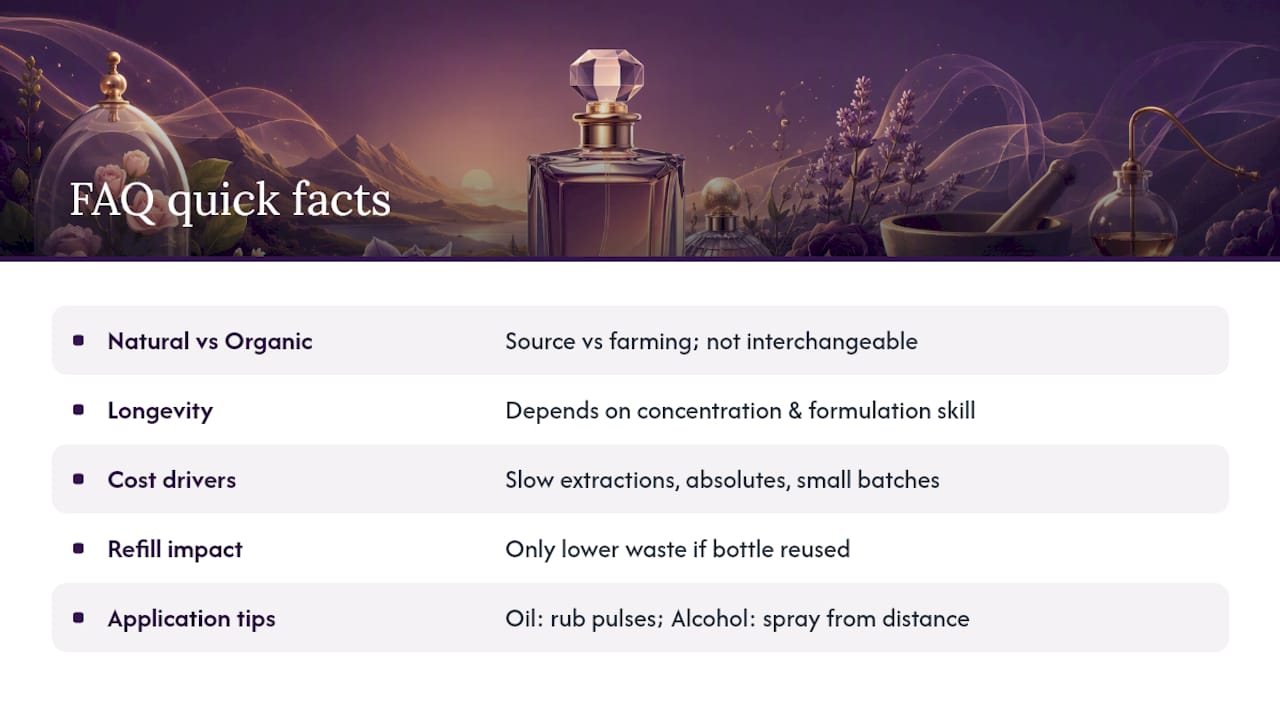
How should I apply an oil-based natural perfume versus an alcohol-based one? Oil-based formulas work best rubbed gently onto pulse points, since they sit close to skin and can stain fabric if sprayed. Alcohol-based eau de parfum can be sprayed from a short distance and typically projects further as it evaporates.
Sources
- 23 Natural Perfumes That Actually Smell Amazing — Byrdie
- 12 Natural Perfumes That Actually Smell Good — The Good Trade
- Environmental Working Group (EWG) — Skin Deep
- World Land Trust
Les sept fragrances Maison Voyageur
- Manifesting · unisexe (69,99 €)
- Intuition · femme (69,99 €)
- Certainty · femme (69,99 €)
- Expansion · femme (69,99 €)
- Release · homme (69,99 €)
- Presence · homme (69,99 €)
- Inner Fire · homme (69,99 €)
Nouvelle ici ? Commence par le Discovery Set · les 7 fragrances en format voyage (40 €).