
81 EU Perfume Allergens: Compliance Steps for Brands and Artisans
Under Commission Regulation (EU) 2023/1545, fragrance allergens covered by Annex III to Regulation (EC) No 1223/2009 must appear individually on the ingredient list once they cross a set threshold. The amendment expanded the declared list from 26 substances to over 80, and Spain’s regulator counts it at 81. If your perfume contains any of them above that trace level, “parfum” alone no longer satisfies the label.
TL;DR:
- Fragrance allergens now number over 80 substances in the EU, with the official list expanded from the original 26 to 81, depending on the counting method.
- A threshold of 0.001% in the finished product triggers mandatory labeling for each allergen, regardless of natural or synthetic origin, and exceptions for rinse-off products do not apply to perfumes.
- “Parfum” or “aroma” cannot mask individual allergens, which must be listed when they exceed the threshold, especially if present in grouped natural extracts.
- Formulators must obtain detailed ingredient and concentration data from suppliers, perform accurate calculations, and update labels and documentation before the July 2026 compliance deadline.
- Natural ingredients are not exempt from allergen labeling, and organic botanical extracts are treated equally to synthetic chemicals regarding disclosure requirements.
Table of Contents
- Perfume Allergens List EU: How Many Substances Are Actually Covered
- What Concentration Triggers Mandatory Labeling?
- Reading a Label: Why ‘Parfum’ Doesn’t Hide Everything
- A Compliance Checklist for Responsible Persons and Formulators
- Natural Ingredients Don’t Get a Pass
- Key Dates: What’s Already Required and What’s Coming
- Maison Voyageur’s Perspective: Transparency as Part of the Craft
- Primary Sources Worth Bookmarking
- Sources
- FAQ
Perfume Allergens List EU: How Many Substances Are Actually Covered
Annex III didn’t grow by a tidy round number. Commission Regulation 2023/1545 folded in dozens of new entries, some as single named substances, others as grouped natural extracts with several chemical constituents bundled under one heading. That structural choice is exactly why you’ll see different totals floating around: some sources say “80-plus,” AEMPS says 81, and older industry material still references the original 26. None of these figures are wrong. They’re counting differently, depending on whether grouped botanical entries get tallied as one line or several.
A short sample of what joined the list gives a sense of scope:
- Farnesol and Hexyl Cinnamal, both long familiar from the original 26.
- Trimethylbenzenepropanol and other synthetic musk-adjacent molecules new to this round.
- Botanical extracts such as Tea Tree Oil (Melaleuca alternifolia) and Ylang Ylang Oil, listed as grouped entries covering multiple natural constituents.
- Several oxidation products of common terpenes, added because they form during storage even when the parent ingredient wasn’t originally allergenic on its own.
This sample only scratches the surface. The definitive table, with full INCI and CAS references, lives in Annex III via the EUR-Lex text and in the European Commission’s CosIng database. Any formulator working from a spreadsheet built before 2023 is very likely working from the wrong list.
What Concentration Triggers Mandatory Labeling?
The rule is precise, and it doesn’t leave room for interpretation.
The number that matters: 0.001% for leave-on. That’s one part in 100,000. A fragrance oil dosed at even 0.1% of a finished eau de parfum can push a single allergen over that line if the raw material itself contains a few percent of it.
Two things worth understanding about that threshold:
- It’s an administrative trigger for disclosure, not a safety cutoff. The European Commission and SCCS treat it as the point at which someone already sensitized to a substance is likely to react, not as proof that anything below it is risk free.
- Perfume is classified as leave-on almost without exception. Rinse-off logic applies to bath and shower products, not to fragrance worn on skin or clothing.
If you formulate perfume and assume the higher rinse-off threshold applies because “it’s diluted anyway,” that assumption is the single most common labeling error in the category.
Reading a Label: Why ‘Parfum’ Doesn’t Hide Everything
“Parfum” or “aroma” can still appear as a single word on an ingredient list. That word describes the overall fragrance compound, not a way to bury allergens inside it. The European Commission’s guidance is unambiguous on this point: the umbrella term was never meant as a workaround.
Grouped entries add a second layer. Annex III sometimes lists a natural extract, such as an essential oil, as one named group rather than breaking out every chemical constituent inside it.
Industry guidelines explain this exists partly for label readability. A consumer doesn’t need six Latin names for compounds naturally present in one oil; the group name does that job.
Three steps make this manageable:
- Request full quantitative disclosure from every fragrance supplier, down to INCI-level detail, not just a proprietary blend name.
- Cross-reference every perfuming or trade name against the CosIng glossary to find its legal INCI equivalent.
- Map each confirmed INCI name against the current Annex III table before finalizing label copy.
Pro Tip: Never accept a supplier’s fragrance oil safety data sheet at face value if it only lists “may contain” language. Ask for the actual percentage of each Annex III substance in the concentrate. Vague disclosure upstream becomes a compliance gap downstream, and it’s yours to answer for, not theirs.
A Compliance Checklist for Responsible Persons and Formulators
Getting this right starts upstream, with your suppliers, and ends with paperwork that can survive a regulatory audit. Here’s the order that actually works in practice.
- Demand full quantitative allergen data from every fragrance supplier. You need named substances and exact concentrations within the concentrate, not a general compliance statement.
- Calculate the finished-product concentration, not the concentrate concentration. If a fragrance oil is dosed at 15% of the final perfume, and that oil contains 2% of a given Annex III substance, the finished product carries 0.3% of it, comfortably over the 0.001% threshold. This math has to happen for every listed allergen in the blend, not just the ones that look obviously high.
- Aggregate any substances covered under a grouped Annex III entry. If your fragrance draws several constituents from one grouped natural extract, they may need to be totaled together against that single group’s threshold, not assessed as isolated trace amounts.
- Update every place the ingredient list lives, meaning the physical label, your website’s product page, and the Product Information File. All three need to match.
- Keep supplier certificates, calculation worksheets, and correspondence on file. A regulator’s request for evidence usually comes with a short deadline, and reconstructing calculations after the fact under time pressure is a bad position to be in.
A few operational notes worth flagging separately:
- Legacy 26-allergen checklists are still circulating among smaller formulators, and relying on one is a documented source of under-labeling since the 2023 expansion.
- Grouped-entry reconciliation, matching supplier CAS numbers against natural-source constituents, is the step most often skipped, and it’s the one AEMPS specifically flags as an under-labeling risk.
- Analytical lab testing is worth commissioning when supplier data is incomplete, contradictory, or when a substance sits close enough to the threshold that a calculation error would matter.
Treating close calls as “probably fine” is how labels quietly fall out of compliance.
Natural Ingredients Don’t Get a Pass
A fragrance built from essential oils rather than synthetic aroma chemicals carries exactly the same labeling duty. Linalool, limonene, and citral occur naturally in citrus and lavender oils, and each sits on Annex III regardless of where it came from. Regulators and the SCCS treat natural and synthetic sources as equal for labeling purposes. “Naturally derived” is a marketing claim, not a regulatory exemption.
For small-batch and artisanal perfumers, a few habits reduce risk without complicating the craft story:
- Calculate allergen concentrations on a worst-case basis when supplier data comes as a range rather than a fixed figure.
- Build a public ingredient page on your website that mirrors the physical label exactly, so a curious or sensitized customer can check before buying.
- Use grouped Annex III names correctly rather than defaulting to full chemical breakdowns that overwhelm the label with little added clarity.
Pro Tip: Transparency and storytelling aren’t in conflict. Naming linalool on a label doesn’t diminish the story of the lavender it came from. It simply tells a fuller version of it.
Key Dates: What’s Already Required and What’s Coming
Commission Regulation (EU) 2023/1545 entered into force on August 16, 2023. The compliance timeline that follows gives the industry room to transition rather than forcing an overnight label change:
- New products placed on the market from July 31, 2026 must already carry the expanded allergen labeling.
- Products placed on the market before that date may continue selling under the old labeling until July 31, 2028, after which they must be withdrawn from shelves if not relabeled.
- Anything you formulate or relabel now should assume the new rules apply, since label art, packaging print runs, and stock cycles rarely move faster than a few months.
If your SKU count is large, an audit now, checking which products were placed on the market when and which fragrance formulations touch which Annex III entries, saves a scramble later. Waiting until closer to July 2026 to start that audit is the most common mistake brands are already making.
Maison Voyageur’s Perspective: Transparency as Part of the Craft
We think about labeling the same way we think about everything else here. Slowly. Carefully.
A fragrance made with real Mediterranean botanicals still has to answer to the same rules as anything made in a lab. That’s not a burden we resent. It’s an extension of what we already believe: that a scent worth wearing is a scent worth understanding.
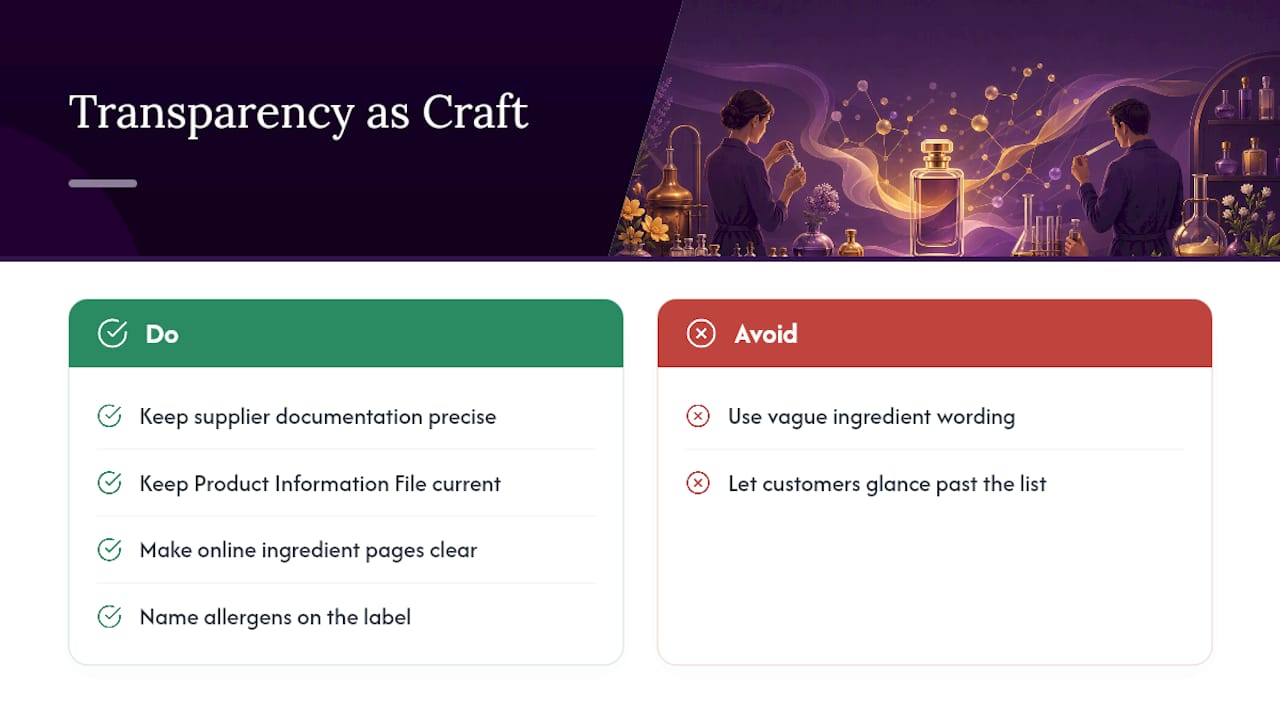
Our approach is to keep supplier documentation precise, our Product Information File current, and our online ingredient pages as clear as the label itself. We’d rather a customer read every name on that list and feel informed than glance past a vague word and feel nothing.
Naming an allergen doesn’t take away from the story. It just tells more of it. If you want to see how that transparency lives alongside craftsmanship, our full-size 100ml perfumes are composed with that balance in mind, priced at €69.99 each.
— Celeste
Primary Sources Worth Bookmarking
For the legal text and Annex III table, consult EUR-Lex. For practical labeling notes, see the European Commission’s guidance, the underlying Regulation 1223/2009, and AEMPS for Spain-specific summary guidance.
Sources
- Commission Regulation (EU) 2023/1545 of 26 July 2023 (EUR-Lex)
- AEMPS: The EU expands to 81 fragrance allergens to be labelled
- Guidelines on the “Fragrance Allergens” Requirements (Cosmeticseurope)
FAQ
What Are the EU Fragrance Allergens?
They’re the substances listed in Annex III to Regulation (EC) No 1223/2009, which must be individually named on a cosmetic label once they exceed a set concentration threshold. Following Commission Regulation (EU) 2023/1545, that list expanded to roughly 80 substances, with AEMPS counting 81.
What Are the 26 Fragrance Allergens?
The 26-allergen list is the original set introduced before the 2023 expansion and still commonly referenced in older industry checklists. It has since been superseded by the expanded Annex III list, so relying on the 26-allergen version alone now risks under-labeling a product.
What Are Common Allergens in Perfume?
Frequently encountered ones include linalool, limonene, citral, hexyl cinnamal, and farnesol, all naturally present in many essential oils as well as synthetic aroma chemicals. Each must be named individually on the label once it crosses the 0.001% threshold for leave-on products like perfume.
What Are the 14 EU Allergens?
There isn’t a distinct, currently recognized “14 allergens” list in EU cosmetics law; that figure doesn’t match the original 26-substance list or the expanded Annex III set of roughly 80. If you’ve seen this number elsewhere, it likely refers to a different regulatory context or an outdated summary, so the 26-allergen and expanded Annex III lists remain the ones to work from.
Does “Parfum” on a Label Mean Allergens Are Hidden?
No. “Parfum” or “aroma” can still appear as a general term for the fragrance blend, but any Annex III allergen present above threshold must still be listed by name alongside it. This rule applies whether the fragrance is synthetic or built from natural essential oils.
Les sept fragrances Maison Voyageur
- Manifesting · unisexe (69,99 €)
- Intuition · femme (69,99 €)
- Certainty · femme (69,99 €)
- Expansion · femme (69,99 €)
- Release · homme (69,99 €)
- Presence · homme (69,99 €)
- Inner Fire · homme (69,99 €)
Nouvelle ici ? Commence par le Discovery Set · les 7 fragrances en format voyage (40 €).