
Neroli in Perfumery: The Perfumer's Scent Map to Choose Your Style
Neroli is the steam-distilled essential oil of bitter orange blossom, a citrus-floral note prized for its fresh, green, honeyed radiance. Perfumers reach for it because it bridges the sharp citrus opening of a fragrance into the softer floral heart that follows. Once you learn its scent map, you stop guessing at what a bottle will do on your skin.
TL;DR:
- Neroli’s quality and character vary significantly based on region, with Tunisian and Moroccan oils tending to be greener and Italian and Spanish ones warmer.
- Steam-distilled neroli produces a brighter, citrus-forward oil, while solvent-extracted absolute offers a heavier, less transparent scent with more floral depth.
- On skin, neroli’s scent develops from a sharp citrus green to a honeyed floral with a faint bitter or metallic undertone that can last several hours.
- Pairing neroli with ingredients like bergamot and mandarin emphasizes its citrus freshness, while jasmine and rose highlight its floral sweetness, affecting overall scent personality.
- Concentration, pairing choices, and raw material quality are more impactful on fragrance character than gender marketing or bottle strength.
Table of Contents
- Neroli en Perfumería: Production and How It Differs From Orange Blossom and Petitgrain
- The Scent Profile: What Neroli Actually Smells Like on Skin
- Common Pairings and How They Shift Neroli’s Character
- Neroli for Men, Women, and Unisex: A Practical Buying Checklist
- Recognizing Neroli’s Commercial Archetypes
- What Actually Matters When You’re Choosing a Neroli Fragrance
- Sample Maison Voyageur’s Neroli Compositions
- Where to Read More on Neroli
- Sources
Neroli en Perfumería: Production and How It Differs From Orange Blossom and Petitgrain
The distillation method is what separates neroli from its botanical relatives, and it changes everything about how the oil smells. Steam passing through fresh bitter orange blossoms carries the volatile aromatic molecules upward, leaving behind the heavier, waxy compounds. The result is a lighter, brighter oil than orange blossom absolute, which is pulled from the same flower using solvents. Solvent extraction captures more of the flower’s indolic, waxy depth. Steam distillation leaves you with something cleaner and more citrus forward.
Petitgrain comes from the same tree entirely but from the leaves and twigs rather than the blossom. It shares neroli’s green backbone without the honeyed sweetness, which is why perfumers sometimes use petitgrain as a sharper, less expensive stand-in when a formula only needs the citrus green facet.
Yield explains the price gap between these three materials. Neroli oil requires a large quantity of orange blossoms for production, which keeps quality neroli firmly in the premium tier of raw materials. Sourcing region shapes the final character too:
- Tunisian and Moroccan neroli tends toward brighter, greener facets.
- Italian and Spanish oils often read rounder and warmer, depending on harvest timing and distillation conditions.
- Solvent-extracted orange blossom absolute delivers more weight and less transparency than steam-distilled neroli.
- Petitgrain offers a budget-friendly green top note without neroli’s floral sweetness.
The Scent Profile: What Neroli Actually Smells Like on Skin
Neroli opens sharp and citrus green, then settles into something warmer within minutes. The first impression is bright, almost sparkling, with a slightly bitter orange peel edge that keeps it from ever smelling saccharine. As it develops, a honeyed, waxy floral sweetness rises underneath, occasionally brushing against a faint soapy or metallic note that gives neroli its distinctive, slightly austere character. This is why it so often behaves as a heart note rather than a fleeting top note: it has enough staying power to anchor a composition through its middle stages.
That staying power comes from its chemistry. Linalool and limonene supply the bright, fresh lift you notice immediately. Linalyl acetate softens the sharpness with a pear-like roundness. Nerolidol and geraniol bring the woody, rosy depth that lets neroli linger well past the citrus fades, sometimes for two or three hours on skin.
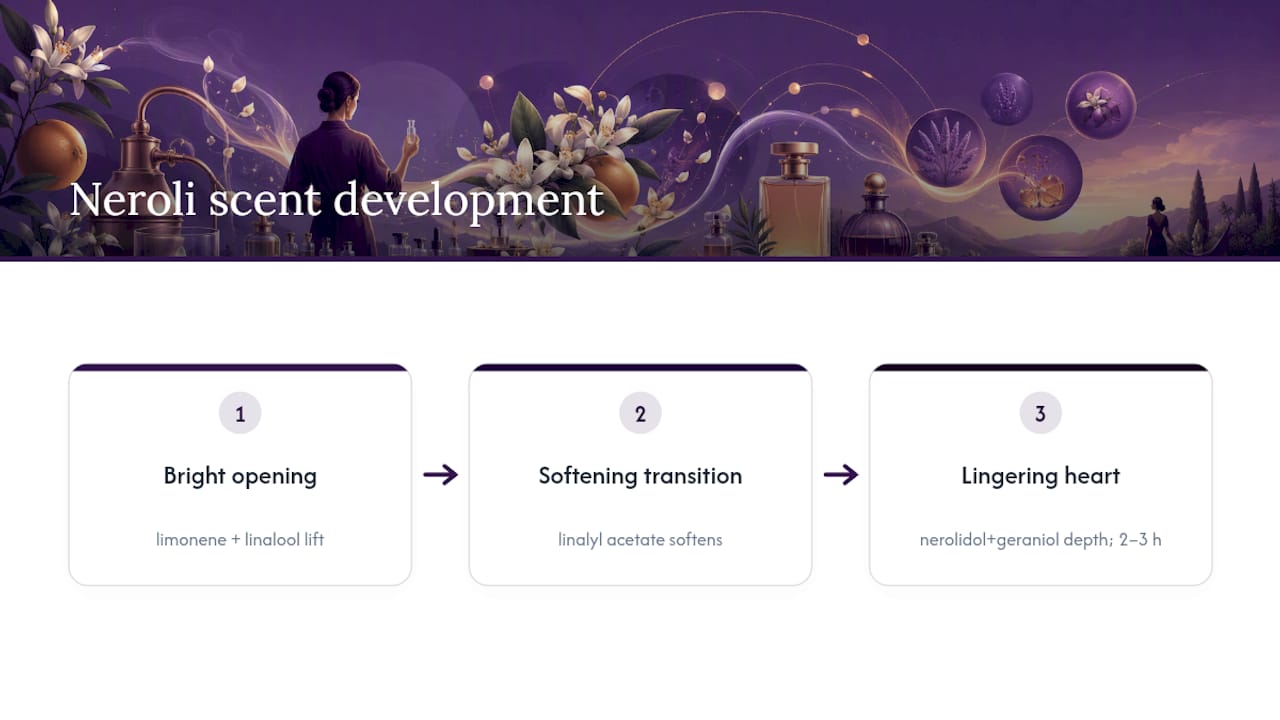
Pro Tip: Always test neroli on skin, not just a blotter. Paper shows you the bright top accord and little else. Skin chemistry reveals the honeyed, slightly bitter heart that only appears after the initial citrus burst evaporates.
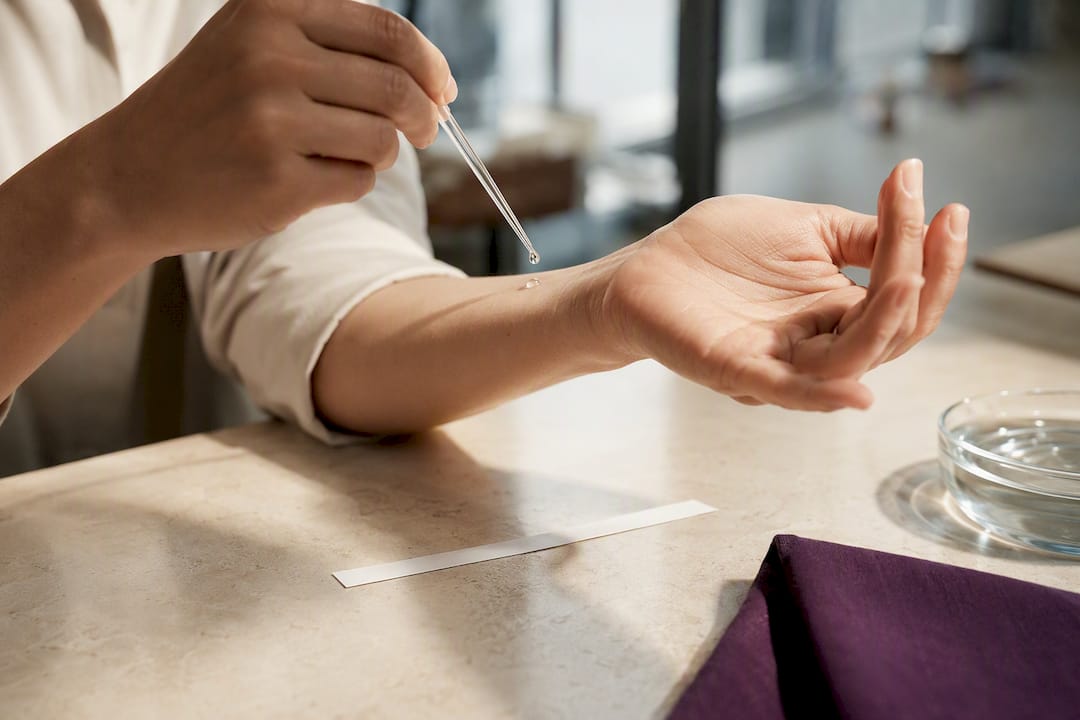
Neroli also contains terpenes that can cause sensitization in some people, so a small patch test is worth the ten minutes before committing to a full application.
Common Pairings and How They Shift Neroli’s Character
Neroli rarely works alone. What surrounds it in a formula decides whether it reads crisp, floral, or resinous.
- Bergamot, mandarin, and petitgrain sharpen neroli’s citrus edge, producing the bright, cologne-style opening found in most Mediterranean-inspired fragrances.
- Jasmine, orange blossom absolute, and rose pull neroli toward its floral honeyed facet, softening the bitterness and building a warmer heart.
- Musk, amber, and sandalwood extend neroli’s life on skin, turning a fleeting citrus flash into a fragrance that lasts through an evening.
- Vetiver and cedar add a green, woody undertone that keeps neroli from tipping into sweetness, which is common in more austere, clean-skin masculine styles.
Perfumers lean on these four directions constantly, because neroli’s own structure (bright top, honeyed middle, faint bitterness throughout) gives each pairing something distinct to amplify. A fragrance built mostly on the first pairing will smell nothing like one built on the third, even though both list neroli prominently.
Neroli for Men, Women, and Unisex: A Practical Buying Checklist
Neroli’s balance of green citrus and honeyed floral makes it genuinely gender-neutral. What changes the perceived masculinity or femininity of a fragrance isn’t the neroli itself. It’s the concentration and what surrounds it.
Cologne-style formulas use neroli at higher percentages with minimal floral support, producing a light, splashy, unisex freshness suited to daytime and warm weather. EDP-style formulas dial neroli back and build florals or ambers around it, creating a warmer, longer-lasting composition often marketed as feminine, though nothing about the raw material demands that framing.
Before buying, run through this short checklist:
- Apply to skin, not a card, and wait at least fifteen minutes before judging the drydown.
- Check whether the notes list leans citrus-forward (cologne style) or floral-forward (EDP style).
- Test in the season you’ll actually wear it. Neroli’s brightness performs differently in summer heat than in cold winter air.
- Give it a full afternoon before deciding, since the honeyed heart often only fully emerges after the citrus opening fades.
Recognizing Neroli’s Commercial Archetypes
Most fragrances built around neroli fall into a handful of recognizable styles, and learning to spot them on a notes list saves you from guessing blind.
- The Mediterranean cologne archetype: bergamot or mandarin up top, neroli and petitgrain in the middle, light musk beneath. Expect a splashy, citrus-forward scent that fades gracefully rather than lingers.
- The clean-skin masculine archetype: neroli paired with cedar, vetiver, and a whisper of amber. Reads soapy and fresh, with almost no sweetness.
- The warm floral EDP archetype: neroli layered under jasmine, orange blossom, and a soft musk or sandalwood base. This version leans feminine in marketing, but the underlying structure is close cousin to the cologne style with more sweetness added.
- The niche translucent archetype: neroli used sparingly at lower concentration, often alongside unusual pairings like herbs or green tea, aiming for subtlety over projection.
Testing on skin remains the only reliable way to confirm which archetype you’re actually smelling, since a notes list can hint at structure without capturing the balance a perfumer chose.
What Actually Matters When You’re Choosing a Neroli Fragrance
Most guides treat neroli as a single fixed smell, as if every bottle labeled with it delivers the same experience. That’s the biggest gap between the conventional advice and what your nose will actually tell you. The concentration, the pairing direction, and the extraction quality of the raw material shift the outcome more than any gender label on the box ever will.
The real skill worth building is patience on skin. Give a neroli fragrance fifteen minutes before judging it, then check back an hour later. The bitter, honeyed heart that makes this note worth seeking out only shows up once the citrus opening has done its job and stepped aside.
If there’s one piece of overrated advice floating around, it’s the idea that a “stronger” neroli is always better. Concentration without balance just gets soapy fast. What separates a forgettable citrus splash from a fragrance you’ll reach for again is restraint in the blending, not raw intensity.
— Celeste
Sample Maison Voyageur’s Neroli Compositions

If you want to experience how neroli behaves against these specific pairings before committing to a full bottle, discovery sets and sample sizes make that possible without the cost of a standard bottle. Each scent is composed in small batches rather than mass-produced, which means the neroli you smell in a sample reflects the same grade and blending process used in the full-size version. Visit the Maison Voyageur collection to browse the current neroli-forward compositions and request a sample set for the style that matches your skin’s chemistry.
Where to Read More on Neroli
- Neroli overview: extraction method and botanical background.
- Neroli in perfumery: chemical constituents and compositional role.
- Neroli oil uses: aromatherapy applications and cost factors.
- Neroli fragrance notes: commercial fragrance examples featuring neroli.
Sources
Grade selection matters more than most shoppers realize; a stylish accessory like a κολιε με charms Nimola can perfectly complement the fresh and radiant vibe inspired by neroli’s essence. A cheaper neroli can smell technically correct while lacking the translucent quality that makes the note feel alive rather than flat.
Maison Voyageur looks for a neroli that keeps its honeyed brightness without tipping soapy, then builds slowly around it with Mediterranean materials, olive leaf for a green quiet undertone, rosemary for herbal lift, cedar for a woody floor that lets the neroli stay legible for hours instead of vanishing after the first twenty minutes.
That slow approach costs more time than mass-market blending, but it preserves the nuance a rushed formula tends to flatten. Maison Voyageur’s compositions favor transparency over sheer projection, letting neroli’s natural character lead rather than burying it under synthetic fixatives.
- Neroli — Wikipedia
- Neroli in perfumery — The Sniff Test
- Neroli oil overview — Healthline
- Neroli — Fragrantica (notes page)
Les sept fragrances Maison Voyageur
- Manifesting · unisexe (69,99 €)
- Intuition · femme (69,99 €)
- Certainty · femme (69,99 €)
- Expansion · femme (69,99 €)
- Release · homme (69,99 €)
- Presence · homme (69,99 €)
- Inner Fire · homme (69,99 €)
Nouvelle ici ? Commence par le Discovery Set · les 7 fragrances en format voyage (40 €).