
Best Natural Perfume Brands: Why 98% Natural Matters and What to Check
Maison Voyageur stands out among natural perfume brands for one clear reason: natural-forward ingredients, composed slowly in Madrid rather than rushed through a mass-market lab. This guide shows you how to verify any brand’s natural claims, decode the certifications that actually matter, and match a formulation style to how you want to feel wearing it.
TL;DR:
- Natural perfume labels claiming high percentages should be supported by detailed ingredient disclosures and explanations of any remaining additives.
- Verify certifications like EWG, Cradle to Cradle, and Cruelty Free International through their official registries rather than relying solely on branded badges.
- Expect botanical-only formulas to be more delicate and variable, with faster scent evolution, compared to blends that include safe synthetics or fixatives for longevity.
- Refillable packaging reduces waste significantly, but only if specific environmental claims are supported by transparent information on material percentages and refill availability.
- Maison Voyageur emphasizes ingredient transparency, slow crafting, and Mediterranean-inspired botanicals, fitting the conscious-luxury profile for natural fragrances.
Table of Contents
- What Are the Best Natural Perfume Brands for Different Buyers?
- What Should You Check Before You Buy a Natural Perfume?
- What Does “Natural” Actually Mean in Perfumery?
- How Do You Verify Certifications on Natural Perfume Labels?
- Which Ingredients Should You Avoid in Perfume, and What’s Safer?
- Does Sustainable Packaging Actually Reduce Waste?
- How Much Should You Pay for a Natural Perfume?
- Why Maison Voyageur Fits the Conscious-Luxury Natural Perfume Category
- A Personal Note on Wearing Natural Fragrance
- Start Your Discovery With Maison Voyageur
- Where to Verify Natural Perfume Claims Yourself
- Sources
What Are the Best Natural Perfume Brands for Different Buyers?
Not every natural perfume shopper wants the same thing. Some want a conscious-luxury piece that feels like a ritual. Others want a refill system that keeps glass out of landfills. Others just want something clean enough to wear without a headache, at a price that doesn’t sting. Here’s how to shop each lane.
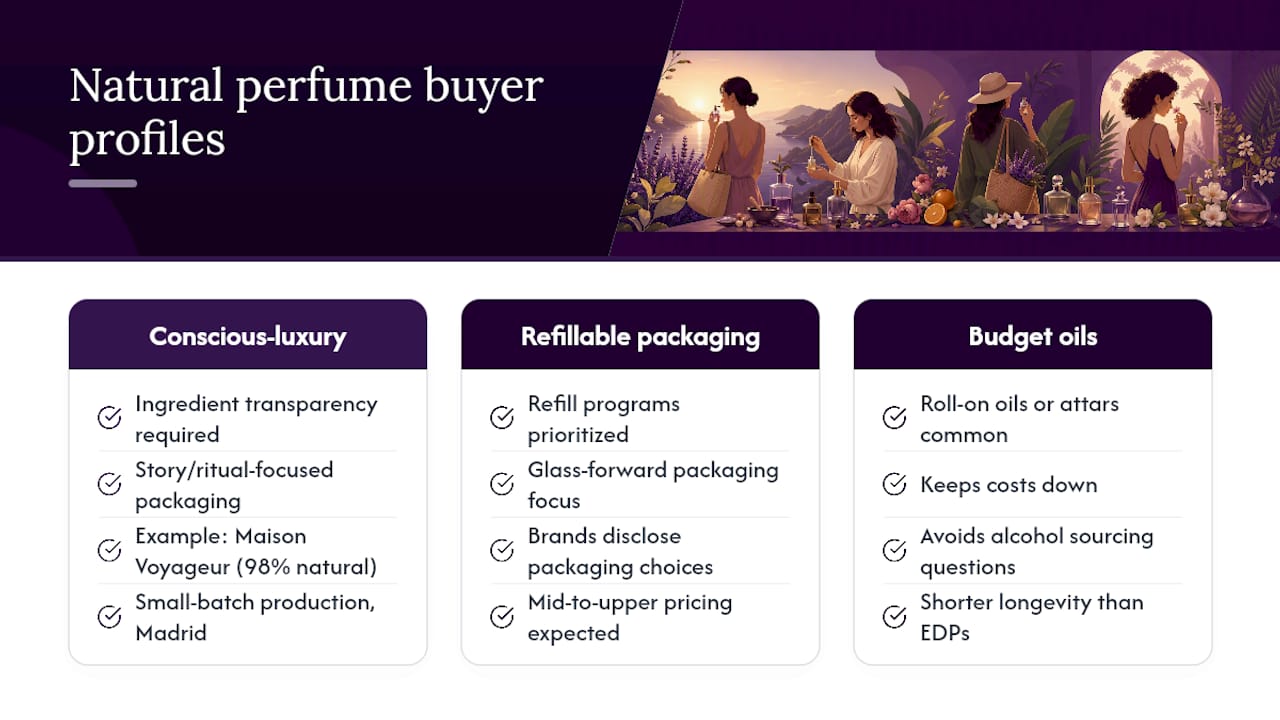
For the conscious-luxury buyer. You want ingredient transparency and a story behind the bottle, not just a spray. Look for brands that publish their percentage of natural ingredients rather than hiding behind the word “natural” on the label alone. Maison Voyageur fits this profile directly: each fragrance is built around 98% natural ingredients, composed in small batches in Madrid with a Mediterranean sensibility that favors citrus peels, resins, and warm woods over synthetic shortcuts. Expect a higher price point, slower production, and a scent that shifts subtly over the day, since that’s what real botanical material does.
For the refillable and sustainable-packaging buyer. Your priority is what happens to the bottle after the perfume runs out. Refill programs and glass-forward packaging matter more here than the ingredient list alone, though the two often travel together. Expect mid-to-upper pricing, since refill infrastructure costs more to build than a one-and-done bottle, and expect brands to talk openly about their packaging choices on their product pages.
For the budget natural-oils buyer. You’re likely looking at roll-on oils or attars rather than alcohol-based sprays, which keeps costs down and sidesteps questions about alcohol sourcing entirely. Expect shorter longevity and lighter sillage compared with a composed eau de parfum, since oils don’t project the same way alcohol-based formulas do. This tier is a reasonable entry point if you’re new to natural fragrance and want to sample a nose’s style before committing to a full bottle.
The throughline across all three profiles: whoever you buy from should be willing to show you what’s actually in the bottle, not just tell you it’s “natural.”
What Should You Check Before You Buy a Natural Perfume?
Most natural perfume shopping mistakes happen before checkout, when a shopper trusts a label instead of reading past it. Run through this checklist on any product page before you spend your money.
- Look for the full INCI list. A legitimate natural perfume brand publishes its International Nomenclature of Cosmetic Ingredients list, not just a marketing summary. If a brand only says “natural fragrance blend” with no breakdown, that’s a gap worth questioning.
- Check the percent-natural claim against specifics. A brand claiming “98% natural” should be able to tell you what the remaining 2% is and why it’s there, often a fixative or stabilizer that keeps the scent performing consistently.
- Scan for allergen labeling. Natural doesn’t mean allergen-free. Essential oils like limonene, linalool, and citral occur naturally but still trigger reactions in sensitive skin, so they should appear on the label regardless of source.
- Confirm the alcohol source. Most eau de parfum formulas rely on alcohol as a carrier. Ask whether it’s derived from grain or synthetic sources, since this affects both purity claims and suitability for some religious or dietary preferences.
- Note the place of manufacture. Artisanal batches made in-house differ meaningfully from white-label formulas bottled overseas and rebranded. Both can be legitimate, but only one supports a “slow craft” story.
Beyond the product page, contact the seller directly with a short list of questions: Do you offer a refill option? Has this batch been tested by a third party? Can you name your ingredient suppliers? A brand confident in its sourcing answers these without deflecting.
Precision about the small stuff usually signals honesty about the big stuff.*
Watch for red flags that justify real skepticism: a fragrance priced far below the category average while claiming full botanical sourcing, product copy that never mentions a single named ingredient, or a brand that can’t point you to any certification registry when asked.
What Does “Natural” Actually Mean in Perfumery?
The word “natural” covers a wider range of formulas than most shoppers assume, and that range affects how a fragrance performs on your skin. Roughly three categories dominate the natural perfume space right now.

100% botanical perfumes use only plant-derived materials: essential oils, absolutes, resins, and tinctures, with no synthetic molecules at all. These tend to be more delicate, evolve faster on skin, and sometimes shift color or scent slightly batch to batch because they depend on harvest variability, a trait that artisan perfumers describe as a mark of authenticity rather than a flaw.
Industry roundups note that many respected eco brands intentionally include safe synthetics rather than claiming 100% botanical, partly because some rare botanicals face supply pressure and a lab-made alternative protects the plant.
Clean blends minimize a specific list of flagged chemicals without claiming a high natural percentage overall. These prioritize what’s excluded over what’s included.
Longevity and sillage generally scale with formulation complexity. Pure botanical scents fade faster and project less. Natural-forward blends with careful fixatives tend to last longer on skin. A synthetic musk or fixative, used deliberately, can sometimes be the more sustainable and skin-safe choice than the natural alternative it replaces, particularly when the natural version is an endangered or over-harvested material.
How Do You Verify Certifications on Natural Perfume Labels?
A seal on a bottle means nothing if you don’t know what it actually tests for. Here’s what the major certifications in natural and eco-friendly perfume actually cover, and how to check that a brand’s claim is real.
- EWG maintains an ingredient safety database that lets you look up individual chemicals and see how they’re graded for hazard concerns. It doesn’t certify whole products, so you’re checking ingredients one at a time, not scanning for an EWG logo on a bottle.
- Cradle to Cradle certification evaluates a product’s material health and circularity, meaning how recyclable or compostable its components are. You can verify a specific product listing on the C2C registry rather than trusting a printed badge alone.
- Leaping Bunny and similar cruelty-free certifiers confirm that a brand and its suppliers don’t conduct animal testing anywhere in the supply chain. Cruelty Free International’s registry lets you cross-check a brand name directly, which matters because “cruelty-free” and “vegan” are different claims that sometimes get conflated on packaging.
- Retailer clean-fragrance programs, like Sephora’s Clean + Planet Aware standard, exclude a defined list of ingredients but vary by retailer and shouldn’t replace checking the brand’s own ingredient list.
No single seal covers safety, circularity, and animal welfare at once, so cross-checking more than one registry gives you a fuller picture than trusting any single logo.
Which Ingredients Should You Avoid in Perfume, and What’s Safer?
Conventional perfume formulas have historically leaned on a handful of ingredients that natural and clean-focused shoppers now actively screen out.
Phthalates, especially diethyl phthalate, are commonly used to help scent last longer but have raised enough health questions that many clean-fragrance programs exclude them outright. Certain synthetic musks, particularly some nitro and polycyclic musks, have drawn similar scrutiny for how they accumulate in the body over time. Formaldehyde releasers show up in some fragrance stabilizers and are a known trigger for skin sensitization in a subset of users. And the single biggest red flag on any label is the word “fragrance” or “parfum” listed alone, with nothing underneath it, since that single word can legally hide dozens of unlisted compounds.
Safer alternatives exist for most of these functions: naturally derived fixatives like benzoin or labdanum resin can replace synthetic musks for hold, and brands that publish a full INCI list instead of a blanket “fragrance” entry give you the ability to actually screen for what concerns you personally.
Reading an INCI list takes a little practice. Ingredients are listed by concentration, highest to lowest, which means allergens buried near the bottom of a long list are present in smaller amounts than ones near the top. EWG’s Skin Deep database is a useful tool for looking up unfamiliar ingredient names one at a time.
Whatever you choose, patch-test a new fragrance on your inner forearm and wait 24 to 48 hours before applying it more broadly, especially if you have sensitive skin or a history of fragrance reactions.
Does Sustainable Packaging Actually Reduce Waste?
Packaging claims are where a lot of natural perfume marketing gets vague fast, so it helps to know what actually moves the needle.
Refill systems let you keep the outer bottle and just replace the fragrance inside, which cuts glass and cap production per use far more than a bottle you toss and repurchase each time. Recyclable glass components help too, but only if the local recycling infrastructure actually processes them, which varies more than most packaging claims admit. Disposable plastic components, like caps or pumps not built for reuse, undercut both approaches regardless of what the glass around them claims.
A refill program generally has a larger environmental impact than a “recyclable” sticker on a bottle you’re expected to throw away, because refill reduces the number of new components manufactured in the first place rather than just changing what happens to them afterward.
To verify a packaging claim is real rather than marketing gloss, check whether the brand states specific numbers: what percentage of a bottle’s material is recycled, whether the refill option is actually available at checkout, and whether the packaging supplier is named anywhere. Vague language like “eco-conscious packaging” with no specifics is worth treating with the same skepticism as a vague ingredient list.
How Much Should You Pay for a Natural Perfume?
Price in this category tracks formulation and packaging choices more directly than in mass-market fragrance, so understanding what you’re paying for helps you spot both fair value and overpriced marketing.
- Under $30, expect roll-on oils, attars, or small-batch indie blends with shorter longevity and simpler packaging.
- $30 to $80, expect natural-forward eau de parfum formulas from established niche brands, often with recyclable glass and moderate lasting power.
- $80 and above, expect artisanal, slow-crafted compositions with higher natural-ingredient percentages, refill options, and more complex sourcing, the tier where Maison Voyageur sits.
Buy with confidence by starting small: discovery sets and travel sizes let you test how a scent evolves on your specific skin chemistry before committing to a full bottle, and reputable direct-to-consumer brands typically offer this path rather than pushing full-size purchases upfront. Be skeptical of any brand claiming a high natural percentage at a price point that undercuts the category by half or more.
Why Maison Voyageur Fits the Conscious-Luxury Natural Perfume Category
Maison Voyageur is a Mediterranean perfumerie based in Madrid, built around a simple premise: fragrance should feel like a moment of introspection, not a quick spritz on the way out the door.
That slow-craft process maps directly onto the checklist covered above. Ingredient transparency isn’t an afterthought here; it’s built into how each fragrance is described and sold, giving you a clearer basis for evaluating the formula than a vague “natural fragrance blend” claim. The Mediterranean influence shows up in the raw materials themselves, citrus peels, resins, warm woods, the kind of botanical palette that rewards patience rather than instant projection.
For buyers in the conscious-luxury profile described in the shortlist above, this is the natural fit: you’re not just buying a scent, you’re buying into a slower relationship with fragrance, one built for reflection rather than a quick sensory hit. Discovery sizes and curated sets make it possible to experience that approach before committing to a full bottle, which matters given the sampling guidance covered earlier in this piece.
A Personal Note on Wearing Natural Fragrance
Apply natural perfume to pulse points, warm skin holds scent better than fabric, and give it a few minutes before judging the opening notes; they shift. Store bottles away from direct light and heat, since botanical material degrades faster than synthetic fragrance under both.
That variability unsettled me at first. Now I read it as proof the ingredients are real.
— Celeste
Start Your Discovery With Maison Voyageur

If you’ve read this far, you already know what to look for: transparency, a real ingredient list, and a formula that doesn’t cut corners to hit a lower price point. That’s the standard Maison Voyageur was built around, from its Mediterranean-inspired compositions to its slow-crafted small batches. Rather than guessing whether a bottle fits your skin and your values, start with a discovery set or travel size and experience how the scent evolves over a few wears before committing to a full bottle. Visit the Maison Voyageur collection to explore available sets, sizes, and gifting options, and find the composition that matches the profile you identified earlier in this guide.
Where to Verify Natural Perfume Claims Yourself
Check ingredient safety directly through EWG’s database, confirm packaging circularity through the Cradle to Cradle registry, and cross-reference animal-testing claims via Cruelty Free International. For a retailer-level view of clean-fragrance standards, browse Sephora’s Clean fragrance program. For broader context on sustainability standards worth applying to any purchase, this practical sustainability guide is a useful companion resource.
Sources
Les sept fragrances Maison Voyageur
- Manifesting · unisexe (69,99 €)
- Intuition · femme (69,99 €)
- Certainty · femme (69,99 €)
- Expansion · femme (69,99 €)
- Release · homme (69,99 €)
- Presence · homme (69,99 €)
- Inner Fire · homme (69,99 €)
Nouvelle ici ? Commence par le Discovery Set · les 7 fragrances en format voyage (40 €).