
Maceration in Perfumery: Why Weeks Deepen Resin and Wood Scents
Maceration in perfumery is the controlled resting step that lets oils and alcohol fuse so a fragrance feels balanced, lasts longer, and loses its harsh alcohol edge. In production, it typically runs from several weeks, though some artisanal houses stretch it far longer. Skip it, and a perfume smells sharp, thin, disjointed. Give it time, and the notes settle into something coherent, something closer to memory than chemistry.
TL;DR:
Factory maceration typically lasts several weeks, during which molecules homogenize, oxidize, and slow-react, especially for resins, woods, and heavy absolutes.
Longer resting times significantly improve resin-heavy and woody fragrances, often requiring weeks to months, whereas citrus and green notes need less time to develop fully.
At home, perfume maturation involves light oxygenation and proper storage, with notable improvements usually appearing after one to three months.
Maceration in perfumery refers to formula blending and aging, not extraction techniques like enfleurage or distillation, which are separate processes.
Natural ingredients like resins, woods, and absolutes benefit from slow, deliberate aging that can take far longer than factory schedules to achieve depth and complexity.
Table of Contents
What Maceración en Perfumería Actually Means
Maceración en perfumería is not one thing. It is two related but distinct practices, and confusing them is where most misunderstandings about “letting a perfume rest” begin.
Industrial maceration is a mandatory, controlled step inside a factory or lab. Perfume oils, alcohol, water, and fixatives get blended, then sealed inside stainless steel tanks for a defined resting period before filtration and bottling. It is a mandatory, controlled step. Josep Feliú of Academia del Perfume describes it as a stage that has to adapt to the final product form. A liquid perfume, a cream, and a shower gel each need their own maceration approach.
Maceration adapts the fragrance to what it is becoming, whether that final form is an eau de parfum, a cream, or a gel. The process changes with the product.
What consumers call “maceration” after buying a bottle is really maturation. It is real, it helps, but it works differently and on a slower, gentler curve than what happens in a production tank.
The Production Workflow, Step by Step
A factory maceration cycle follows a fairly consistent sequence, even when the timeline shifts by brand and formula.
-
Blending. Perfume oils, ethanol, water, and fixatives are combined in exact ratios according to the formula.
-
Sealing. The mixture goes into a closed tank or vessel, shielded from light and temperature swings.
-
Resting. The batch sits, often for several weeks, while molecules disperse and integrate.
-
Sampling. Technicians check the scent periodically, watching for balance rather than a fixed calendar date.
-
Filtration and chilling. The batch is cold filtered to remove sediment before bottling.
-
Final aging. Some formulas rest again briefly after filtration to smooth any disruption from that step.
Some perfumers extend the resting phase beyond the factory average and use sensory checks instead of strictly timed schedules. A resin-heavy composition might get sampled every few days for a month, with adjustments made by nose rather than by schedule.
The Chemistry Behind Why Scent Changes
Three things happen inside that sealed tank, and each one reshapes how the fragrance will eventually smell on skin.
-
Homogenization. Oil molecules disperse evenly through the alcohol, and the different volatility rates of top, heart, and base notes start sorting themselves into a coherent structure instead of competing all at once.
-
Controlled oxidation. Limited oxygen exposure softens sharp top notes and slowly reveals what the base notes were hiding underneath.
-
Reaction speed. Temperature, solvent ratio, and oxygen exposure all speed up or slow down how fast this integration happens.
Pro Tip: Heavy naturals, resins, woods, dense absolutes, need more time simply because their molecules are larger and slower to disperse through alcohol. A citrus-forward eau de toilette reaches equilibrium fast. A resin-driven extrait does not. Industry observation across multiple perfumery houses consistently points to woody and resinous compositions showing the most noticeable improvement the longer maceration runs, because those heavier molecules take longer to find their place in the blend.
Which Ingredients Need the Most Time
Not every raw material benefits equally from a long rest, and knowing which ones do helps set realistic expectations.
-
Resins and balsams (myrrh, benzoin, labdanum): often benefit from weeks to months of maceration since their thick molecular structure integrates slowly.
-
Woods and spices (sandalwood, cedar, clove, cardamom): typically fall into the multi-week range, showing clear improvement between the second and sixth week.
-
Absolutes (jasmine, rose, tuberose): tend to reward patience, deepening in richness the longer they rest.
-
Citrus and green notes: need far less time and risk flattening or losing brightness if left to macerate too long.
Concentration matters too. An extrait de parfum, dense with oil, generally macerates longer than an eau de toilette. Factory averages cluster around several weeks, but niche and artisanal producers regularly push past that window when the formula calls for it.
Maturing a Perfume at Home: A Safe Method
Once a bottle leaves the factory, the real maceration work is finished, but the fragrance can still shift and soften with proper care. This is maturation, not production-stage maceration, and it follows a gentler protocol.
-
Oxygenate lightly. Spray the perfume several times into open air rather than onto skin. This introduces a small amount of oxygen that can help the fragrance settle.
-
Store it right. Keep the bottle in its original box, in a cool, dark, stable spot. Avoid bathrooms, windowsills, and anywhere near heat or direct light.
-
Wait and test. Check the scent at the one-month and three-month marks. A rounder, less alcohol-forward opening is the signal it is working.
Pro Tip: If a perfume already smells balanced out of the box, leave it alone. Not every fragrance needs extra time, and over-aging citrus or aquatic compositions can flatten what made them appealing in the first place.
Do not attempt this with vintage or already-oxidized bottles showing discoloration. That is degradation, not maturation, and no amount of patience reverses it.
Maceration vs. Extraction: Not the Same Process
People often lump every “getting scent from plants” technique into one category, but maceration plays a completely different role than the methods that actually pull aromatic material out of raw ingredients.
-
Enfleurage and solvent extraction pull aromatic compounds out of flowers or raw materials, they are extraction techniques, not blending steps.
-
Steam distillation produces essential oils by separating volatile compounds from plant matter using heat and vapor, a different goal entirely from resting a finished formula.
-
Maceration happens after those raw materials are already sourced. It is a formula-level blending and aging step, not a way of harvesting scent from anything.
Confusing the two leads to a strange assumption: that macerating longer somehow extracts more fragrance. It does not. It only integrates what is already in the bottle. For readers curious about how formulation choices affect a finished scent more broadly, aromatherapy-focused formulation guides offer a useful parallel view from a different corner of scent crafting.
The Slow Approach: How an Artisanal House Treats Rest
Speed is easy. Depth is not.
Natural absolutes and woods do not integrate on a factory clock. They integrate on their own. That means longer tanks, more sensory checks, more waiting before a batch is called finished, not because a calendar says so, but because the scent itself says so.
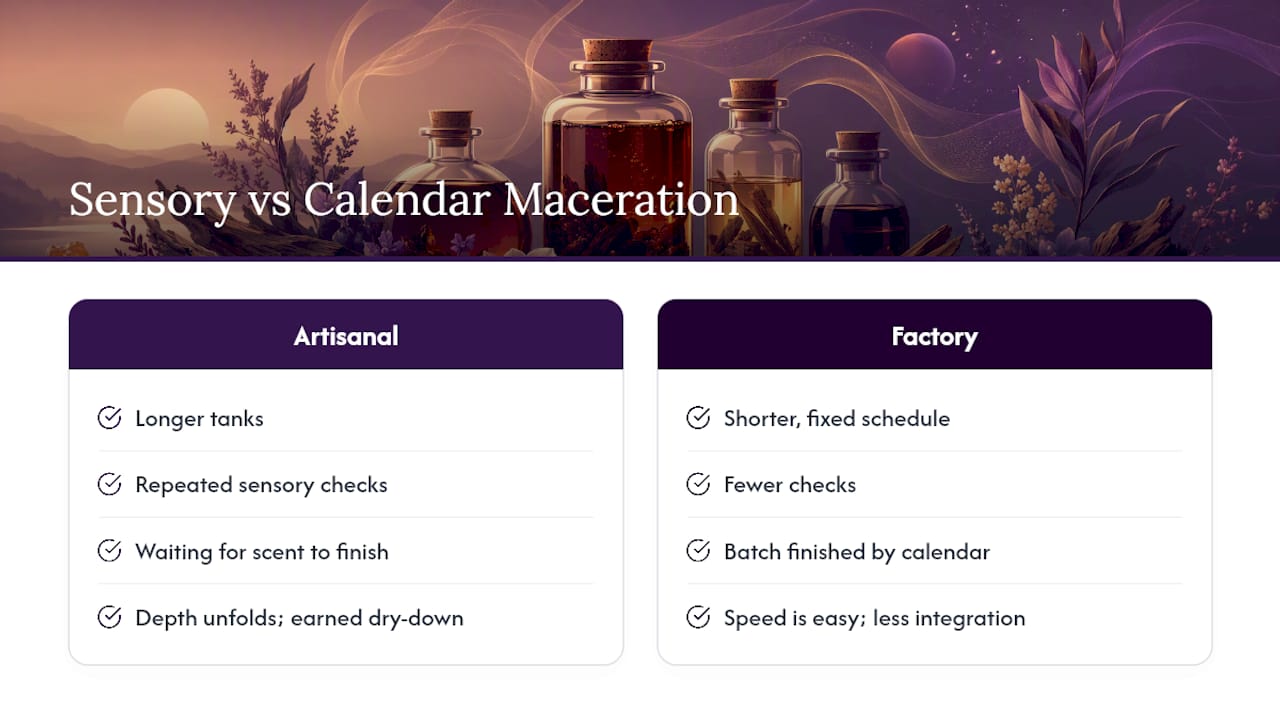
What should you look for when choosing an artisanal perfume? Depth that unfolds rather than announces itself. A dry-down that feels earned. That is what slow maceration gives a fragrance, and it is worth seeking out.
Why the Rush to Wear a New Perfume Misses the Point
The conventional advice treats maceration as a single fact to memorize: wait a few weeks, spray it in the air, done. That is not wrong, but it flattens a process that is genuinely two different things wearing one name.
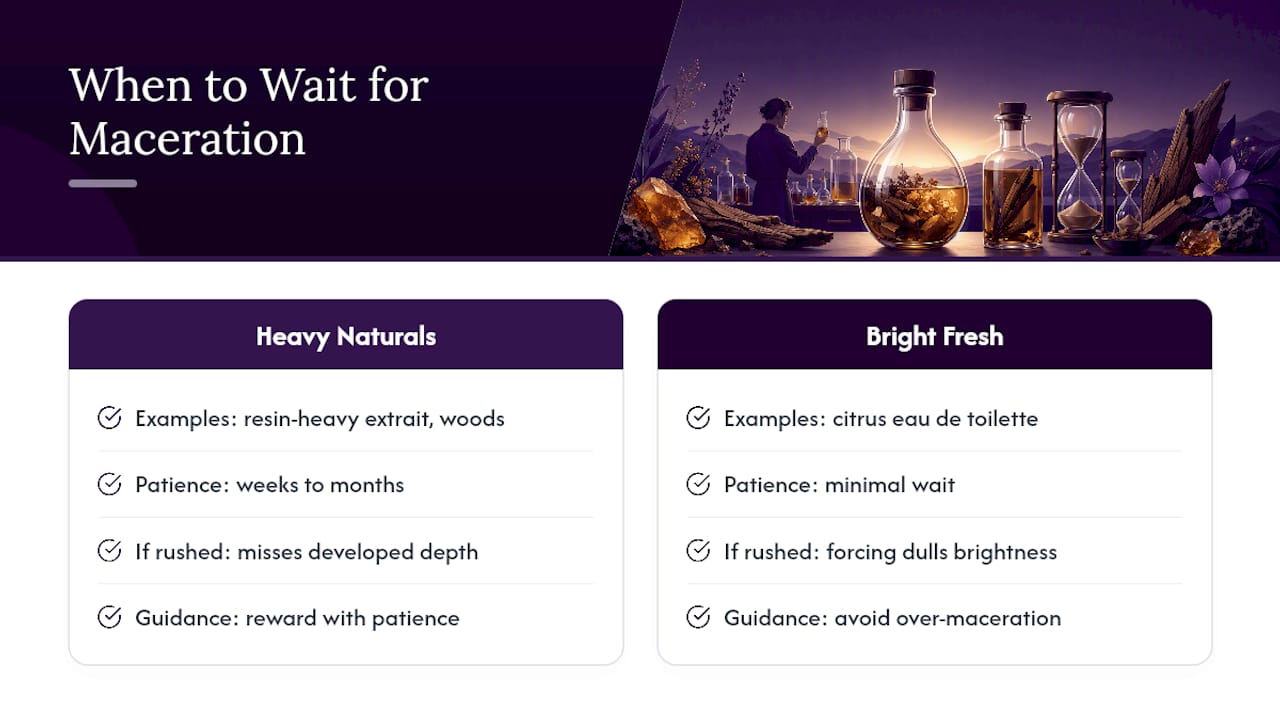
What gets underestimated is how much the ingredients themselves dictate the timeline, not some universal rule. A citrus eau de toilette and a resin-heavy extrait have nothing in common in terms of patience required, yet most guides treat them identically.
If there is one thing worth prioritizing, it is this: stop asking “how long should I wait” and start asking “what is actually in this bottle.” Heavy naturals reward patience. Bright, fresh compositions do not need much of it, and forcing it can dull them. The houses that understand this difference, rather than applying one rule to every formula, are the ones producing fragrances that feel like they were made for a person to sit with, not just spray and forget.
— Celeste