
Immersive Fragrance Experiences: 9 Standout Examples
Immersive fragrance experiences are defined as multi-sensory environments that integrate scent, sound, and spatial design to evoke deep emotional and introspective responses. This category, known in the industry as experiential perfumery or olfactory scenography, has moved well beyond retail counters. L’Oréal Luxe’s partnership with DATALAND museum in Los Angeles and Francis Kurkdjian’s Playing with Fire odyssey represent the current frontier. Scent is no longer a passive product. It is an active media strategy that turns fragrance into narrative, memory, and shared experience.
1. What are the best examples of immersive fragrance experiences?
The most compelling examples of immersive fragrance experiences share one quality: they make scent the protagonist, not the backdrop. Each of the following formats does that in a distinct way.
2. DATALAND museum’s responsive olfactory installation
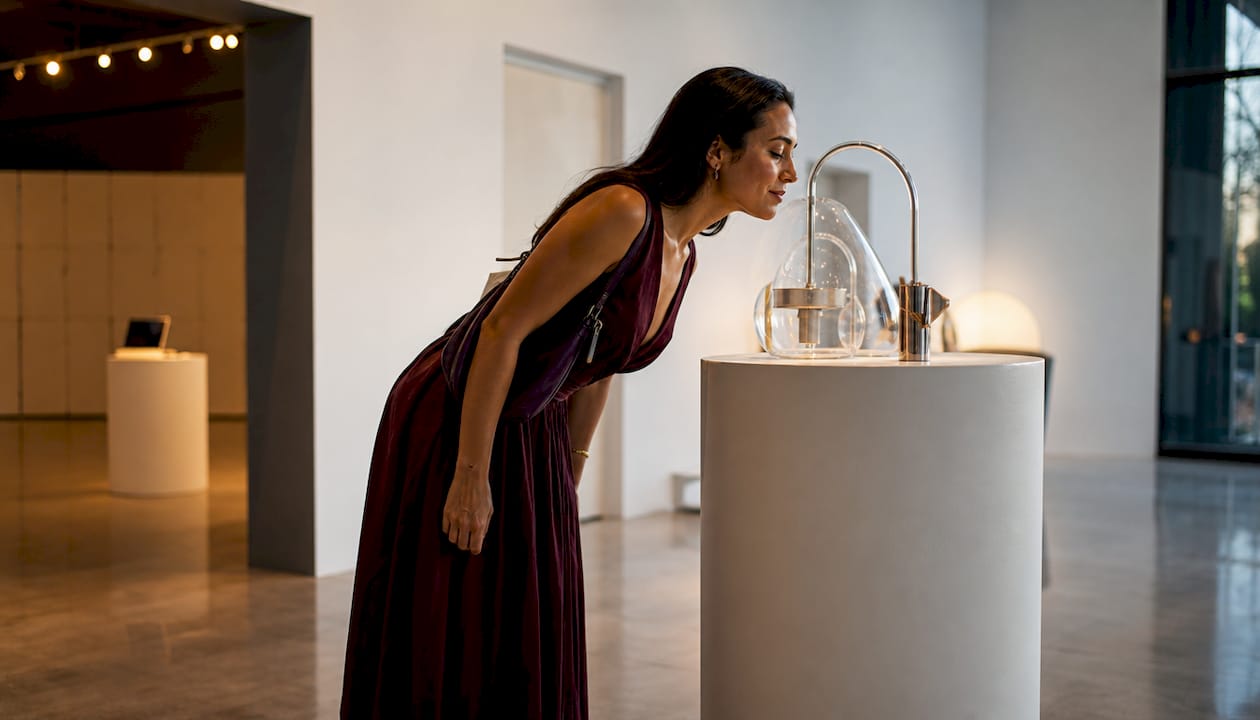
DATALAND museum in Los Angeles offers one of the most technically ambitious olfactory art experiences currently running. The 25,000 square foot space houses Machine Dreams: Rainforest, a display rendered in 1.5 billion pixels, with 12 avant-garde scents diffused in real time as visitors move through the space. Smart diffusers respond to visitor presence, releasing specific accords at precise moments. The result is a living olfactory score that changes with the crowd. This format proves that scent can function as a dynamic, data-driven art medium.
3. Francis Kurkdjian’s Playing with Fire odyssey
Playing with Fire is an 8-part olfactory score composed by Francis Kurkdjian and synchronized with live piano performed by Yuja Wang. The experience toured from november 2025 through may 2026, with stops at the Musée de la Musique in Paris and international venues. Visitors wore VR headsets while fragrance was released in timed sequences aligned with the music. Each of the eight movements corresponded to a distinct emotional register. The experience is the clearest existing proof that fragrance and music share a compositional grammar.
Pro Tip: If you attend a multi-sensory scent event, arrive early. The first visitors experience the full olfactory arc before the room’s ambient scent builds up and blurs individual notes.
4. BDK Parfums’ synesthetic gallery
BDK Parfums created an ephemeral gallery that applied synesthesia directly. The scent and dessert pairing format placed curated pastries alongside each fragrance, so visitors tasted a flavor that mirrored the scent’s emotional character. A coffee shop atmosphere anchored the space, making the experience feel intimate rather than clinical. Guests could also personalize their fragrance selection based on the sensory pairings they responded to most. This format works because taste and smell share the same neural pathway, making the pairing feel instinctive rather than contrived.
5. How technology and space deepen scent experiences
Spatial scenting is the practice of designing a room’s olfactory atmosphere the way a set designer builds a stage. Sophisticated diffuser systems use polymer gel cartridges concealed within décor elements, so the hardware never interrupts the visual narrative. Presence detectors trigger scent release when a visitor enters a specific zone, creating a personalized olfactory moment without any visible mechanism. Experts consistently advise hiding delivery hardware to preserve the emotional integrity of the experience. When the technology is invisible, the scent feels like a natural property of the space itself.
Complex accords, such as damp earth, smoky wood, or marine salt, give a room volume and substance. These notes read as environmental rather than perfumed, which is exactly the effect olfactory scenographers aim for. The goal is not to make a room smell like a perfume counter. The goal is to make it feel like a place that exists nowhere else.
Pro Tip: When designing a scented space at home, choose one anchor accord, such as cedarwood or vetiver, and layer a single complementary note on top. Two well-chosen scents create depth. Three or more compete.
| Design element | Function in immersive scent environments |
|---|---|
| Polymer gel cartridges | Deliver consistent scent without visible hardware |
| Presence detectors | Trigger scent release based on visitor location |
| Complex accords | Create environmental depth rather than perfume-counter effect |
| Concealed diffusers | Preserve visual and emotional immersion |
| Timed scenography | Align scent release with narrative or musical arc |
6. The sensory overload problem
Scent variety has a hard limit in immersive settings. The Sensory Odyssey exhibition in 2022 found that visitors identified a maximum of 7 scents out of 21 used. That finding reshaped how curators approach olfactory programming. More scents do not create a richer experience. They create confusion. The most effective immersive exhibits now limit their fragrance palette to around seven distinct notes, each assigned a clear emotional or narrative role. Restraint is the defining discipline of serious olfactory scenography.
7. What role do sound and taste play in scent experiences?
Multi-sensory integration is not decorative. It is functional. Research from early 2026 shows that tailored soundscapes increase fragrance purchase intent by nearly 60% in online settings. That figure reflects something deeper than marketing effectiveness. It shows that scent perception itself changes when sound is present. The brain does not process senses in isolation. When sound and smell arrive together, they reinforce each other’s emotional signal.
The most effective multi-sensory formats combine:
- Synchronized music: High-definition piano scores aligned with fragrance composition, as in Playing with Fire, where each musical phrase introduced a new olfactory note.
- Curated taste pairings: Desserts or beverages chosen to mirror a fragrance’s dominant accord, activating the shared neural pathway between taste and smell.
- Lighting design: Warm or cool light that shifts with the scent’s emotional register, reinforcing the mood without competing with it.
- Textural elements: Surfaces and materials that echo the fragrance’s character, such as raw linen for green notes or polished stone for aquatic accords.
Synesthesia in fragrance exhibits deepens sensory memory by activating multiple senses simultaneously. A scent experienced alongside music and taste is encoded more richly than a scent experienced alone. That encoding is what makes immersive fragrance events feel personal long after they end.
8. Personal scent experiences for introspection
Not every meaningful olfactory experience requires a museum or a VR headset. The most lasting ones often happen in quieter settings. The practice of intentional perfume wearing treats fragrance as a daily ritual of self-reflection rather than a finishing touch. Here are four formats that support personal introspective scent work:
- Custom perfume creation sessions. Working with an artisan perfumer to build a scent from raw botanicals connects you to the materials and the memory they carry. The process itself is the experience.
- Pop-up sensory installations. Ephemeral spaces, like the BDK Parfums gallery, invite you to explore a curated environment without the pressure of purchase. Attend with no agenda other than noticing what you feel.
- Layering at home. Applying two complementary fragrances in sequence, one on skin and one on fabric, creates a personal accord that no one else wears. This is the simplest form of olfactory self-exploration available to anyone.
- Spatial scenting for emotional ambiance. Using a diffuser with a single, carefully chosen accord to set the emotional tone of a room before meditation, reading, or reflection. Scent primes the nervous system for a particular inner state.
Pro Tip: Keep a scent journal. After wearing a fragrance or visiting a scented space, write one sentence about the memory or feeling it surfaced. Over time, patterns emerge that reveal something true about you’re inner life.
Sensory branding research from Esxence Milan confirms that sensory coherence across space, scent, and communication is what makes an olfactory experience feel complete rather than scattered. The same principle applies at home. When your fragrance, your lighting, and your environment align, the effect on mood and introspection is measurably stronger.
Key Takeaways
Immersive fragrance experiences work because they align scent, sound, space, and emotional narrative into a single, coherent sensory environment that the brain encodes as memory.
| Point | Details |
|---|---|
| Scent as active media | Fragrance functions as a narrative medium, not just a product, when paired with sound and spatial design. |
| Sensory limit matters | Limiting scent variety to around seven notes preserves clarity and emotional impact in immersive settings. |
| Sound amplifies scent | Tailored soundscapes increase fragrance purchase intent by nearly 60%, showing that multi-sensory pairing changes perception. |
| Technology stays hidden | Concealed diffusers and presence detectors deliver scent without breaking the emotional narrative of the space. |
| Personal practice counts | Layering, spatial scenting, and intentional wearing bring immersive fragrance principles into daily introspective life. |
Scent as a mirror: why this matters more than it seems
Celeste’s perspective
Most people treat fragrance as the last step before leaving the house. I think that is the wrong frame entirely. The experiences I find most worth seeking out, from the DATALAND installation to a quiet evening with a single diffusing accord, share one quality: they slow you down enough to notice what you actually feel.
The conventional view is that immersive scent experiences are a luxury category, something for art fairs and high-end retail. What I have found is that the underlying mechanism, scent triggering memory and emotion before the conscious mind catches up, is available at any scale. You do not need a 25,000 square foot museum. You need one well-chosen fragrance and the intention to pay attention.
What I think the industry gets wrong is the emphasis on spectacle over stillness. The most emotionally resonant scent experiences I have encountered were not the loudest ones. They were the ones where a single accord arrived at the right moment and said something that words could not. That is the future worth building toward: not more stimulation, but more precision. Scent as a tool for knowing yourself, not just impressing others.
The brands and curators doing this well understand that fragrance promotes introspection through its direct line to emotional memory. The ones doing it poorly are chasing novelty. The difference shows up immediately in how you feel when you leave.
— Celeste
Maisonvoyageurparfum: slow luxury for the inner voyage
Maisonvoyageurparfum is a Mediterranean perfumerie based in Madrid, built on the belief that a fragrance should do more than smell beautiful. Each scent is crafted slowly, using 98% natural ingredients, with the intention of evoking a specific emotional state or memory.
The Inner Trip method at Maisonvoyageurparfum uses the Seven Archetypes framework to match each person to a fragrance that reflects their inner world rather than a trend. The slow luxury philosophy behind every collection treats time itself as an ingredient. These are not fragrances you wear once and forget. They are scents that grow with you. For anyone drawn to the kind of introspective sensory experience described in this article, the Maisonvoyageurparfum full collection is a considered place to begin.
FAQ
What is an immersive fragrance experience?
An immersive fragrance experience is a multi-sensory environment that uses scent alongside sound, light, and spatial design to create an emotionally resonant, narrative-driven encounter. The industry term for this practice is olfactory scenography.
How many scents should an immersive exhibit use?
Research from the Sensory Odyssey exhibition shows visitors can identify a maximum of around seven scents before recognition breaks down. Effective immersive exhibits limit their fragrance palette to that number for clarity.
Can I create an immersive scent experience at home?
Yes. Choosing one anchor accord for a diffuser, layering two complementary fragrances, and aligning your scent with lighting and music are all accessible ways to apply immersive fragrance principles at home.
How does sound affect fragrance perception?
Tailored soundscapes increase fragrance purchase intent by nearly 60%, according to research published in early 2026. Sound and scent share emotional processing pathways in the brain, so pairing them intensifies both experiences.
What makes a fragrance experience introspective rather than just pleasant?
An introspective fragrance experience is one where the scent surfaces a specific memory, emotion, or inner state rather than simply smelling agreeable. Intentional wearing, quiet environments, and personally meaningful accords are the conditions that make this possible.
Recommended
- Offrir un parfum expérience cadeau immersive – Maison Voyageur
- Combinar perfume con experiencia inmersiva: guía 2026 – Maison Voyageur
- How Fragrance Promotes Introspection: A Science Guide – Maison Voyageur
- Benefits of Intentional Fragrance Use for Wellness – Maison Voyageur
Les sept fragrances Maison Voyageur
- Manifesting · unisexe (69,99 €)
- Intuition · femme (69,99 €)
- Certainty · femme (69,99 €)
- Expansion · femme (69,99 €)
- Release · homme (69,99 €)
- Presence · homme (69,99 €)
- Inner Fire · homme (69,99 €)
Nouvelle ici ? Commence par le Discovery Set · les 7 fragrances en format voyage (40 €).