
Verify a Natural Perfume in Five Minutes: COSMOS, NATRUE, BioVidaSana
Look for four names before you trust a natural perfume claim: COSMOS (in its ORGANIC and NATURAL forms), NATRUE, and Ecocert, plus Spain’s own BioVidaSana. These are the seals with real audits behind them. IFRA does not certify naturalness at all. It governs safety limits. ISO 9235 defines what qualifies as a natural aromatic raw material in the first place. Confirm a claim by checking the certifier’s own database or asking the brand for its certificate number.
TL;DR:
- The main certified standards for natural perfumes are COSMOS, NATRUE, Ecocert, and Spain’s BioVidaSana, each with specific ingredient and organic content requirements.
- Certification audits focus on supply chain documentation, formulation compliance, factory conditions, and label accuracy, not scent quality or longevity.
- IFRA certifies fragrance safety limits but does not verify natural origin, and ISO 9235 defines what qualifies as a natural aromatic raw material.
- Third-party audit and supply chain traceability are the most reliable signals of genuine natural claims, especially when checking certificates via official databases.
- Local standards like BioVidaSana and ECOGEA provide rigorous, transparent certification options outside international seals, often with stricter rules against synthetic fragrances.
Table of Contents
- What Does Perfume Certification Actually Audit?
- COSMOS, NATRUE, and Ecocert: What Each Seal Actually Means
- How Do IFRA and ISO 9235 Fit Into This?
- Where Do Local Standards Like BioVidaSana Fit In?
- How Do You Verify a Perfume’s Certification Before Buying?
- What Does “95% Organic” Actually Mean on a Label?
- How Does Maison Voyageur Document Its Natural Ingredient Claims?
- Certifier Rigor or Brand Transparency: Which Should Guide You?
- Where Can You Verify These Standards Yourself?
- Sources
- FAQ
What Does Perfume Certification Actually Audit?
A certification body doesn’t smell your perfume and decide whether it’s convincing. It checks paperwork, factories, and supply chains.
Certifiers verify the formulation against their standard’s ingredient rules, trace raw materials back to suppliers, inspect processing facilities, and confirm that packaging claims match what’s actually inside the bottle. What they generally don’t do is judge whether a scent is pleasant, long lasting, or worth the price. That’s a separate conversation entirely, one no auditor is qualified to settle.
The strongest trust signal in this whole system is the combination of independent third-party audit and supplier traceability. A brand claiming “natural” ingredients but unable to produce documentation from its raw material suppliers is making a marketing statement, not a verified one. Independent audits and supply chain checks remain the clearest way to separate a real claim from a hopeful one.
Certification also doesn’t replace mandatory safety assessments required for cosmetic products sold in the European Union. It sits alongside them. A perfume can pass every safety requirement and still have no natural or organic certification whatsoever, and the reverse is equally possible in poorly regulated markets.
What a proper audit typically covers:
- Ingredient sourcing and raw material origin documentation
- Formulation ratios against the standard’s organic and natural thresholds
- Factory or workshop hygiene and processing conditions
- Label accuracy, including percentage claims and logo usage
- Chain-of-custody records connecting supplier to finished bottle
COSMOS, NATRUE, and Ecocert: What Each Seal Actually Means
Three names dominate this space internationally, and each one draws its lines a little differently.
COSMOS operates as a shared standard developed by five European certification bodies, and it comes in two distinct tiers. COSMOS NATURAL sets rules for naturally derived ingredients without requiring an organic threshold. COSMOS ORGANIC goes further, requiring at least 95% of plant-based ingredients to be organically grown, alongside a minimum organic content across the total formula, often around 20% depending on the product category. That distinction matters when you’re reading a label: NATURAL and ORGANIC are not interchangeable claims under this standard, even though both carry the COSMOS name.
NATRUE takes a stricter ingredient philosophy. Certified products may only contain natural, naturally derived, or nature-identical substances, and NATRUE requires aromatic raw materials to align with ISO 9235, the international reference for what counts as a natural aromatic material.
Ecocert functions differently from the other two. It’s not a separate standard so much as one of the accredited bodies that audits and certifies products against COSMOS. When you see an Ecocert logo or certificate code on packaging, you’re looking at COSMOS certification performed by that specific certifier, and the code should be traceable back to Ecocert’s own product records.
Quick comparison of what each seal actually requires:
| Certification | Core requirement | Best used for |
|---|---|---|
| COSMOS NATURAL | Naturally derived ingredients, no organic minimum | Confirming natural-origin sourcing |
| COSMOS ORGANIC | 95% organic plant ingredients, formula-wide organic minimum | Verifying genuine organic content |
| NATRUE | Only natural/nature-identical substances, ISO 9235 aligned | Strict natural-only formulations |
| Ecocert | Accredited auditor issuing COSMOS certification | Confirming the certificate is genuine |
How Do IFRA and ISO 9235 Fit Into This?
IFRA compliance tells you a fragrance is safe to wear. It tells you nothing about whether it’s natural.
The International Fragrance Association sets maximum usage limits for fragrance ingredients based on toxicological and dermatological data, and brands document compliance through internal processes and Certificates of Conformity. A synthetic musk and a wild-harvested rose absolute can both be IFRA compliant simultaneously. Confusing “IFRA certified” with “natural” is one of the more common misunderstandings in fragrance marketing, and it’s occasionally used, deliberately or not, to imply an organic pedigree that IFRA never claimed to verify.
ISO 9235 works at a different layer entirely. It’s the reference standard that defines what qualifies as a natural aromatic raw material, and certifiers including NATRUE build their ingredient rules directly on top of it. When a supplier calls an essential oil “natural” under ISO 9235’s criteria, that’s a specific technical classification, not a marketing adjective.
If you’re genuinely unsure about a product, ask the brand for:
- The IFRA Certificate of Conformity for the finished fragrance
- ISO 9235 documentation for individual essential oils
- A Safety Data Sheet (SDS) covering the formulation
- Allergen declarations for the 26 fragrance allergens requiring disclosure under EU law
- A toxicological profile summary if the brand maintains one
A brand comfortable with its sourcing will usually produce at least some of these without hesitation.
Where Do Local Standards Like BioVidaSana Fit In?
Not every credible seal is international. Spain has its own frameworks, and they’re worth understanding on their own terms rather than dismissing as lesser alternatives.
BioVidaSana prohibits synthetic fragrances outright in certified products and requires suppliers to document the natural origin of essential oils used. For smaller Spanish perfume houses that don’t have the scale or budget to pursue COSMOS or NATRUE certification across an entire product line, BioVidaSana offers a rigorous, locally administered path to a verifiable claim.
ECOGEA goes a step further in one specific respect: its standard for fragrances includes explicit anti-greenwashing rules and, in cases where adulteration is suspected, can require GC-MS (gas chromatography, mass spectrometry) testing to confirm that an essential oil is what the supplier claims it is.
When judging a local seal against COSMOS or NATRUE, ask three questions:
- Does an independent body conduct the audit, or is it self-declared?
- Does the standard publish its ingredient thresholds openly?
- Can you look up the specific product in a public database?
A standard that answers yes to all three deserves the same baseline trust as its bigger international counterparts, even if it’s less globally recognized.
How Do You Verify a Perfume’s Certification Before Buying?
Verification takes five minutes if you know where to look, and it’s the single best defense against greenwashing in this category.
-
Search the certifier’s own database. COSMOS, NATRUE, and Ecocert all maintain product listings. Search by product name or, if the packaging includes one, the certificate number. If the product isn’t listed, that’s worth asking the brand about directly.
-
Request the underlying documents. For essential oil heavy formulations, ask for the IFRA Certificate of Conformity, any ISO 9235 documentation for individual oils, the Safety Data Sheet, and GC-MS results if authenticity is genuinely in question.
-
Watch for red flags. A brand featuring “IFRA certified” prominently on packaging as though it were a naturalness claim is either confused or hoping you will be. So is a vague “made with natural ingredients” statement with no percentage, no certifier name, and no traceability offered.
Pro Tip: Never take a logo at face value. Copy the certificate number off the packaging and type it directly into the certifier’s official database. A real certification takes seconds to confirm; a fabricated one usually returns nothing at all.
What Does “95% Organic” Actually Mean on a Label?
Percentage claims on perfume packaging follow specific counting rules, and those rules differ by certifier in ways that catch people off guard.
Both numbers are real; they’re just measuring different things.
NATRUE handles this differently again. Its natural certification doesn’t require a stated percentage the way COSMOS ORGANIC does; instead it restricts the categories of substances allowed at all, then layers organic-content requirements on top for products seeking that additional tier.
Practical checks worth running yourself:
- Read the INCI ingredient list, not just the front-of-bottle claim
- Look for where the percentage figure actually sits on the packaging, front label versus fine print matters
- Ask the certifier directly how a specific percentage was calculated if the brand’s explanation seems vague
How Does Maison Voyageur Document Its Natural Ingredient Claims?
It’s a claim we hold ourselves to, and it’s the kind of number that only means something when the paperwork behind it can be shown.
For any artisanal perfumer making a similar claim, the honest version of transparency looks like a specific set of documents: ingredient lists that break down natural versus synthetic components, supplier certificates confirming the origin of essential oils and absolutes, and, where a specific note’s authenticity matters, GC-MS analysis on the raw material itself.
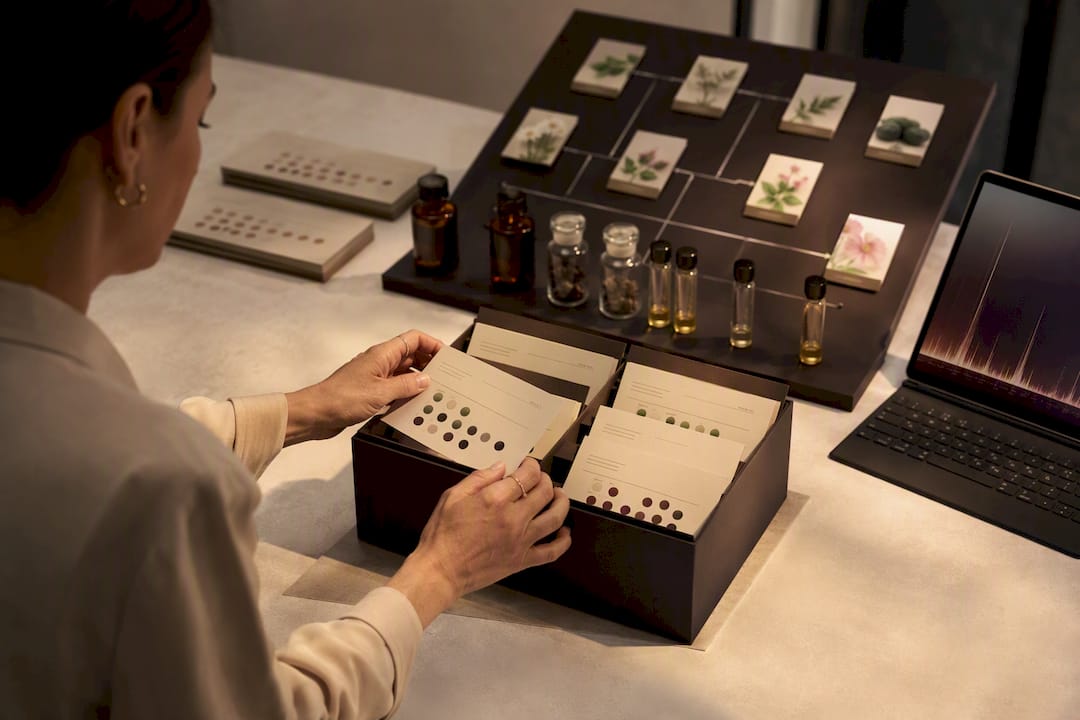
If a small perfumer’s transparency matters to you, the exploration doesn’t need to stop at the bottle. You can request that documentation directly, the same way you’d ask a larger certified brand for its certificate number. A house with nothing to hide will usually welcome the question.
Certifier Rigor or Brand Transparency: Which Should Guide You?
Certification and trust aren’t quite the same thing, and treating them as interchangeable is where a lot of fragrance shopping goes wrong.
An internationally recognized seal like COSMOS or NATRUE earns its weight when you have allergies, dietary-adjacent ethical priorities like avoiding animal-derived ingredients, or simply no relationship with the brand yet. The audit trail does the trusting for you. But artisanal perfumery often operates at a scale where formal certification isn’t financially realistic, and that doesn’t automatically make a brand’s claims less true. It just shifts the burden of proof onto direct documentation.
My honest read: if a specific health concern is on the line, ask for the certificate. If it’s a values question, a well-documented small house can earn the same confidence a logo would, just through a different kind of paperwork. Either way, ask before you buy, not after.
— Celeste
Where Can You Verify These Standards Yourself?
The primary sources below let you check any claim in this article against the standard’s own text or a certifier’s live product database, rather than taking a brand’s word for it.
- COSMOS certification overview for ORGANIC and NATURAL thresholds
- NATRUE Technical Guide for ingredient rules and the 75% brand threshold
- Ecocert’s COSMOS certification page for logo and code verification
- International Fragrance Association for safety limit guidance
- BioVidaSana standard and ECOGEA standard for locally administered rules
Sources
- NATRUE Technical Guide (2025 update)
- Certificación COSMOS (Ecocert)
- Norma BioVidaSana (BioVidaSana standard PDF)
- ECOGEA Natural and Organic Standard for cosmetics and fragrances
FAQ
What Is the IFRA Certificate for Fragrances?
It’s documentation confirming a fragrance formulation stays within IFRA’s safety usage limits for its ingredients. It says nothing about whether those ingredients are natural or synthetic.
Who Certifies Organic Perfume Products?
Ecocert is one of the accredited bodies that audits and certifies formulations against the COSMOS standard, while NATRUE runs its own independent certification with separate natural and organic tiers. In Spain, BioVidaSana offers a locally administered alternative with similar documentation requirements.
What Makes a Perfume Both Natural and Eco-Friendly?
A perfume earns that combination when it meets an ingredient-based natural or organic standard, such as COSMOS or NATRUE, and its production and sourcing avoid synthetic fragrance compounds entirely, as BioVidaSana and ECOGEA both require. Checking the certifier’s product database confirms whether a specific bottle actually holds that status.
Les sept fragrances Maison Voyageur
- Manifesting · unisexe (69,99 €)
- Intuition · femme (69,99 €)
- Certainty · femme (69,99 €)
- Expansion · femme (69,99 €)
- Release · homme (69,99 €)
- Presence · homme (69,99 €)
- Inner Fire · homme (69,99 €)
Nouvelle ici ? Commence par le Discovery Set · les 7 fragrances en format voyage (40 €).