
Aromatherapy vs Perfumery: A Guide for Connoisseurs
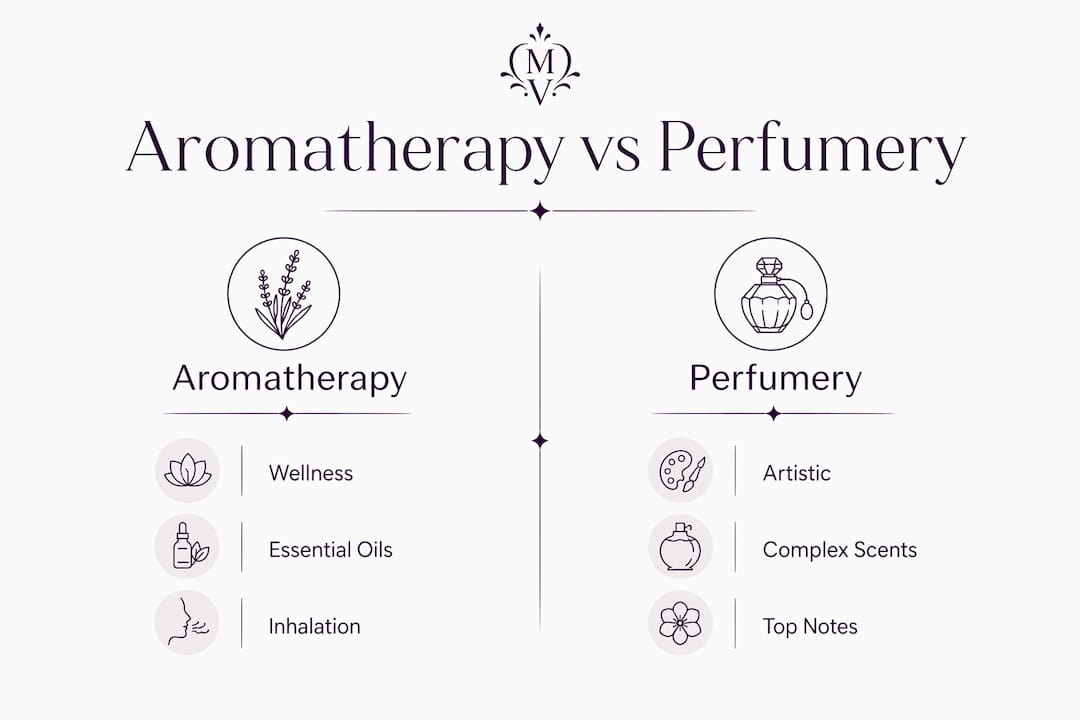
Aromatherapy uses scent as a therapeutic tool. Perfumery uses scent as an artistic product. That single distinction shapes everything: the materials chosen, the way a blend is built, how it feels on skin, and what you should expect from a bottle. The 2024 Australian Government Natural Therapies Review; Johns Hopkins Medicine, and Maisonvoyageurparfum each illuminates a different facet of this comparison.
At a glance:
- Aromatherapy selects essential oils for documented wellness profiles and safety clarity
- Perfumery selects materials for blending complexity, emotional storytelling, and olfactory evolution
- Both traditions share raw materials; intention separates them
- Evidence for therapeutic claims is real but limited, as noted below
- Artisanal natural perfumery can honor both traditions simultaneously
Table of Contents
- How aromatherapy and perfumery differ in purpose and form
- What raw materials and extraction methods actually do to a scent
- How each tradition is applied and experienced over time
- What the science actually supports about therapeutic claims
- Safety, concentration, and what U.S. regulation actually covers
- Where aromatherapy and perfumery meet
- How to choose an artisanal fragrance that honors both traditions
- Key Takeaways
- The distinction that actually matters for introspective fragrance lovers
- Maisonvoyageurparfum: where artisanal craft meets introspective ritual
- Useful sources
How aromatherapy and perfumery differ in purpose and form
The clearest way to understand what is aromatherapy vs perfumery is to ask what each practice is hired to do. Aromatherapy treats scent as a means to an end: reduced anxiety, better sleep, a calmer nervous system. The fragrance is the vehicle, not the destination. Perfumery inverts that relationship entirely. The scent is the destination, a composed sensory identity that unfolds over hours on skin.
Formulation follows from that difference. Aromatherapy blends tend to be simple, often a single essential oil or a short list, with dilution percentages printed clearly on the label. Perfumery builds in layers: bright top notes that open the experience, warmer heart notes that carry its character, and deep base notes that anchor it for hours. Ingredient intent is the dividing line, not the raw material itself.
- Aromatherapy label signals: single essential oil listed, dilution % stated, no artistic fragrance name
- Perfumery label signals: a composed name, layered INCI list, no therapeutic claim
- Hybrid signals: both a wellness claim and a structured fragrance pyramid
Pro Tip: Flip the bottle. If the label names a dilution percentage and a single botanical, you are holding an aromatherapy product. If it carries an evocative title and a multi-ingredient INCI list, you are holding a perfume. Knowing which is which protects your expectations.
What raw materials and extraction methods actually do to a scent
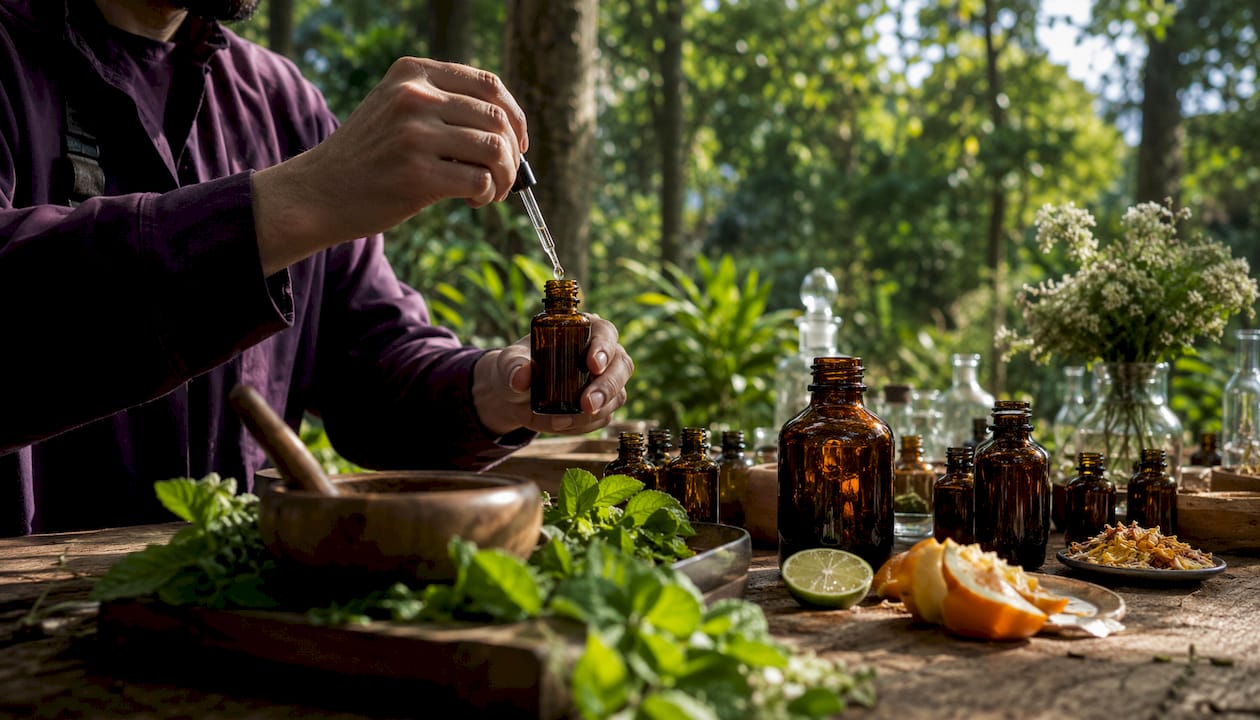
The materials used in each tradition overlap more than most people realize. Essential oils, absolutes, CO₂ extracts, resins, and concretes appear in both. What differs is how they are selected and what extraction method was used to obtain them, because extraction shapes olfactory character at a fundamental level.
| Extraction Method | Typical Materials | Olfactory Result | Artisanal Notes |
|---|---|---|---|
| Steam distillation | Lavender, rosemary, eucalyptus | Clean, bright, true-to-plant | Most common; some delicate notes lost to heat |
| Solvent extraction (absolute) | Rose, jasmine, tuberose | Rich, waxy, deeply floral | Trace solvent residue possible; high aromatic complexity |
| Cold expression | Citrus peels | Fresh, zesty, volatile | Phototoxic risk with bergamot; short longevity |
| Enfleurage | Delicate florals (historical) | Extraordinarily nuanced | Labor-intensive; rare in modern production |
| Supercritical CO₂ | Ginger, frankincense, vetiver | Close to living plant; full spectrum | Low heat preserves volatile compounds; premium cost |
CO₂ extraction operates at approximately 32°C and around 73 bar of pressure, conditions gentle enough to preserve aromatic compounds that steam distillation destroys. For a connoisseur reading an ingredient list, an absolute signals depth and complexity; an essential oil signals clarity and therapeutic lineage. The real science behind natural perfume complexity traces directly to these choices.
- Enfleurage and CO₂ extracts represent the highest artisanal investment
- Steam-distilled oils are the backbone of aromatherapy for purity and safety
- Solvent-extracted absolutes carry the richest floral character in fine perfumery
How each tradition is applied and experienced over time
Aromatherapy is typically administered by inhalation through a diffuser or personal inhaler, or applied topically in a properly diluted carrier oil. The Cleveland Clinic frames it as a complementary approach, noting reported benefits for anxiety and sleep quality. The experience is immediate and functional: you inhale, you notice a shift, the session ends.
Perfume unfolds differently. You spray, and the top notes open bright and fleeting. Over twenty minutes, the heart emerges. By the second hour, the base settles into something intimate and lasting. That arc is intentional composition, not accident. Fragrance layering techniques extend this further, letting you build a personal olfactory signature across multiple applications.
Pro Tip: On your next sample, apply to bare skin and check back at 15 minutes, 1 hour, and 3 hours. If the scent smells identical at each interval, it was likely built for function. If it has changed meaningfully, you are wearing a composed perfume.
What the science actually supports about therapeutic claims
The evidence for aromatherapy is real, but modest. A systematic review across 323 studies commissioned by the Australian Government found low-certainty evidence for many claimed clinical outcomes, including sleep, pain, anxiety, and depression. Results were mixed or insufficient across most conditions reviewed.
Statistic: A government review examining a large number of studies concluded that evidence quality is low for the majority of aromatherapy’s claimed clinical outcomes.
The neurological mechanism is plausible. Scent molecules reach the amygdala via the olfactory nerves faster than almost any other sensory input, which explains why a smell can shift your mood in seconds. But a mood shift is not a medical treatment. The limbic system’s role in emotional response is well-documented; clinical efficacy for specific diseases is not.
- Strongest evidence: modest relaxation and sleep support in specific populations
- Weakest evidence: treatment of defined medical conditions
- Watch for: vendor language that conflates “may support” with “treats”
Safety, concentration, and what U.S. regulation actually covers
Essential oils are potent. Bergamot expressed cold from the peel carries furanocoumarins that cause phototoxic burns on sun-exposed skin. Many oils cause sensitization at high concentrations, a reaction that worsens with repeated exposure. Knowing what to avoid in mass perfumes is one layer of protection; understanding dilution is another.
Assume potency. Patch test every new natural extract on inner forearm skin before full application, and wait 24 hours before judging safety.
In the United States, the FDA regulates fragrance products as cosmetics, meaning safety substantiation is the manufacturer’s responsibility, not a pre-market approval process. The International Fragrance Association (IFRA) publishes concentration guidelines for known sensitizers and phototoxic materials, but compliance is voluntary for brands not selling into markets that require it. When reading a label, look for INCI names, dilution percentages, batch codes, and harvest origin when available.
- Bergamot FCF (furanocoumarin-free) is the safer citrus choice for skin application
- A dilution of 1–2% is the general topical guideline for most essential oils in adults
- “Fragrance” as a single INCI entry can mask dozens of undisclosed ingredients
Where aromatherapy and perfumery meet
Functional or wellness fragrances occupy the space between the two traditions. They carry an artistic structure, top, heart, and base notes, while foregrounding specific botanicals chosen for their mood associations. The benefits of intentional fragrance use for wellbeing are real enough to take seriously, even if the clinical evidence remains modest.
Evaluating a hybrid honestly requires a short checklist:
- Does the label disclose extraction method and natural percentage?
- Are therapeutic claims framed as “may support” rather than “treats”?
- Is the olfactory structure complex enough to suggest artistic intent?
- Are IFRA guidelines or equivalent safety standards referenced?
- Does the brand disclose sourcing and harvest information?
A hybrid that passes all five is worth your attention. One that fails on transparency, regardless of how it smells, is a marketing exercise.
How to choose an artisanal fragrance that honors both traditions
Choosing well starts before you smell anything. Reading natural fragrance labels is a skill that separates informed buyers from impulse buyers. Ask the perfumer or retailer: What extraction method was used for the key materials? What is the natural percentage by weight? Were absolutes or CO₂ extracts used, and from which harvest?
Pro Tip: Structure a home sniff session in three rounds: dry strip at arm’s length, skin application at 15 minutes, and skin again at 90 minutes. Note what changed. Emotional resonance that deepens over time signals authentic natural complexity.
A practical purchase sequence:
- Request a sample before committing to a full bottle
- Wear the sample on skin for a full day, not just in-store
- Check the ingredient list for floral essential oil transparency
- Confirm the natural percentage claim is stated, not implied
- Assess whether the scent changes meaningfully from application to drydown
Building a curated fragrance wardrobe around these criteria takes patience. That patience is the practice.
Key Takeaways
Aromatherapy and perfumery share raw materials but serve entirely different intentions, and knowing which you are buying changes how you evaluate every bottle.
| Point | Details |
|---|---|
| Purpose is the dividing line | Aromatherapy uses scent as a wellness tool; perfumery uses it as artistic expression. |
| Extraction shapes quality | CO₂ and enfleurage preserve the most nuance; steam distillation prioritizes purity and safety. |
| Evidence is modest | The 2024 Australian Government review of 323+ studies found low-certainty evidence for most aromatherapy clinical claims. |
| Safety requires attention | Patch test all natural extracts; bergamot cold-press carries phototoxic risk without FCF processing. |
| Maisonvoyageurparfum | Crafted with 98% natural ingredients, the atelier model foregrounds extraction quality and introspective ritual. |
The distinction that actually matters for introspective fragrance lovers
Most fragrance writing treats aromatherapy and perfumery as opposites. They are not. They are two different relationships with the same raw material. What changes is the question you bring to the bottle.
When intent, extraction, and ritual are aligned, a scent becomes something quieter and more personal than either category alone. That is what artisanal natural perfumery, at its best, offers. Maisonvoyageurparfum’s Mediterranean atelier practice, built around slow craftsmanship and a high natural-ingredient commitment, reflects exactly that alignment. The fragrances are not made to treat a condition or to perform on a shelf. They are made to accompany personal identity through scent, slowly, over time.
The connoisseur who understands the difference between an absolute and an essential oil, who reads a label for extraction method rather than just notes, who gives a fragrance three hours before judging it, is practicing something closer to mindfulness than shopping. That reader deserves a perfume built with the same care they bring to wearing it.
Maisonvoyageurparfum: where artisanal craft meets introspective ritual
For readers who want a perfume that embodies the criteria in this article, Maisonvoyageurparfum’s Madrid atelier is a place worth knowing. The fragrances are crafted with 98% natural ingredients, with extraction method and sourcing treated as part of the creative decision, not an afterthought. Each scent is built slowly, with the kind of olfactory complexity that only reveals itself across a full drydown.

This is not mass-market fragrance with a natural label attached. The atelier model means each creation carries a specific intention, a sense of place, and a structure designed for personal reflection rather than broad appeal. If the article’s checklist resonates with you, the Madrid atelier offers sampling visits and an immersive introduction to what artisanal Mediterranean perfumery can be. Visit to find the scent that belongs to you.
Useful sources
- Natural Therapies Review 2024 — Australian Government: Primary source for evidence quality and clinical outcomes in the evidence section
- Johns Hopkins Medicine — Aromatherapy overview: Scent-amygdala mechanism and practical guidance on essential oil purity
- NCCIH — Aromatherapy: U.S. government overview of aromatherapy uses, evidence, and safety
- NCBI Bookshelf — Aromatherapy and Essential Oils: A Map of the Evidence: Systematic review for the Veterans Health Administration covering 26 meta-analyses
- Scento — Extraction Techniques in French Perfumery: Detailed method descriptions used in the extraction table
- CaFleureBon — Aromatherapy vs Natural Perfumery: Industry commentary on intent and ingredient selection
- RAA — Limbic System and Aromatherapy: Neurobiological grounding for mood effects in the evidence section
- Maisonvoyageurparfum — Why Natural Perfume Smells Complex: Extraction science and natural ingredient performance
Recommended
- Fragrance Layering Techniques for Enthusiasts: Expert Guide – Maison Voyageur
- Fragrance Concentration Explained: Your Complete Guide – Maison Voyageur
- Parfum artisanal vs industriel : les vraies différences – Maison Voyageur
- Parfum & rituel de don · Guide · Maison Voyageur
Les sept fragrances Maison Voyageur
- Manifesting · unisexe (69,99 €)
- Intuition · femme (69,99 €)
- Certainty · femme (69,99 €)
- Expansion · femme (69,99 €)
- Release · homme (69,99 €)
- Presence · homme (69,99 €)
- Inner Fire · homme (69,99 €)
Nouvelle ici ? Commence par le Discovery Set · les 7 fragrances en format voyage (40 €).