
Fragrance Concentration Explained: Your Complete Guide
Fragrance concentration is defined as the percentage of aromatic compounds dissolved in a carrier solution, typically alcohol, that determines a perfume’s strength, longevity, and character. Understanding what is fragrance concentration explained in industry terms means knowing the difference between categories like Parfum, Eau de Parfum (EDP), Eau de Toilette (EDT), and Eau de Cologne (EDC). These categories follow general industry conventions, though the International Fragrance Association (IFRA) does not legally regulate the exact percentages each label must contain. The concentration level you choose shapes how a scent opens on your skin, how long it lingers, and how much you pay for it. Knowing this one number changes how you shop for fragrance forever.
What are the common fragrance concentration levels and how do they differ?
Fragrance concentration ranges from roughly 1% aromatic oil in a body mist to 40% in a pure Parfum extract. That spread is wider than most people realize. Each category delivers a meaningfully different sensory experience, not just a stronger or weaker version of the same thing.
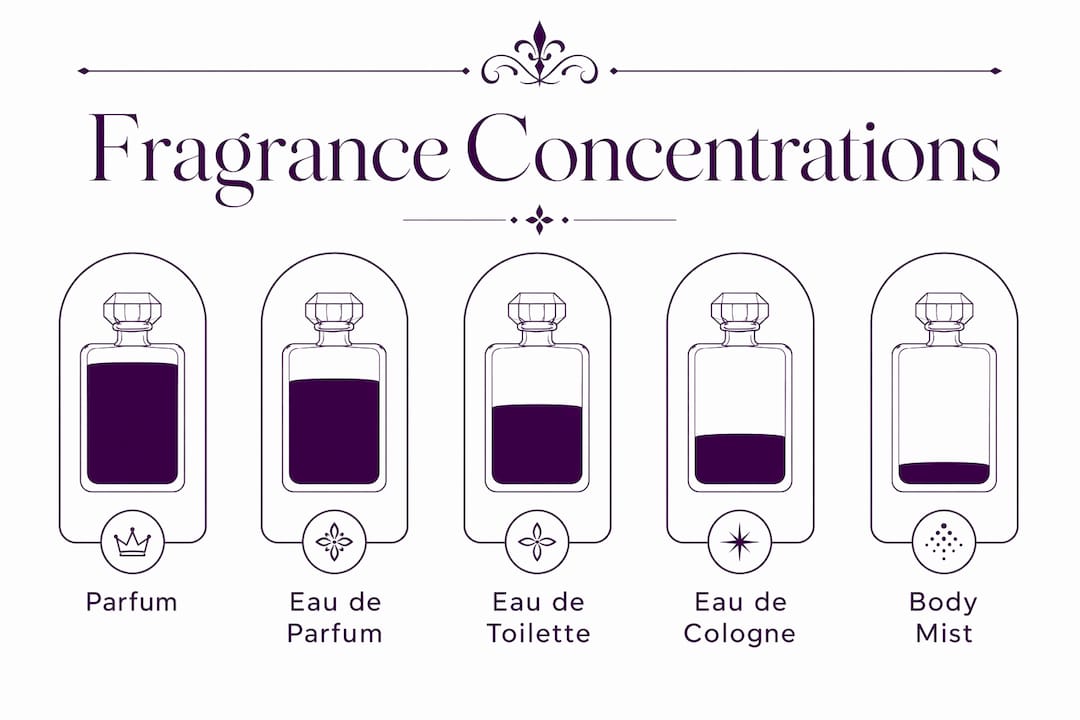
| Concentration type | Aromatic oil percentage | Typical longevity | Best use case |
|---|---|---|---|
| Parfum (Extrait) | 20–40% | 8–24+ hours | Evening, intimate settings |
| Eau de Parfum (EDP) | 15–20% | 6–10 hours | Day to night, versatile wear |
| Eau de Toilette (EDT) | 5–15% | 3–6 hours | Office, daytime, warm weather |
| Eau de Cologne (EDC) | 2–5% | 1–3 hours | Casual, light refresh |
| Eau Fraîche / Body Mist | 1–3% | 1–3 hours | Post-shower, layering |
Parfum sits at the top of the fragrance concentration chart. Its high oil content means the alcohol evaporates slowly, keeping the scent close to the skin for the longest time. EDP offers a balance that works across most occasions. EDT delivers bright, energetic top notes that fade faster, making it a natural fit for professional or warm-weather settings. EDC and body mists are the lightest options, designed for a quick, refreshing lift rather than lasting presence.
One detail that surprises many people: the percentage ranges above overlap. A brand’s EDT might contain 14% oil, while another brand’s EDP starts at 15%. The categories are guidelines, not guarantees.
Pro Tip: When comparing two fragrances in the same category, smell them on your skin after 30 minutes, not just from the bottle. The oil percentage alone does not tell you how a scent will actually perform on you.
How does fragrance concentration affect scent performance?
Higher concentration means a lower alcohol ratio, which slows evaporation and shifts the scent experience toward heart and base notes. This is why a Parfum often smells quieter at first but grows richer and more complex over hours. An EDT, by contrast, opens with a burst of citrus or green top notes that fade within the first hour.
Longevity follows a clear pattern by category:
- Parfum: lasts 8–24+ hours, anchored by woods, resins, and musks
- EDP: lasts 6–10 hours, balancing top, heart, and base notes evenly
- EDT: lasts 3–6 hours, projecting well in the first two hours before softening
- EDC and Eau Fraîche: last 1–3 hours, ideal for light, frequent reapplication
Projection, meaning how far a scent radiates from your body, does not always match concentration. A Parfum can sit intimately close to the skin while an EDT projects loudly into a room. The difference comes down to the specific molecules used, not just the oil percentage.
“EDPs offer balanced scent profiles suitable for day-to-night wear, while Parfums focus on long-lasting base notes for intimate settings. The right choice depends on the occasion and the effect you want to create.”
This is why scent development phases matter so much. A high-concentration fragrance rewards patience. The opening may feel dense or muted, but the dry-down reveals the full character of the perfume. Lower-concentration options give you the full picture quickly, which suits people who want immediate gratification from their scent.
Common misconceptions about fragrance concentration
The most persistent myth in perfumery is that higher concentration always means a stronger, louder scent. Projection depends on molecular volatility and fixatives, not oil percentage alone. A molecule like Iso E Super projects aggressively even in small amounts, while some heavy musks stay skin-close regardless of how much oil is in the formula.
Skin chemistry adds another layer of complexity. Your skin’s pH, hydration level, and natural oils all change how a fragrance performs. A dry skin type tends to absorb fragrance faster, shortening longevity regardless of concentration. An oily skin type holds scent longer, sometimes making an EDT perform like an EDP.
“Fragrance concentration labels are marketing conventions, not legally regulated standards. Percentages and scent profiles vary between brands, making personal scent testing the only reliable guide to real-world performance.”
Concentration labels carry no legal definition. A brand can call a product an EDP with 12% oil or 22% oil. This variability is not a flaw in the system. It reflects the reality that perfumery is a craft, not a regulated pharmaceutical category. Treat the label as a starting point, not a specification.
Pro Tip: Apply a fragrance to your inner wrist, wait 20 minutes, then assess it again at the one-hour mark. That two-step test tells you more about real-world performance than any label or concentration chart.
How to choose the right fragrance concentration for your lifestyle
Matching concentration to occasion is the most practical skill in fragrance selection. A clear framework makes the choice straightforward.
- For daytime and professional settings, choose an EDT. EDTs provide bright top notes and moderate longevity that suits shared spaces without overwhelming colleagues.
- For evening or social events, reach for an EDP. The balanced note structure carries through dinner, conversation, and the hours after without needing reapplication.
- For intimate or special occasions, a Parfum is the right call. Its slow, skin-close development creates a personal scent signature that only those near you can fully experience.
- For warm climates or summer wear, lighter concentrations like EDT or EDC feel more comfortable. Heat amplifies fragrance projection, so a lower oil percentage prevents the scent from becoming overpowering.
- For layering, start with a body mist or Eau Fraîche as a base, then apply an EDP or EDT on top. The lighter layer extends the life of the heavier one without adding cost.
Price follows concentration directly. Parfum typically costs significantly more than lighter categories because fragrance oils are the most expensive component in any formula. If budget matters, an EDP often delivers the best value: strong enough to last a full day, versatile enough for most occasions.
Pro Tip: Buy a sample or decant before committing to a full bottle. Skin chemistry and concentration interact differently for every person, and a 2ml sample costs a fraction of a 50ml bottle.
Seasonal rotation is worth building into your fragrance wardrobe. Many people keep a lighter EDT for spring and summer, then switch to an EDP or Parfum in fall and winter when the cooler air slows evaporation and allows richer base notes to shine.
Key takeaways
Fragrance concentration is the single most important technical factor in perfume selection, because it determines longevity, projection, price, and the way a scent unfolds on your skin.
| Point | Details |
|---|---|
| Concentration defines performance | Oil percentage controls how long a scent lasts and how it develops over time. |
| Labels are not legally standardized | Treat category names as general guidance, not guaranteed specifications. |
| Projection is not just concentration | Molecular volatility and fixatives determine how far a scent radiates, not oil percentage alone. |
| Skin chemistry changes everything | Test on your own skin before buying; your body’s chemistry alters real-world longevity. |
| Match concentration to occasion | EDTs suit daytime wear; EDPs work day to night; Parfums are best for intimate settings. |
Why I think most people choose fragrance concentration backwards
Most people walk into a fragrance counter and reach for the highest concentration available, assuming it means the best value. I have watched this play out hundreds of times, and it almost always leads to disappointment.
A Parfum applied too generously in a warm office becomes suffocating. An EDT worn on a cold winter evening disappears within an hour. The mismatch is not about quality. It is about context. The person who wears a skin-close Parfum to a quiet dinner and an energetic EDT on a summer morning understands fragrance at a deeper level than someone who simply buys the highest percentage on the shelf.
What I find most meaningful about Maisonvoyageurparfum’s approach is that it reframes this entirely. Their slow luxury philosophy treats concentration as one part of a larger conversation about how a scent makes you feel, not just how long it lasts. When a fragrance is crafted slowly with 98% natural ingredients, the concentration becomes an expression of intention rather than a marketing category. That shift in thinking changes how you wear perfume and, more quietly, how you experience yourself wearing it.
— Celeste
Maisonvoyageurparfum: where concentration meets intention

Maisonvoyageurparfum crafts each fragrance slowly, with 98% natural ingredients sourced through a Mediterranean sensibility rooted in Madrid. Their collection spans concentration levels, from lighter, luminous formulas to rich, long-lasting Parfum expressions, each built to evoke a specific emotional state rather than simply fill a room. The full fragrance collection reflects a philosophy where concentration is a choice about depth, not volume. If you want to understand how fragrance concentration feels in practice rather than on paper, their artisanal range offers a rare opportunity to experience the difference firsthand. Each scent is an invitation to pause and pay attention.
FAQ
What is fragrance concentration in simple terms?
Fragrance concentration is the percentage of aromatic oils in a perfume formula. Higher percentages mean stronger, longer-lasting scents.
How long does each fragrance concentration last?
Parfum lasts 8–24+ hours, EDP lasts 6–10 hours, EDT lasts 3–6 hours, and EDC or body mists last 1–3 hours on average.
Does higher concentration always mean a stronger scent?
No. Projection depends on molecular volatility and fixatives, not oil percentage alone. Some high-concentration Parfums sit close to the skin while certain EDTs project loudly.
Are fragrance concentration labels regulated by law?
No. Terms like Parfum, EDP, and EDT carry no legal definition. Percentages vary by brand, so treat labels as general guidance and always test on your skin.
What fragrance concentration is best for everyday wear?
EDT works well for daytime and professional settings because it projects cleanly without overwhelming shared spaces. EDP suits those who want longer wear across a full day.
Recommended
- Perfume Concentration Differences: A Clear Guide – Maison Voyageur
- Concentration parfum EDC et EDP expliquée – Maison Voyageur
- Fragrance Layering Techniques for Enthusiasts: Expert Guide – Maison Voyageur
- How to Read Natural Fragrance Ingredient Labels – Maison Voyageur
Les sept fragrances Maison Voyageur
- Manifesting · unisexe (69,99 €)
- Intuition · femme (69,99 €)
- Certainty · femme (69,99 €)
- Expansion · femme (69,99 €)
- Release · homme (69,99 €)
- Presence · homme (69,99 €)
- Inner Fire · homme (69,99 €)
Nouvelle ici ? Commence par le Discovery Set · les 7 fragrances en format voyage (40 €).