
Types of Emotional Responses to Scent: A Science-Backed Guide
Scents trigger a small, reliable set of emotional response types: immediate hedonic valence (pleasant or unpleasant), arousal shifts (calming or energizing), memory-evoked emotion, longer-lasting mood changes, conditioned responses built through personal history, and physiological reflexes via the trigeminal nerve. Knowing which type you are experiencing lets you use fragrance with intention rather than accident. Here is a quick map of the categories:
- Immediate hedonic valence — the instant like or dislike a scent produces
- Arousal shift — a change in alertness or calm, independent of whether you like the scent
- Memory-evoked emotion — a vivid feeling pulled from autobiographical memory
- Mood shift — a slower, longer-lasting change in emotional tone
- Conditioned/learned response — an association built through repeated pairing with an experience
- Physiological reflex — a body-level reaction (tingling, tears, tension) driven by the trigeminal nerve
- Social/empathic effect — a change in how you read or relate to others, sometimes without awareness
Table of Contents
- How does smell connect so directly to emotion?
- What are the distinct types of emotional responses to scent?
- Which scents produce which emotional effects?
- Why do people respond so differently to the same scent?
- How to use scent intentionally to shift your emotional state
- How do scientists actually measure scent-emotion responses?
- A quick scent-for-goal reference
- Key Takeaways
- Scent as emotional work: what the science actually asks of you
- The part most guides skip
- Artisanal fragrance designed for introspection
- Useful sources for further reading
How does smell connect so directly to emotion?
The answer lives in anatomy. When you inhale a scent, odor molecules bind to receptors in the nasal epithelium, and signals travel along the olfactory nerve to the olfactory bulb. From there, the pathway projects directly into the limbic system, reaching the amygdala and hippocampus before any conscious processing occurs. This is the thalamic bypass that makes smell unique among the senses: every other sense routes through the thalamus first, giving the cortex a chance to interpret before emotion fires. Smell skips that step.
The key brain structures involved:
- Olfactory bulb — first relay station; begins basic odor coding
- Amygdala — assigns emotional significance and threat value
- Hippocampus — links the odor to autobiographical memory
- Orbitofrontal cortex (OFC) — integrates hedonic valence (pleasant vs. unpleasant) and context
This architecture means a scent can shift your emotional state before you have named what you are smelling. Olfaction bypasses the thalamus and projects directly to limbic regions, so emotional processing can precede conscious odor identification, making scent a uniquely fast lever for in-the-moment emotional change.
Two terms are worth holding separately. Hedonic valence is the immediate, binary signal: pleasant or unpleasant. Mood is the slower, longer-lasting emotional tone that follows. As Rachel Herz argues, treating these as distinct is what separates deliberate scent use from accidental triggering.
“Scent and emotion are encoded together. When you encounter that scent again, the emotion comes with it — that is the Proustian moment, and it can be consciously curated.” — Pamela Dalton, as described in Time
Understanding the mechanism also explains why fragrance promotes introspection so reliably: the limbic loop connects smell to self-referential memory almost automatically.
What are the distinct types of emotional responses to scent?
Here is a structured catalogue you can use to identify what you are experiencing and why.
-
Immediate hedonic valence. The first, fastest response: a scent registers as pleasant or unpleasant within milliseconds. This reaction is partly universal (most people find putrefaction unpleasant) and partly learned. Example: the instant comfort of fresh bread. Consistency: moderate to robust across populations.
-
Arousal shift. Separate from liking, arousal describes changes in alertness or calm. A scent can be pleasant yet energizing, or pleasant yet sedating. Peppermint tends to increase alertness; lavender tends to reduce it. Example: inhaling eucalyptus before a morning meeting. Consistency: moderate, context-dependent.
-
Memory-evoked emotion (Proustian response). Odor-evoked autobiographical memories are rated as more emotionally vivid and transportive than memories triggered by any other sense. The emotion arrives first, the memory second. Example: a specific sunscreen scent returning you to a childhood summer. Consistency: highly individual.
-
Mood shift. Slower and longer-lasting than valence or arousal, a mood shift is a change in overall emotional tone that can persist for minutes to hours after exposure ends. Lavender and citrus are among the most studied for this effect. Example: diffusing bergamot during a work session and noticing a lighter quality to the afternoon. Consistency: moderate.
-
Conditioned/learned response. Through repeated pairing, any scent can acquire emotional meaning. A perfume worn during a significant relationship becomes emotionally charged. This is classical conditioning applied to olfaction. Example: a specific cologne triggering grief after a loss. Consistency: highly individual.
-
Physiological reflex (trigeminal activation). High-intensity odors stimulate the trigeminal nerve alongside the olfactory nerve, producing physical sensations — tingling, tears, tension, or a racing pulse — that can be mistaken for anxiety. Example: a very strong menthol causing chest tightness. Consistency: robust at high intensities.
-
Social and empathic effects. Some odor effects occur without conscious awareness and interact with social context. Mood improvements tied to ambient scent in a shared space may partly reflect others’ behavior rather than the scent alone. Example: a scented retail environment where staff seem warmer. Consistency: mixed, lab-dependent.
Understanding how fragrance maps your emotional landscape means recognizing which of these types is active in a given moment, because each calls for a different response.
Which scents produce which emotional effects?
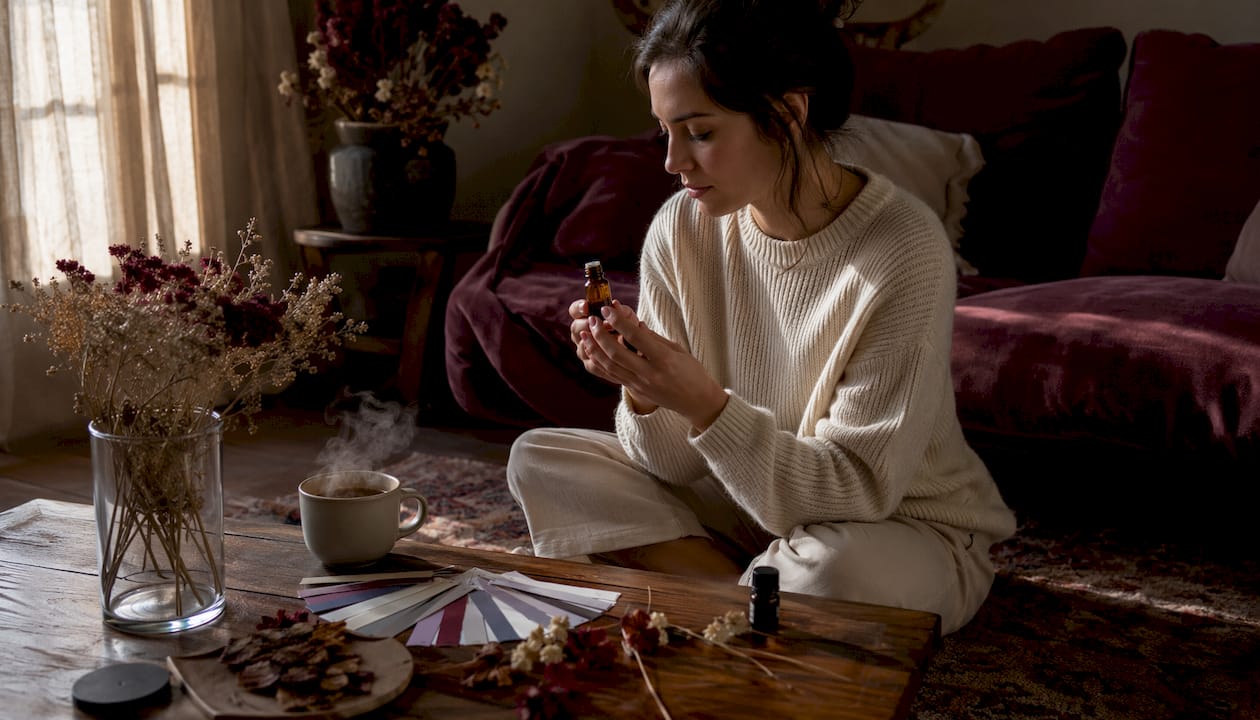
The table below maps common scent categories to their typical emotional effects and tags the strength of the evidence. “Strong” means multiple controlled studies with consistent findings; “moderate” means replicated but with notable variation; “mixed” means studies conflict; “anecdotal” means primarily self-report or cultural tradition without controlled replication.
| Scent | Typical emotional effect | Evidence strength |
|---|---|---|
| Lavender | Reduced anxiety, calm, mild sedation | Strong |
| Citrus (lemon, bergamot, orange) | Increased energy, positive mood, mild invigoration | Moderate |
| Vanilla | Comfort, warmth, mild pleasure | Moderate evidence, possibly influenced by early-life exposure |
| Peppermint / eucalyptus | Increased alertness, mental clarity | Moderate |
| Jasmine | Mild sensuality, elevated mood | Mixed |
| Green / leafy notes | Freshness, mild stress reduction | Mixed |
| Woody / resinous (sandalwood, cedar) | Grounding, calm, introspection | Anecdotal to moderate |
| Putrid / sulfurous | Disgust, fear, avoidance | Strong (near-universal) |
A few important caveats. Intensity matters enormously: the same lavender oil that calms at low concentration can feel overwhelming at high concentration, activating the trigeminal nerve and producing the opposite of relaxation. Cultural background and early-life associations also shape the response. Vanilla’s cross-cultural pleasantness may partly trace to aroma-like compounds present in breast milk, but that does not make the effect universal or predictable for every individual.
Scent marketers sometimes cite sweeping statistics about the percentage of emotions triggered by smell. Researchers caution against overgeneralizing such claims: effect sizes vary, and lab findings do not always translate cleanly to real-world settings. Treat the table above as a starting point for personal testing, not a guarantee.

Why do people respond so differently to the same scent?
Individual variation in scent-emotion responses is the rule, not the exception. Four forces drive it.
- Learned associations. Childhood is the most powerful period for olfactory conditioning. A scent paired repeatedly with safety, joy, or fear during early development becomes a lasting emotional trigger. Past experiences shape fragrance preferences in ways that persist into adulthood and resist conscious override.
- Cultural context. What smells “clean” in one culture smells medicinal in another. Associations with specific foods, rituals, or environments vary by region and tradition.
- Genetic differences. Humans carry roughly 400 functional olfactory receptor genes, and which variants you carry affects which molecules you can detect and how intensely. Some people cannot smell androstenone at all; others find it intensely unpleasant.
- State at exposure. Hunger, fatigue, stress, and concurrent sensory input all modulate how a scent registers emotionally. The same perfume can feel comforting on a calm morning and irritating during a headache.
Risks and when to stop
Negative odor-evoked memories can persist for decades and may trigger intense reactions. For people with PTSD or a history of trauma, a scent linked to a difficult experience can produce a full physiological stress response without warning. Clinicians recommend grounding techniques when a scent provokes distress, and professional support when reactions are severe or recurring.
High-intensity fragrances carry a separate risk: trigeminal activation from strong odors can produce physical arousal that feels like anxiety, even when the scent is one you normally enjoy. Repeated exposure to a sensitizing compound can also develop into a contact allergy over time.
Pro Tip: Before committing to a new fragrance for emotional work, do a micro-test. Apply or diffuse at the lowest possible intensity for 60 seconds. Notice your breathing, heart rate, and any shift in mood. If you feel tension, nausea, or agitation, stop immediately. A scent that produces a stress response at low intensity is not the right tool for you, regardless of what studies say about it.
Why certain smells feel like home is a question worth sitting with before you build any scent practice, because the answer is always personal.
How to use scent intentionally to shift your emotional state
The single most useful instruction: choose deliberately, test at low intensity, pair with a body cue, repeat consistently, and reflect on what actually changes for you. That five-step loop is the foundation of intentional scent use.
- Choose a target emotion. Decide what state you want to support: calm, energy, focus, comfort, or confidence. Use the scent map above as a starting point, not a prescription.
- Micro-test first. Apply or diffuse at the lowest usable intensity. Observe for 60–90 seconds. Note any physical sensations, mood shifts, or memories. If the response is neutral or positive, continue. If it is aversive, stop and choose a different scent.
- Build an anchor. Once you have a scent that produces a consistent positive response, pair it with a deliberate body cue: three slow breaths, a hand on the chest, or a brief visualization of a calm place. Repeat this pairing every time you use the scent. Over time, the cue alone begins to carry some of the emotional signal.
- Rotate intentionally. Using the same scent for every emotional goal dilutes its anchoring power. Keep two or three scents for distinct purposes: one for calm, one for focus, one for comfort. Rotate them so each retains its associative clarity.
- Reflect and log. After two weeks, note which scents reliably produced the intended shift and which did not. Building a personal olfactory vocabulary log is more useful than following generic aromatherapy rules, because your associations are yours alone.
Pro Tip: For a simple anchoring exercise, hold the scent source two to three inches from your nose. Inhale slowly for four counts, hold for two, exhale for six. While exhaling, picture a specific place where you feel safe and at ease. Repeat three times. Do this consistently with the same scent for at least ten sessions before evaluating whether the anchor has formed.
Practical format notes: a personal inhaler or roll-on gives you intensity control and portability. A diffuser works for ambient mood shifts but is harder to calibrate. Sprays on fabric are slower to dissipate and useful for sustained, low-level exposure. For deep relaxation, subtle is always better than strong. The role of scent in ritual is well-documented; the format you choose shapes how that ritual lands.
How do scientists actually measure scent-emotion responses?
The short answer: a combination of self-report, behavioral observation, physiological measures, and neuroimaging, each with real limitations.
- Subjective rating scales — participants rate pleasantness, arousal, and specific emotions on validated scales (e.g., the Geneva Emotion Wheel). Fast and scalable, but susceptible to demand effects and cultural framing.
- Facial expression coding — automated or manual coding of micro-expressions during odor exposure. Captures involuntary reactions but requires controlled conditions.
- Implicit association measures — reaction-time tasks that reveal associations participants may not consciously report.
- Heart rate and galvanic skin response (GSR) — physiological markers of arousal. Reliable for detecting activation but cannot distinguish between positive and negative arousal without self-report.
- EEG — measures electrical brain activity in real time. Useful for detecting rapid emotional processing but has limited spatial resolution.
- fMRI — maps brain activation with high spatial resolution. Confirms limbic involvement but is expensive, slow, and ecologically limited (participants lie still in a scanner).
- Conditioned-behavior models — measure approach/avoidance or performance changes after odor exposure.
- Placebo and subliminal testing — expose participants to odors below conscious detection or label the same odor differently to isolate chemistry from expectation.
Studies combining subjective and objective measures consistently show that context and social conditions change results, sometimes dramatically. Lab findings often use small, culturally homogeneous samples, and the controlled environment strips away the ambient cues that normally accompany scent in daily life. Treat any single study as one data point, not a universal rule.
A quick scent-for-goal reference
Use this as a fast-scan starting point. Every recommendation assumes a micro-test first and low-to-moderate intensity.
- Calm — Lavender or sandalwood; inhale slowly for 30 seconds while breathing deeply; avoid high concentrations.
- Energy — Citrus (lemon, sweet orange, bergamot); use in the morning or before a task requiring alertness; a personal inhaler gives you control.
- Focus — Peppermint or rosemary; brief exposure (60 seconds) before a cognitive task; do not diffuse continuously.
- Comfort — Vanilla or warm amber; low-intensity application; particularly useful during stressful transitions.
- Confidence — Woody or resinous notes (cedar, vetiver); pair with a grounding breath before a high-stakes moment.
- Mood lift — Bergamot or jasmine; diffuse at low intensity during a creative or social activity.
- Grounding (acute stress) — A personally meaningful scent with positive associations; the specificity of your own anchor matters more than the category.
- Sleep preparation — Lavender at very low intensity; apply to a pillow or use a diffuser with a timer; avoid stimulating notes entirely.
Allergy caution applies across all categories. Natural does not mean hypoallergenic. If you notice skin irritation, headache, or respiratory discomfort, discontinue and consult a healthcare provider.
Key Takeaways
Scent triggers emotion through a direct limbic pathway, producing at least seven distinct response types, each shaped by biology, memory, and context in ways that make personal testing more reliable than any generic rule.
| Point | Details |
|---|---|
| Seven response types | Hedonic valence, arousal, memory-evoked emotion, mood shift, conditioned response, trigeminal reflex, and social effect are the core categories. |
| Thalamic bypass | Smell reaches the amygdala before conscious processing, making it uniquely fast for in-the-moment emotional change. |
| Individual variation | Genetics, childhood associations, culture, and current state all shape your response; generic aromatherapy rules are a starting point, not a guarantee. |
| Safe testing protocol | Micro-test at low intensity, pair with a body cue, rotate scents by goal, and log what actually works for you over two weeks. |
| Maisonvoyageurparfum | Artisanal Mediterranean fragrances composed with 98% natural ingredients, designed for introspection and intentional emotional anchoring. |
Scent as emotional work: what the science actually asks of you
The part most guides skip
Most writing on scent and emotion stops at the catalogue: lavender calms, citrus energizes, vanilla comforts. That framing is useful, but it quietly implies that scent acts on you rather than with you. The neuroscience tells a more interesting story.
Because the olfactory pathway encodes scent and emotion together at the moment of first exposure, the emotional meaning of any fragrance is partly something you build, not something the molecule delivers. Pamela Dalton’s point about conscious curation is not a wellness platitude; it is a description of how associative memory actually works. You can, with repetition and intention, assign emotional meaning to a scent that has none for you yet.
What that means practically: the most powerful fragrance for your well-being is probably not the one with the strongest clinical evidence. It is the one you have paired, deliberately and repeatedly, with a state you want to return to. Generic aromatherapy lists are a reasonable place to start. Your own log, built over weeks of honest observation, is where the real signal lives.
There is also a caution worth naming plainly. Scent is a fast, pre-cognitive lever, and that speed cuts both ways. A fragrance that bypasses your cortex on the way to your amygdala can just as easily surface a difficult memory as a peaceful one. The same mechanism that makes scent a tool for well-being makes it a potential trigger. Testing slowly, at low intensity, with full permission to stop, is not overcaution. It is the only responsible way to work with something this direct.
Artisanal fragrance designed for introspection

If you want to explore intentional scent use with fragrances built specifically for that purpose, Maisonvoyageurparfum offers a considered alternative to mass-market perfumery. Each scent in the collection is composed slowly in Madrid with 98% natural ingredients, chosen not for broad commercial appeal but for the quality of the emotional territory they open. The fragrances are designed for personal introspection, not performance, which makes them a natural fit for the kind of anchoring practice described in this article.
Travel sizes make micro-testing straightforward: you can work with a scent at low intensity over several sessions before committing to a full bottle. The Inner Trip collection offers a guided discovery method built around seven emotional archetypes, giving you a structured starting point rather than an overwhelming shelf of options. If a scent triggers a strong negative reaction during testing, stop and try another; the range is wide enough to find something that works for your particular associations. Explore the collection and begin with a travel size.
Useful sources for further reading
These are the primary sources used in this article, selected for authority and relevance to the science of scent and emotion.
- Harvard Gazette — How scent, emotion, and memory are intertwined — Accessible overview of the olfactory pathway and limbic connection, with expert commentary on how scent is used commercially and therapeutically.
- Frontiers in Behavioral Neuroscience — Behavioral and Neurobiological Convergence of Odor, Mood and Emotion — Peer-reviewed review covering measurement methods, context dependence, and the evidence base for specific scent-emotion pairings.
- Brain Sciences (MDPI) — Smell Is Emotion — Covers odor-evoked autobiographical memory, hedonic valence theory, and clinical observations on negative memory effects; includes Rachel Herz’s framework.
- MDPI — Olfaction and Trigeminal Effects — Detailed review of how high-intensity odors activate the trigeminal nerve and produce physiological arousal; essential reading for safe scent use.
- Cleveland Clinic — Why (and How) Smells Trigger Memories — Clinically grounded explainer on smell-memory links, grounding techniques for distress, and when to seek professional support.
- Time — How smells impact your mental health — Feature-length journalism synthesizing current research with expert commentary from Pamela Dalton and others; good for understanding the Proustian effect and practical applications.
Lab studies offer controlled conditions but limited ecological validity. Real-world scent responses are shaped by context, social environment, and personal history in ways a controlled experiment cannot fully replicate. Reading across both types of evidence gives you the most complete picture.
Recommended
- Nature’s Role in Scent Therapy: A Science-Backed Guide – Maison Voyageur
- How Fragrance Promotes Introspection: A Science Guide – Maison Voyageur
- Why Certain Smells Feel Like Home – Maison Voyageur
- How Fragrance Maps Your Emotional Landscape – Maison Voyageur
Les sept fragrances Maison Voyageur
- Manifesting · unisexe (69,99 €)
- Intuition · femme (69,99 €)
- Certainty · femme (69,99 €)
- Expansion · femme (69,99 €)
- Release · homme (69,99 €)
- Presence · homme (69,99 €)
- Inner Fire · homme (69,99 €)
Nouvelle ici ? Commence par le Discovery Set · les 7 fragrances en format voyage (40 €).