
Scent and Emotional Intelligence: How Smell Shapes Feelings
Scent is a fast, memory-tied channel to emotion that you can use to notice, understand, and regulate feelings. That is the core of what scent and emotional intelligence share: olfaction is the only sense with a direct anatomical route to the brain’s emotional centers, which means a single smell can surface a feeling before conscious thought even begins. Affective scientist Rachel S. Herz argues that smell and emotion are fundamentally equivalent — the olfactory experience is tightly coupled to affect because the primary olfactory cortex overlaps the very structures that process emotion and memory.
- The mechanism: Odor signals travel directly to the amygdala and hippocampus, bypassing the thalamic relay that other senses use, giving scent privileged and near-instant access to emotional memory.
- The evidence: Peer-reviewed work from MDPI, Frontiers in Behavioral Neuroscience, and Translational Psychiatry all converge on the same finding: odors reliably shift mood, trigger autobiographical memory, and can even transmit emotional states between people via chemosignals.
- The practical implication: You can use scent intentionally, pairing a chosen fragrance with a desired emotional state to build a reliable anchor for awareness and regulation.
Try this now: hold something with a familiar, pleasant scent close and breathe slowly for three counts. Notice what feeling or image surfaces. That is the olfactory-limbic pathway at work.
Table of Contents
- How your brain is wired to feel through smell
- Why scent shapes your mood and feelings
- Why scents trigger vivid memories
- How scent maps onto the four branches of emotional intelligence
- Three exercises to build emotional awareness through scent
- What the science actually supports, and where it gets complicated
- How scent communicates emotion between people
- Do scent and emotion work the same way across cultures?
- Integrating scent into daily life and work for emotional awareness
- The neurochemistry connecting scent to emotional regulation
- Key Takeaways
- Scent as a quiet form of self-knowledge
- Scent with intention: Maisonvoyageurparfum’s curated approach
- Useful sources for further reading
How your brain is wired to feel through smell
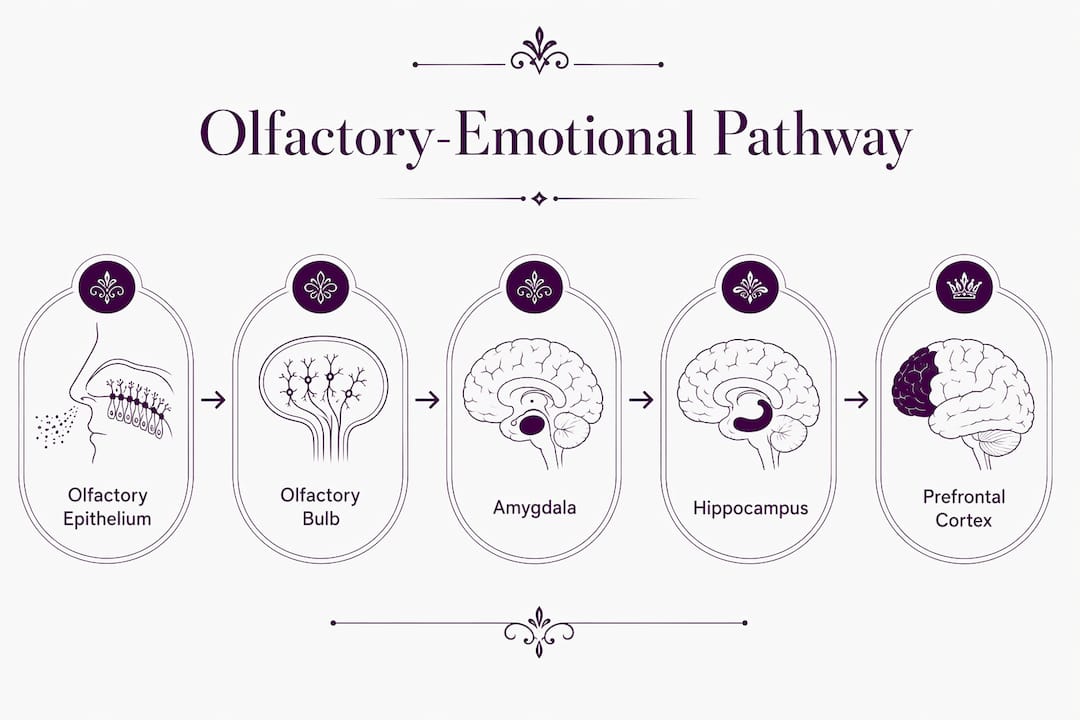
No other sense bypasses the thalamus the way olfaction does. When you inhale an odor, receptor neurons in the olfactory epithelium send signals directly to the olfactory bulb, which projects immediately to the piriform cortex, amygdala, and hippocampus. The orbitofrontal cortex (OFC) then integrates that signal with value and context, producing the conscious experience of “pleasant” or “unpleasant.” Every other sense routes through the thalamus first, adding a processing step that slows emotional access. Olfaction skips it entirely.

This direct limbic access is why odors feel emotional rather than merely informational. The amygdala appraises threat and reward; the hippocampus anchors the experience to autobiographical memory; the OFC assigns hedonic value. Together, they produce the sensation that a smell does not just register — it means something.
| Brain structure | Role in olfactory-emotional processing |
|---|---|
| Olfactory epithelium | Detects odor molecules; sends signals to the olfactory bulb |
| Olfactory bulb | First central relay; projects directly to limbic structures |
| Piriform cortex | Primary olfactory cortex; overlaps with emotion/memory circuits |
| Amygdala | Rapid emotional appraisal; threat and reward tagging |
| Hippocampus | Episodic memory encoding; links odors to past experiences |
| Orbitofrontal cortex | Conscious hedonic valence; integrates context and meaning |
Because olfaction is evolutionarily ancient, it is well suited to quick approach-or-avoid decisions. Long before language, organisms needed to assess whether something was safe or dangerous in an instant. That ancient wiring is still active in you every time a scent stops you mid-thought.
Why scent shapes your mood and feelings
Scent shapes affect primarily through two routes: learned associations and rapid limbic appraisal. Neither is pharmacological. As Herz’s research makes clear, scent effects are associative, not metabolic — a smell shifts your mood because your brain has paired it with a prior emotional state, not because the molecules chemically alter your neurotransmitter levels in real time. That distinction matters for anyone evaluating aromatherapy claims.

The associative mechanism is vivid in everyday life. The smell of a childhood kitchen does not produce comfort because cinnamon has sedative properties; it produces comfort because your brain encoded that smell alongside safety and warmth years ago. The response is fast precisely because it is cognitive, not metabolic.
Chemosignals add a subtler layer. Studies show that emotional body odors can change recipients’ heart rate variability and neural processing even when the odor is not consciously perceived. Exposure to fear-related body odors can shift facial expressions and heighten vigilance; exposure to happiness-related chemosignals can increase openness and creativity. You are reading the emotional state of others through your nose without knowing it.
There is also the question of individual variability. Accessible science reporting confirms there is no universal “magic scent” — responses are shaped by memory, culture, and prior experience. What calms one person may unsettle another.
Pro Tip: When designing a personal scent anchor, choose a fragrance you have no strong prior associations with. Pair it repeatedly with the target emotional state — calm, focus, confidence — in a low-intensity, replicable way. A travel-size bottle works well for this. Always check for allergies and workplace appropriateness before using it around others.
Why scents trigger vivid memories
Scent-evoked memories are often more emotionally intense than memories triggered by sight or sound, because olfactory inputs connect directly to episodic memory structures. Reviews confirm that odors are particularly effective at eliciting autobiographical memories and vivid recollections compared with other sensory cues. This is sometimes called the Proustian effect, after Marcel Proust’s famous account of a madeleine’s scent unlocking a flood of childhood memory.
The mechanism is structural, not poetic. The hippocampus encodes episodic memory; the amygdala tags it with emotional weight. Because olfactory signals reach both structures before reaching conscious awareness, the memory arrives already colored by feeling. You do not recall the event and then feel something — the feeling and the memory surface together.
The implications for well-being are real:
- Mood repair: A familiar, positive scent can interrupt a low mood by surfacing a memory of a better time, offering a brief but genuine emotional reset.
- Grief and nostalgia: Scent can reconnect people to those they have lost, which can be comforting. It can also reopen grief unexpectedly, so the same mechanism that soothes can also sting.
- Therapeutic memory cueing: Clinicians working in memory care and trauma-informed settings have explored scent as a tool for accessing autobiographical narrative, though this remains an area of active research.
- A caution: Scent-triggered nostalgia can also produce false comfort, anchoring you to a past state rather than the present. Awareness of this tendency is part of using scent with emotional intelligence.
For a deeper look at how certain smells feel like home, the science behind scent-triggered nostalgia is worth sitting with slowly.
How scent maps onto the four branches of emotional intelligence
Scent supports emotional intelligence by improving perception and prompting the kind of reflective pause that aids understanding and regulation. The four-branch model of EI — perceiving, using, understanding, and managing emotions — maps onto olfactory experience in specific, practical ways.
- Perceiving emotions: A mindful scent check is one of the simplest ways to sharpen emotional awareness. Pause, inhale something familiar, and ask what feeling surfaces. The speed of the olfactory response makes it a reliable signal of your current affective state, often surfacing something you have not consciously registered.
- Using emotions to facilitate thought: Brief exposure to a pleasant odor can shift arousal and cognitive tone. Odors can modulate mood and cognition, and short exposures to pleasant scents have produced measurable mood changes in experimental settings. Choosing a scent before a creative task or a difficult conversation is a low-effort way to tune your emotional starting point.
- Understanding emotions: Because scent-evoked memories carry emotional context, they can help you trace the origin of a feeling. Noticing that a particular smell makes you anxious, and then asking why, is a form of emotional literacy. The role of fragrance in emotional intelligence is partly this: scent as a map, not just a mood.
- Managing emotions: Scent anchors, built through deliberate associative pairing, can serve as a regulation tool. A scent paired with calm can cue a calmer state when you need it. This is not a substitute for therapy or deeper emotional work, but it is a real, accessible lever.
A clear caution: the evidence for each branch varies in strength. Perception and use have the most direct experimental support. Understanding and managing through scent depend heavily on individual history and consistent practice.
Three exercises to build emotional awareness through scent
Scent-based emotional awareness does not require elaborate ritual. Three short practices cover the core applications.
-
The mindful sniff check. Hold a scent you know well — a perfume, a spice, a piece of clothing — close and inhale for three slow counts. Before analyzing, simply notice: what feeling arrived first? What image, if any? This is a perception exercise. Use it at the start of a day or before any emotionally significant event to take a quick reading of your affective state.
-
The anchor pairing practice. Choose a fragrance with no strong prior associations. Over one to two weeks, apply it only during a specific desired state — focused work, quiet calm, or confident preparation. Keep the intensity low and the context consistent. Over time, the scent begins to cue that state. The science behind scent anchors supports this: pairing a neutral but pleasant scent with a desired state helps create a reliable emotional trigger.
-
Environment tuning. Use a diffuser or a scented object to shift the emotional register of a space before you enter it for a specific purpose — a home office before deep work, a bedroom before sleep. The goal is not to mask the environment but to add a consistent sensory cue that your nervous system learns to associate with that mode.
Dos and don’ts:
- Do use low intensity. Overpowering scent is more likely to irritate than to calm.
- Do check for allergies before using any scent around others.
- Do not use scent as a substitute for professional mental health support.
- Do not assume your scent anchor will work for everyone in a shared space — workplace etiquette requires consent.
What the science actually supports, and where it gets complicated
Scent influences emotion, but the evidence quality varies considerably. Many studies in this space are small, use heterogeneous stimuli, and cannot fully separate the scent’s effect from expectancy. Reviews recommend caution: common limitations include small sample sizes, lack of stimulus control, and placebo confounds.
Key limitations worth knowing:
- Sample sizes: Many foundational aroma studies involve fewer than 50 participants, limiting generalizability.
- Stimulus control: “Lavender” in one study may differ chemically from “lavender” in another, making replication difficult.
- Expectancy effects: If participants know they are inhaling a “calming” scent, their reported calm may reflect belief as much as biology.
- Cultural and individual differences: Emotional responses to scent are shaped by personal history and cultural context, not universal chemistry.
- Publication bias: Positive results are more likely to be published, which may inflate the apparent consistency of scent-mood effects.
The research gaps are real. Larger samples, standardized stimuli, longer follow-up periods, and cross-cultural designs would all strengthen the field. When you encounter a product claiming a specific emotional outcome from a specific molecule, ask whether the evidence comes from a controlled study or from marketing copy. The sense of smell and emotions connection is genuine; the precision of any single product’s claim usually is not.
How scent communicates emotion between people
Scent is not only a private, internal experience. It is also a channel of social and emotional communication, often operating below conscious awareness. Emotional chemosignals can produce emotional contagion: exposure to fear-related body odors shifts recipients’ facial expressions toward vigilance, while happiness-related chemosignals can increase creativity and openness. This happens even when the perceiver does not consciously detect an odor.
The social implications are significant. Shared scent experiences, whether a communal meal, a familiar space, or a gift with a meaningful fragrance, can synchronize emotional states and strengthen relational bonds. Scent becomes a form of nonverbal empathy, a way of reading and transmitting feeling without words.
This is also why personal fragrance choices carry social weight. The scent you wear communicates something about your emotional state and identity, even to people who are not consciously registering it. Wearing a fragrance with intention, as an act of self-expression and presence, is a form of emotional communication directed outward.
Do scent and emotion work the same way across cultures?
Not entirely. While the olfactory pathway is universal, the emotional meaning of a specific scent is not. Cross-cultural research consistently shows that hedonic valence — whether a smell is pleasant or unpleasant — is influenced by familiarity and cultural exposure, not just chemistry. A scent considered pleasant in one cultural context may be neutral or aversive in another, depending on what it has been paired with historically.
Some responses do appear more consistent across cultures, particularly those tied to biological signals: the smell of decay tends to produce aversion widely, likely because of its evolutionary warning function. But the emotional richness layered onto most everyday scents, the comfort of a particular spice, the nostalgia of a specific flower, is learned and culturally specific.
For anyone using scent in a multicultural workplace or designing a fragrance for a broad audience, this variability is not a footnote. It is the central design constraint. A scent anchor that works reliably for one person may carry entirely different associations for a colleague from a different background. Awareness of this is itself a form of emotional intelligence.
Integrating scent into daily life and work for emotional awareness
Scent-based strategies work best when they are consistent, low-intensity, and tied to clear intentions. A few practical guidelines:
At home: Build a morning scent ritual around a fragrance you associate with clarity or calm. Apply it before reflection, journaling, or any practice that asks you to check in with yourself. The repetition is what creates the anchor.
At work: Keep a personal scent object, a small bottle or a scented card, at your desk for private use. Before a high-stakes meeting or a difficult conversation, a brief, private inhale can serve as a grounding cue. Never diffuse into a shared space without checking for allergies and preferences.
As a gift or shared practice: Scent can be a meaningful way to mark transitions, celebrations, or shared experiences. Unique, scent-laden gifts create strong associative memories and can deepen relational bonds precisely because they engage the olfactory-memory system.
The one rule that applies everywhere: keep intensity low. The goal is a gentle cue, not a statement. Scent at low intensity is more likely to work as an emotional anchor; at high intensity, it becomes a distraction or an irritant.
The neurochemistry connecting scent to emotional regulation
The olfactory-limbic pathway does not operate in isolation. It intersects with several neurochemical systems that regulate mood and arousal. When the amygdala processes an odor signal, it can trigger the release of norepinephrine, which heightens alertness and attention. The hippocampal response to a familiar, comforting scent may engage the serotonergic system, contributing to the sense of ease that follows. Some research points to endorphin release in response to pleasurable olfactory stimuli, though the precise mechanisms remain under investigation.
Dopamine is also implicated. The anticipation of a pleasant scent, and the reward of encountering it, engages the mesolimbic dopamine pathway in ways that parallel other reward experiences. This is part of why a beloved fragrance can feel genuinely uplifting rather than merely neutral.
Nonconscious olfactory processing adds another layer. Chemosignals can modulate vagal tone and produce measurable autonomic changes, including shifts in heart rate variability, that align with emotional contagion research. The body responds to emotional scent information even when the mind does not register it. That is a remarkable degree of influence for a sense that most people treat as secondary.
Key Takeaways
Scent reaches the brain’s emotional centers faster than any other sense, making it a uniquely direct tool for noticing, understanding, and regulating feelings.
| Point | Details |
|---|---|
| Direct limbic wiring | Olfactory signals bypass the thalamus and reach the amygdala and hippocampus almost instantly. |
| Associative, not pharmacological | Scent shifts mood through learned associations, not metabolic action — meaning personal history shapes every response. |
| Vivid memory retrieval | Odors are particularly effective at triggering autobiographical memories with strong emotional intensity. |
| Evidence has real limits | Many scent-mood studies are small and subject to expectancy effects; treat specific product claims with healthy skepticism. |
| Maisonvoyageurparfum’s approach | Maisonvoyageurparfum crafts artisanal scents with mostly natural ingredients, designed for intentional emotional awareness and introspection. |
Scent as a quiet form of self-knowledge
The science is clear enough: olfaction is not a minor sense. It is the sense most directly wired to the parts of the brain that hold your emotional history. What strikes me, though, is how rarely people treat it with intention.
Most of us encounter scent passively. A smell arrives, a feeling follows, and we move on without asking what just happened. The research on the olfactory-limbic pathway suggests something more interesting is possible: that you can use scent as a deliberate act of self-inquiry. Not as a cure, not as a shortcut to happiness, but as a quiet prompt to notice what you are actually feeling.
At Maisonvoyageurparfum, this is the premise behind every fragrance we craft. Each scent is made slowly, with 98% natural ingredients, not to produce a universal emotional effect but to offer a specific sensory experience that invites you inward. The science of fragrance and introspection supports this: the most meaningful olfactory experiences are personal ones, built through attention and repetition. That is not a marketing claim. It is what the neuroscience describes.
Scent with intention: Maisonvoyageurparfum’s curated approach
If the science in this article has made you curious about using scent more deliberately, Maisonvoyageurparfum offers a place to begin. Each fragrance in the collection is composed in Madrid with 98% natural ingredients, crafted slowly and with a specific emotional intention in mind — not to overwhelm, but to invite a quiet moment of self-awareness.

The Seven Archetypes method is a guided scent discovery experience designed to help you find the fragrance that resonates with your own emotional landscape. It is not a diagnostic tool and it is not medical advice. It is a considered, unhurried way to explore which scents feel true to you — and why. Individual bottles, travel sizes, and curated sets are available for those who want to begin building a personal scent practice. Visit the collection and let the process be slow.
This article is general information, not professional medical or psychological advice. For mental health concerns, please consult a qualified professional.
Useful sources for further reading
| Source | What it covers | Why it is useful |
|---|---|---|
| Herz, R.S. — Brain Sciences (MDPI): “Smell Is Emotion” | Argues that olfaction and affect are fundamentally equivalent; reviews the neurobiological overlap | Foundational for the EI-scent connection; written by a leading affective scientist |
| Walla et al. — Life (MDPI): Olfactory Origins of Affective Processing | Maps the olfactory-limbic pathway and the Walla Emotion Model | Best single source for the neural pathway table and the thalamus-bypass claim |
| Frontiers in Behavioral Neuroscience: Behavioral and Neurobiological Convergence | Reviews odor-mood-emotion convergence; flags methodological limits | Covers both the Proustian memory effect and the evidence-limits discussion |
| Frontiers in Systems Neuroscience: Effects of Odor on Emotion | Experimental evidence for brief odor exposures shifting mood and cognition | Supports the practical exercises and the anchor-pairing rationale |
| Translational Psychiatry (Nature): Emotion perception through the nose | Chemosignal studies; autonomic and neural effects of emotional body odors | Key source for the social communication and neurochemistry sections |
| Harvard Medical School: Connections Between Smell, Memory, and Health | Accessible synthesis of smell, memory, and clinical implications | Credible, accessible explainer for readers new to the neuroscience |
| Quanta Magazine: How smell guides our inner world | Science journalism covering individual variability and the limits of universal scent claims | Useful counterweight to overclaiming; written for a general audience |