
What Is Intentional Perfume Wearing and Why It Matters
Intentional perfume wearing is the purposeful selection and application of fragrance to reflect your identity, shape your emotional state, and support your presence throughout the day. This practice treats scent as an active wellbeing tool rather than a passive accessory. 70% of Gen Z consumers now view scent as an expression of personal identity, signaling a broad cultural shift from fragrance as luxury decoration to fragrance as self-knowledge. Aromatherapy experts describe this shift as moving perfume from passive luxury to an active tool for emotional outcomes. Maisonvoyageurparfum was built on exactly this philosophy: each scent crafted slowly, with 98% natural ingredients, to evoke something real within you.
What is intentional perfume wearing and how does it shape identity?
Scent is one of the most direct paths to self-perception. The olfactory system connects directly to the brain’s limbic region, which governs emotion and memory. That biological link means fragrance does not just signal who you are to others. It actively shapes how you feel about yourself in the moment you wear it.
Olfactory anchors are the clearest example of this. An olfactory anchor is a scent you wear consistently in a specific emotional context, such as before a presentation or during a morning ritual, until the fragrance itself triggers that emotional state on demand. Over time, the scent becomes a cue. Your nervous system learns to associate it with readiness, calm, or focus.
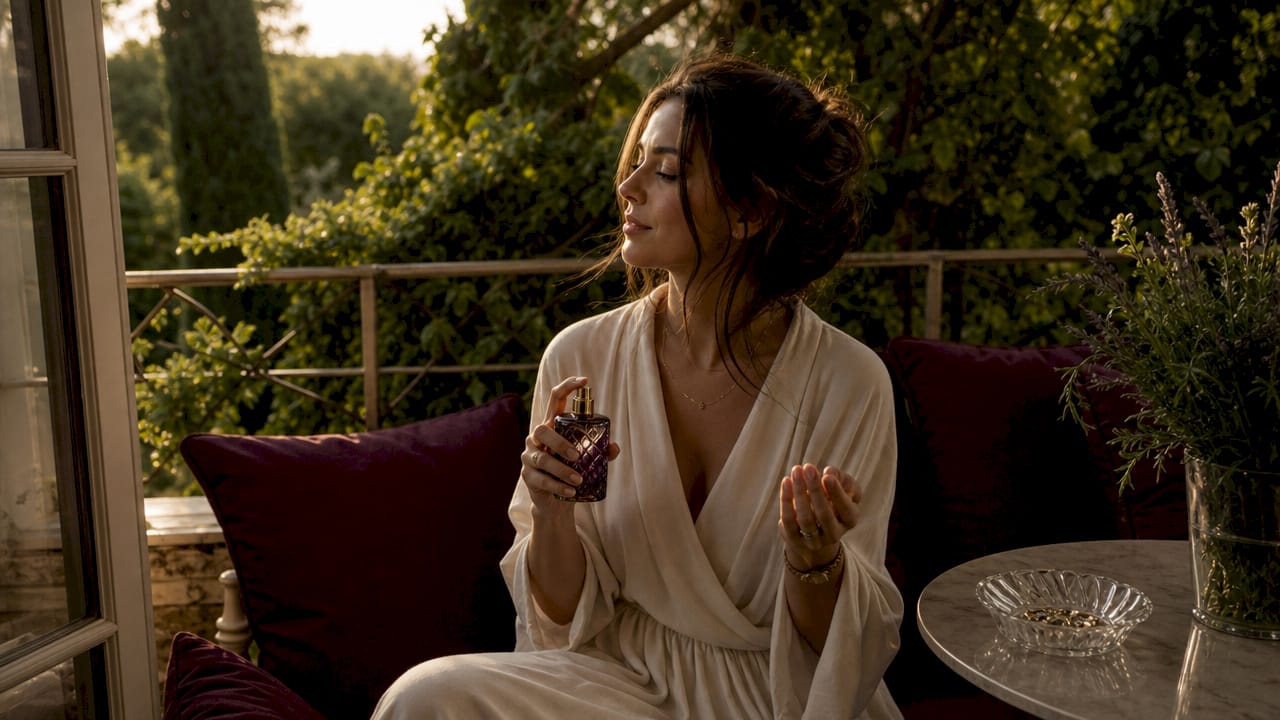
Purposeful fragrance use goes further than mood. It becomes a mirror for personal identity through scent. The fragrances you return to repeatedly reveal something about your inner world: your need for grounding, your appetite for warmth, your preference for clarity. Wearing perfume with this awareness turns a daily habit into a form of self-inquiry.
Research confirms that intentional scent selection also shifts physical presence. People who wear fragrance for themselves rather than for approval report changes in posture, pace, and tone of voice. The internal shift is subtle but consistent. Confidence becomes quieter and more grounded.
- Scent as identity signal: The fragrances you choose communicate values and temperament without words.
- Olfactory anchors: Repeated use of a scent in a specific context builds a reliable emotional trigger.
- Internal dialogue: Wearing perfume intentionally changes how you speak to yourself, not just how others perceive you.
- Presence and posture: Scent worn for personal resonance shifts physical bearing in measurable ways.
- Memory and emotion: The olfactory system’s direct link to the limbic brain makes fragrance uniquely powerful for mood regulation.
Pro Tip: Choose one fragrance to wear exclusively during a morning preparation ritual for three weeks. Notice whether your mood shifts when you apply it, even before you leave the house.
How to wear perfume intentionally: key practices and techniques
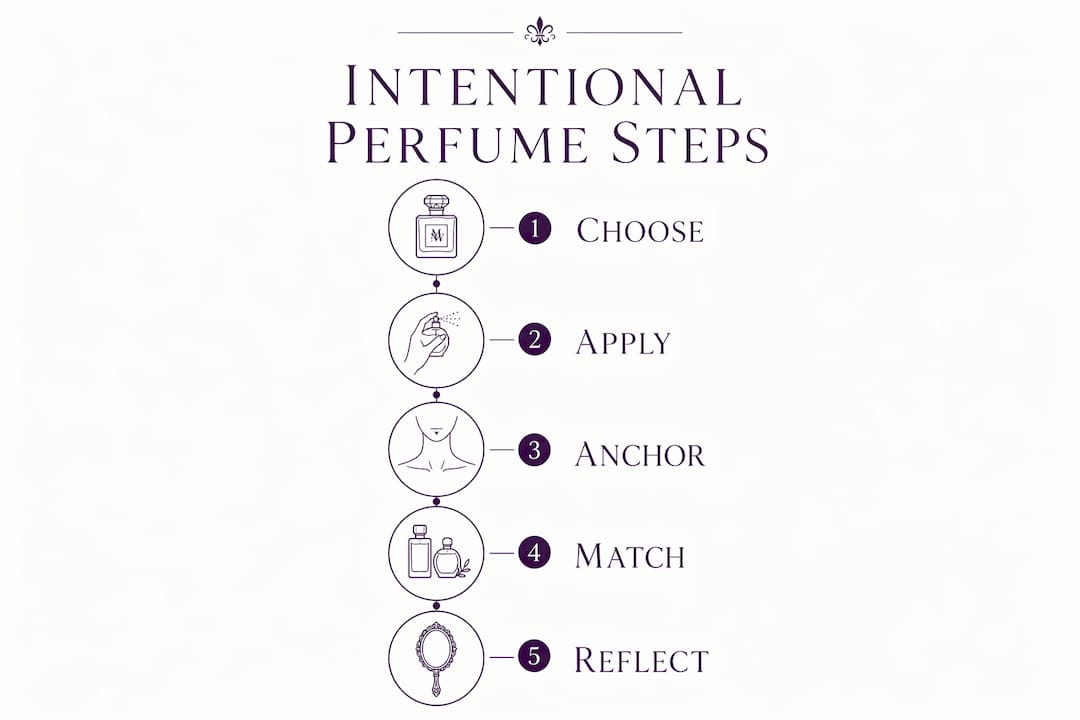
Wearing perfume with intention is less about quantity and more about alignment. The goal is to match your scent choice to your emotional aim, the occasion, and the time of day, then apply it with presence rather than habit.
Matching scent to moment
Citrus and green notes support energy and mental clarity. They work well in the morning or before focused work. Woody and resinous notes provide grounding. They suit evenings, creative work, or moments when you need to feel settled. Floral and musky notes carry warmth and openness, making them well suited to social settings or moments of emotional softness. Fragrance families each carry a natural emotional bias, and working with that bias rather than against it is the foundation of intentional scent selection.
Charging your fragrance with intention
Charging a perfume with intention is a psychological practice, not a mystical one. It means applying your fragrance slowly and with full attention, holding a clear emotional aim in mind as the scent settles on your skin. This focused state allows the emotional meaning you assign to the scent to become part of how you experience it. Consistent scent rituals strengthen this association over time, making the fragrance a reliable anchor for that emotional state.
Layering versus single scent wear
| Approach | Best for | Key consideration |
|---|---|---|
| Single scent wear | Building a strong olfactory anchor | Consistency deepens emotional association |
| Layering two scents | Personalizing mood or occasion | Start with the heavier base, apply lighter note on top |
| Seasonal rotation | Reflecting inner and outer change | Rotate with intention, not restlessness |
| Scent wardrobe | Full emotional range across contexts | Curated fragrance wardrobe requires patience and self-knowledge |
Artisan perfumers emphasize that high-quality natural materials need time to reveal their true character on skin. Rushing the process, or over-applying to compensate, works against the fragrance. Patience is not passive. It is part of the practice.
- Apply to pulse points: wrists, inner elbows, the base of the throat.
- Let the fragrance settle for ten minutes before assessing it.
- Resist the urge to layer more before the first application has opened fully.
- Rotate scents by season and emotional need, not by trend.
- Keep a short mental note of how each scent makes you feel after thirty minutes.
Pro Tip: When layering, apply your base note first and wait five minutes before adding the lighter scent. This lets each layer breathe and prevents the combination from reading as a single muddled note.
How can fragrance support emotional wellbeing and mental clarity?
Functional fragrance is defined as the intentional use of scent to support specific emotional states such as energy, focus, and calm throughout the day. This differs from traditional perfumery, which focuses primarily on scent profile and aesthetic pleasure. Functional fragrance treats the olfactory experience as a tool with a purpose.
The biochemical basis is well established. Scent molecules interact with olfactory receptors that connect directly to the amygdala and hippocampus. These are the brain’s centers for emotional processing and memory. The result is that fragrance can shift mood faster than almost any other sensory input.
- Citrus and green notes (bergamot, grapefruit, basil): support alertness and mental energy.
- Woody and earthy notes (cedarwood, vetiver, sandalwood): promote grounding and calm.
- Floral notes (rose, jasmine, neroli): encourage emotional openness and warmth.
- Resinous and amber notes (frankincense, labdanum, benzoin): support focus and a sense of protection.
- Herbal notes (lavender, rosemary, sage): reduce tension and support mental clarity.
Aroma anchoring takes this further. You apply a specific scent consistently before a desired emotional state, such as calm before sleep or focus before writing. Over weeks, the scent alone begins to cue that state. Wellness practitioners describe this as one of the most accessible forms of fragrance for introspection and emotional regulation available without clinical intervention.
Scented spaces extend the practice beyond the body. A candle or room scent in your workspace, chosen with the same intentionality as your personal fragrance, creates an environmental anchor that supports sustained focus or relaxation throughout the day.
What mindset shifts make intentional perfume wearing work?
The most common obstacle to purposeful fragrance use is wearing perfume for other people. Choosing a scent based on what you imagine others will find appealing places the entire practice outside yourself. It turns fragrance into performance rather than presence.
Wearing perfume for yourself shifts the practice entirely. The pressure to select the “right” scent dissolves when the only measure of success is how the fragrance makes you feel. This is not selfishness. It is the condition under which fragrance actually works as a wellbeing tool.
Perfume perceived as what it represents emotionally, rather than its molecular ingredients, carries meaning that is entirely personal. That meaning is what makes it powerful. A scent that grounds you is worth more than a scent that impresses a room.
- Release the idea of a universally correct fragrance choice.
- Ask “how does this make me feel?” before “what will others think of this?”
- Treat your fragrance ritual as private preparation, not public presentation.
- Allow your scent preferences to change as you change.
Pro Tip: The next time you test a fragrance, close your eyes after applying it and sit with it for two minutes before forming an opinion. Your first emotional response, before analysis, is the most honest signal.
Key takeaways
Intentional perfume wearing is the practice of choosing and applying fragrance consciously to reflect personal identity, regulate emotional states, and build a consistent sense of presence and self.
| Point | Details |
|---|---|
| Definition of intentional wearing | Purposeful scent selection aligned with mood, identity, and occasion rather than habit or approval. |
| Olfactory anchors | Consistent use of a scent in a specific context builds a reliable emotional trigger over time. |
| Functional fragrance | Scent families carry emotional biases; matching them to your aim makes fragrance an active wellbeing tool. |
| Mindset shift required | Wearing perfume for yourself rather than others dissolves performance pressure and deepens the practice. |
| Patience and natural materials | High-quality natural ingredients reveal their character slowly; intentional wearing mirrors personal growth. |
Why I think most people are wearing perfume backwards
I spent years choosing fragrances based on what I thought they said about me to other people. The result was a collection of scents I admired intellectually but rarely felt anything wearing. The shift came when I started asking a different question: not “what does this communicate?” but “what does this do to me?”
That reorientation changed everything. A woody, resinous scent I had dismissed as too quiet became the fragrance I reached for before any situation requiring steadiness. A bright citrus blend I had written off as too simple became the one that reliably lifted my mood on difficult mornings. Neither choice would have impressed anyone at a fragrance counter. Both changed how I moved through my days.
The patience piece is the part most people skip. Artisan perfumery is intentional in a way that mass-market fragrance rarely is, and that intentionality asks something of the wearer too. You have to slow down enough to notice what a scent is doing, not just what it smells like in the first thirty seconds. That slowness is where the practice actually lives.
Scent as self-expression is not about trends or status. It is about building a private vocabulary of feeling. The fragrances that matter most are the ones that build confidence and presence from the inside out, quietly and consistently, without needing anyone else to notice.
— Celeste
Maisonvoyageurparfum: fragrance crafted for self-discovery
Maisonvoyageurparfum was built around the idea that real luxury is time to explore within yourself. Each fragrance in the collection is slowly made with 98% natural ingredients, designed to evoke emotion and memory rather than simply to impress.

For those beginning a scent ritual practice, the Personalized Soy Candle offers a grounding starting point: a handcrafted, customizable candle designed to support manifestation and daily preparation. For a deeper introduction to the full collection and the philosophy behind it, the Maisonvoyageurparfum atelier in Madrid offers a personal, unhurried experience of intentional scent selection.
FAQ
What is intentional perfume wearing?
Intentional perfume wearing is the conscious selection and application of fragrance to reflect personal identity and support emotional wellbeing, rather than wearing scent out of habit or for external approval.
How does scent influence mood and emotional state?
Scent molecules connect directly to the brain’s limbic system, which governs emotion and memory. This biological link allows fragrance to shift mood faster than almost any other sensory input, making it a reliable tool for emotional regulation.
What are olfactory anchors and how do they work?
An olfactory anchor is a scent worn consistently in a specific emotional context until the fragrance itself triggers that emotional state on demand. Repeated use over weeks strengthens the association between the scent and the desired feeling.
Which scent families support specific emotional outcomes?
Citrus and green notes support energy and focus. Woody and resinous notes promote grounding and calm. Floral and musky notes encourage warmth and openness. Matching your scent family to your emotional aim is the core of functional fragrance practice.
How do I start wearing perfume with intention?
Begin by choosing one fragrance and applying it slowly, with full attention, before a consistent daily activity. Notice how the scent makes you feel after ten minutes, not just on first application. Repeat the ritual daily and let the emotional association build naturally over time.
Recommended
- How Fragrance Promotes Introspection: A Science Guide – Maison Voyageur
- Why Perfume Tells Your Story: Scent, Memory, and Identity – Maison Voyageur
- Why Natural Perfume Smells Complex: The Real Science – Maison Voyageur
- Harmful Chemicals in Mass Perfumes: What to Avoid – Maison Voyageur
Les sept fragrances Maison Voyageur
- Manifesting · unisexe (69,99 €)
- Intuition · femme (69,99 €)
- Certainty · femme (69,99 €)
- Expansion · femme (69,99 €)
- Release · homme (69,99 €)
- Presence · homme (69,99 €)
- Inner Fire · homme (69,99 €)
Nouvelle ici ? Commence par le Discovery Set · les 7 fragrances en format voyage (40 €).