
What Does 98% Natural Ingredients Mean for You?
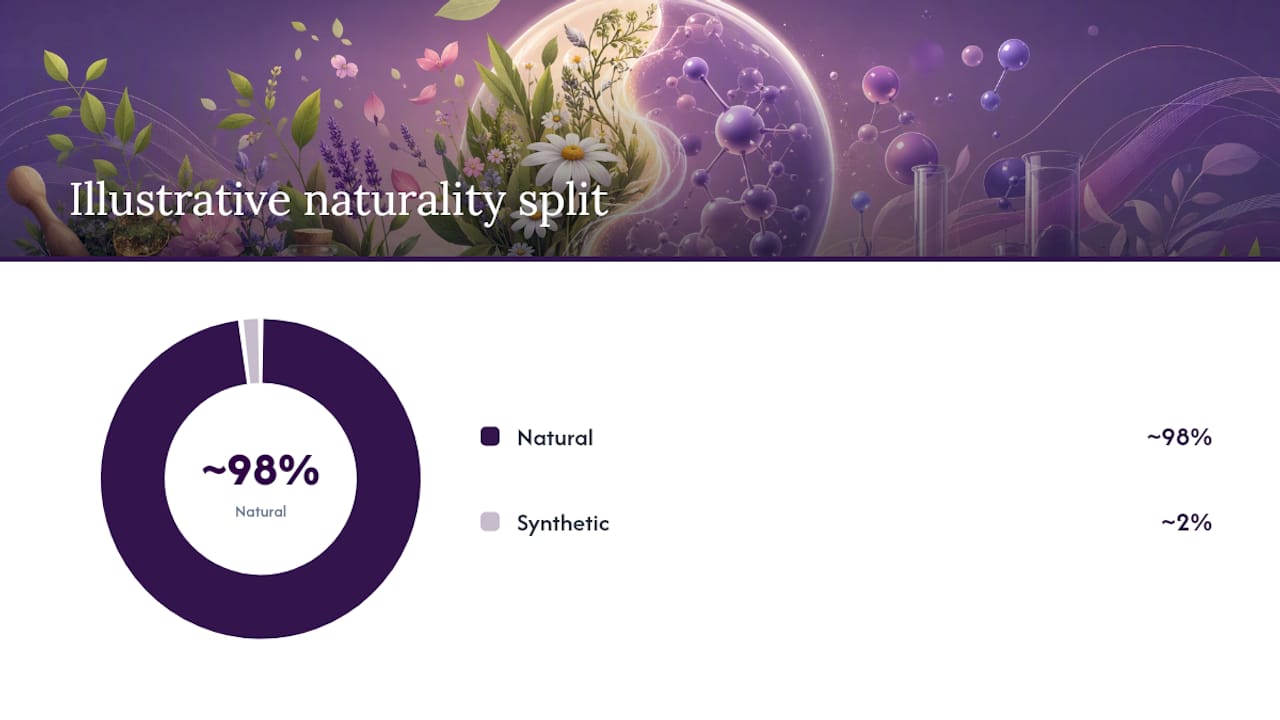
When a product says “98% natural ingredients,” it is reporting a brand-calculated figure, not a U.S. government certification. For most personal-care products and fragrances, no federal agency has issued a binding legal definition of “natural.” The percentage typically follows the ISO 16128 calculation framework, where each ingredient receives a naturality index between 0 and 1, weighted by its share of the formula. The FDA has a longstanding policy on the word “natural” for food labels but has never formalized it into a binding rule for cosmetics or for fragrances. The FTC can act if a claim is deceptive, but no single agency certifies the number.
What fills the remaining small fraction? Usually one or more of these:
- Preservatives such as phenoxyethanol, added for microbial safety
- Stabilizers that prevent separation or oxidation
- Synthetic fragrance molecules or nature-identical aroma chemicals for scent consistency
- Solubilizers that help oil and water phases blend
Your first action: pull up the full INCI ingredient list. Order reflects concentration, and Truth in Advertising has documented that “natural” percentage claims can appear inconsistently across marketing channels and product pages.
Table of Contents
- Which U.S. agencies set rules, and who actually enforces them?
- What the remaining ~2% commonly contains
- How third-party certifications compare to a brand’s percentage claim
- How to verify a “98% natural” claim before you buy
- A simple calculation that produces ~98% natural
- Key Takeaways
- Why ingredient transparency matters to Maisonvoyageurparfum
- Official sources worth bookmarking
Which U.S. agencies set rules, and who actually enforces them?
Three agencies shape the regulatory space around “natural” claims in the U.S., each with a different scope and level of authority.
FDA holds a policy, not a rule. It has stated that it considers “natural” to mean nothing artificial or synthetic has been added that would not normally be expected. That policy applies to food labels and does not address production methods, processing technologies, or cosmetics. No binding federal definition exists for most product categories.
USDA is the one agency with an enforceable definition, but only for meat and poultry. Under USDA Food Safety and Inspection Service rules, “natural” on a meat label means minimally processed with no artificial ingredients. USDA Organic is a separate, stricter standard with its own certification requirements. It governs organic content, not “natural” content, and the two terms are not interchangeable.
FTC operates under advertising law. It can investigate and act on “natural” claims that mislead consumers, but it does not pre-approve labels or issue certifications.
The practical result: most “natural” percentages on personal-care and fragrance products are industry or brand statements. They may be accurate and carefully calculated, or they may be loosely applied marketing language. The label alone cannot tell you which is the case.
What the remaining ~2% commonly contains
That small fraction carries real functional weight. A formula can be mostly natural by index and still include ingredients that some shoppers actively want to avoid.
Common inclusions in this non-natural portion include:
- Synthetic aroma chemicals — individual fragrance molecules such as synthetic linalool or iso e super, used for consistency and longevity in a scent profile
None of these are inherently harmful. Preservatives, in particular, exist to protect you. A product without any preservation system in a water-containing formula is a microbial risk. The role of synthetic fragrance molecules is more nuanced: some are used because the natural equivalent is cost-prohibitive or ecologically sensitive to harvest at scale.
Pro Tip: If synthetic fragrances are a concern for you, look for “natural fragrance” or the specific botanical source on the INCI list. A vague “fragrance” entry can legally contain dozens of undisclosed synthetic molecules. Contact the brand and ask whether their fragrance component is fully natural-origin.
How third-party certifications compare to a brand’s percentage claim
A brand’s self-reported “98% natural” and a third-party certification seal are not the same thing. They answer different questions.
| Standard | Scope | Enforceability | Calculation method | Consumer assurance |
|---|---|---|---|---|
| Brand claim (ISO 16128) | Any product category | Company declaration | ISO 16128 index × weight% | Low — no external audit |
| NATRUE | Cosmetics and personal care | Third-party certified | ISO 16128 + conservative supplier ranges | High — audited annually |
| COSMOS | Cosmetics and personal care | Third-party certified | Own standard, ingredient-level rules | High — audited |
| USDA Organic | Food, some personal care | Federally enforced | Organic content percentage | High — government-backed |
COSMOS and NATRUE both set minimum thresholds for certification levels. NATRUE, for example, maps product-level natural percentages to eligibility tiers and requires brands to apply the most conservative value when a supplier provides a range for raw-material composition. That conservative approach prevents brands from cherry-picking the most favorable number from a supplier’s data sheet.
USDA Organic governs organic content, not naturality percentage. A product can be USDA Organic certified and still contain synthetic preservatives permitted under the National Organic Program. The two standards measure different things.
How to verify a “98% natural” claim before you buy
A label is a starting point, not a conclusion. Here is a practical sequence for evaluating any natural ingredient percentage:
- Read the INCI list in order. Ingredients are listed from highest to lowest concentration. If water or a carrier oil is first, the high naturality percentage may reflect that base more than any active botanical.
- Look for a certification seal. COSMOS, NATRUE, or USDA Organic seals indicate third-party verification. A bare percentage with no seal is a brand declaration.
- Find the brand’s transparency page. Reputable brands publish their calculation methodology. Look for mentions of ISO 16128, supplier-range handling, and how fragrance components are counted.
- Ask the manufacturer directly. Specific questions get useful answers: Did you use ISO 16128? Did you apply supplier ranges conservatively? Is the fragrance component fully natural-origin?
- Check for “fragrance” or “parfum” entries. These can legally aggregate many individual molecules under one term. A brand committed to transparency will specify whether that entry is natural or synthetic.
When to be more skeptical:
- Water is the first ingredient and the brand offers no breakdown of active natural content
- The INCI list includes “fragrance” or “parfum” with no further detail
- No calculation method is disclosed and no third-party seal appears
- The percentage appears only in marketing copy, not on the product label itself
Learning to read natural fragrance ingredient labels is one of the most practical skills a conscious shopper can develop.
A simple calculation that produces ~98% natural
The table below shows a hypothetical, illustrative formula using the ISO 16128 approach. No brand or product is named. The purpose is to show how the math behaves.
| Ingredient | Weight % | Naturality index | Weighted contribution |
|---|---|---|---|
| Water | substantial portion | 1.0 | high naturality contribution |
| Jojoba oil | significant portion | 1.0 | correspondingly high |
| Rose hip extract | notable portion | — | notable contribution |
| Emulsifier (derived natural) | moderate portion | lower index | moderate contribution |
| Phenoxyethanol (preservative) | small portion | — | no naturality contribution |
| Synthetic aroma chemical | small portion | — | no naturality contribution |
The overall naturality percentage depends on ingredient shares and indexes. Adjusting ingredient proportions and selecting higher-index components can raise the naturality figure. The formula retains a small synthetic fraction by weight, while the naturality index sums weighted contributions rather than a simple natural vs synthetic count.
Supplier ranges matter here. If a raw-material supplier states that a botanical extract has a naturality index between 0.7 and 0.95, a brand applying ISO 16128 conservatively must use 0.7. A brand using 0.95 will report a higher percentage from the same formula. Both are technically applying the framework — but only one is being conservative.
This is why third-party certification, with its requirement for audited, conservative supplier-range handling, offers a more reliable signal than a self-reported number alone.
Key Takeaways
A “98% natural” claim is a brand-calculated metric using the ISO 16128 framework, not a U.S. government certification, and the remaining ~2% often contains functional synthetics that serve real safety or stability purposes.
| Point | Details |
|---|---|
| Brand claim, not certification | “98% natural” is self-reported unless a COSMOS, NATRUE, or USDA Organic seal confirms third-party verification. |
| ISO 16128 explains the math | The framework assigns each ingredient an index of 0–1, weighted by formula percentage — it is a calculation tool, not a consumer seal. |
| Water inflates the percentage | A 75% water formula starts with a 0.75 naturality contribution before any botanical is added. |
| The ~2% often serves safety | Preservatives and stabilizers in the non-natural fraction protect product integrity and consumer safety. |
| Verify via INCI and seals | Check ingredient order, look for certification logos, and ask the brand for its calculation methodology. |
Why ingredient transparency matters to Maisonvoyageurparfum
At Maisonvoyageurparfum, the 98% natural figure is not a marketing shorthand. It reflects a deliberate choice made slowly, ingredient by ingredient, in the way artisan perfumery has always worked. Each raw material is selected for what it carries: the memory of a place, the warmth of a resin, the quiet clarity of a citrus note harvested at the right moment. Natural materials are the foundation because they hold complexity that synthetic approximations rarely match.
That said, honest craftsmanship means acknowledging what the remaining fraction does. A small, carefully chosen synthetic component can protect a formula’s integrity across climates and time, allowing the natural heart of a scent to arrive as intended. Maisonvoyageurparfum’s slow luxury philosophy is built on that balance: transparency about what is in the bottle, and why.
Conscious shoppers deserve to know both the number and the reasoning behind it. That is what real ingredient transparency looks like.
Official sources worth bookmarking
- Use of the term ‘Natural’ on Food Labeling — FDA
- ISO 16128 fact sheet — NATRUE
- ISO 16128-2:2017 — Guidelines on technical definitions and criteria for natural and organic cosmetic ingredients — Part 2
- UConn Extension — Food labels
- NATRUE product-category calculation and certification-level guidance (Feb 2024)
- When natural means 98% natural — Truth in Advertising
This article is general consumer information, not legal or regulatory advice. For current rules specific to your product category, consult the FDA, FTC, or a qualified regulatory professional.
Recommended
- Ingrédients naturels parfum 98 pourcent : guide 2026 – Maison Voyageur
- How to Read Natural Fragrance Ingredient Labels – Maison Voyageur
- Why Natural Perfume Smells Complex: The Real Science – Maison Voyageur
- Ingredientes naturales en alta perfumería: guía esencial – Maison Voyageur
Les sept fragrances Maison Voyageur
- Manifesting · unisexe (69,99 €)
- Intuition · femme (69,99 €)
- Certainty · femme (69,99 €)
- Expansion · femme (69,99 €)
- Release · homme (69,99 €)
- Presence · homme (69,99 €)
- Inner Fire · homme (69,99 €)
Nouvelle ici ? Commence par le Discovery Set · les 7 fragrances en format voyage (40 €).