
What Is the Olfactory Pyramid? A Clear Guide to Scent Structure
The olfactory pyramid is the model perfumers use to map how a fragrance unfolds on skin, sorting its ingredients into three layers by how quickly they evaporate.
- Top notes: the first impression, bright and fleeting, gone within minutes.
- Heart notes: the fragrance’s main character, emerging as the top fades.
- Base notes: the quiet, long-lasting foundation that lingers for hours.
Knowing this changes how you test a perfume. What you smell in the first thirty seconds is rarely what you’ll wear for the rest of the day.
Key Takeaways
The olfactory pyramid works because it maps evaporation speed, not marketing appeal, so testing on skin over several hours beats reading any note list.
| Point | Details |
|---|---|
| Three layers, one timeline | Top notes fade in minutes, heart notes emerge next, base notes anchor the fragrance for hours. |
| Evaporation drives everything | Poucher’s coefficients (top ~1 minute, heart ~15 minutes, base hours) explain why timing differs by layer. |
| The model has limits | Many modern fragrances present their character upfront instead of in strict tiered stages. |
| Families are a filter, not a rule | Seven families exist, but most fragrances blend two or three and lean on the dominant one. |
| Test before you trust the label | Maison Voyageur’s sampler sets let you track a scent’s real evolution from open to drydown. |
Table of Contents
- Where the Fragrance Pyramid Explained Model Comes From
- Top, Heart, and Base Notes: What Actually Happens on Skin
- Reading the Pyramid Without Being Fooled by It
- The Seven Olfactory Families, Explained Simply
- How to Test a Perfume Using the Pyramid
- What Olfactory Memory Teaches Us About Scent Storytelling
- Frequently Asked Questions
- Sources
Where the Fragrance Pyramid Explained Model Comes From
The pyramid isn’t a marketing invention. It traces back to Jean Carles, a French perfumer who, in the mid-twentieth century, formalized the idea of grouping raw materials by volatility rather than by scent family alone. His method gave perfumers a shared vocabulary for describing how a composition changes over time.
At its core, the pyramid is a craft and communication tool. It helps a perfumer plan a formula so the opening, the middle, and the drydown feel intentional rather than accidental. For you, standing in front of a counter or a sample vial, it does something similar. It sets honest expectations. A perfume rarely smells the same at minute one as it does at hour four, and the pyramid explains why that’s normal, not a flaw in the fragrance or in your nose.
Top, Heart, and Base Notes: What Actually Happens on Skin
Every layer of the pyramid corresponds to a real physical property: how fast a molecule evaporates. Perfumer George William Septimus Poucher assigned numeric evaporation coefficients to note classes), and those numbers still shape how fragrances are built today.
| Layer | Evaporation coefficient | Typical duration | Example notes |
|---|---|---|---|
| Top | ~1 minute | 5–15 minutes | Bergamot, lemon, mint, pink pepper |
| Heart | ~15 minutes | minutes to hours | Jasmine, rose, lavender, iris |
| Base | hours | hours | Sandalwood, vanilla, musk, amber |
Pro Tip: Spray a sample and set a timer for 15 minutes, then 90 minutes, then 4 hours. Write down one word each time. You’ll learn more about a fragrance’s real structure than any note list could tell you.
Individual skin chemistry, the concentration of the perfume, and the raw materials used in the formula all shift these timings. A vanilla absolute behaves differently than a synthetic vanillin, and dry skin holds base notes shorter than skin with more natural oil. Treat the table as a guide to sequence, not a stopwatch.
Reading the Pyramid Without Being Fooled by It
A classical, pyramid-built perfume reveals itself in stages: sharp citrus opens, floral or spice notes take over, then a warm base settles in for the long haul. Many modern releases skip that choreography entirely. Perfumery critic Denyse Beaulieu at Bois de Jasmin has noted that contemporary fragrances often present their main character from the opening spray, rather than building toward it. These “panoramic” compositions can smell nearly the same at minute five as they do at hour three.
Watch for these signals when reading a note list on packaging or a press release:
- Notes that seem chosen for appeal rather than for how they’d actually smell together, like “rain” or “cloud.”
- A heavy base claim (oud, amber, musk) with no mention of a fixative that could actually hold it there.
- Longevity promises that don’t match the concentration listed on the bottle.
- A note list so long it reads like a marketing brainstorm rather than a formula.
The pyramid remains a useful map for style and dominant character, but the only real test is on your own skin.
The Seven Olfactory Families, Explained Simply
Beyond timing, fragrances group into scent families, and knowing them helps you filter what you like faster than any note list. The Fundación Academia del Perfume recognizes seven principal families:
- Citrus (Hesperide): bergamot, lemon, grapefruit. Light, energizing, best in warm weather.
- Floral: rose, jasmine, tuberose. The largest family, ranging from soft to opulent.
- Woody: sandalwood, cedar, vetiver. Grounding, works year round.
- Fougère: lavender, oakmoss, coumarin. Classic, herbaceous, often in men’s fragrances.
- Chypre: bergamot, oakmoss, labdanum. Sophisticated, best for evening.
- Amber/Oriental: vanilla, benzoin, resins. Warm and enveloping, suited to cold weather.
- Gourmand: caramel, cocoa, praline. Sweet and comforting, popular in cooler seasons.
Most fragrances blend two or three families and get classified by whichever one dominates. A consumer-facing family chart can point you toward fresh families for summer and woody or amber families for evening and winter wear, which makes the system a practical shortcut rather than a rigid label.
How to Test a Perfume Using the Pyramid
- Spray once on skin, not just a blotter. Skin oils change how notes develop, and that’s the point.
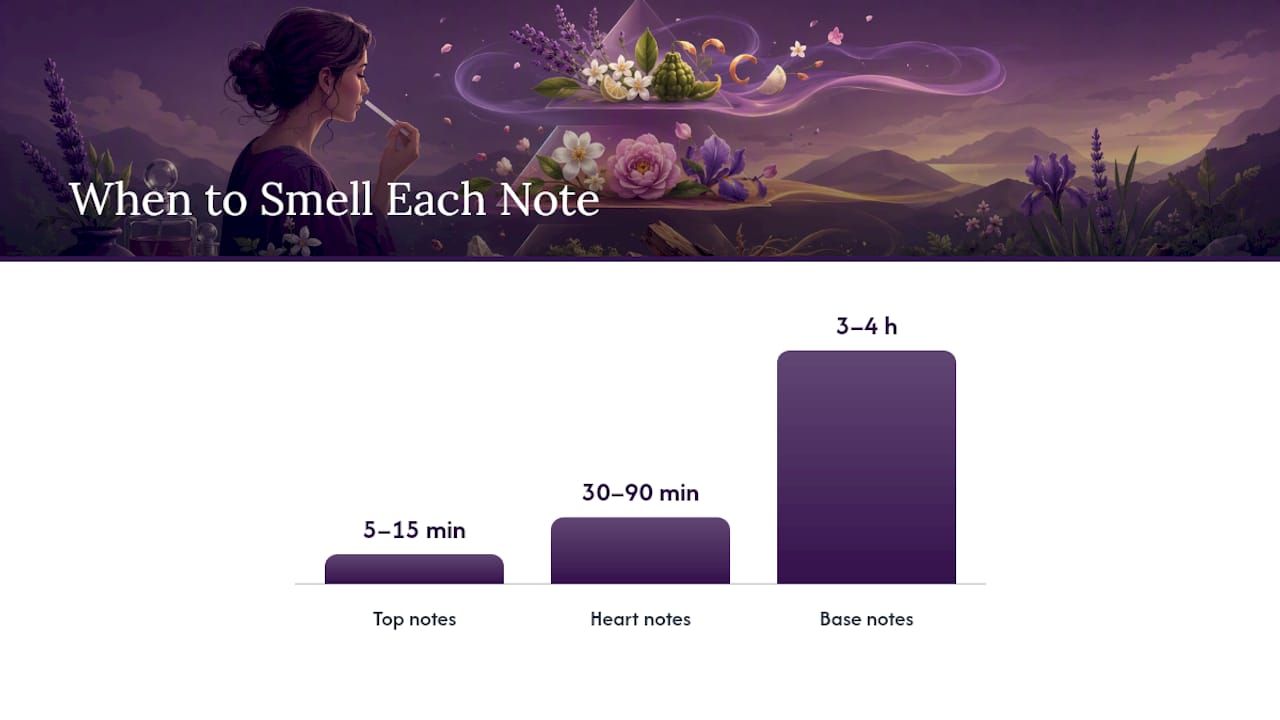
- Wait 5 to 15 minutes before judging the top notes. Don’t decide based on the spray alone.
- Check back at the 30 to 90 minute mark to catch the heart notes settling in.
- Smell the base at the 3 to 4 hour mark, ideally after a few hours of normal movement.
- Test no more than two or three scents per session so your nose doesn’t fatigue.
- Note the concentration (EDT fades faster than EDP), and remember that heat and humidity intensify projection.
Pro Tip: Rotate testing across a morning and an evening. Skin temperature and humidity shift throughout the day, and the same fragrance can read noticeably warmer at night.
For deeper background on how concentration affects what you’re smelling, our guide on perfume concentration differences breaks down EDT versus EDP in practical terms.
What Olfactory Memory Teaches Us About Scent Storytelling
A fragrance that unfolds slowly gives your memory something to hold onto. The opening becomes a moment, the heart becomes a mood, and the base becomes what lingers on a scarf or a pillow days later. That’s why testing on skin matters so much more than reading a note list.
Natural materials rarely behave in straight lines. A real jasmine absolute or a slow-extracted vetiver shifts in ways a single synthetic molecule can’t, which is exactly what makes a fragrance worth sitting with instead of judging in the first ten seconds.
Working with a high percentage of natural materials, as Maison Voyageur’s approach does, tends to produce more visible transitions between layers. If you want to feel this for yourself, try a sampler set and wear the same scent once in the morning and once in the evening.
A Note From the Editor
Trust your patience more than your first impression. A fragrance that rewards ten minutes of attention usually rewards ten years of wear.
Try the Pyramid on Your Own Skin
There’s a difference between reading about top, heart, and base notes and actually watching them happen. Maison Voyageur’s sampler sets let you track a fragrance’s full evolution before committing to a full bottle, at a fraction of the cost and none of the guesswork of buying blind.

Each set is built for exactly the kind of testing this guide walks through: spray, wait, check back, and see whether the base note that hooked you online still holds up on your own skin hours later. If you’re not sure where to start, the seven archetypes discovery method walks you through matching a scent family to how you actually want to feel wearing it. Order a sampler set and give yourself the morning-to-evening test this week.
Frequently Asked Questions
What is the olfactory pyramid in simple terms? It’s a model that sorts a perfume’s ingredients into three layers, top, heart, and base, based on how quickly each one evaporates off your skin.
How long do top notes typically last? Top notes generally fade quickly, often within minutes, though exact duration varies by concentration and skin chemistry.
Does every perfume follow the pyramid structure? No. Many modern fragrances, especially panoramic or collage-style compositions, present their main character from the first spray rather than building toward it in stages.
Why do note lists on packaging sometimes feel misleading? Marketing note lists often highlight trend-driven or appealing ingredients that play only a minor role in the actual formula, so the real test is always on skin.

How many olfactory families are there? Seven principal families are widely recognized: Citrus, Floral, Woody, Fougère, Chypre, Amber/Oriental, and Gourmand, though most fragrances blend more than one.
Sources
- Familias Olfativas » Fundación Academia del Perfume
- What is the Fragrance Pyramid and Perfume Notes? - Bois de Jasmin
- The Olfactive Pyramid guide — DropOfOdor
- Familias olfativas en perfumería: guía completa | divain
Recommended
- Cómo se percibe la evolución olfativa: guía esencial – Maison Voyageur
- Why Natural Perfume Smells Complex: The Real Science – Maison Voyageur
- Why Certain Smells Feel Like Home – Maison Voyageur
- Cómo funciona la memoria olfativa: guía para perfumes – Maison Voyageur
Les sept fragrances Maison Voyageur
- Manifesting · unisexe (69,99 €)
- Intuition · femme (69,99 €)
- Certainty · femme (69,99 €)
- Expansion · femme (69,99 €)
- Release · homme (69,99 €)
- Presence · homme (69,99 €)
- Inner Fire · homme (69,99 €)
Nouvelle ici ? Commence par le Discovery Set · les 7 fragrances en format voyage (40 €).