
Inner Journey Through Scent: A Self-Discovery Guide
The inner journey through scent is the intentional practice of smelling to unlock emotional memories and guide personal reflection. Unlike passive fragrance enjoyment, this practice treats each scent as a portal to inner states, inviting you to notice what rises in your body and mind before thought takes over. Neuroscience confirms that smell reaches the brain’s emotional centers faster than any other sense. That speed makes fragrance a uniquely direct tool for self-discovery. Maisonvoyageurparfum was built on exactly this idea: that a slowly made scent, crafted from natural ingredients, can offer more than pleasure. It can offer a quiet conversation with yourself.
What is inner journey through scent, and why does it matter?
The inner journey through scent is defined as using conscious, attentive smelling to access emotion, memory, and self-understanding. This framing appears in both clinical olfactory somatics and wellness practice. The key word is intentional. You are not simply enjoying a perfume. You are pausing, breathing, and listening to what the scent stirs inside you.
Scent bypasses the logical filters of the mind. While sight and sound travel through the thalamus before reaching emotional centers, olfactory signals project directly to the amygdala and hippocampus. Those two structures govern emotion and memory. That direct route is why a single whiff of cedar or orange blossom can pull you back to a specific afternoon from twenty years ago with startling clarity.
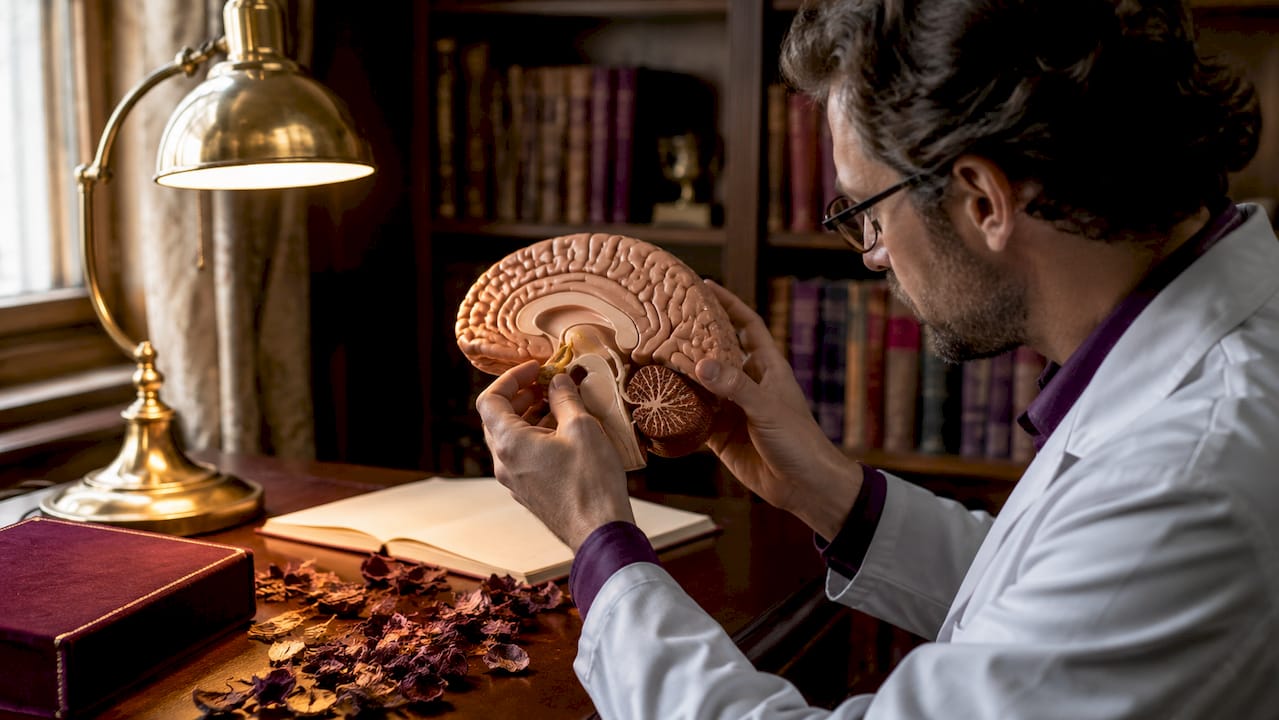
This makes fragrance a rare tool for inner exploration. Other sensory experiences require more cognitive processing before they reach feeling. Scent arrives at feeling first. That quality is what gives the aromatic journey of the soul its depth and its intimacy.
How does scent connect to the brain and memory?
The limbic shortcut
The olfactory system is the only sensory system with a direct anatomical connection to the limbic brain. Olfactory signals bypass the thalamus and reach the amygdala and hippocampus without detour. The amygdala processes emotional significance. The hippocampus encodes and retrieves memory. When a scent activates both simultaneously, the result is a memory that feels immediate, vivid, and charged with feeling.
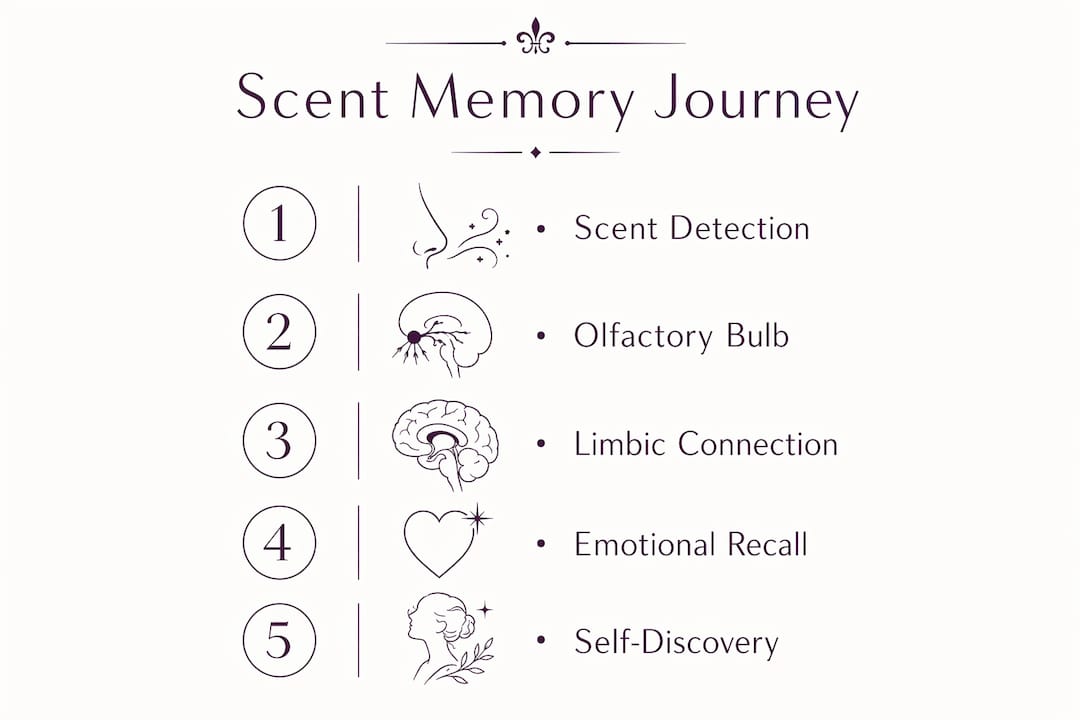
This is not a poetic metaphor. It is neurobiological architecture. The emotional intensity of scent memories is rooted in how the brain is wired, not in imagination. That is why certain smells feel like home, even when you cannot explain why.
Here is what this means for your inner exploration through fragrance:
- Scent memories are often pre-verbal. They form before language and live outside the reach of talk therapy.
- Emotional reactions to scent can surface without conscious effort or narrative.
- The body responds to scent before the mind has time to interpret it.
- Repeated exposure to a specific scent strengthens the neural pathway between that scent and its emotional associations.
Pro Tip: When you smell a new fragrance, close your eyes and wait five seconds before forming any opinion. Let the body respond first. Notice where you feel it: chest, throat, stomach. That physical location is data.
Why scent memories feel more intense
Scent memories carry a quality researchers call “Proustian memory,” named after Marcel Proust’s famous description of involuntary recall triggered by smell. The intensity comes from the amygdala’s direct involvement. Emotional tagging happens at the moment of encoding, which means the memory is stored with its feeling already attached. Other senses encode memory and emotion in separate steps. Scent encodes them together.
What emotional and physical effects does intentional scent exploration produce?
Relaxation and the nervous system
A 2025 study published in Scientific Reports found that pleasant odors slow respiration, decrease heart rate, and increase heart rate variability. These are measurable signs of nervous system relaxation. The same effects were not produced by pleasant music in the same study. That distinction matters. Scent appears to couple the brain and body in a way that other sensory inputs do not.
Heart rate variability, or HRV, is a marker of autonomic flexibility. Higher HRV is associated with better stress resilience and emotional regulation. The fact that pleasant scent raises HRV suggests that an aromatic practice can support the nervous system in a direct, physical way, not just a psychological one.
| Effect | What the research shows |
|---|---|
| Respiration rate | Pleasant odors slow breathing, promoting calm |
| Heart rate | Decreases with personally pleasant scent exposure |
| Heart rate variability | Increases, indicating better autonomic regulation |
| Subjective anxiety | May decrease, though not always aligned with physical markers |
The complexity of scent and anxiety
Scent effects are not universal. A 2025 pilot study found that lavender reduced self-reported anxiety but produced no measurable physiological change, while another scent showed the opposite pattern. Subjective experience and physiological response can diverge. This means you cannot assume a scent labeled “calming” will calm your nervous system. What matters most is your personal response to a given fragrance.
Personal scent preference shapes the relaxation response more than any universal category of “relaxing” aromas. A scent that brings you peace may do nothing for someone else. This is why personalized fragrance selection is central to meaningful inner work.
Pro Tip: Keep a small notebook near your fragrance collection. After each intentional smelling session, write one word for the emotion and one word for the physical sensation. Over weeks, patterns will emerge that reveal your personal scent map.
How can you use scent as a practical self-discovery tool?
Scent and self-discovery become a real practice when you build structure around the experience. These steps reflect principles from olfactory somatics and scent memory training:
- Choose a quiet moment. Morning or evening works well. Silence reduces cognitive noise and lets the olfactory experience take the foreground.
- Select one scent. A single fragrance at a time prevents sensory confusion. Hold the bottle or cloth close, breathe slowly, and give the scent your full attention.
- Observe the body first. Notice shifts in breath, muscle tone, or sensation before forming any story. Olfactory somatics practice treats these physical cues as the primary data, not the narrative that follows.
- Name what you notice. Label the emotion and any memory fragments that arise. Naming strengthens the neural link between the scent and its emotional content.
- Write it down. Journaling after a scent session captures insights that fade quickly. A brief entry of two to three sentences is enough.
- Repeat with the same scent over several days. Repeated mindful exposure deepens the memory network and enriches the emotional insight available from each session.
The most common mistake in this practice is forcing a narrative. You do not need to explain why a scent moves you. The goal is to notice, not to analyze. Curiosity serves this work better than interpretation.
Pro Tip: Incorporate one intentional scent moment into an existing ritual, such as lighting a candle before meditation or applying a fragrance before journaling. Pairing scent with a consistent context accelerates the depth of the practice.
How does scent-based inner work differ from other therapeutic approaches?
Scent vs. talk therapy and other sensory modalities
Talk therapy works through language and conscious narrative. It is powerful for processing explicit memories and building insight through reflection. Scent-based inner work reaches a different layer. Scent accesses pre-verbal material and emotion-memory links that exist outside language. This makes it complementary to talk therapy, not a replacement for it.
| Approach | Primary access point | Cognitive involvement | Body response |
|---|---|---|---|
| Talk therapy | Explicit, verbal memory | High | Indirect |
| Music therapy | Emotional and rhythmic memory | Moderate | Moderate |
| Visual art therapy | Symbolic and visual memory | Moderate to high | Indirect |
| Scent-based inner work | Implicit, pre-verbal memory | Low | Direct and immediate |
Music therapy influences mood and can regulate emotion through rhythm and melody. Scent goes further into the body. The 2025 Scientific Reports study showed that pleasant odors produced autonomic coupling between brain and body that pleasant music did not replicate. That physical coupling is the defining feature of emotional healing through fragrance.
Scent also carries fewer cognitive filters. You cannot intellectualize a smell the way you can a piece of music or a painting. The response arrives before the mind can shape it. That quality makes scent a gentle but direct portal for emotional activation.
One caution: physiological markers do not always confirm what you feel subjectively. Journaled reflections hold high value precisely because they capture the subjective layer that instruments may miss.
Key Takeaways
The inner journey through scent works because olfactory signals reach the brain’s emotional and memory centers directly, bypassing cognitive filters that other senses cannot avoid.
| Point | Details |
|---|---|
| Direct brain access | Scent projects to the amygdala and hippocampus without passing through the thalamus. |
| Personal preference matters | Your relaxation response depends on individual scent preference, not universal “calming” categories. |
| Body before narrative | Notice physical shifts first; avoid forcing a story onto the scent experience. |
| Repetition deepens insight | Repeated mindful smelling strengthens emotional memory networks over time. |
| Scent reaches pre-verbal memory | Unlike talk therapy, scent accesses implicit memories that exist outside language. |
Scent as a quiet teacher: a personal reflection
I have worked with fragrance and personal growth for years, and the insight that changed my practice was simple: scent does not lie. The mind edits. Language softens. But the body’s first response to a smell is honest in a way that almost nothing else is.
What I have noticed in repeated practice is that the scents I resist are often more revealing than the ones I love. A sharp, resinous note that makes me pull back slightly is worth sitting with. That small contraction in the chest is information. Patience is the skill this practice actually teaches, not olfactory sensitivity.
The mistake most people make is treating scent exploration as a performance. They expect a clear memory or a defined emotion. Real inner work through fragrance is quieter. It is a slight shift in breath. A warmth behind the sternum. A word that surfaces without context. Those small signals, tracked over time, build a map of your inner life that no conversation can replicate.
Treat scent as a gentle guide. Not a definitive answer. The aromatic journey of the soul is not a straight line. It circles back, surprises you, and asks you to stay curious rather than certain.
— Celeste
Maisonvoyageurparfum: scents made for inner exploration
Maisonvoyageurparfum was created for exactly this kind of practice. Each fragrance in the collection is slowly made with 98% natural ingredients, chosen to evoke emotion and memory rather than simply to please.

The Seven Archetypes Method at Maisonvoyageurparfum offers a structured way to find the scents most aligned with your inner world. The scent archetype quiz guides you toward fragrances that resonate with your emotional profile, removing the guesswork from selection. For those who want a grounding ritual at home, the personalized soy candle collection offers a tactile, intentional starting point for daily scent practice. Real luxury is time to explore within yourself.
FAQ
What is the inner journey through scent?
The inner journey through scent is the intentional practice of smelling to access emotional memories and guide self-reflection. It treats fragrance as a portal to implicit, pre-verbal inner states rather than a passive sensory pleasure.
How does scent affect mood and emotion?
Olfactory signals project directly to the amygdala and hippocampus, the brain’s emotion and memory centers, without passing through the thalamus. This direct pathway means scent can trigger vivid emotional responses faster than sight or sound.
Can any scent work for emotional self-discovery?
Personal preference shapes the emotional impact of a scent more than any universal category. A fragrance that promotes relaxation for you may have no effect on someone else, so individual response is the most reliable guide.
How is scent-based inner work different from aromatherapy?
Aromatherapy typically focuses on the physiological or mood effects of specific compounds. Scent-based inner work, or olfactory somatics, uses fragrance to access implicit memories and body-based awareness as a tool for self-understanding and emotional regulation.
How often should I practice intentional scent exploration?
Repeated, mindful scent exposure strengthens the emotional memory networks associated with each fragrance. A short daily or several-times-weekly practice builds more depth over time than occasional, longer sessions.
Recommended
- How Fragrance Promotes Introspection: A Science Guide – Maison Voyageur
- Nature’s Role in Scent Therapy: A Science-Backed Guide – Maison Voyageur
- Why Certain Smells Feel Like Home – Maison Voyageur
- Niche Perfume Discovery · Manifesting 15ml | Maison Voyageur
Les sept fragrances Maison Voyageur
- Manifesting · unisexe (69,99 €)
- Intuition · femme (69,99 €)
- Certainty · femme (69,99 €)
- Expansion · femme (69,99 €)
- Release · homme (69,99 €)
- Presence · homme (69,99 €)
- Inner Fire · homme (69,99 €)
Nouvelle ici ? Commence par le Discovery Set · les 7 fragrances en format voyage (40 €).