
How to Explore Personal Identity Through Scent
Scent is the only sense with a direct neural pathway to the brain’s emotional and memory centers, making it the most powerful tool for self-discovery available to you. When you explore personal identity through scent, you are not simply choosing a fragrance. You are accessing the amygdala and hippocampus, the brain structures that store emotional memory and shape your sense of self. This is not metaphor. Olfactory signals connect directly to these limbic structures, bypassing the thalamus entirely. No other sense works this way. That biological shortcut is exactly why a single inhale can surface a memory, a feeling, or a version of yourself you had nearly forgotten.
How scent forms and influences personal identity
Scent shapes identity through a process called olfactory self-priming. Each time you smell something consistently associated with a particular emotional state or context, your brain reinforces that connection. Over time, the scent becomes a psychological anchor. Repeated scent exposure activates positive self-concept neural networks, improving confidence and social presence. That means wearing the same fragrance during focused work, creative rituals, or quiet mornings is not a habit. It is a form of identity reinforcement.
The role of smell in self-discovery goes deeper than mood. Scent encodes who you are at a given period of your life. A cedar and vetiver blend worn during a year of personal growth carries that growth inside it. When you smell it again, you do not just remember the year. You briefly become that version of yourself again. This is why fragrance and self-discovery are inseparable for people doing serious inner work.
Here is what consistent, intentional scent use does for your sense of self:
- Stabilizes self-perception during periods of change or uncertainty
- Anchors emotional states you want to return to, such as calm, clarity, or confidence
- Creates continuity between past and present versions of yourself
- Signals identity to others without words, reinforcing how you want to be seen
Pro Tip: Choose one scent to wear exclusively during a practice you value, such as meditation, writing, or morning walks. Within weeks, that scent will reliably return you to that mental state on demand.
What are the best methods to actively explore your identity through scent?

Active scent exploration, known in sensory science as olfactory training, is a structured practice. It differs from passively enjoying a candle or spraying a perfume on your way out the door. The goal is to find smells that are truly resonant with your emotional life, not a universally appealing fragrance. That distinction changes everything about how you approach the process.
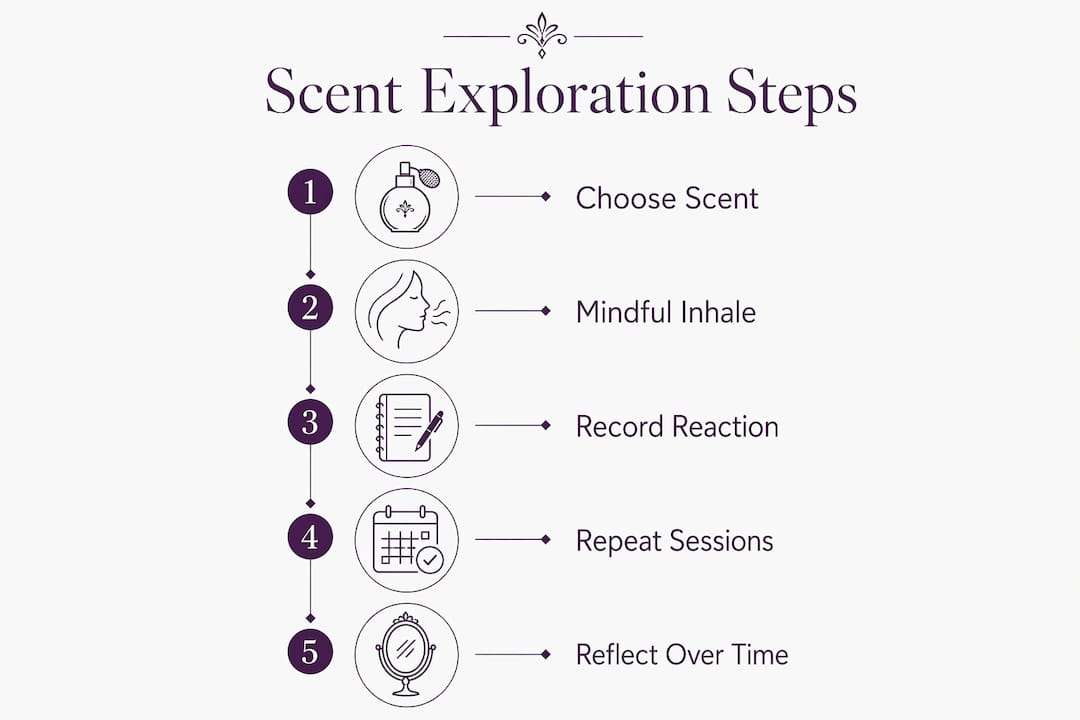
Follow these steps to build a real aromatic self-exploration practice:
- Set a controlled environment. Test scents at the same time of day, in the same room, with no competing aromas. This separates what the scent does from what your mood or surroundings are doing.
- Practice intentional inhalation. Hold each inhale for approximately 30 seconds. University of Kent research shows that prolonged inhalation measurably shifts physiology and mood, far beyond a quick sniff.
- Work with complex mixtures. Single-note scents are easier to process but less revealing. Active olfactory training with complex scent mixtures produces durable and generalizable learning. Complexity forces your brain to discriminate, and that discrimination deepens self-awareness.
- Begin fragrance journaling for self-discovery. After each session, write down your emotional response, any memory the scent triggered, and your subjective sense of its intensity. Do not rate scents as good or bad. Describe what they do to you.
- Repeat each scent across multiple sessions. One encounter is not enough. Patterns emerge over three to five sessions with the same fragrance.
Pro Tip: Record your subjective intensity, not just whether you liked the scent. Neural encoding in olfactory structures prioritizes perceived intensity over physical concentration. Your felt sense of a scent is more meaningful than its formula.
The table below shows how different scent exploration formats compare in depth and practicality:
| Format | Depth of insight | Time required | Best for |
|---|---|---|---|
| Passive sniffing | Low | Under 1 minute | Initial exposure only |
| 30-second intentional inhale | Medium | 1–3 minutes | Mood and emotional mapping |
| Complex mixture training | High | 15–30 minutes | Perceptual skill and identity work |
| Fragrance journaling | Very high | Ongoing | Long-term self-discovery patterns |
How to build and maintain a personal scent identity
A signature scent is not simply your favorite fragrance. It is a scent you wear with enough consistency that it begins to function as a psychological anchor for identity continuity. A signature scent functions as a stabilizing force amid life changes. That is a meaningful distinction from casual fragrance use, where you rotate scents by season or mood without intention.
Building a personal scent identity requires honesty about what you actually feel, not what you think you should like. Woody and smoky fragrances may feel grounding to one person and oppressive to another. Citrus and green notes may feel alive and clear to you, or they may feel thin and forgettable. Neither response is wrong. The point is to find the scent that reflects your stable self-concept, not your aspirational one.
Consider these factors when selecting your identity anchor scent:
- Emotional resonance over pleasantness. A scent that moves you is more useful than one that simply smells nice.
- Longevity on your skin. A fragrance that fades within an hour cannot anchor anything. Understand perfume concentration differences before committing to a format.
- Natural ingredient quality. Synthetic accords can smell accurate but often lack the depth that triggers genuine emotional response. Fragrances built from natural materials tend to evolve on skin in ways that reveal more about your chemistry and character.
- Consistency of use. Wear your chosen scent regularly, not just on special occasions. Identity anchoring requires repetition.
| Casual fragrance use | Signature scent practice |
|---|---|
| Rotated by mood or season | Worn consistently over time |
| Chosen for pleasantness | Chosen for emotional resonance |
| No psychological anchoring | Builds identity continuity |
| Reactive to external context | Reinforces internal self-concept |
Understanding how fragrance promotes introspection at a neurological level makes the selection process far less arbitrary. You are not shopping. You are listening.
Common challenges in scent-identity exploration and how to overcome them
Most people who begin aromatic self-exploration hit the same obstacles. Recognizing them early saves weeks of confusion.
- Conflating mood with scent response. If you test a fragrance on a difficult day, your negative reaction may belong to the day, not the scent. Always test in a neutral emotional state and repeat the session before drawing conclusions.
- Multitasking during scent sessions. Scent exploration requires full attention. A distracted inhale produces a distracted result. Treat each session as a brief meditation, not a background activity.
- Olfactory fatigue. After three to four scents, your nose loses discrimination ability. Limit each session to three fragrances maximum. Smell your own skin or coffee beans between samples to reset your palate.
- Shifting preferences over time. Your scent preferences will change as you change. This is not failure. It is data. A scent that no longer resonates tells you something real about who you are becoming.
- Overreliance on intensity or projection. A scent does not need to fill a room to anchor your identity. Skin-close fragrances often create a more intimate and accurate self-signal than loud, high-projection ones.
When confusion persists, seek structured guidance. Tools like the archetype quiz from Maisonvoyageurparfum offer a framework for matching emotional archetypes to fragrance families, which gives your exploration a useful starting point without narrowing your options prematurely.
Key Takeaways
Scent is the most direct sensory path to emotional memory, and using it deliberately is the most grounded method for ongoing self-discovery.
| Point | Details |
|---|---|
| Scent reaches the brain directly | Olfactory signals bypass the thalamus and connect to the amygdala and hippocampus, making scent uniquely powerful for identity work. |
| Intentional inhalation matters | Holding a scent for 30 seconds measurably shifts mood and emotional engagement, far beyond a passive sniff. |
| Fragrance journaling deepens insight | Recording emotional responses and perceived intensity over multiple sessions reveals lasting personal patterns. |
| A signature scent anchors identity | Consistent use of one fragrance builds psychological stability and reinforces your self-concept over time. |
| Complex scents train perception | Working with layered fragrance mixtures produces deeper and more durable olfactory self-awareness than single-note exposure. |
What I have learned from years of sitting with scent
By Celeste
The most common mistake I see is impatience. People smell something once, decide it is not for them, and move on. Scent does not reveal itself in a single encounter. Neither do you.
What I have found, after years of working with fragrance as a tool for self-awareness, is that the scents I initially dismissed were often the most revealing. A dark, resinous oud that felt foreign on first inhale became, over several sessions, the fragrance that most accurately reflected a part of myself I had been avoiding. That is the uncomfortable truth about why certain smells feel like home. Sometimes they feel like home because they reflect something true, not something comfortable.
Patience is not passive. It means returning to the same scent across different days, different moods, and different seasons. It means keeping a journal even when the entries feel mundane. The patterns that emerge from that consistency are worth more than any single revelation.
Honor your individual responses. If a fragrance that everyone around you loves leaves you cold, that is information. Your olfactory identity is yours alone. The goal was never to smell like everyone else.
— Celeste
Artisan fragrances crafted for self-exploration
Maisonvoyageurparfum was built around a single belief: real luxury is time to explore within yourself. Each fragrance in the collection is slowly made with 98% natural ingredients, sourced with the same care you bring to your own self-discovery practice.

The artisan perfume collection offers Mediterranean-inspired scents designed to evoke emotion and memory, not simply to smell pleasant. For those beginning their scent-identity work, the personalized soy candle offers a quieter, more contemplative entry point. A candle slows you down. It asks you to stay. That is exactly the right condition for the kind of inner listening this practice requires.
FAQ
What is olfactory self-priming?
Olfactory self-priming is the process by which repeated exposure to a scent reinforces associated emotional states and self-perceptions. Over time, the scent becomes a reliable trigger for a specific psychological state or identity signal.
How long should I smell a fragrance during exploration?
Hold each intentional inhale for approximately 30 seconds. Research from the University of Kent shows this duration measurably shifts physiology and mood, producing a more accurate emotional response than a brief sniff.
What is fragrance journaling and why does it help?
Fragrance journaling means recording your emotional reactions, memories, and perceived intensity after each scent session. Tracking these responses over multiple sessions reveals personal patterns that a single encounter cannot show.
How many scents should I test in one session?
Limit each session to three fragrances. Beyond that, olfactory fatigue reduces your ability to discriminate accurately between scents and distorts your emotional responses.
Can my scent preferences change over time?
Yes, and they should. Shifting preferences reflect genuine personal growth. A scent that no longer resonates is not a failed choice. It is a signal that your sense of self has evolved.
Recommended
- Why Certain Smells Feel Like Home – Maison Voyageur
- How Fragrance Promotes Introspection: A Science Guide – Maison Voyageur
- Find Your Scent · Archetype Quiz | Maison Voyageur
- Nature’s Role in Scent Therapy: A Science-Backed Guide – Maison Voyageur
Les sept fragrances Maison Voyageur
- Manifesting · unisexe (69,99 €)
- Intuition · femme (69,99 €)
- Certainty · femme (69,99 €)
- Expansion · femme (69,99 €)
- Release · homme (69,99 €)
- Presence · homme (69,99 €)
- Inner Fire · homme (69,99 €)
Nouvelle ici ? Commence par le Discovery Set · les 7 fragrances en format voyage (40 €).