
How Fragrance Connects Past and Present: The Science
Scent is defined as the most direct sensory pathway to human memory and emotion. How fragrance connects past and present is not metaphor. It is anatomy. The olfactory bulb routes signals straight to the amygdala and hippocampus, the brain’s centers for emotional memory, bypassing the rational processing layers that filter every other sense. Studies show approximately 77% of odors are recognized on first encounter, and of those recognized, 55% trigger recall of specific past memories. That is a recall rate no photograph or song can reliably match.
How fragrance connects past and present through the brain
The olfactory bulb is the only sensory organ with a direct connection to the amygdala and hippocampus. Every other sense, sight, sound, touch, and taste, travels first through the thalamus, a relay station that filters and organizes input before sending it forward. Smell skips that step entirely. The result is a memory that arrives before you can think about it.
This is the neuroscience behind what literature calls the Proustian effect. Marcel Proust described tasting a madeleine and being flooded with childhood memory. The science confirms it. The olfactory-limbic connection makes scent-triggered memories unusually vivid, emotional, and old. Most scent memories originate from early life, before age ten, when the brain is building its first emotional maps.
Odor-evoked memory unfolds in two distinct steps. Recognition comes first, driven largely by emotional intensity. Unpleasant odors tend to be recognized faster and more reliably than neutral ones. Associative retrieval comes second. This is the step where a recognized smell pulls a specific episode from memory. Research on 106 participants found that associative retrieval depends heavily on semantic richness, meaning how much descriptive meaning a person attaches to a scent.
Pro Tip: When you encounter a scent that moves you, pause and name it out loud. Attaching words to a smell deepens its semantic richness and strengthens the memory trace it leaves behind.
Understanding how scent promotes introspection helps explain why certain fragrances feel like more than perfume. They feel like time.
How do familiarity and uniqueness shape scent memory?
Not all familiar scents trigger strong memories. The relationship between familiarity and recall follows a U-shaped curve. Very familiar and very unfamiliar odors both trigger stronger associative memories than moderately familiar ones. The scent of your grandmother’s kitchen and a fragrance you smelled once in a foreign city both carry unusual power. The scents you encounter every day without noticing carry the least.
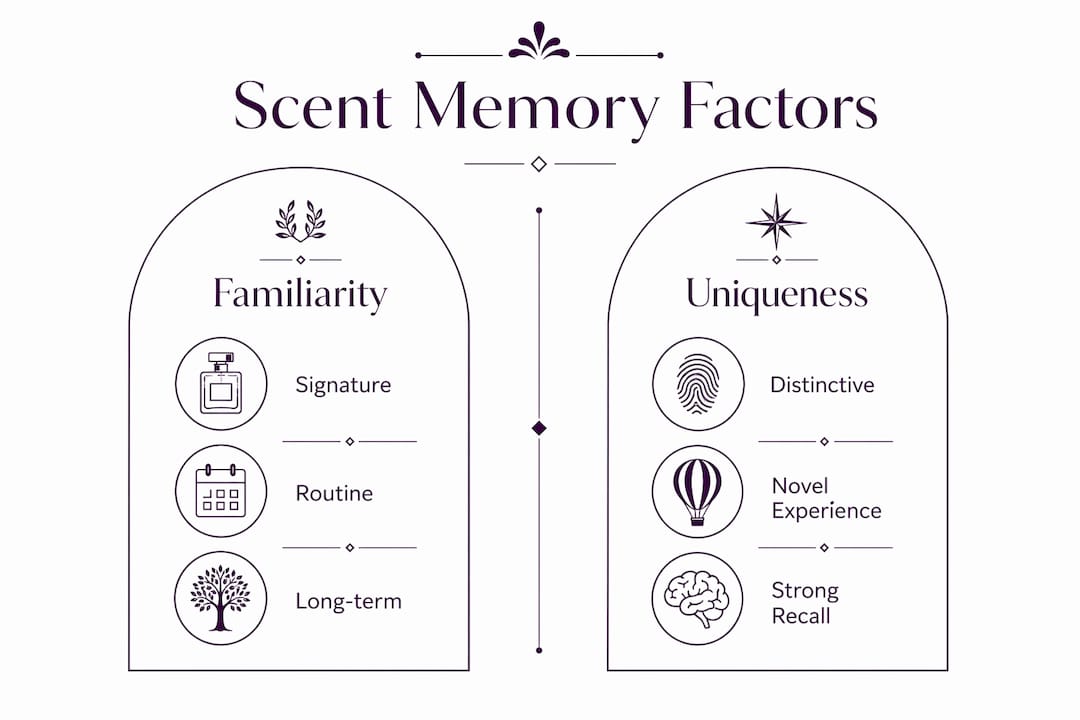
This has a practical implication. Signature fragrances, the ones you wear consistently over years, become deeply encoded. They stop being background and become identity. The same logic applies to place. The smell of a particular beach, a childhood home, or a specific season can anchor years of experience into a single breath.
Distinctive scents also work through semantic richness. A scent described as “smoky cedar after rain” creates a richer memory trace than one described only as “woody.” The more specific the mental image a fragrance evokes, the more retrievable the memory becomes. This is why certain smells feel like home in a way that defies rational explanation.
Here are four ways to recognize which fragrances hold the most memory potential for you:
- Notice the pause. A scent that makes you stop mid-thought is already activating your limbic system. Pay attention to that moment.
- Track emotional intensity. Scents that produce a strong emotional response, pleasant or not, are more likely to become lasting memory anchors.
- Seek the unusual. Novel fragrances with distinctive character create stronger associative traces than generic ones.
- Revisit deliberately. Returning to a meaningful scent after a gap reinforces the neural pathway and deepens the memory connection.
Pro Tip: Try wearing a new, distinctive fragrance only during meaningful experiences. The scent becomes a sensory bookmark you can return to intentionally.
How are historical scents recreated to connect with the past?
Science has developed methods to reconstruct fragrances from history. The primary tool is gas chromatography-mass spectrometry combined with olfactometry, known as GC-MS/O. This technique separates a scent sample into its chemical components and identifies which of those compounds are actually perceptible to the human nose. Not every chemical in a fragrance contributes to its smell. GC-MS/O isolates the ones that do.
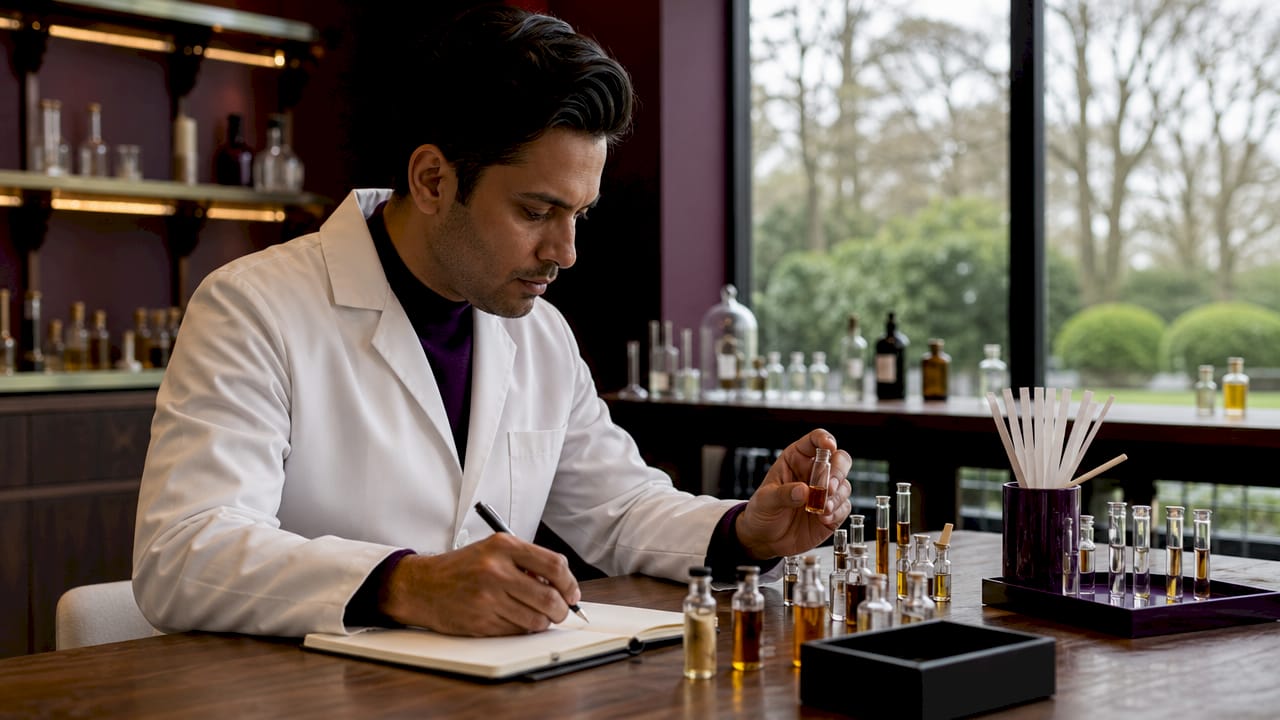
A 2026 study published in Nature demonstrated this process by reproducing a 20th-century perfume using 13 identified odour-active compounds. A panel of 70 participants found no significant sensory difference between the reconstruction and the original. The study validated each compound through omission tests, removing one ingredient at a time to confirm its contribution to the overall profile.
| Method | Purpose | Outcome |
|---|---|---|
| GC-MS/O analysis | Identify odour-active compounds | Chemical and sensory profile of original scent |
| Omission testing | Validate each compound’s role | Confirmed which ingredients are perceptually necessary |
| Sensory panel evaluation | Compare original and reconstruction | No significant difference detected by 70 participants |
Museums now use scent recreations to give visitors a richer experience of history. Breathing in the past through reconstructed fragrances creates emotional engagement that text and images alone cannot produce. A visitor standing before an ancient artifact while smelling its original environment crosses a sensory threshold that changes how memory forms around that experience.
The limits of this approach are real. Scent perception is personal. A reconstructed fragrance carries the chemical accuracy of the original but lands differently in each person’s memory. Cultural context and individual history shape what a smell means. Accuracy and resonance are not the same thing.
How can intentional scent use improve memory and emotional wellbeing?
Scent is not only a passive trigger. It is a tool. The concept of an olfactory anchor describes a scent deliberately paired with a specific mental or emotional state. Pairing a novel scent with a desired state, calm focus before a presentation, for example, trains the brain to re-enter that state when the scent is encountered again. This works because olfactory anchors bypass the cognitive delays that slow other forms of emotional regulation.
Research also shows that regular engagement with diverse scents can physically enlarge the olfactory bulb and hippocampus. Larger hippocampal volume is associated with stronger memory retention and reduced cognitive decline. Smell training is not a wellness trend. It is a neurological practice with measurable structural effects on the brain.
Practical ways to use scent intentionally include:
- Create a morning anchor. Use one specific fragrance only during quiet, reflective morning time. Over weeks, the scent becomes a reliable signal for that mental state.
- Pair scent with learning. Studying or working with a consistent ambient fragrance improves recall of that material when the same scent is present during review.
- Use natural ingredients. Fragrances built from natural materials, like those Maisonvoyageurparfum crafts with 98% natural ingredients, carry greater complexity and tend to produce richer sensory associations.
- Practice slow attention. Rushing past a fragrance reduces its memory impact. Pause, breathe, and let the scent register fully before moving on.
Pro Tip: Explore scent therapy practices rooted in natural ingredients. The complexity of natural fragrance profiles gives the brain more to encode, which deepens the memory trace.
What cultural and personal significance does fragrance hold?
Fragrance is a narrative. The scents you carry through life tell the story of where you have been, who you loved, and what mattered. Scent and personal identity are inseparable because the memories a fragrance holds are not abstract. They are specific people, specific rooms, specific moments.
Cultural heritage works the same way. Families pass scents across generations without naming them. The smell of a particular spice, a religious ceremony, a seasonal ritual. These olfactory traditions carry cultural memory in a form that survives long after the words for it are gone. Scent is how belonging gets encoded in the body.
Loss also lives in fragrance. The scent of someone who has died, found unexpectedly on an old coat or in a familiar room, produces grief with a physical immediacy that no other sense delivers. This is not weakness. It is the limbic system doing exactly what it was built to do.
Key ways fragrance shapes personal and cultural identity:
- Signature scents become part of how others remember you
- Familiar place-scents anchor a sense of belonging and home
- Family fragrance traditions carry cultural memory across generations
- Grief and comfort both arrive through scent with unusual directness
- Choosing a fragrance intentionally becomes an act of self-expression
Key Takeaways
Scent connects past and present through direct neural pathways that bypass rational processing, making fragrance the most immediate and emotionally vivid trigger of personal memory available to the human brain.
| Point | Details |
|---|---|
| Direct neural pathway | The olfactory bulb connects straight to the amygdala and hippocampus, triggering emotional memories faster than any other sense. |
| U-shaped familiarity effect | Very familiar and very unfamiliar scents trigger stronger memories than moderately familiar ones. |
| Two-step memory retrieval | Scent memory begins with recognition, then moves to associative recall, which depends on emotional intensity and semantic richness. |
| Historical scent recreation | GC-MS/O technology can reconstruct historical fragrances with sensory accuracy, as validated by a 70-person panel study in 2026. |
| Olfactory anchors | Pairing a novel scent with a desired mental state trains the brain to return to that state on re-exposure. |
Scent as a living archive: a personal reflection
By Celeste
The research on olfactory memory is compelling. But what it cannot fully capture is the quality of the experience. A scent-triggered memory does not feel like remembering. It feels like returning.
I have spent years thinking about why certain fragrances hold more weight than others. The science points to familiarity curves and semantic richness. My experience points to something quieter. The fragrances that have stayed with me are the ones I encountered during moments of genuine presence. Not distraction. Not routine. Presence.
That is what I find most honest about Maisonvoyageurparfum’s approach. The brand’s philosophy of slow luxury is not marketing language. It reflects something neurologically real. A fragrance encountered slowly, with full attention, encodes more deeply. The 98% natural ingredient commitment matters here too. Natural complexity gives the brain more to hold onto. Synthetic simplicity gives it less.
Most people treat fragrance as finishing. Something applied quickly before leaving the house. I think that misses the point entirely. A fragrance chosen with intention, worn with awareness, becomes a living archive of the time you spend inside it. That is worth slowing down for.
— Celeste
Maisonvoyageurparfum: where scent becomes memory
Maisonvoyageurparfum is a Mediterranean perfumerie based in Madrid, built on the belief that fragrance is not decoration. It is experience.

Each scent in the Maisonvoyageurparfum collection is slowly crafted with 98% natural ingredients, designed to evoke emotion, invite reflection, and anchor personal memory. For those who want to create a deliberate scent-memory connection at home, the personalized soy candle offers a way to bring that intention into daily ritual. Each candle carries the same artisanal care as the full fragrance line. For a wider view of what Maisonvoyageurparfum offers, the full fragrance collection reflects the brand’s commitment to scent as a form of personal storytelling.
FAQ
How does fragrance connect past and present memories?
Scent connects past and present by routing directly through the olfactory bulb to the amygdala and hippocampus, the brain’s memory and emotion centers. This direct pathway allows fragrance to trigger vivid, emotionally charged memories faster than any other sense.
Why do some smells trigger stronger memories than others?
Memory retrieval from scent follows a U-shaped familiarity curve. Very familiar and very unfamiliar odors trigger stronger associative memories than moderately familiar ones, and emotional intensity at the time of encoding also increases recall strength.
What is an olfactory anchor?
An olfactory anchor is a novel scent deliberately paired with a specific mental or emotional state. Re-encountering that scent later cues the brain to return to the associated state, bypassing the cognitive delays of other emotional regulation methods.
Can scent training improve memory over time?
Regular engagement with diverse scents can physically enlarge the olfactory bulb and hippocampus. Larger hippocampal volume is associated with stronger memory retention and reduced cognitive decline.
How do museums use scent to connect visitors with history?
Museums reconstruct historical fragrances using GC-MS/O technology to identify the odour-active compounds of original scents. Visitors who experience these recreations form emotional connections with historical artifacts that text and images alone cannot produce.
Recommended
- How Fragrance Promotes Introspection: A Science Guide – Maison Voyageur
- Why Certain Smells Feel Like Home – Maison Voyageur
- Why Natural Perfume Smells Complex: The Real Science – Maison Voyageur
- Why Perfume Tells Your Story: Scent, Memory, and Identity – Maison Voyageur
Les sept fragrances Maison Voyageur
- Manifesting · unisexe (69,99 €)
- Intuition · femme (69,99 €)
- Certainty · femme (69,99 €)
- Expansion · femme (69,99 €)
- Release · homme (69,99 €)
- Presence · homme (69,99 €)
- Inner Fire · homme (69,99 €)
Nouvelle ici ? Commence par le Discovery Set · les 7 fragrances en format voyage (40 €).