
Why Artisanal Perfume Differs for Wellness: What to Expect
Artisanal perfumes differ from mass-produced fragrances because they prioritize perfumer intent, ingredient provenance, and a layered sensory experience that supports intentional wellbeing. Where a mass-market bottle is engineered for broad appeal and shelf stability, an artisanal scent is slowly made to evoke something specific: a memory, an emotion, a quiet moment of self-recognition. Maisonvoyageurparfum, for instance, formulates with a focus on natural ingredients, a commitment that shapes not just what you smell but how you feel wearing it.
- What to expect: Artisanal perfumes evolve on your skin through distinct top, heart, and base notes. Mass-market fragrances tend to project a single, consistent scent cloud.
- Wellness relevance: Scent reaches the limbic system directly, influencing emotion and memory. Artisanal formulas, with their natural complexity, invite slower, more mindful inhalation.
- When to choose artisanal: When you want depth, narrative, and a ritual that supports emotional balance rather than a fragrance that simply announces your presence.
Table of Contents
- What does “artisanal perfume” actually mean?
- How mass-produced perfumes are made differently
- How ingredients shape the scent and your wellbeing
- How does the wearing experience actually differ?
- What does research actually say about scent and wellbeing?
- Does artisanal perfumery take sourcing more seriously?
- How to use artisanal perfume intentionally for wellbeing
- Why do artisanal perfumes cost more, and is it worth it?
- When should you choose artisanal over mass-market?
- Key Takeaways
- Maisonvoyageurparfum: slowly made for those who want more than a scent
- Useful sources and further reading
What does “artisanal perfume” actually mean?
Artisanal perfumery is perfumer-led creation at a human scale. A single nose, or a small creative team, makes deliberate choices about every ingredient, every proportion, every story the scent tells. Batches stay small, sometimes only a few hundred bottles per run, so quality control is intimate rather than statistical. The result is a fragrance that carries a point of view.
The core attributes that separate artisanal from other categories:
- Perfumer-led intent: A named perfumer’s creative vision drives the formula, not a marketing brief.
- Small-batch production: Limited runs allow for ingredient flexibility and quality adjustment between batches.
- Higher natural-ingredient ratios: Natural absolutes, essential oils, and resins appear in meaningful concentrations, not as trace accents.
- Ingredient transparency: Artisanal houses typically disclose key materials, extraction methods, and sourcing regions.
- Storytelling: Each scent carries a concept, a place, or an emotional arc that the wearer can inhabit.
Pro Tip: When evaluating any “artisanal” claim, look for four things on the product page: batch size or batch number, a named perfumer, an ingredient list with specific botanical names (not just “fragrance”), and any mention of GC-MS testing or third-party quality verification. Vague language like “inspired by nature” without specifics is a signal to ask more questions.
How mass-produced perfumes are made differently
Mass-market fragrance production begins with a commercial brief: a target demographic, a price ceiling, a desired shelf life, and a projected scent family. Bench chemists at large fragrance houses like IFF or Givaudan then build a formula designed to perform consistently across millions of units, in varying climates, on diverse skin types. The goal is predictability at scale.
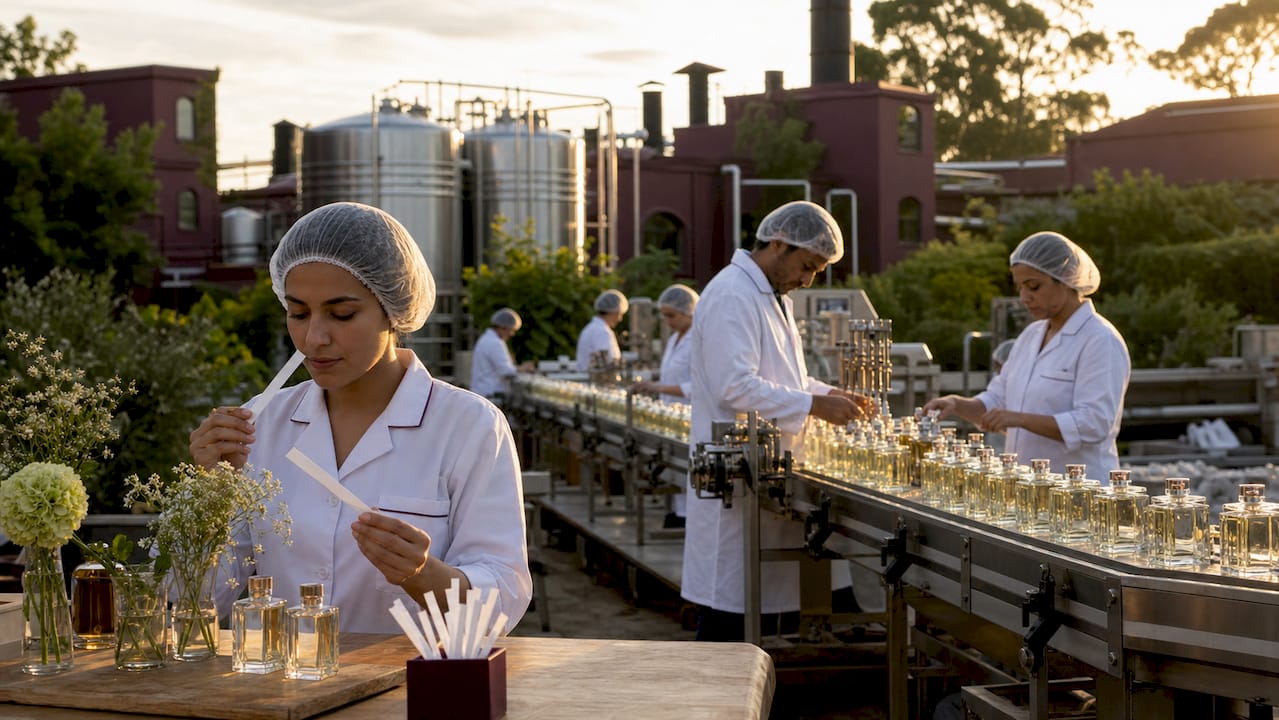
Synthetic aroma chemicals are the backbone of that predictability. They cost a fraction of natural absolutes, remain stable across temperature fluctuations, and project powerfully. A single synthetic musks molecule can anchor a fragrance for hours in a way that natural musks, which are now largely restricted under IFRA guidelines, cannot replicate cheaply. The tradeoff is complexity: artisanal fragrances prioritize layered, evolving profiles, while industrial formulas tend toward a consistent, linear scent that reads the same from first spray to dry-down.
| Feature | Artisanal / Niche | Mass-Market |
|---|---|---|
| Ingredient base | Natural absolutes, essential oils, select synthetics | Primarily synthetic aroma chemicals |
| Batch size | Small, limited runs | Large-scale, millions of units |
| Scent evolution | Layered top/heart/base transitions | Consistent, linear projection |
| Ingredient transparency | Named botanicals, sourcing notes | “Fragrance” as a single INCI entry |
| Wellness ritual support | High (invites slow, mindful inhalation) | Low (designed for immediate impact) |
| Price per mL | Higher | Lower |
Pro Tip: When a fragrance is marketed as “long-lasting,” that usually means strong synthetic fixatives. When an artisanal house describes “complex evolution,” they mean the scent changes meaningfully over hours. These are not competing claims about quality; they describe different design goals entirely.
How ingredients shape the scent and your wellbeing
Every perfume is built from a palette of ingredient families, and which families dominate determines both the sensory experience and any wellness effect.
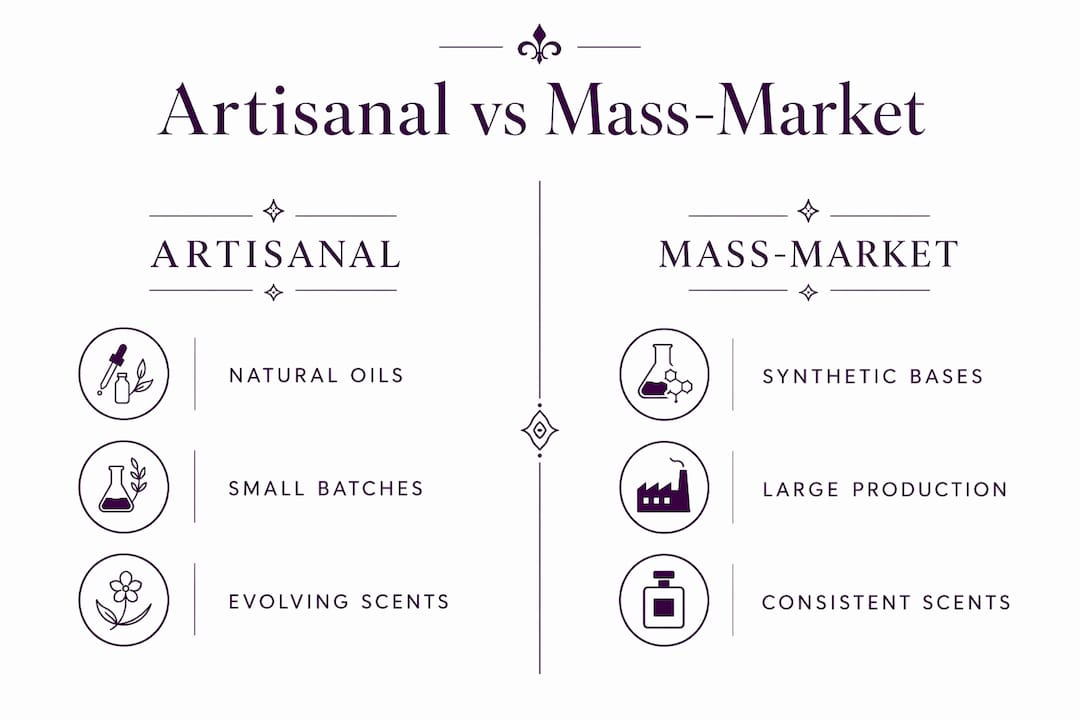
Natural essential oils and absolutes are extracted directly from plant material: steam-distilled lavender, cold-pressed bergamot, solvent-extracted jasmine absolute. They carry the full biochemical complexity of the source plant, including minor aromatic compounds that synthetic versions omit. That complexity is what creates a scent that shifts and breathes on skin.
Synthetic aroma chemicals and isolates are either lab-synthesized molecules or single compounds extracted from natural sources. They offer precision and consistency. Iso E Super, for example, gives a woody, cedar-like warmth that is nearly impossible to achieve at that intensity with natural cedarwood alone. Neither category is inherently superior; the question is how they are used and in what proportion.
Common wellness-associated ingredients and their evidence basis:
- Lavender (Lavandula angustifolia): Among the most studied aromatic botanicals. Research supports calming effects, though mood outcomes remain subjective and vary by individual.
- Citrus (bergamot, lemon, grapefruit): Frequently cited for uplifting, energizing effects. The wellness fragrance trend positions citrus as a focus-supporting note.
- Sandalwood: Used in meditative traditions across South Asia for centuries. Valued for grounding, centering qualities in intentional scent rituals.
- Vetiver: Earthy, smoky, and deeply rooted. Associated with anxiety reduction in some aromatherapy practices, though clinical evidence is limited.
A note on “all-natural” claims: The FDA does not regulate the word “natural” on fragrance labels. A product can carry that phrase while still containing synthetic fixatives or undisclosed allergens under the catch-all INCI entry “fragrance.” Look for full ingredient disclosure, INCI-compliant listings, and third-party certifications rather than marketing language alone.
One counterintuitive point worth knowing: natural ingredients are not automatically safer for sensitive skin. Rose absolute, oakmoss, and certain citrus oils contain known contact allergens. The International Fragrance Association (IFRA) restricts several natural materials precisely because of their sensitization potential. Synthetics, in some cases, offer a more predictable safety profile for reactive skin. The honest answer is that both categories carry risks; transparency about what is in the bottle matters more than whether the source is botanical or lab-derived.
How does the wearing experience actually differ?
Put an artisanal perfume on your wrist and a mass-market fragrance on the other. Within the first hour, the difference becomes tangible.
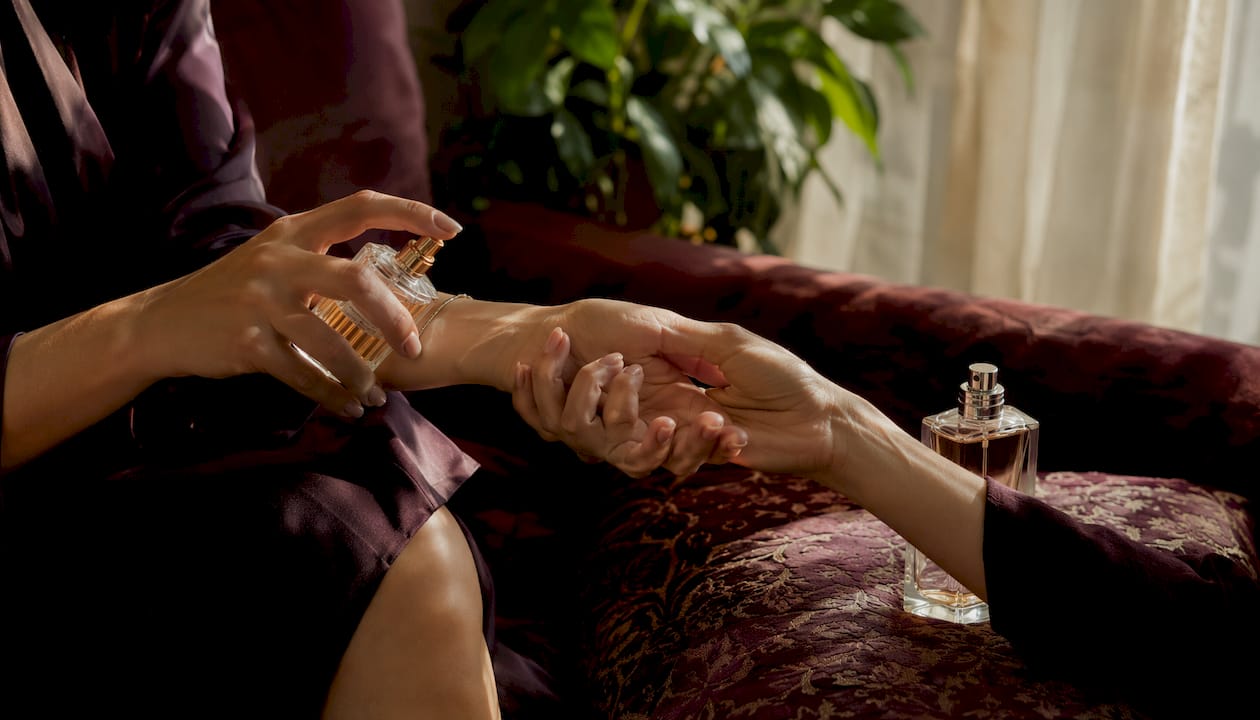
The artisanal scent opens with a bright, volatile top note, perhaps a sharp citrus or green herb, that fades within 15–20 minutes to reveal the heart: the emotional core of the composition. Floral, resinous, or woody materials emerge slowly, shaped by your skin’s warmth and chemistry. By the third or fourth hour, the base notes settle: sandalwood, amber, musks, or labdanum. The scent has traveled somewhere. It tells a small story across the day.
The mass-market fragrance, by contrast, announces itself immediately and holds that announcement. The projection is stronger, the sillage wider, and the character more consistent from first spray to last trace. That is not a flaw; it is the design intent. For a fashion statement or a signature that fills a room, it works perfectly.
How a single artisanal spritz evolves across time:
- 0–20 minutes (top notes): Volatile citrus, green, or aldehydic notes open the composition. Fresh, immediate, and brief.
- 20–60 minutes (heart emergence): Floral, spice, or herbal materials come forward as the top notes fade. This is the emotional center.
- 1–4 hours (heart to base transition): The scent deepens. Resinous, woody, or musky base notes begin to anchor the composition.
- 4–8+ hours (base notes): What remains is intimate, close to the skin, and uniquely shaped by your body chemistry.
| Stage | Artisanal Experience | Mass-Market Experience |
|---|---|---|
| Opening | Bright, complex, evolving | Strong, immediate, consistent |
| Mid-wear | Layered transitions, personal | Stable projection, predictable |
| Dry-down | Intimate, skin-close, unique | Fades uniformly or lingers synthetically |
Niche and artisan fragrances produce layered, evolving scents that resist the homogenization of mass-market formulas. That resistance is part of what makes them useful for wellbeing: a scent that changes with you invites attention, presence, and a kind of quiet self-awareness that a static fragrance cloud does not.
What does research actually say about scent and wellbeing?
Scent can support moments of wellness, but the effects are highly individual and shaped more by personal memory than by any universal chemical action. That is the honest answer, and it matters before you invest in any fragrance for therapeutic reasons.
The mechanism is real. Odor molecules travel from the olfactory epithelium to the olfactory bulb, which connects directly to the limbic system, the brain’s center for emotion and memory. No other sense has that direct a route. As neuroscientists explain, scent acts as an associative cue: it retrieves emotional states tied to past experiences faster than conscious thought can intervene. Dr. Sandeep Robert Datta and other researchers emphasize that this pathway is powerful precisely because it bypasses the cortex.
“The olfactory system has a privileged connection to the emotional centers of the brain. A scent doesn’t just remind you of something — it can briefly return you to the emotional state you were in when you first encountered it.” — Summarized from neuroscience coverage, Today.com
What the research supports more cautiously: lavender has documented calming properties in controlled settings, and citrus notes are associated with elevated mood in several studies. What it does not support: the idea that any single fragrance will produce the same emotional effect in every person. Brand-backed user trials from companies like Charlotte Tilbury report strong mood effects, but neuroscientists caution that expectation and placebo responses are significant contributors to those results.
The practical implication is that ritual matters as much as chemistry. Perfumers and wellness experts note that the primary therapeutic value of scent often comes from the intentional act of application itself: the pause, the breath, the moment of deliberate attention. Artisanal perfumes, with their subtler and more layered profiles, tend to reward that attention more than a synthetic-heavy spray designed for immediate impact.
Pro Tip: Build a personal scent ritual around a consistent time and intention. Apply your fragrance before meditation, a morning walk, or an evening wind-down, and inhale slowly for a count of three before moving on. Over time, your brain will begin to associate that scent with that state, creating a reliable associative anchor that works independently of any ingredient’s pharmacological effect.
You can explore the science behind this more deeply in Maisonvoyageurparfum’s guide on how perfume supports meditation.
Does artisanal perfumery take sourcing more seriously?
Artisanal houses tend to source with more visibility into the supply chain, though “tend to” is doing real work in that sentence. Size alone does not guarantee ethics, and a small brand can still source irresponsibly. What artisanal production does allow is the possibility of direct relationships with growers, smaller purchase volumes that support niche farming communities, and the flexibility to change suppliers when practices do not meet standards.
Questions worth asking before you buy:
- Where is the primary botanical material grown, and by whom?
- Does the brand hold or pursue organic certification for its key ingredients?
- Is there any fair-trade or Fair for Life certification in the supply chain?
- How does the brand source high-risk materials like oud or sandalwood?
- Does the brand disclose whether any materials appear on CITES (Convention on International Trade in Endangered Species) watch lists?
Oud and sandalwood deserve particular attention. Wild agarwood (the source of oud) is listed under CITES Appendix II, meaning international trade requires documentation. Indian sandalwood (Santalum album) faces similar conservation pressures. Responsible artisanal houses either source from certified sustainable plantations or use alternative species with comparable aromatic profiles. Mass-market brands, working at volume, often rely on synthetic oud and sandalwood substitutes, which sidesteps the conservation issue entirely but also removes the depth of the natural material.
Certifications to look for:
- USDA Organic for botanical raw materials sourced in the United States.
- Ecocert / COSMOS for organic and natural cosmetic standards, widely recognized in the fragrance industry.
- Fair for Life for fair-trade supply chain verification.
- RSPO (Roundtable on Sustainable Palm Oil) where palm-derived carriers or solvents are used.
Artisanal houses increasingly highlight sustainability and ethical sourcing as core brand values, and for wellness-minded consumers, that transparency is part of what makes the purchase feel coherent with their broader values.
How to use artisanal perfume intentionally for wellbeing
The difference between wearing a fragrance and using it as a wellness tool is almost entirely in the approach. The scent is the same; the attention you bring to it changes everything.
A step-by-step ritual for intentional application:
- Prepare your space and your breath. Before applying, take one slow breath in and out. This is not ceremonial; it clears your olfactory palate and signals to your nervous system that something intentional is about to happen.
- Hold the bottle and read the notes. Knowing that the opening is bergamot and the heart is iris primes your attention to notice the transition. Expectation shapes perception.
- Apply to pulse points with restraint. Inner wrists, the base of the throat, and behind the ears are warm, well-circulated areas that help diffuse the scent naturally. One or two spritzes is enough for an artisanal concentration.
- Inhale slowly and hold for a moment. A slow, deliberate inhale, held briefly before exhaling, encourages a mild parasympathetic response. This is the moment of the ritual, not just the application.
- Pause before moving on. Give yourself 30–60 seconds with the opening notes before returning to your day. This brief pause is where the associative memory anchor forms.
Dos and don’ts for artisanal fragrance care:
- Do store bottles away from direct light and heat. Natural ingredients degrade faster than synthetics when exposed to UV or temperature swings.
- Do test on skin before committing to a full bottle. Skin chemistry alters every natural formula differently.
- Don’t rub your wrists together after applying. This breaks the top notes prematurely and flattens the opening.
- Don’t layer heavily scented body products underneath. Unscented or lightly scented moisturizer on pulse points helps the fragrance project cleanly.
- Don’t over-spray. Artisanal concentrations are often higher than mass-market equivalents; two spritzes is usually more than sufficient.
Pro Tip: For a scent ritual built around self-discovery, try applying your fragrance in silence for one week at the same time each day. Notice what thoughts or feelings arise during the inhale. Over time, the scent becomes a consistent entry point into a particular emotional state, which is the real wellness mechanism at work.
If you are still searching for a fragrance that fits your personality and emotional needs, a fragrance quiz can help you identify your preferred scent families before you invest in a full bottle.
Why do artisanal perfumes cost more, and is it worth it?
The price of an artisanal fragrance reflects the actual cost of making it slowly, with care, at small scale. That is not a marketing position; it is a production reality.
The main cost drivers:
- Rare botanical materials: Rose absolute from Grasse can cost thousands of dollars per kilogram. Natural oud, iris root, and aged patchouli carry similar premiums.
- Extraction costs: Enfleurage, CO2 extraction, and cold-pressing are labor-intensive processes that yield small quantities of highly concentrated material.
- Skilled perfumer time: A named perfumer’s creative labor is not priced like a commodity. Months of development work go into a single formula.
- Small-batch losses: Smaller production runs mean higher per-unit overhead and less tolerance for waste.
- Certification and testing: GC-MS testing, organic certification, and IFRA compliance documentation add cost that mass-market brands spread across millions of units.
Typical formats and what to expect at each level:
- Sample / decant (1–2 mL): The lowest-risk entry point, usually $5–$20. Ideal for testing on skin before committing.
- Travel size (10–15 mL): Often $40–$80. Enough to build a genuine relationship with a scent over several weeks.
- Standard bottle (30–50 mL): The core format for artisanal houses, typically $120–$300 or more for rare-ingredient formulas.
The premium is justified when: the scent resonates personally and emotionally, the ingredient transparency meets your standards, the brand offers a bespoke or consultative experience, and you intend to use it as part of a consistent wellness ritual. For casual daily wear where projection and longevity matter more than depth, a well-made mass-market fragrance is a perfectly reasonable choice.
Alternatives for lowering the cost of exploration: fragrance decanting communities (Reddit’s r/fragrance, Basenotes), brand sample programs, and immersive fragrance experiences offered by artisanal houses that let you sample before purchasing.
When should you choose artisanal over mass-market?
The honest answer is that neither is universally better. They serve different intentions.
Choose artisanal when:
- You want a scent that evolves and rewards attention over hours.
- Ingredient transparency and natural sourcing matter to your values.
- You are building a wellness ritual where the fragrance serves as an emotional anchor.
- You want something that feels personal, not shared with millions of other wearers.
- You are drawn to the story behind a scent as much as the scent itself.
Mass-market may suffice when:
- You want strong, consistent projection for a social or professional setting.
- Budget is a primary constraint and you are not using fragrance therapeutically.
- You prefer a familiar, widely recognized scent profile.
One guiding question: are you wearing fragrance as a fashion statement or as a tool for self-awareness? If the answer is the latter, artisanal is almost always the more purposeful choice. Start with a sample. Wear it intentionally for a week. Notice what it does to your mood, your attention, your sense of self. That experiment costs very little and tells you everything.
Key Takeaways
Artisanal perfumes differ from mass-produced fragrances in intent, ingredients, and sensory depth, and those differences make them more effective tools for intentional wellbeing.
| Point | Details |
|---|---|
| Intent drives the difference | Artisanal perfumes are perfumer-led and story-driven; mass-market formulas are engineered for broad appeal and shelf stability. |
| Natural complexity supports ritual | Higher natural-ingredient ratios create evolving top/heart/base transitions that reward slow, mindful inhalation. |
| Scent effects are personal, not universal | The olfactory pathway connects directly to the limbic system, but emotional outcomes depend on individual memory associations, not ingredient chemistry alone. |
| Ritual matters as much as formula | The intentional act of application, a slow inhale, a deliberate pause, is where the real wellness mechanism operates. |
| Maisonvoyageurparfum’s approach | Formulated with a focus on 98% natural ingredients and a bespoke, introspective method, Maisonvoyageurparfum embodies the artisanal principles described throughout this article. |
The part most fragrance guides quietly skip
Most writing about artisanal perfume focuses on what is in the bottle. The ingredient lists, the extraction methods, the certifications. All of that matters. But the more I think about how scent actually works for wellbeing, the more I believe the bottle is almost beside the point.
What changes when someone moves from a mass-market fragrance to an artisanal one is not primarily chemical. It is attentional. An artisanal scent, because it evolves and surprises and asks something of you, pulls you into the present moment in a way that a static synthetic cloud simply does not. You notice the transition from bergamot to iris. You catch the moment the base notes settle. That noticing is a form of mindfulness, and it happens whether or not you set an intention for it.
Industry perfumers note that artisanal fragrances invite self-discovery precisely because they resist trendy formulas and encourage the wearer to form a personal narrative around scent. That is not a marketing claim. It is a description of what happens when a fragrance is complex enough to mean something different to you on a Tuesday morning than it did on a Saturday evening. The scent becomes a mirror, not just an accessory.
The wellness value of artisanal perfume, then, is less about lavender’s documented calming properties and more about what happens when you slow down enough to actually smell what you are wearing. That is a practice. And like any practice, it compounds.
Maisonvoyageurparfum: slowly made for those who want more than a scent
If the artisanal approach described here resonates, Maisonvoyageurparfum offers a direct way to experience it. Each fragrance is formulated with a focus on 98% natural ingredients, crafted slowly in the Mediterranean tradition, and designed not just to smell beautiful but to invite genuine self-exploration.

The brand’s Seven Archetypes Method is a bespoke approach that matches a fragrance to your inner world rather than your demographic. It is the opposite of a mass-market brief. You begin by understanding which archetype resonates with your current life stage, and the scent follows from there. The result is a fragrance that feels like it was made for you, because in a meaningful sense, it was.
To find the scent that fits your personal narrative, visit Maisonvoyageurparfum and explore the collection or begin with the Seven Archetypes Method. Samples are available, and the experience is worth taking slowly.
Useful sources and further reading
The following sources informed this article and offer deeper reading on the science, craft, and culture of artisanal fragrance and wellness:
- Can Perfume Boost Your Mood? Scientists Explain (Today.com): The most thorough journalistic treatment of the neuroscience behind scent and mood, including expert commentary from researchers and a clear-eyed look at brand-backed trial limitations.
- The Scent of Wellness: From Smelling Good to Feeling Well (B Futurist): Industry trend analysis linking specific aromatic ingredients to wellness positioning; useful for understanding how the market is evolving.
- Artisanal vs. Industrial Perfumery (OKPerfumes): A clear technical comparison of production methods, ingredient choices, and the practical tradeoffs between artisanal and industrial approaches.
- The Benefits of Using Niche and Artisan Perfumes (Kaind): Practical overview of what distinguishes niche and artisanal fragrances, with attention to ingredient quality and scent evolution.
- The Scent of Wellness (The Perfume Society): A thoughtful editorial on how fragrance intersects with emotional wellbeing, written from an industry-insider perspective.
- Olfactory Pathway and the Limbic System (NCBI / National Library of Medicine): Primary scientific reference for the neuroanatomy of smell, including the olfactory bulb’s direct connection to the amygdala and hippocampus.
- Scent, Memory, and Identity (NYU Latinx Project): An academic essay exploring how scent encodes cultural memory and personal identity, relevant to the psychological dimension of artisanal fragrance.
- Channel NewsAsia: Perfume and Wellness: Lifestyle coverage on how intentional fragrance rituals are being adopted as wellness practices across Asia and globally.
- South China Morning Post: Artisanal Perfumery: Trend and culture reporting on niche perfumery, including perfumer perspectives on self-discovery and personal narrative.
- UNESCO: Skills Related to Perfume in Pays de Grasse: The UNESCO intangible cultural heritage listing for Grasse perfumery, documenting the historical and cultural depth of artisanal fragrance craft.
Recommended
- Benefits of Intentional Fragrance Use for Wellness – Maison Voyageur
- Perfume artesanal y salud emocional: guía 2026 – Maison Voyageur
- Parfum artisanal vs industriel : les vraies différences – Maison Voyageur
- Perfume artesanal vs. masivo: diferencias clave – Maison Voyageur
Les sept fragrances Maison Voyageur
- Manifesting · unisexe (69,99 €)
- Intuition · femme (69,99 €)
- Certainty · femme (69,99 €)
- Expansion · femme (69,99 €)
- Release · homme (69,99 €)
- Presence · homme (69,99 €)
- Inner Fire · homme (69,99 €)
Nouvelle ici ? Commence par le Discovery Set · les 7 fragrances en format voyage (40 €).