
Perfume artesanal vs. masivo: diferencias clave
The difference between artisan and mass-produced perfume is defined by three factors: production scale, ingredient quality, and the intention behind each formula. An artisan perfume, also called niche perfume in the industry, is made in small batches with selected raw materials and a careful process that prioritizes the sensory experience. A mass-produced perfume, on the other hand, is produced in large volumes with standardized formulas to ensure profitability and general acceptance. Brands like Maisonvoyageurparfum represent the first approach: slow creation, natural ingredients, and a fragrance that tells a story. Large commercial houses represent the second: accessibility, consistency, and global reach.
What is the difference between artisan and mass-produced perfume in terms of production?
The production scale is the first and most visible difference between both types. Artisan perfumes are made in batches of 1,000 to 5,000 bottles, while mass production exceeds 100,000 bottles per reference. This difference in scale is not just numerical: it determines the level of control possible at each stage of the process.
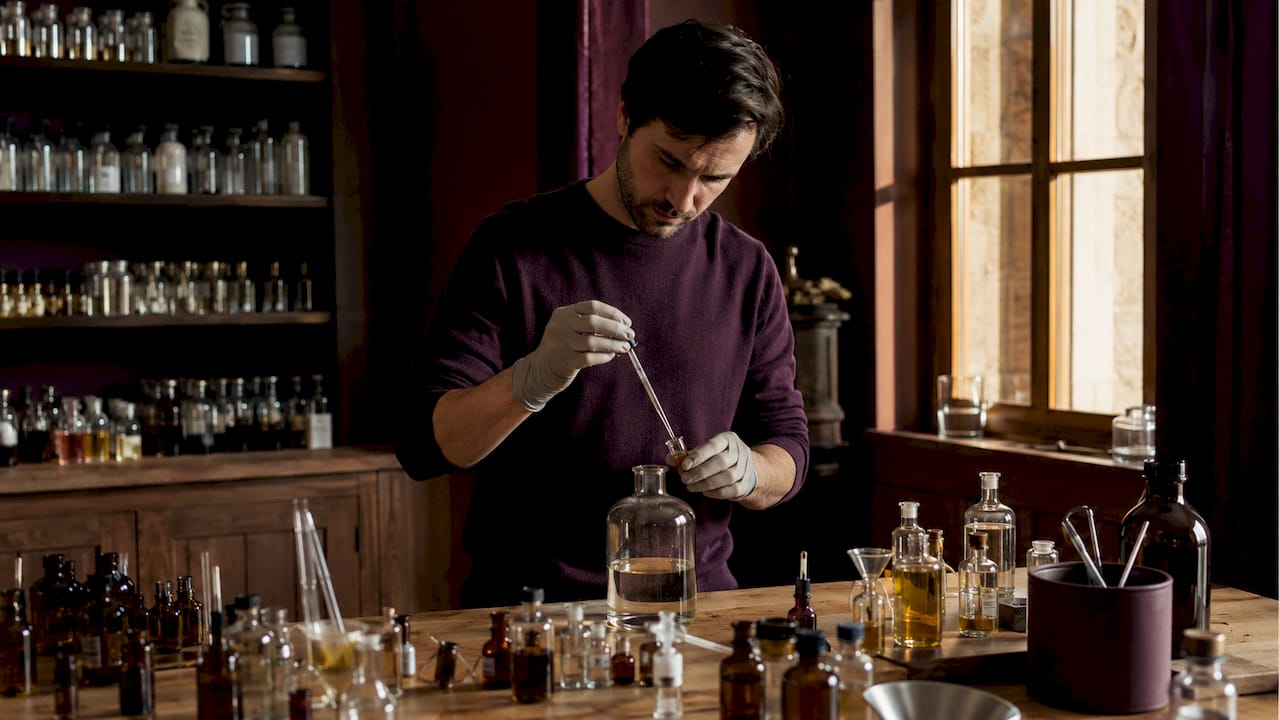
In a small batch, the perfumer can review each mixture, adjust proportions, and discard batches that do not meet the standard. In mass production, the priority is consistency at low cost, which forces formulas to be simplified and variables reduced. The result is a predictable product, but with less depth.
Exclusivity also changes. An artisan perfume with a limited run cannot be found in any large department store. This scarcity has real value for those looking for a fragrance that not everyone wears.
- Quality control: In small batches, each bottle can be individually inspected.
- Exclusivity: Limited runs ensure that the fragrance is not ubiquitous.
- Creative flexibility: The perfumer can change a formula between batches without serious economic impact.
- Price: Small production increases the unit cost, but also the perceived value.
Professional tip: If you are looking for a fragrance that you won't recognize on the subway or at a business meeting, look for brands with runs of fewer than 5,000 units per reference. That number is the first real filter for exclusivity.
What role does maceration play in perfume quality?
Maceration is the resting process after mixing ingredients, and it is one of the most underestimated factors in the final quality of a perfume. Maceration homogeneously integrates the ingredients and provides balance and stability to the aroma. Without this rest, the notes do not blend: each ingredient acts separately and the result is an unbalanced fragrance.
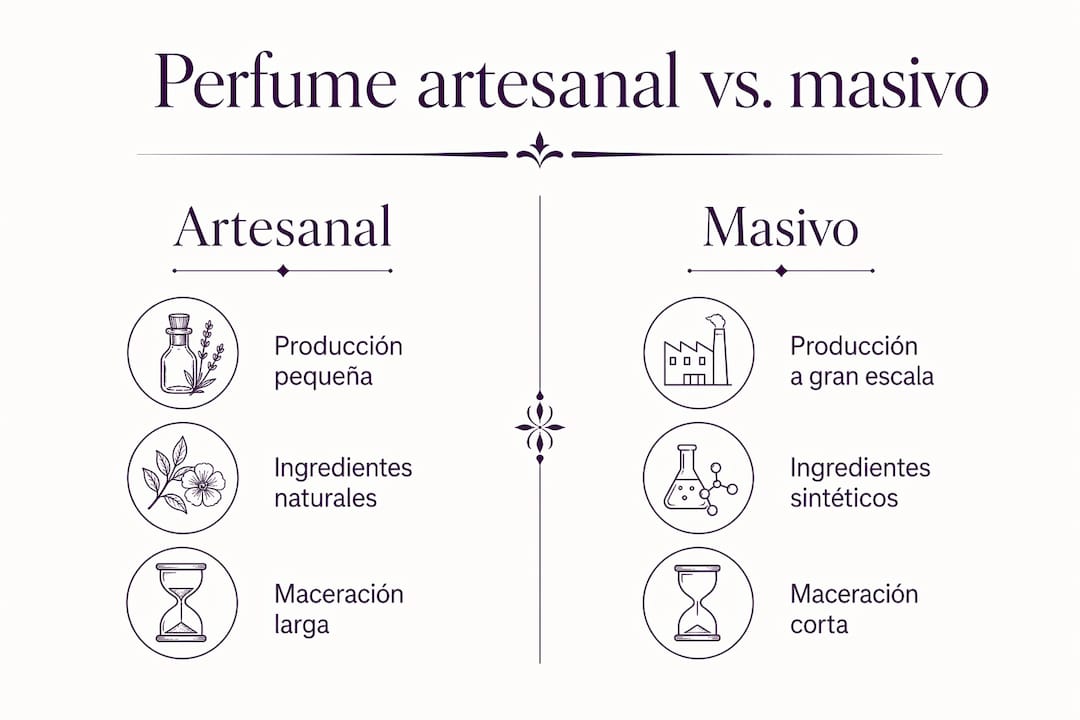
The maceration time varies depending on the complexity of the formula. In artisan perfumes, it can range from 48 hours to several weeks. In mass production, this step is reduced or accelerated to meet manufacturing deadlines. Without adequate maceration, aggressive notes or poor evolution are common.
What many buyers don't know is that maceration does not add new ingredients. Maceration allows the formula to develop; its management in time and temperature directly impacts the harmony of the result. It is the difference between a perfume that "blooms" on the skin and one that simply smells.
Concentration levels also define the duration and evolution of the aroma:
- Parfum (20–40% oils): lasts between 12 and 24 hours; the most intense and long-lasting option.
- Eau de Parfum (15–20%): lasts between 5 and 8 hours; the most common format in niche perfumery.
- Eau de Toilette (5–15%): lasts between 3 and 5 hours; common in mass perfumery due to its lower cost.
"The buyer usually judges only by visible ingredients, but the big difference lies in the accord-to-accord balance, the control of maceration, and the adjustment so that the perfume blooms on the skin." Mixerpack
Artisan perfumes tend to have higher concentrations and use natural fixatives that prolong their evolution. Mass-produced ones prioritize cost and predictability, which limits the depth of the aroma throughout the day.
What are the ingredient differences between artisan and industrial perfumes?
Ingredients are where the difference between artisan and industrial perfumes becomes most tangible. Artisan perfumes use rare ingredients and pure essential oils, while mass-produced ones combine standard synthetic molecules to ensure consistency and reduce costs. Neither approach is inherently bad, but they produce very different results.
Ingredients such as authentic oud, Grasse rose absolute, or iris cultivated in Florence are exclusive to artisan and niche perfumery. These materials are scarce, costly, and difficult to standardize, making them incompatible with mass production. Their presence in a formula provides complexity and depth that no synthetic molecule can accurately replicate.
| Aspect | Artisan perfume | Mass-produced perfume |
|---|---|---|
| Raw materials | Pure essential oils, rare ingredients | Synthetic molecules, standard blends |
| Creative freedom | High; unique and polarizing formulas | Low; formulas oriented to general taste |
| Ingredient examples | Oud, Grasse rose, Florentine iris | Aldehydes, synthetic musks, chemical fixatives |
| Olfactory richness | Complex, with evolution on skin | Homogeneous, predictable |
| Target audience | Consumers seeking exclusivity | Consumers seeking accessibility |
Mass-produced perfumes design formulas to appeal to the largest number of people, prioritizing safety and profitability. Artisan perfumes offer creative freedom and more polarizing results. This polarization is not a defect: it is a sign that the fragrance has its own point of view.
Professional tip: When you read the ingredient list of a perfume, look for real botanical names like “Rosa damascena” or “Boswellia sacra.” Their presence indicates genuine raw materials, not just marketing denominations.
How do prices vary and what does that cost represent?
Price is the point where many consumers hesitate, and rightly so. Artisan niche perfumes range from €200 to €800 or more, while commercial ones are between €40 and €150. This gap reflects real differences in production, ingredients, and exclusivity, not just marketing.
The factors that explain the price of an artisan perfume are concrete:
- Ingredients: Authentic oud can cost thousands of euros per kilo. Grasse rose absolute exceeds €5,000 per kilo in the wholesale market.
- Small-batch production: The fixed cost of formulation, maceration, and packaging is distributed among fewer units.
- Exclusivity: A limited run has a rarity value that the market recognizes.
- Artisan process: The perfumer's time, manual supervision, and adjustments between batches have a cost that does not exist in automated production.
In mass perfumery, the low price is sustained by economies of scale, synthetic ingredients, and global distribution. A 100ml bottle for €60 can contain ingredients that cost less than €3. The rest is advertising, packaging, and distribution.
The question is not whether an artisan perfume is expensive. The question is what you get for that price: a unique fragrance, with real ingredients, made with time and artistic criteria.
What sensory experience does an artisan perfume offer compared to a mass-produced one?
The sensory experience is where the difference between artisan and mass-produced perfume is felt most directly. Artisan perfumes offer greater olfactory complexity, evolution on the skin, and emotional connection, unlike the more homogeneous and standardized aromas of mass-produced ones. An artisan perfume changes throughout the day: it opens with lively top notes, evolves into the heart, and closes with a base that lingers for hours.
A mass-produced perfume, on the other hand, tends to remain the same from the first spray until it disappears. This consistency is its virtue and its limit. It does not surprise, does not evolve, does not tell anything new.
The emotional connection also differs. A complex aroma, made with natural ingredients and real maceration time, activates memory and emotion more intensely. Maisonvoyageurparfum works from this premise: each fragrance from its workshop in Madrid is conceived to evoke an inner state, not just to smell good.
The choice of fragrances, in this sense, is also a choice about what kind of experience you want to have. A mass-produced perfume is functional and accessible. An artisan perfume is a presence that accompanies you with its own nuances.
Key points
The difference between artisan and mass-produced perfume is not just about price: it's about the process, ingredients, and the sensory experience each can offer.
| Point | Details |
|---|---|
| Production scale | Artisan perfumes are made in batches of 1,000–5,000 bottles, allowing for greater quality control. |
| Maceration and concentration | Adequate maceration defines the balance and duration of the aroma; artisan perfumes respect it. |
| Natural ingredients | Raw materials like oud or Grasse rose provide complexity that synthetics cannot replicate. |
| Price range | Artisan perfumes range from €200 to €800; mass-produced ones from €40 to €150. |
| Sensory experience | Artisan perfumes evolve on the skin and create an emotional connection; mass-produced ones are predictable and homogeneous. |
What I learned choosing between artisan and mass-produced
by Celeste
For years I used big brand perfumes without questioning them. They were comfortable, recognizable, and easy to find. The change came when I first tried a fragrance made with Grasse rose absolute and authentic oud, with weeks of real maceration. It wasn't just a different scent. It was an experience that evolved on my skin for hours and that I remembered days later.
What no one tells you is that most mass-produced perfumes are designed not to bother anyone. That makes them safe, but also empty. An artisan perfume may not appeal to everyone, and that's exactly what makes it valuable.
My practical advice: if you have a tight budget, a mass-produced perfume does its job. But if you are looking for something that represents you, that evolves with you throughout the day, and that no one else wears, it is worth investing in a niche fragrance. Start with a discovery format, such as the 15ml bottles that some artisan brands offer, before committing to the full size.
The niche perfumery market grows every year because more people are looking for authenticity. It's not a trend. It's a response to decades of formulas designed to please everyone and thrill no one.
— Celeste
Discover Mediterranean artisan perfumery
Maisonvoyageurparfum is a Mediterranean perfumery with a workshop in Madrid that elaborates each fragrance with 98% natural ingredients and a careful maceration process. It is not mass production. It is slow creation, with artistic criteria and selected raw materials.

If you want to explore which fragrance connects with you, Maisonvoyageurparfum offers a personalized discovery experience to find the scent that reflects your way of being. You can also explore the complete collection of archetypes, where each fragrance represents a distinct inner state. The right perfume is not chosen just for how it smells. It is chosen for how it makes you feel.
Frequently asked questions
What exactly is an artisan perfume?
An artisan perfume, also called niche perfume, is made in small batches with selected natural ingredients and a careful maceration process. Its objective is unique olfactory expression, not mass acceptance.
How much longer does an artisan perfume last than a mass-produced one?
An artisan perfume in Parfum format lasts between 12 and 24 hours thanks to its 20–40% oil concentration. A typical mass-produced Eau de Toilette lasts between 3 and 5 hours with a 5–15% concentration.
Why are artisan perfumes more expensive?
The price reflects high-quality ingredients such as oud or Grasse rose absolute, small-batch production, and a maceration process that can last weeks. The unit cost is higher because there are no economies of scale.
Can a mass-produced perfume be of good quality?
Yes. Mass-produced perfumes offer consistency, accessibility, and a functional olfactory experience. Their limitation is not technical quality, but the sensory depth and exclusivity they cannot offer due to their production model.
How do I choose between an artisan and a mass-produced perfume?
If you are looking for an everyday, accessible, and recognizable fragrance, a mass-produced perfume fulfills its function well. If you are looking for exclusivity, evolution on the skin, and emotional connection, an artisan perfume is the right choice. Start with a sample format before investing in the full bottle.