
Slow Intentional Living: Benefits for Daily Well-Being
Slow intentional living reliably reduces stress, sharpens presence, deepens sleep, and clears thinking. Research from the NIH and Harvard’s Benson-Henry Institute confirms these outcomes are accessible through small, consistent practice. Start now: place both hands flat on a surface, take one slow breath in for four counts, hold for two, release for six. That single minute is already a slow intentional living practice.
- Reduced stress and anxiety through mindful attention
- Improved sleep quality and cardiovascular calm
- Sharper focus and longer creative attention spans
- Deeper, more present relationships
Key Takeaways
Slow intentional living produces measurable benefits in stress, sleep, focus, and relationships through small, consistent practices that anyone can begin today.
| Point | Details |
|---|---|
| Start with one micro-practice | A single brief breathing anchor or mindful meal is enough to begin. |
| Benefits arrive in stages | Calm comes immediately; sleep and habit changes take 4–8 weeks of consistency. |
| De-centering reduces reactivity | Observing thoughts without acting on them lowers anxiety and steadies mood over time. |
| Small beats sweeping | Incremental changes like 15–20 minutes of daily unplugging sustain better than overhauls. |
| Maisonvoyageurparfum | Their slow luxury fragrances are designed as intentional sensory anchors for presence and introspection. |
This article is general information, not a substitute for advice from a qualified doctor. Consult a qualified healthcare professional about your own circumstances before acting on anything here.
Table of Contents
- What does slow intentional living actually mean?
- How does slow living improve mental and emotional health?
- What physical health changes can you expect?
- Can slowing down actually improve focus and creativity?
- How does slow living change your relationships?
- How long before you notice the benefits?
- A practical 7-day starter plan for slow intentional living
- Common misconceptions that derail slow living
- How to measure progress without turning it into another performance metric
- How sensory rituals can support your slow practice
- What actually changes when you start small
- Fragrance as an optional companion to slow living
- Sources
What does slow intentional living actually mean?
Slow intentional living means choosing fewer activities and doing each one with full presence. It is not idleness. It is not avoidance. Harvard Health frames it plainly: focused, purposeful pace rather than inactivity, with stress reduction and better cognitive health as natural byproducts.
Core features of the practice:
- Single-tasking: one thing at a time, with full attention
- Prioritized commitments: fewer obligations chosen with care
- Mindful rituals: small, repeated moments that anchor you to the present
The laziness myth persists because slowing down looks unproductive from the outside. The difference is internal. Laziness avoids engagement. Slow intentional living deepens it.
How does slow living improve mental and emotional health?
Reduced stress and greater emotional steadiness are the most consistent early benefits. The NIH summarizes clinical evidence showing that mindfulness-based approaches help people observe their thoughts without being swept away by them, a capacity researchers call de-centering.
De-centering in practice looks like this: a difficult email arrives, and instead of reacting immediately, you notice the tightness in your chest, name it, and choose your response. That pause is de-centering. It is trainable.
Key emotional benefits readers report:
- Lower baseline anxiety and fewer reactive moments
- Steadier mood across the day
- Greater capacity to sit with discomfort without acting on it
What physical health changes can you expect?
A slower daily pace supports what physiologists call rest-and-digest function: the parasympathetic nervous system gets room to operate. INTEGRIS Health explains the pathway clearly: slower habits lower cortisol, reduce sympathetic stress responses, and produce measurable downstream effects on the body.
Physical improvements you may notice:
- Lower resting blood pressure
- Calmer, slower breathing at rest
- More consistent, restorative sleep
- Improved digestion and reduced gut reactivity
- Greater immune resilience over time
A note on cortisol: chronic stress keeps cortisol elevated, which suppresses immune function, disrupts sleep architecture, and raises cardiovascular risk. Slowing down is one of the most direct ways to interrupt that cycle.
Time magazine’s reporting adds an unexpected dimension: occasional slow days that displace driving or high-consumption activities also reduce environmental impact, with co-benefits for restorative movement and local connection.
Can slowing down actually improve focus and creativity?
Yes. Slowing down improves sustained attention, memory encoding, and creative problem-solving by reducing cognitive load. Psychology Today describes a compelling side effect: people who live mindfully often report that days feel longer because they absorb more perceptions. Researchers call this the time-stretching effect.

Johns Hopkins Medicine adds that mindfulness practices can reshape brain regions tied to memory and emotional regulation, with improvements in focused attention over time.
Cognitive benefits of intentional slowness:
- Longer sustained attention on single tasks
- Better memory for daily experiences
- More creative, less reactive problem-solving
- A felt sense that time is more spacious
A workplace example: a writer who stops checking messages between drafts and works in 45-minute single-task blocks typically produces cleaner first drafts and needs fewer revision passes. Speed follows slowness, not the other way around.
How does slow living change your relationships?
Slowing down makes you a better listener. Less distraction means more eye contact, slower pacing in conversation, and a genuine sense of being present with another person. Those qualities build trust faster than almost anything else.
A simple conversation ritual worth trying: before any meaningful exchange, take two minutes to set your phone face-down, take one slow breath, and ask yourself, “What does this person need from me right now?” That micro-pause shifts the quality of the entire conversation.
Relational benefits:
- Deeper sense of connection with close relationships
- Reduced misunderstandings from distracted listening
- More reciprocal, less transactional interactions
- Stronger local and community ties, especially on slow days
How long before you notice the benefits?
Some effects arrive within minutes. Others take weeks. Setting realistic expectations is what keeps people from quitting too early.
- Immediate (first session): A calmer nervous system, slower breathing, and a brief sense of mental quiet after even one mindful practice.
- 1–2 weeks: Slightly improved sleep onset, a small reduction in reactive moments, and a growing awareness of when you are rushing unnecessarily.
- 4–8 weeks: More consistent mood, measurably longer attention spans, and the beginning of habit formation around slow rituals.
Simple signals to watch: how quickly you fall asleep, how often you reach for your phone out of habit, and how you feel in the first ten minutes after waking. Those three markers tell you more than any app.
A practical 7-day starter plan for slow intentional living
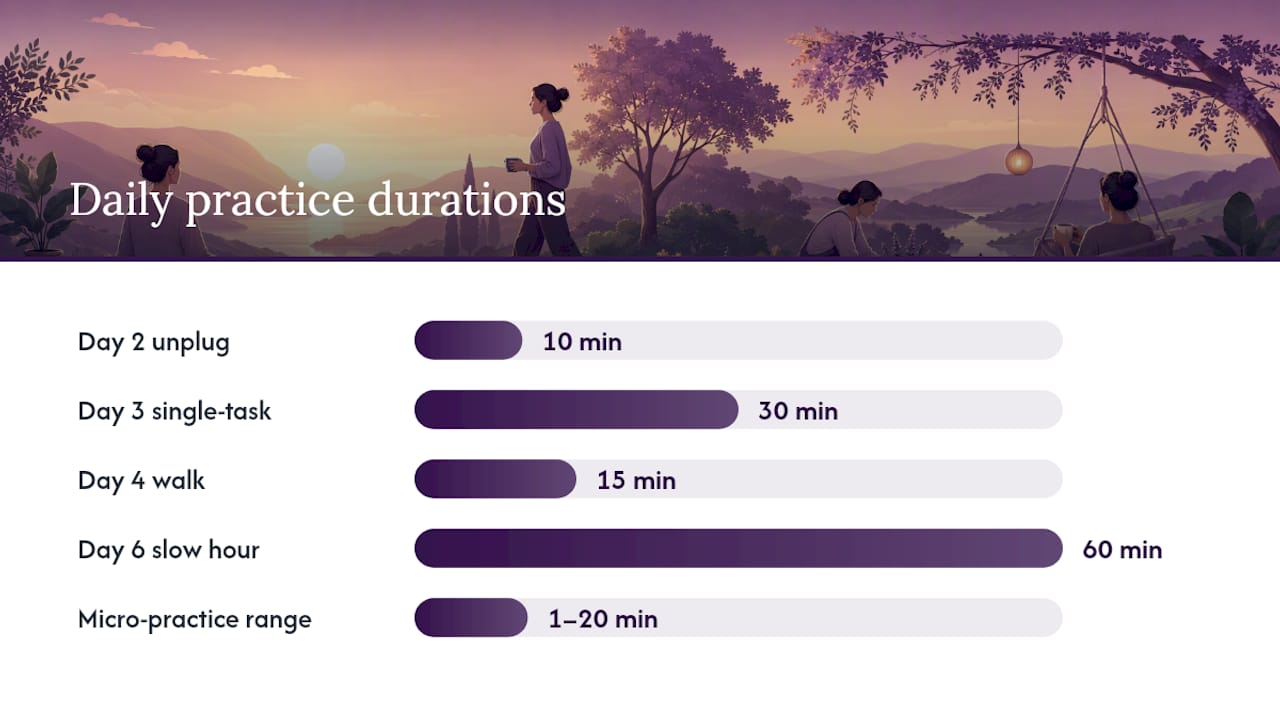
Micro-practices that take 1–20 minutes daily yield consistent benefits, according to HelpGuide’s synthesis of mindfulness research. Harvard Health specifically recommends small, incremental changes over sweeping overhauls for sustainable habit formation.
Core micro-practices:
- Single-task one activity per morning (coffee, breakfast, a short walk)
- Unplug for a short period after lunch
- Eat one meal slowly, without screens
- Use a breathing anchor (4-count in, 6-count out) before transitions
- Take a brief walk with no destination or podcast
7-day plan:
- Day 1: One mindful breakfast. No phone at the table.
- Day 2: Add a 10-minute unplug window after work.
- Day 3: Single-task your most important work task for 30 minutes.
- Day 4: Take a 15-minute walk with no audio.
- Day 5: Write three sentences in a journal before bed.
- Day 6: Designate a partial slow day: one hour with no agenda.
- Day 7: Review what felt easiest. Repeat only that for the next week.
Pro Tip: Set your phone to Do Not Disturb automatically from 9 PM to 7 AM. Removing the decision to silence it removes the friction entirely.
Common misconceptions that derail slow living
Most people abandon slow practices because of three misunderstandings, not because the practices fail.
| Myth | Reality |
|---|---|
| Slow living means doing less and falling behind | It means doing fewer things with full attention, which often produces better results |
| You need hours of free time to practice it | Most effective practices take 1–20 minutes and fit inside an existing day |
| Slowing down is only for people without responsibilities | It is most useful precisely when responsibilities are heaviest |
Pitfalls to watch for:
- All-or-nothing thinking: missing one day and abandoning the whole practice
- Social pressure: feeling judged for not being “busy enough”
- Using slow living to avoid obligations: genuine rest differs from avoidance; the former restores, the latter compounds stress
Course-correct by returning to the smallest possible version of the practice. One breath. One meal. One task.
How to measure progress without turning it into another performance metric
Use qualitative and small quantitative markers rather than strict KPIs. The goal is noticing, not scoring.
Journal prompts (weekly):
- What moment this week felt most present?
- When did I rush, and what was I avoiding?
- How did I sleep on nights after a slow practice?
Measurable signals to track lightly:
- Sleep hours and morning energy (1–10 scale)
- Single-task duration before distraction
- Number of reactive responses you caught before acting on them
A simple weekly check-in: spend five minutes on Sunday answering those three prompts. If the answers feel lighter than the week before, the practice is working. If not, reduce the practice further, not more.
How sensory rituals can support your slow practice
Sensory rituals act as reliable anchors for presence. They work because the brain links specific sensory inputs to states of attention, making it easier to shift into a slower mode on cue.
Practical sensory anchors:
- A fragrance ritual at the start of a slow morning
- A mindful hand-wash with attention on temperature and texture
- Holding a textured object (a smooth stone, a wooden bead) during breathing exercises
Scent is particularly effective because the olfactory system connects directly to memory and emotional centers in the brain. Applying a fragrance with intention, pausing to notice its opening notes before moving into the day, can serve as a reliable presence cue. Maisonvoyageurparfum’s approach to intentional fragrance use for wellness explores this connection in depth, and their science-backed guide to scent in ritual offers further grounding for anyone curious about the mechanism.
Pro Tip: Choose one fragrance specifically for slow mornings and use it only then. The association builds quickly, and within a week, the scent alone begins to cue the slower state.
For self-care products that complement a slow daily ritual, SweeTee Beauty’s wellness collection offers accessible options worth exploring.
What actually changes when you start small
The conventional advice around slow living tends toward the grand gesture: quit the hustle, move to the countryside, simplify everything. That framing misses the point entirely.
What actually shifts first is something quieter. A single morning without a screen. A meal eaten without multitasking. These moments do not feel significant in the moment. They feel almost too small to matter. That smallness is precisely why they work.
The evidence from NIH, Harvard, and Psychology Today all points in the same direction: incremental, repeated practice reshapes attention and nervous system response over weeks, not days. The people who sustain slow living are not the ones who overhauled their lives. They are the ones who protected one small ritual and let it compound.
Imperfect practice is still practice. A slow morning followed by a chaotic afternoon is not a failure. It is the whole point: you now know what calm feels like, which makes it easier to return to.
Fragrance as an optional companion to slow living

Slow living does not require any product. But for those who find sensory anchors useful, a fragrance crafted with intention can make the practice more tangible. The difference is felt in how you use it: slowly, with attention, as a cue to arrive in the present moment.
Their slow luxury philosophy aligns directly with the practices described in this article. If you are curious whether a scent ritual could anchor your own slow practice, their guided discovery tool is a quiet, unhurried place to begin.
Sources
- Mindfulness for Your Health | NIH News in Health
- Taking it slow - Harvard Health
- Benefits of Slow Living | INTEGRIS Health
- Helpguide
- How slowing down can help your health and the planet | Time
Recommended
- Benefits of Intentional Fragrance Use for Wellness – Maison Voyageur
- What Is Intentional Perfume Wearing and Why It Matters – Maison Voyageur
- How Fragrance Promotes Introspection: A Science Guide – Maison Voyageur
- The Life Menu · A slow letter from Maison Voyageur
Les sept fragrances Maison Voyageur
- Manifesting · unisexe (69,99 €)
- Intuition · femme (69,99 €)
- Certainty · femme (69,99 €)
- Expansion · femme (69,99 €)
- Release · homme (69,99 €)
- Presence · homme (69,99 €)
- Inner Fire · homme (69,99 €)
Nouvelle ici ? Commence par le Discovery Set · les 7 fragrances en format voyage (40 €).