
Why Scent Discovery Differs From Ordinary Fragrance Shopping
An exploratory fragrance experience is intentionally slow, guided, and sample-led. It produces more reliable emotional fit than a five-minute counter test ever could. Shoppers who take this path reduce purchase regret and build a genuine connection with their scent, one that deepens over days rather than dissolving the moment they leave the store. What follows covers the concrete contrasts between these two modes, how thoughtful brands design discovery experiences, a practical testing protocol you can follow at home, and how Maisonvoyageurparfum brings the slow-luxury model to U.S. shoppers.
Fragrance sampling shifts decision-making from brand marketing to personal experience, strengthening emotional attachment and reducing the likelihood of returns. That single shift is what separates exploratory scent buying from ordinary shopping.
Table of Contents
- Why the exploratory fragrance experience differs from a counter test
- How brands design a true scent discovery experience
- How to run your own exploratory fragrance test
- Why ingredient transparency matters to exploratory shoppers
- When does an exploratory approach make sense for you?
- How Maisonvoyageurparfum builds a slow Mediterranean discovery experience
- Key Takeaways
- The case for slowing down
- Maisonvoyageurparfum discovery sets for U.S. shoppers
Why the exploratory fragrance experience differs from a counter test
The differences are not subtle. They show up in time, method, environment, and the quality of the decision you make at the end.
| Dimension | Exploratory experience | Ordinary counter shopping |
|---|---|---|
| Time investment | A few days of wear across contexts | A short in-store test |
| Testing method | Skin application, full drydown | Blotter strip or quick wrist spray |
| Environment | Neutral, daily life | Crowded boutique, ambient scent |
| Guidance | Consultant or written narrative | Transactional sales interaction |
| Post-test evaluation | Notes tracked across wear timeline | Immediate impression only |
The emotional outcomes diverge just as sharply. Exploratory shoppers tend to arrive at a decision with confidence and attachment. Counter shoppers often feel uncertain, sometimes buying on impulse and regretting it later.
- Exploratory path: higher confidence, stronger emotional attachment, lower return rate, more meaningful repeat purchases
- Counter path: faster decision, higher impulse-buy rate, greater likelihood of buyer’s remorse
Top notes evaporate within 10–15 minutes for many volatile citrus and green accords, so an immediate judgment at the counter captures only the opening, never the heart or base. Retail air saturated with multiple perfumes also causes olfactory fatigue, making in-store testing less reliable unless it is structured carefully.
Pro Tip: Never rub your wrists after applying a fragrance. The friction generates heat that accelerates evaporation and can crush a composition before the heart notes even emerge. Apply, walk away, and wait at least 30 minutes before forming any opinion.
How brands design a true scent discovery experience
The best boutiques and artisanal perfumers have moved away from the open-counter model. Their goal, as retail designers now describe it, is to decode the product rather than force a guess.

Sensory merchandising means grouping scents by family, using materials and textures that hint at accords, and keeping the selection tight enough to avoid overload. A wall of 200 bottles is a counter. A curated edit of 12, each with a written narrative, is a discovery destination.
New retail strategies including discovery boxes, micro-fulfillment, sampling subscriptions, and appointment commerce now let shoppers test scents across multiple days in their own environments. That raises conversion and reduces returns for niche perfumers. Guided consultations change the decision mechanics further: curation plus interpretation reduces choice paralysis and accelerates genuine preference formation.
How to run your own exploratory fragrance test
A repeatable protocol matters. Without one, even the best sample becomes another guess.
- Pre-shop prep. Note your current mood, what you are wearing, and the scent families you are drawn to. Arrive with a clean, unscented wrist.
- In-store blotter pass. Use no more than three blotter strips to shortlist candidates. This is a filter, not a decision.
- One or two skin tests only. Apply to inner wrists or forearms. Do not rub. Leave the store.
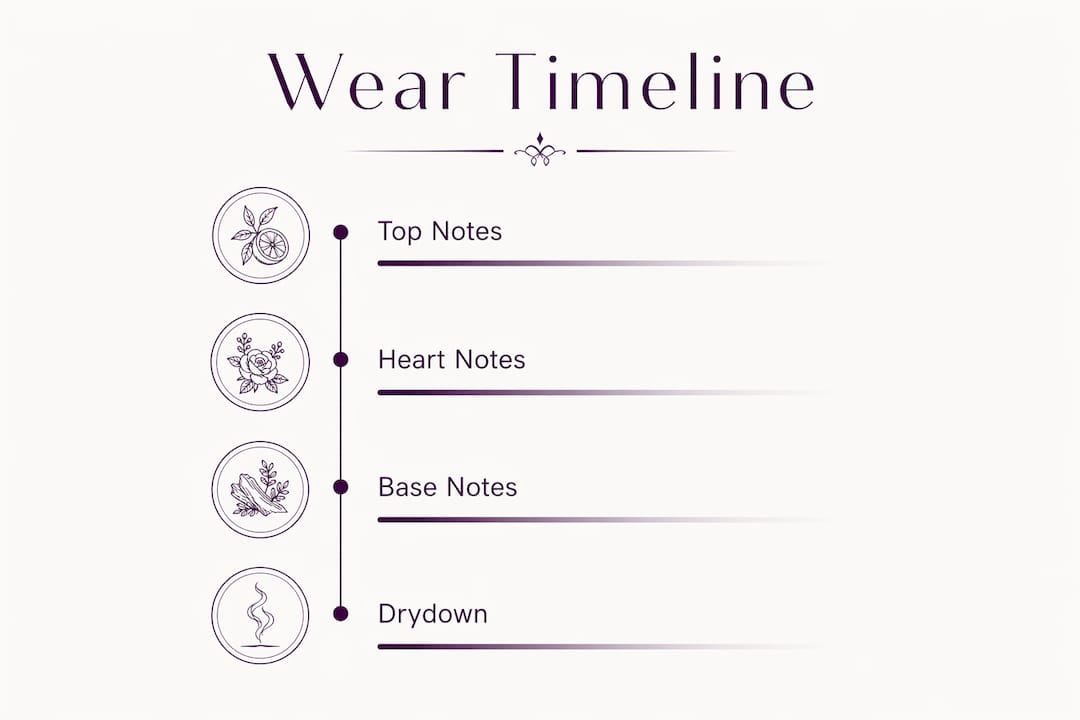
- Wear for hours. Track reactions at 0–15 minutes (top notes), 30–90 minutes (heart), and 4–24 hours (base and drydown).
- Record everything. Note environment, activities, how the scent felt at each stage, and whether you kept reaching for it or found it intrusive.
- Repeat on a second day. Diet, hormones, and skin condition all shift a fragrance’s behavior. One day’s result can mislead.
What to expect at each stage of the wear timeline
| Stage | Timeframe | What you notice |
|---|---|---|
| Top notes | 0–15 min | Bright, volatile; citrus, green, aldehydic |
| Heart notes | 30–90 min | True character emerges; floral, spice, resinous |
| Base notes | 4 hrs | Depth, warmth, longevity; woods, musks, amber |
| Drydown | 4–24 hrs | Skin scent; comfort and persistence |
You can also test on natural textiles. Wool or cashmere reveals base notes and drydown stability without the distortion of skin heat and pH, a technique connoisseurs use to isolate the composition itself.
What to ask a consultant: ingredient origin, longevity on your skin type, projection, recommended layering, and the brand’s sample or return policy.
Pricing expectations for U.S. shoppers: single vials typically run $5–$15, 15 ml discovery sizes $25–$60, curated discovery sets $50–$120, and private guided sessions $75–$150 depending on the brand. A 15 ml discovery size is often the most cost-effective way to complete a full wear cycle before committing to a full bottle.
Why ingredient transparency matters to exploratory shoppers
Slow-luxury shoppers want more than a scent. They want to understand what they are wearing and why it moves them. Ingredient origin, percent natural content, and batch notes convert a marketing story into something verifiable across wear trials.
A natural orange distillate behaves differently than a synthetic citrus accord. It opens brighter, fades faster, and leaves a warmer residue on skin. That difference is something you can feel and track. Transparency makes the testing process meaningful rather than arbitrary.
Signals worth looking for: full ingredient lists with cultivar and origin notes, batch or distillation references, IFRA compliance statements, and independent certifications. Ingredient transparency and authentic storytelling together increase trust for shoppers who prefer evidence over mass-market claims.
A short trust-signal checklist:
- Full ingredient list with sourcing notes
- Batch or distillation references
- Clear sampling and return policy
- Customer testimonials describing specific, transformative experiences
- IFRA compliance or equivalent certification
When does an exploratory approach make sense for you?
Not every purchase warrants a multi-day wear test. The right path depends on your situation.
| Scenario | Recommended approach | Why it fits |
|---|---|---|
| Gift for someone else | Curated discovery set | Low risk; recipient tests at home |
| Impulse or seasonal refresh | Quick counter test or single vial | Low commitment, low stakes |
| Signature-scent hunt | Guided session plus multi-day samples | High stakes; worth the time investment |
| Exploring a new scent family | Discovery set with 3–5 options | Lets you compare across contexts |
For a gift scenario, a curated set removes the pressure of guessing. For a personalized fragrance gift, the discovery-set format lets the recipient run their own exploratory test. For a signature-scent hunt, nothing replaces a guided session followed by at least two days of wear.
How Maisonvoyageurparfum builds a slow Mediterranean discovery experience
Maisonvoyageurparfum is a Mediterranean perfumerie based in Madrid. Every scent is composed with 98% natural ingredients and a deliberate focus on introspective narratives. The brand’s approach is not about selling a bottle. It is about giving you time to explore within yourself.
For U.S. shoppers, the discovery path looks like this:
- Sample vials and travel sizes for initial exploration without committing to a full bottle
- Curated discovery sets that group scents by emotional archetype, not just scent family
- Written wear guidance included with each set, so you know what to track and when
- Transparent ingredient notes that explain the origin and behavior of key materials
When testing Maisonvoyageurparfum samples, record your emotional state at each wear stage, the environments you moved through, and whether the scent felt like an extension of you or something external. That record is the real data. It tells you far more than a first impression ever could.
Key Takeaways
Exploratory fragrance discovery produces more reliable emotional fit than counter shopping because it is slow, skin-tested, and guided by transparency rather than impulse.
| Point | Details |
|---|---|
| Time changes everything | Wearing a scent for 4–24 hours reveals heart and base notes a counter test never shows. |
| Skin beats blotter | Blotters capture top notes only; skin testing reveals true drydown, longevity, and personal chemistry. |
| Transparency builds trust | Full ingredient lists, batch notes, and IFRA compliance turn storytelling into verifiable facts. |
| Match the approach to the stakes | Use a quick vial for a seasonal refresh; use a guided session for a signature-scent search. |
| Maisonvoyageurparfum | Offers curated discovery sets with 98% natural ingredients and written wear guidance for U.S. shoppers. |
The case for slowing down
There is a version of fragrance shopping that feels like a chore: too many bottles, too little air, a decision made under fluorescent lights in three minutes. Most people have been there. Most people have also regretted the bottle sitting unused on their shelf.
What the exploratory model offers is not complexity. It is permission to take your time. To wear something for a day before deciding. To ask where an ingredient comes from. To notice how a scent changes when you move from morning coffee to an evening walk. Those moments of noticing are where the real connection forms. A fragrance that earns your attention across 24 hours is one you will actually reach for. That is the difference between a purchase and a practice.
If you are drawn to artisanal, introspective scents, the slow path is not a luxury. It is the only honest way to know.
Maisonvoyageurparfum discovery sets for U.S. shoppers
Maisonvoyageurparfum offers the slow-luxury path in a format designed for at-home exploration. The Slow Luxury collection presents each scent with its ingredient philosophy, wear guidance, and the emotional narrative behind the composition. For shoppers who want a more structured entry point, The Inner Trip frames seven archetypes as a guided method for finding the scent that resonates with who you are right now.
Discovery sets ship to the U.S. and include sample vials, written wear notes, and a clear sampling policy so you can test without pressure. Approximate pricing follows the ranges outlined above: vials for initial exploration, 15 ml sizes for a full wear cycle, and full bottles once you know. To begin, visit the Slow Luxury page, choose the set that matches your current mood or scent curiosity, and give yourself at least two days with each sample before deciding. That is the whole protocol. Slow, honest, and worth it.
Recommended
- Immersive Fragrance Experiences: 9 Standout Examples – Maison Voyageur
- Scent Rituals for Self-Discovery: A Practical Guide – Maison Voyageur
- Find Your Signature Scent · Maison Voyageur
- How Fragrance Connects Past and Present: The Science – Maison Voyageur
Les sept fragrances Maison Voyageur
- Manifesting · unisexe (69,99 €)
- Intuition · femme (69,99 €)
- Certainty · femme (69,99 €)
- Expansion · femme (69,99 €)
- Release · homme (69,99 €)
- Presence · homme (69,99 €)
- Inner Fire · homme (69,99 €)
Nouvelle ici ? Commence par le Discovery Set · les 7 fragrances en format voyage (40 €).