
Perfumes Inspired by Travel: Scents for the Inner Journey
Here, “perfumes inspirados en viajes” means something specific: artisanal scents composed not to evoke a city or a coastline, but to evoke the journey inward. These are fragrances built for introspection, using natural botanicals with documented effects on stress and memory. Our short recommendation: choose a ritual-ready natural perfume, such as Maison Voyageur’s The Inner Trip, built on the Seven Archetypes Method, as an anchor for reflection.
- Scent connects directly to the brain’s emotional centers, a link explored in Brain Sciences research.
- Clinical trials as recent as May 2026 confirm specific botanicals shift stress markers.
- Maison Voyageur applies this science through composed, natural fragrance.
Key Takeaways
Introspective perfume works because natural botanicals act directly on the limbic system, and consistent ritual use turns that biological response into a reliable emotional anchor.
| Point | Details |
|---|---|
| Scent bypasses analysis | Aroma connects directly to the limbic system, making it faster at shifting mood than sight or sound. |
| Specific botanicals are proven | Lavender, bergamot, and frankincense each show measurable effects on stress markers in clinical research. |
| Repetition builds the anchor | Use the same fragrance for about ten sessions before switching to establish a real sensory association. |
| Test before you commit | Sample on skin across a full day and into the evening, since natural perfumes evolve with body chemistry. |
| Maison Voyageur offers a direct path | The Inner Trip’s Seven Archetypes Method matches composed, 98% natural fragrances to specific emotional states for ritual use. |
Table of Contents
- What We Mean by Travel-Inspired Perfumes for Introspection
- Why Scent Reaches the Mind Faster Than Words
- Which Botanicals Support Grounding, Focus, and Release
- How Do You Choose a Perfume for Inner Work?
- A Simple Ritual for Using Perfume in Mindful Practice
- The Inner Trip: Maison Voyageur’s Seven Archetypes Method
- How to Sample and Test an Artisanal Perfume Properly
- Why I Treat Scent as a Companion, Not a Decoration
- A Quiet Way to Begin: The Inner Trip
- Sources
What We Mean by Travel-Inspired Perfumes for Introspection
Some fragrances chase a memory of a place. Ours chase a memory of a feeling.
When we talk about perfumes inspirados en viajes, we mean scents composed as passage, not postcard. Not a bottle labeled “Marrakech” or “Kyoto.” Not a travel-size flacon meant only for your carry-on. Something else entirely.
- The scope here: artisanal, natural-forward compositions meant to accompany inward exploration.
- What it excludes: destination-souvenir perfumes and merely travel-formatted fragrances built for portability alone.
- Why the distinction matters: a scent meant for self-inquiry is built differently. Slower. With intention, not geography, as the compass.
This framing draws on what practitioners of natural perfumery at the Northwest School of Aromatic Medicine describe: botanical extracts that evolve on skin, creating an experience unique to the wearer’s own chemistry.
Why Scent Reaches the Mind Faster Than Words
Scent skips the queue. It bypasses the analytical brain and speaks straight to the limbic system, the seat of emotion and memory. That is why a single note can undo you before you understand why.
This is not metaphor. Research on smell and memory confirms that personally meaningful aromas lower stress markers more reliably than scents that are simply pleasant but neutral. The nose has a private line to feeling that the eyes and ears do not.
Clinical findings as of May 2026, published in a review on essential oils and their psychological effects, give us specifics worth naming:
- Lavender measurably lowers heart rate and cortisol.
- Bergamot reduces anxiety in controlled settings.
- Frankincense contains compounds tied to relief from anxiety and depressive states.
Separately, Johns Hopkins research identified incensole acetate, a frankincense component, as psychoactive in preclinical studies. It helps explain something humans have practiced for millennia without needing the chemistry: burning resin to still the mind.
For a perfume meant for inner work, this translates simply. The right botanical does not just smell calming. It changes something in the body while you breathe it in.
Which Botanicals Support Grounding, Focus, and Release
Certain botanical families show up again and again in scent-anchored meditation practice, and not by accident. Different materials shift the mind toward different states, a pattern aroma-and-meditation research links to distinct patterns of brain activity.
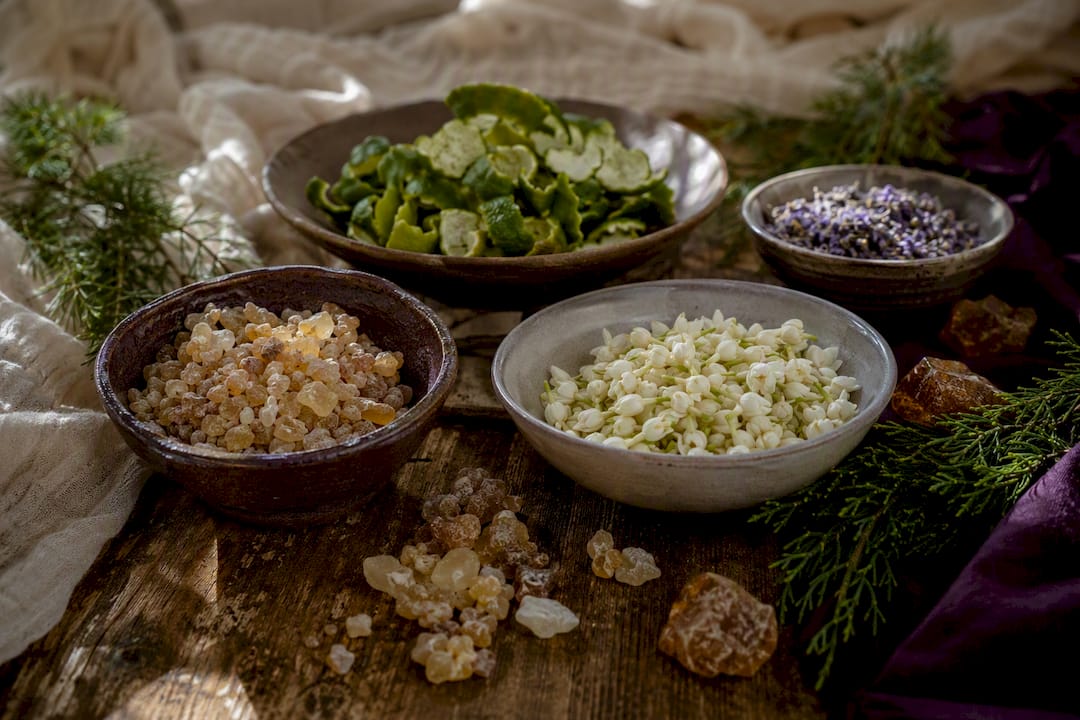
Grounding Sandalwood and vetiver. Both are associated with alpha wave activity, the register the brain settles into during rest.
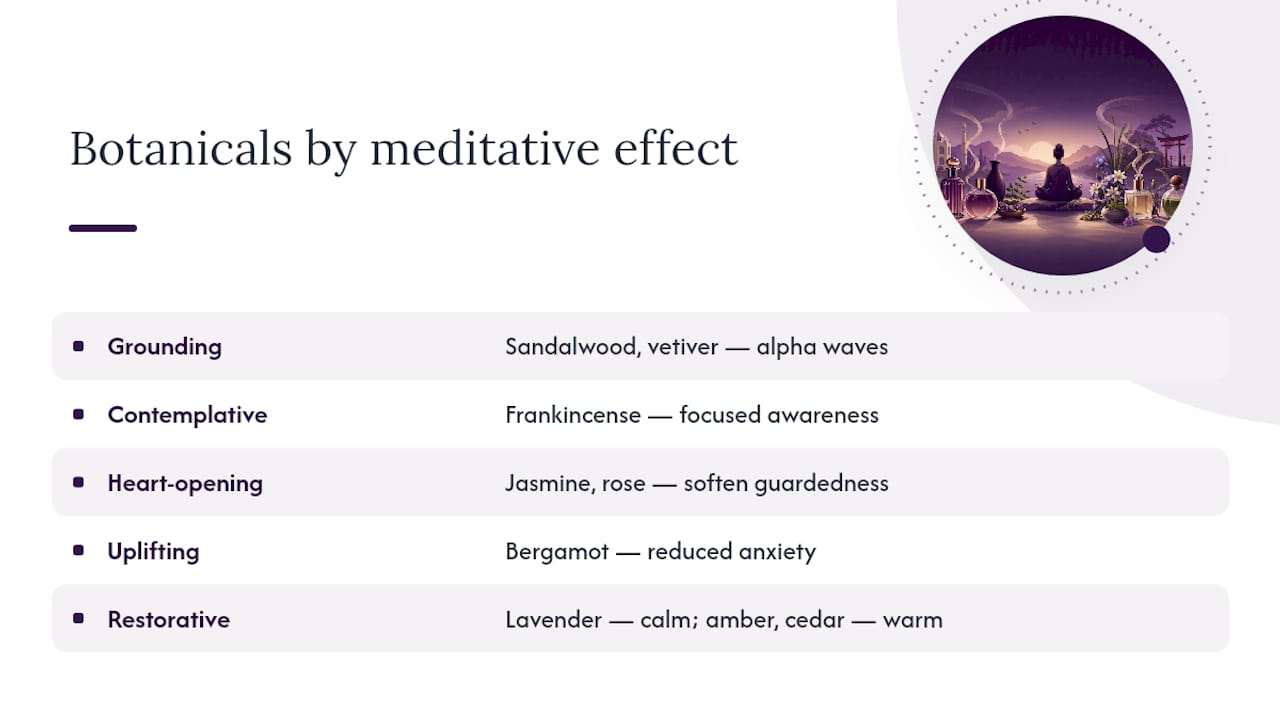
Contemplative Frankincense. Supports sustained, focused awareness rather than drift.
Heart-opening Jasmine and rose. Notes traditionally used to soften emotional guardedness.
Uplifting Bergamot. Clinically tied to reduced anxiety, useful when introspection tips toward heaviness.
Restorative Lavender, amber, cedar. Lavender for nervous-system calm, amber and cedar for a quiet, encasing warmth.
Pro Tip: Pair one grounding note (vetiver, sandalwood) with one heart-opening note (rose, jasmine) for a composition that steadies you before it opens you up.
A caution: natural ingredients still carry allergy risk. Essential oil compounds like linalool or limonene, common in lavender and citrus notes, can trigger sensitivity in some skin types. Patch-test before committing to daily wear.
How Do You Choose a Perfume for Inner Work?
Pick the scent that quiets you, not the one that impresses a room.
That is the single principle worth holding onto. A perfume for introspection needs to be comfortable enough to wear for months, and honest enough to keep surprising you.
Beyond that instinct, a few practical criteria matter:
- Ingredient transparency. Can the brand tell you what is actually in the bottle?
- Travelability. Does it come in a roll-on or travel spray for portable ritual use?
- Longevity and evolution. Natural perfumes shift over hours. Does it evolve in a way that still feels like you by evening?
- Sustainability. Is sourcing traceable, and is the botanical material ethically harvested?
- Allergy suitability. Are common irritants disclosed clearly?
Before buying, a short checklist helps:
- Ask for the full ingredient list, not a marketing summary.
- Ask where and how the perfume is composed.
- Request a sample size before committing to a full bottle.
- Confirm the return or exchange policy for sensitivity reactions.
Trust signals worth demanding: provenance of raw materials, a described artisan process, and a company willing to explain its formulation rather than hide behind “fragrance” as a catchall term.
A Simple Ritual for Using Perfume in Mindful Practice
Consistency builds meaning. Randomness does not.
The protocol is short enough to repeat daily:
- Choose one setting. Same chair, same time of day, ideally before meditation, journaling, or breathwork.
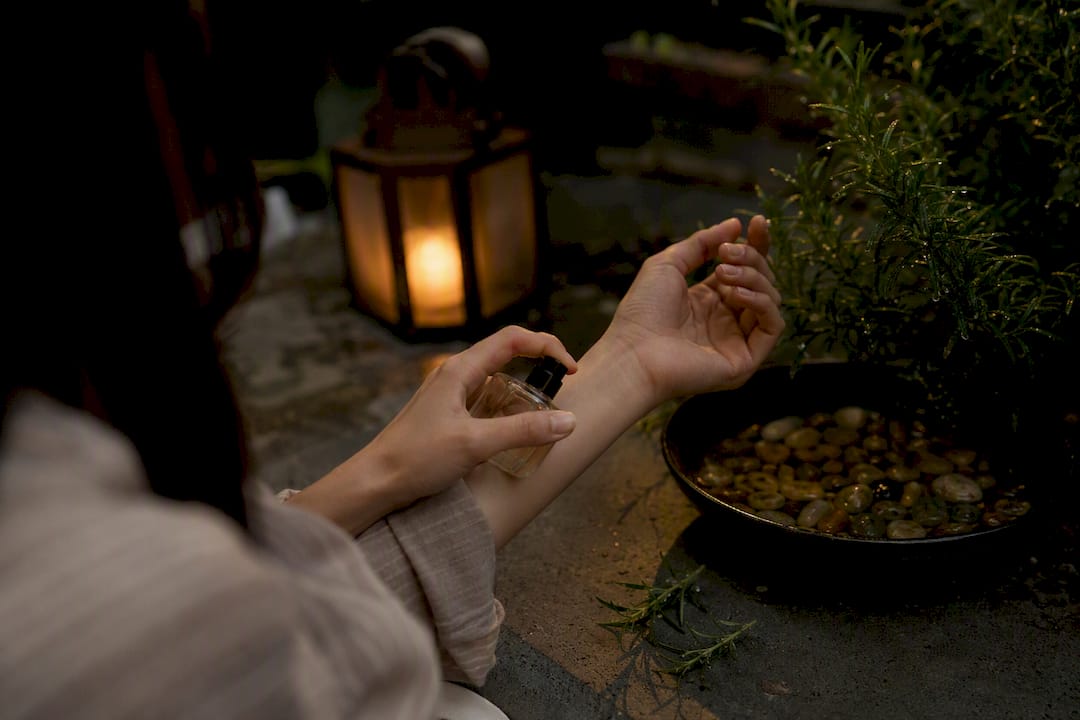
- Apply the perfume to pulse points. Wrists, inner elbow, base of the throat.
- Take three slow inhalations, eyes closed, before beginning your practice.
- Let the scent fade into the background as you work. Do not chase it. Let it hold you instead.
Pro Tip: Use the same fragrance for at least ten consecutive sessions before switching. The nervous system needs repetition to form the scent into a genuine anchor for calm.
A note on overexposure: even calming botanicals can lose their effect, or start to irritate skin, with excessive daily reapplication. Give your skin, and your senses, a rest day when needed.
The Inner Trip: Maison Voyageur’s Seven Archetypes Method
Maison Voyageur built The Inner Trip around a simple premise: fragrance can map to psychological states the way a compass maps to direction.
The Seven Archetypes Method assigns each composition to an emotional territory rather than a geographic one. A customer begins with a short quiz, mapping their current emotional landscape to one of seven archetypes, then receives a sample or travel size matched to that result before committing to a full bottle.
Two examples show the range. One archetype, built around vetiver and sandalwood, leans grounding, meant for readers who feel scattered and need to settle. Another, built around jasmine and amber, leans toward emotional opening, meant for readers working through something they have kept guarded.
Slow-made perfume asks something different of its wearer. It is not decoration. It is a quiet return to yourself, built one natural material at a time.
Trust signals matter here. Maison Voyageur composes each scent in Madrid using 98% natural ingredients, an approach that echoes what artisanal perfumer Mandy Aftel calls “Slow Scent,” where materials are given room to converse rather than being forced into a single note.
- Guided discovery through the archetype quiz.
- Travel-size and sample formats before full-bottle commitment.
- Real customer accounts of scent-triggered emotional shifts.
How to Sample and Test an Artisanal Perfume Properly
Sample on skin, not on paper alone. Natural perfumes change as they meet your body’s warmth and chemistry, something research on personalized fragrance confirms varies meaningfully from person to person.
A workable testing sequence:
- Start with a blotter strip for the first impression.
- Apply a small amount to skin, ideally the inner wrist.
- Wear it through a full day to see how it evolves.
- Revisit it at night. Natural compositions often deepen or shift entirely by evening.
A few practical notes:
- Patch-test on the inner arm 24 hours before full application if you have sensitive skin.
- Natural perfumes often have shorter, more intimate longevity than synthetic ones. That is a feature, not a flaw, for ritual use.
- Online buyers should look for sample packs or decants before a full-size purchase. In-person sampling, where available, still offers the most complete first impression. Consider a single-ingredient oil, such as Wellthious’s essential oils, if you want to test a botanical in isolation before committing to a full composition.
Why I Treat Scent as a Companion, Not a Decoration
Most people wear perfume the way they scroll a feed. Fast, unconscious, forgettable. I have come to see it differently.
A well-made natural perfume rewards patience. Give it the same fragrance for weeks, and it starts to hold your own memories inside it, not the perfumer’s. Read more in our journal on fragrance and introspection.
A Quiet Way to Begin: The Inner Trip
Maison Voyageur exists for readers who want more from a perfume than a compliment. The Inner Trip pairs the Seven Archetypes Method with a discovery pathway built for exactly the ritual work this article describes: a short quiz, a matched sample or travel size, and a full bottle only once you know it belongs to you.
Customers describe the process as less like buying a product and more like meeting something already familiar. If a grounding, contemplative, or heart-opening archetype from this article caught your attention, start with the Seven Archetypes discovery pathway and request a sample before choosing your full-size bottle.
Sources
- Smell and memory
- PMC article on essential oils and effects
- Essential oils and anxiety (Tisserand Institute)
Recommended
- Perfumes inspirados en viajes: aromas para el autoconocimiento – Maison Voyageur
- Meilleures fragrances voyage intérieur : guide introspection – Maison Voyageur
- Inner Journey Through Scent: A Self-Discovery Guide – Maison Voyageur
- Scent-Triggered Emotional Journeys: Real Examples – Maison Voyageur
Les sept fragrances Maison Voyageur
- Manifesting · unisexe (69,99 €)
- Intuition · femme (69,99 €)
- Certainty · femme (69,99 €)
- Expansion · femme (69,99 €)
- Release · homme (69,99 €)
- Presence · homme (69,99 €)
- Inner Fire · homme (69,99 €)
Nouvelle ici ? Commence par le Discovery Set · les 7 fragrances en format voyage (40 €).