
Perfume Lovers: Tell If Myrtle Is Real in 10–20 Minutes
Mirto, or myrtle, is a green, slightly camphoraceous Mediterranean note drawn from the plant Myrtus communis. Its expression varies considerably between perfumes because of chemotype and formulation differences, so testing on skin matters more than trusting a notes list. Two proof points worth remembering before you shop: the International Fragrance Association (IFRA) governs how these natural constituents can be used safely, and houses like Maisonvoyageurparfum treat myrtle as a living, variable material rather than a fixed formula.
TL;DR:
- Myrtle’s scent varies significantly based on chemotype, with major compounds like 1,8-cineole and myrtenyl acetate influencing whether it smells more medicinal or resinous.
- The plant’s growing conditions and extraction methods cause extensive variability, making each batch of myrtle oil unique in aroma profile.
- Skin reactions and actual scent perception can differ from the notes list, so on-skin testing and comparison to herbal references are essential.
- Myrtle blends influence its character, with citrus creating brightness or florals softening the medicinal edge, affecting how long the fragrance lasts.
- Checking the notes’ placement (top, heart, base) and concentration levels is crucial before purchasing, as these factors shape scent projection and longevity.
Table of Contents
- What Does Mirto Smell Like? The Chemistry Behind the Note
- Why Mirto Smells Different From One Perfume to the Next
- How to Identify Mirto on Skin and in the Notes Pyramid
- How Mirto Pairs With Other Notes to Shape Style
- What to Check Before Buying a Perfume With Mirto
- An Artisanal View: How Composition Choices Shape Myrtle’s Character
- A Perfumer’s Honest Take on the Myrtle Note
- Try Myrtle-Forward Scents From Maisonvoyageurparfum
- Sources
- FAQ
What Does Mirto Smell Like? The Chemistry Behind the Note
Close your eyes and press a myrtle leaf between your fingers. That is the closest shortcut to understanding mirto. The impression is green and resinous, with a camphoraceous coolness that can turn sweet, almost fruited, depending on how it is distilled.
The sensation traces back to a small set of molecules that show up again and again in essential oil analysis. Perfumers and chemists point to:
- 1,8-cineole — the eucalyptus-like, medicinal coolness
- Myrtenyl acetate — the sweeter, resinous, almost floral facet
- Alpha-pinene — the sharp, piney top note
- Linalool — a soft, slightly floral rounding effect
Pro Tip: If a fragrance description calls mirto “sweet and fruity,” it likely leans on myrtenyl acetate. If it reads as “medicinal” or “herbal,” expect a higher 1,8-cineole content instead.
The proportions shift by a wide margin. One GC-MS analysis of Algerian Myrtus communis oil found myrtenyl acetate at 57.58% alongside 1,8-cineole at 17.82%, a ratio that skews the entire oil toward resinous sweetness rather than sharp camphor. Broader chemical composition research confirms these same four compounds recur across essential oil studies, which is why “mirto” rarely smells identical twice.
Why Mirto Smells Different From One Perfume to the Next
No two bottles of myrtle oil are guaranteed to smell alike, and that is not a formulation flaw. It is botany.
A 2021 analysis of 33 Moroccan myrtle oil samples identified distinct chemotypes driven by differing myrtenyl acetate, alpha-pinene, and 1,8-cineole levels. Samples clustered into recognizably different chemical groups depending on where and how the plant grew. That single fact explains most of the confusion you will find in online reviews.
The same word, “mediterranean,” can describe a bright citrus-forward mirto or a dry, apothecary-like camphor accord, depending entirely on which chemotype and which fraction the perfumer chose to work with.
Formulation choices compound the effect further:
- Concentration (EDT versus EDP) changes how present the note reads on skin
- Supporting notes can amplify or mute the camphoraceous edge
- Fractionated or diluted myrtle extracts soften the note into a background nuance rather than a lead
So when one reviewer calls a fragrance “sunny and citrusy” and another calls the same bottle “medicinal,” both may be smelling real facets of the same chemically complex material.
How to Identify Mirto on Skin and in the Notes Pyramid
A blotter tells you what the bottle intends. Skin tells you what actually happens, and myrtle is a note where the gap between the two can be significant.
- Start with the blotter. Note the immediate impression: green, cool, sharp, or already sweet.
- Apply one or two sprays to skin, ideally on the inner wrist and inner elbow, where warmth and oils differ slightly.
- Wait 10 to 20 minutes before judging anything. Top notes fade fast, and myrtle’s true character often needs that window to settle.
- Track the note by phase. Look for green, slightly camphoraceous facets up top, herbal camphor warmth in the heart, and faint resinous depth by the base.
- Compare against a reference. A drop of true myrtle essential oil, or even crushed bay leaf, gives your nose an anchor.
Pro Tip: Keep a small vial of a green-herbal reference, like rosemary or eucalyptus oil, in your testing kit. Comparing an unfamiliar fragrance against a known herbal scent trains your nose faster than memory alone.
If you have sensitive skin, check the ingredient list (INCI) before buying a full bottle. Natural does not automatically mean hypoallergenic, and IFRA’s guidance on sensitizing ingredients applies to natural essential oil constituents just as much as synthetic ones.
How Mirto Pairs With Other Notes to Shape Style
Myrtle rarely stands alone. What surrounds it decides whether the finished fragrance feels like a coastal afternoon or a walk through dry Mediterranean scrubland.
Common pairings produce distinct outcomes:
- Citrus plus mirto creates a bright, sun-warmed accord, often read as classically Mediterranean
- Juniper or cypress plus mirto pushes toward something wilder and more resinous, closer to maquis scrubland than a garden
- Soft florals plus mirto round the camphor edge into something gentler and more wearable day to day
- Amber or musk bases extend mirto’s life on skin, since the note alone tends to fade faster than heavier resins
If you want brightness for warm weather, look for mirto paired with citrus or other green herbs. If you prefer something softer for daily wear, florals or amber-based compositions tame the medicinal edge without erasing it.
Projection and longevity depend heavily on concentration. Myrtle-forward fragrances built at eau de toilette strength tend to sit close to the skin and fade within a few hours, while eau de parfum concentrations with amber or resin support can extend that considerably.
What to Check Before Buying a Perfume With Mirto
A well-written product page tells you where mirto sits in the composition, not just that it exists somewhere in the list.
Before buying, check for:
- Whether mirto is listed as a top, heart, or base note, and whether the copy says it is central or a background nuance
- The concentration (EDT, EDP, or parfum), since this shapes both projection and longevity
- Sample or discovery-size availability, so you can test before committing to a full bottle
- Recent buyer reviews mentioning actual wear time, since reported longevity on myrtle-centered releases varies noticeably even within the same product line
Pro Tip: Ask directly, “Is mirto the lead note or a supporting nuance here?” A vague answer, or a product description with no clear notes pyramid, is a signal to keep looking.
Treat claims of “natural” or “pure myrtle” with mild skepticism if the brand offers no INCI transparency. A fragrance house confident in its sourcing usually says so plainly, without needing to hide behind marketing language.
An Artisanal View: How Composition Choices Shape Myrtle’s Character
That approach matters specifically for a note as variable as mirto.
Small-batch composition allows a perfumer to select for a particular myrtle fraction rather than blending toward a generic average. Choosing oil richer in 1,8-cineole and alpha-pinene yields a clearer, greener, more camphoraceous read. Leaning toward myrtenyl acetate produces something softer and more resinous, often rounded with florals. Mass-market formulations, working at scale, tend to average these facets out into something more predictable and less distinct.
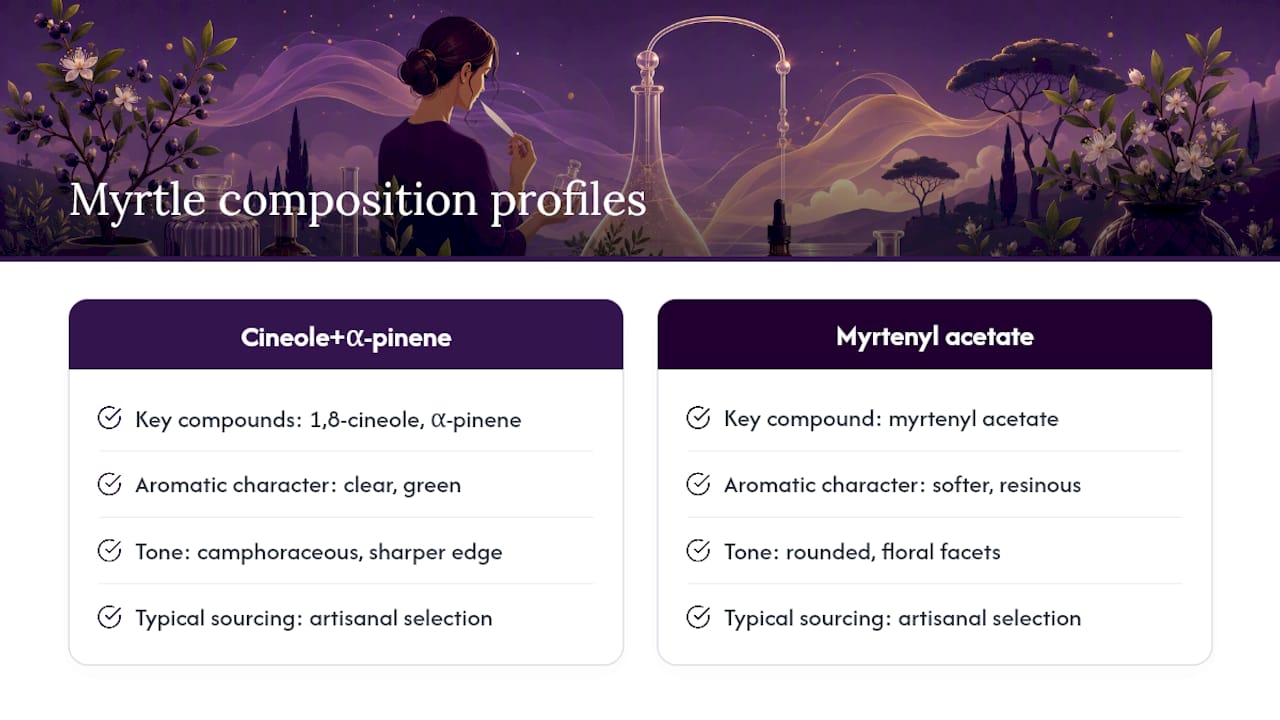
Choose an artisanal composition when you want mirto to read as a specific, recognizable material rather than a vague “fresh” accent. A mass-market alternative may suffice if you simply want a light, inoffensive green note without needing to know exactly which facet you are smelling.
A Perfumer’s Honest Take on the Myrtle Note
Most advice about mirto treats it like a single, stable smell you either like or don’t. That is the wrong frame. The chemistry says otherwise: myrtle oil is a moving target, and the same descriptor can point to two genuinely different accords depending on chemotype and how the perfumer fractionated the material.
The conventional advice, read the notes list and trust it, falls short here more than with almost any other Mediterranean note. Rosemary and lavender have their own variability, but myrtle’s swing between medicinal camphor and sweet resin is unusually wide for a single named ingredient.
What should you prioritize first? Skip the marketing copy and go straight to skin testing, ideally against a known herbal reference. Ask what fraction or facet the house is working with before you ask about price or bottle design. A perfumer who can answer that question with specifics, rather than adjectives, is usually working with real, traceable material rather than a generic aroma chemical standing in for the real thing.
— Celeste
Try Myrtle-Forward Scents From Maisonvoyageurparfum
That approach is what lets a note like mirto show its real character instead of a flattened, generic version of itself.

If myrtle’s green, resinous complexity is what drew you to this note in the first place, browse the full-size 100ml perfume collection, priced at €69.99 each. Start by sampling before committing to a full bottle, and let your own skin tell you which facet of mirto, green and sharp, or soft and resinous, actually suits you. Once you find the expression that feels right, the full-size bottle is there waiting.
Sources
The chemical variability claims in this article draw from GC-MS analyses of Moroccan and Algerian myrtle oil, including the Moroccan chemotype study and the Algerian composition analysis, both of which document real compositional swings by origin. Safety guidance on natural sensitizers comes from IFRA’s QRA information booklet.
- Chemical Variability of Moroccan Myrtle Oil
- Comprehensive In Vitro and In Silico Analysis of Antimicrobial and Insecticidal Properties of Essential Oil of Myrtus communis L. from Algeria
- Myrtus communis essential oil: chemical composition and antimicrobial activities (Molecules, 2014)
FAQ
What Does Mirto Smell Like?
Mirto smells green, slightly camphoraceous, and resinous, with facets that can lean sweet and almost fruited depending on the oil’s chemotype. Major compounds like 1,8-cineole and myrtenyl acetate drive that range from medicinal coolness to soft resinous sweetness.
Do Perfumes With Mirto Smell Like Myrrh?
No. Mirto (myrtle) and myrrh are entirely different materials from different plant families, and they are commonly confused only because the names sound similar in English and Spanish. Myrrh is a warm, smoky, slightly bitter resin, while mirto is a cool, green, herbal note.
What Does Myrrh Smell Like in a Fragrance?
Myrrh reads as warm, resinous, and faintly smoky, often with a bitter, medicinal undertone that deepens in the base of a composition. It behaves nothing like mirto’s fresher, greener profile, despite the naming overlap that causes confusion for shoppers.
What Is Mirto Called in English?
Mirto is called “myrtle” in English, referring to the Mediterranean shrub Myrtus communis. Perfumers and fragrance databases use “myrtle” interchangeably with “mirto” when describing this note.
How Do I Know if a Perfume’s Mirto Note Will Suit Me?
Test the fragrance on skin and wait 10 to 20 minutes before judging it, since myrtle’s true character often only emerges after the initial top notes settle. Compare the dry down against a known herbal reference, and check whether the brand describes mirto as central or as a background nuance before buying a full bottle from a collection like Maisonvoyageurparfum’s.
Les sept fragrances Maison Voyageur
- Manifesting · unisexe (69,99 €)
- Intuition · femme (69,99 €)
- Certainty · femme (69,99 €)
- Expansion · femme (69,99 €)
- Release · homme (69,99 €)
- Presence · homme (69,99 €)
- Inner Fire · homme (69,99 €)
Nouvelle ici ? Commence par le Discovery Set · les 7 fragrances en format voyage (40 €).