
3 Layers That Make Mediterranean Aromatic Perfumes Last for Shoppers
Mediterranean aromatic perfumes build a scent picture of sun, herb, and salt. They open with citrus brightness, settle into a heart of maquis herbs like rosemary, thyme, and lavender, often lifted by azahar (orange blossom), and rest on woods, resins, or a suggestion of the sea. This guide breaks down that structure, how perfumers keep it from fading by noon, and where to find it done well, including at Maison Voyageur.
TL;DR:
- Mediterranean perfumes rely heavily on fixatives like labdanum, cedar, or musk to extend longevity despite their volatile citrus and herbal notes.
- Concentration impacts wear time, with eau de parfum formulations offering better longevity and more developed base notes suited for warmer weather.
- Proper evaluation requires waiting at least five to ten minutes after application and checking the scent at one and four hours to assess its true character.
- Fragrance descriptions often include notes like bergamot, azahar, cypress, or marine accord, which indicate the scent’s coastal or interior inspiration.
- Maison Voyageur emphasizes natural ingredients and a slow, layered approach that prioritizes emotional depth and memory over immediate projection.
Table of Contents
- What Notes Define a Mediterranean Aromatic Scent?
- How Perfumers Structure These Fragrances For Longevity
- How Do You Choose The Right Mediterranean Perfume?
- Maison Voyageur’s Approach To The Mediterranean Palette
- Why Mediterranean Perfumes Endure
- Try Maison Voyageur’s Mediterranean Collection
- Sources
What Notes Define a Mediterranean Aromatic Scent?
Mediterranean perfumery has a vocabulary. Once you learn it, you can read a fragrance description or a note list and know, before you smell it, whether it will lean coastal or interior, sunny or shadowed by pine.
Editors describing this style tend to reach for the same words: bergamot, marine accords, and white florals show up again and again in roundups meant to conjure a coastal vacation. That’s the brightness layer. Citrus, especially bergamot and lemon, is what gives Mediterranean perfumes their lift. Green citrus, the kind that smells more like the peel than the pulp, adds a slightly bitter edge that keeps the top note from feeling like fruit punch.
The herbal heart is where things get interesting. This is the “maquis” character, named for the scrubland that covers hillsides across the Mediterranean basin. Rosemary, thyme, and lavender dominate here, and they’re rarely sweet. Perfumes built around this fragrance family, like Torroella de Montgrí by Santi Burgas, list lavender, rosemary, and cypress directly on the bottle, translating an actual landscape into a wearable accord. Green and slightly olivaceous facets sometimes thread through this section too, hinting at olive leaf or fig without naming either outright.
Then come the florals, and here Spanish perfumery has a signature move. Azahar, or orange blossom, appears constantly in Spanish fragrance, often alongside olive-derived nuances that ground the floral in something more agricultural than boudoir. Neroli, the more citrus cousin of orange blossom, does similar work. Houses like Álvarez Gómez have built entire fragrance lines around orange blossom, treating it as a cultural touchstone rather than just another floral note.
Marine and saline accords are trickier to pin down because there’s no literal “ocean” molecule. Perfumers suggest the sea through mineral, ozonic, or slightly salty facets, often built from synthetic aroma chemicals that read as clean air and wet stone rather than actual brine. A well-done marine accord doesn’t smell like a beach. It smells like the memory of standing near one.
The base is where restraint matters most. Cypress, cedar, labdanum, and a light touch of incense provide depth, but Mediterranean perfumery avoids the heavy, sweet resins that define oriental fragrances. Soft musks round things out without adding weight. The goal is a base you feel more than notice.
A few combinations to watch for on labels:
- Coastal profile: bergamot, marine accord, white florals, light musk
- Interior maquis profile: rosemary, thyme, lavender, cypress, cedar
- Floral Spanish profile: azahar, neroli, olive nuance, soft resin
- Historical or ritual profile: orange blossom, myrrh, frankincense, warm wood
None of these are rigid categories. Most Mediterranean perfumes borrow across two or three of them, which is exactly why the palette feels alive rather than formulaic.
How Perfumers Structure These Fragrances For Longevity
Every Mediterranean aromatic perfume follows a version of the same architectural logic, even when the notes on top differ wildly. Understanding that logic tells you why a scent behaves the way it does on skin, and why some fade in an hour while others hold shape all afternoon.
The blueprint runs in three layers:
- Top notes (citrus): bergamot, lemon, or green citrus hit first and evaporate fastest. This is the “sunny” opening that lasts for a short while.
- Heart notes (herbs and white florals): rosemary, thyme, lavender, azahar, or neroli emerge next and carry the perfume for a few hours, forming the emotional core of the scent.
- Base notes (woods, resins, musk): cypress, cedar, labdanum, and musk anchor everything, extending wear time and giving the composition somewhere to land once the brighter notes are gone.
This ordering matters because citrus and herbs are inherently volatile. Left alone, they’d vanish within the hour, which is a real problem for a fragrance family built almost entirely on notes that want to disappear.
Fixatives solve that problem. Labdanum, a resin with a warm, slightly leathery character, is one of the most common anchors in this style. It slows the evaporation of lighter notes without dragging the composition into oriental territory. Cedar and vetiver do similar work from the woody side, while modern musks, often synthetic for stability, extend the whole structure by hours. A perfume that pairs volatile citrus with fixatives like musks, woods, and resins holds its identity even in warm weather, which matters enormously for a fragrance style associated with summer heat.
Concentration is the other lever perfumers pull. Eau de toilette formulations, lighter in oil concentration, suit the airy character of citrus and herbs but typically fade faster in a few hours. Eau de parfum versions carry more oil, which means the same top notes last longer and the base notes get a chance to fully develop, resulting in greater longevity. Some formulators respond to warm-climate wear by leaning harder into resinous or woody bases, essentially building a stronger anchor so the citrus opening has more to hold onto.
Sillage, the trail a perfume leaves as you move, tends to be moderate to close in well-made Mediterranean scents. That’s intentional. This isn’t a fragrance family built for room-filling projection. Drydown, the final phase after the top and heart notes fade, usually settles into something warm and soft rather than sweet, a quiet echo of cypress or labdanum rather than vanilla or amber.
Pro Tip: If a Mediterranean perfume seems to vanish within an hour, it likely leans too heavily on citrus without enough fixative support. Look for cedar, labdanum, or musk listed in the base before you write off the whole bottle.
How Do You Choose The Right Mediterranean Perfume?
Choosing a Mediterranean perfume comes down to matching a few concrete signals against your own skin, season, and intended use. The note list on the bottle tells you most of what you need to know before you even open it.
Start with what to look for on the label itself. Words like “maquis,” “azahar,” “neroli,” “cypress,” or “marine accord” are strong indicators you’re looking at a genuinely Mediterranean-style fragrance rather than a generic citrus scent wearing a vacation-themed name. Concentration matters too: eau de toilette (EDT) suits daytime wear and hot weather because it’s lighter and less likely to feel cloying, while eau de parfum (EDP) gives you more staying power for longer days or cooler evenings.
A proper sampling routine changes everything about how you judge a fragrance. Most people smell a perfume once from the bottle and decide. That’s a mistake with this fragrance family specifically, because the top notes are designed to fade fast and mislead you.
Here’s a routine worth following:
- Spray on skin, not paper. Pulse points on the wrist or inner elbow work best.
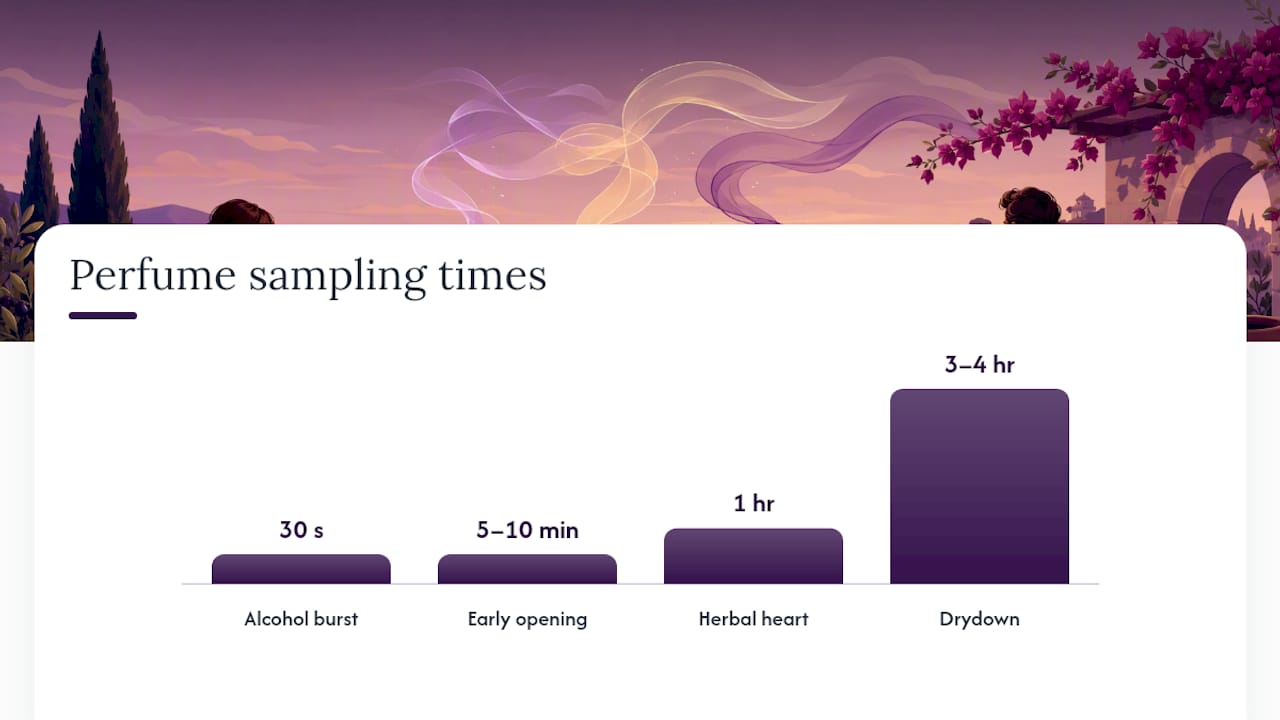
- Wait five to ten minutes before judging the opening. The first thirty seconds is alcohol, not perfume.
- Check back at the one-hour mark to catch the herbal heart in full bloom.
- Return at three to four hours to evaluate the drydown. This is the true test of whether the fixatives are doing their job.
- Avoid layering multiple samples on the same skin area within a day. Mediterranean notes are subtle enough that overlap muddies your judgment.
Season and occasion guidance is fairly intuitive once you understand the note structure. Bright, citrus-forward Mediterranean scents suit spring and summer daylife: office wear, daytime errands, outdoor lunches. Versions leaning harder into resin, incense, or warm wood carry better into cooler months or evening occasions, since the base notes read as more substantial once daylight fades.
Application affects projection more than most people realize. Two sprays on pulse points and one on clothing gives you a controlled trail without overwhelming a room. Skin chemistry, particularly oil levels, changes how long citrus and herbal notes last. Drier skin tends to lose top notes faster, so people with drier skin often benefit from an EDP concentration or a scent with a stronger resinous base.
Storage matters more here than with heavier fragrance families. Citrus and herbal molecules degrade with heat and light exposure faster than dense oriental compounds do. Keep bottles away from windowsills or bathroom humidity, and store them upright in a cool, dark drawer to preserve the volatile top notes that define the whole point of the scent.
Maison Voyageur’s Approach To The Mediterranean Palette
Maison Voyageur composes its Mediterranean fragrances slowly, in a Madrid atelier, using a very high proportion of natural ingredients. That number isn’t a marketing flourish. It’s a formulation constraint that shapes every decision about how a scent opens, develops, and settles on skin.
The philosophy centers on introspection rather than projection. Where mass-market Mediterranean scents often chase an obvious, immediately recognizable “vacation” impression, Maison Voyageur’s compositions favor a quieter storyline, built around ingredients meant to surface memory and place rather than announce themselves across a room. Herbal and floral notes appear with restraint, layered so the wearer discovers new facets over hours rather than all at once.
Volatility is managed the way traditional perfumery has always managed it: natural fixatives, careful ratios between top and base materials, and patience during the aging process rather than synthetic shortcuts to force longevity. The Madrid atelier’s approach treats each scent as a slow-built composition, not a quick assembly of trending notes.
A fragrance made this way isn’t meant to be identified in a single sniff. It’s meant to be lived in, revisited, and understood a little differently each time you wear it.
That’s the throughline across the collection: less spectacle, more depth.
Why Mediterranean Perfumes Endure
Scent and memory sit closer together in the brain than almost any other sense pairing, which is part of why Mediterranean perfumes never really go out of fashion. A single note of rosemary or orange blossom can pull someone back to a specific afternoon, a specific coastline, faster than a photograph ever could. That’s not marketing language. It’s just how olfactory memory works, and this fragrance family leans into it more honestly than most.
These perfumes suit people who want scent as a quiet companion rather than a statement. If you gravitate toward linen over silk, toward mornings over nightlife, a citrus and herb composition will likely feel more like you than a heavy oriental ever would. They pair naturally with warm-weather wardrobes, understated jewelry, and the kind of gathering where conversation matters more than entrance.
The best Mediterranean scents don’t try to recreate a beach. They recreate a feeling of unhurried time, which is worth more than realism.
— Celeste
Try Maison Voyageur’s Mediterranean Collection
Maison Voyageur’s Mediterranean line covers the full palette described here: citrus openings, maquis herbs, azahar, and soft woody bases, each composed in small batches rather than mass-produced runs. They’re the actual formulation approach behind each scent.

You don’t have to commit to a full bottle to find out if a composition suits you. Travel sizes and curated sets let you sample the range against your own skin chemistry before deciding, and gift sets make sense if you’re introducing someone else to the collection rather than choosing for yourself. For a smaller, complementary gesture alongside a fragrance gift, scented shea butter from Sayhey Gifting pairs well with a travel-size scent without competing with it.
Visit the Maison Voyageur collection page to browse current Mediterranean compositions, check available formats, and order a sample or full-size bottle directly.
Sources
For readers who want to go deeper into the note families and formulation ideas covered here, these sources offer direct, practical detail:
- Torroella de Montgri — Santi Burgas | Fragrantica
- Aromas mediterráneos en los perfumes españoles | Scento
- 12 perfumes que nos recuerdan al Mediterráneo | Glamour
Les sept fragrances Maison Voyageur
- Manifesting · unisexe (69,99 €)
- Intuition · femme (69,99 €)
- Certainty · femme (69,99 €)
- Expansion · femme (69,99 €)
- Release · homme (69,99 €)
- Presence · homme (69,99 €)
- Inner Fire · homme (69,99 €)
Nouvelle ici ? Commence par le Discovery Set · les 7 fragrances en format voyage (40 €).