
Perfume Concentration Differences: A Clear Guide
Perfume concentration is defined as the percentage of fragrance oil in a formula, and it directly shapes how a scent smells, how long it lasts, and how far it projects. To understand perfume concentration differences is to understand why two bottles labeled with the same name can feel like entirely different experiences on your skin. The standard industry term for this measurement is fragrance concentration, and it covers five main categories: Parfum, Eau de Parfum, Eau de Toilette, Eau de Cologne, and Eau Fraîche. Each category carries its own character, price point, and purpose. Choosing the right one is less about prestige and more about knowing what you actually need.
What are the standard perfume concentration categories?
The five fragrance concentration levels map to specific fragrance oil percentages in the finished formula, with the remainder made up of alcohol and solvents. Those percentages determine everything from how quickly a scent opens to how long it lingers on your skin.
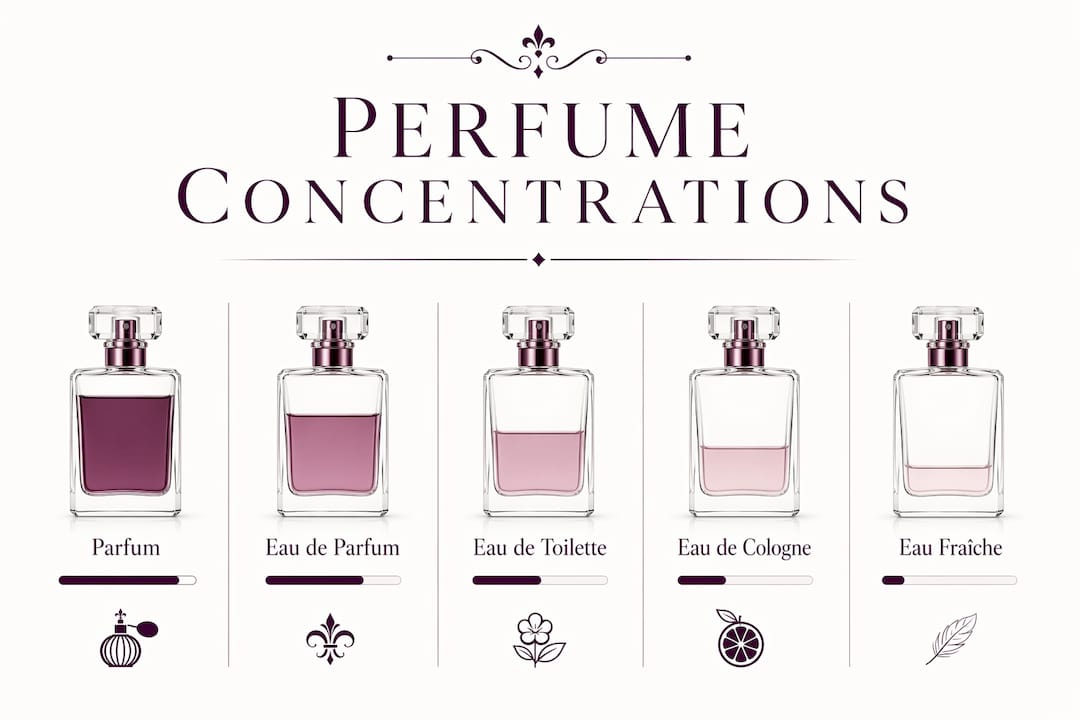
| Concentration | Oil Percentage | Typical Longevity | Best For |
|---|---|---|---|
| Parfum (Extrait) | 20–40% | 8–24 hours | Special occasions, cool weather |
| Eau de Parfum (EDP) | 15–20% | 6–10 hours | Day to evening, versatile wear |
| Eau de Toilette (EDT) | 5–15% | 3–5 hours | Daily wear, warm climates |
| Eau de Cologne (EDC) | 2–5% | 2–3 hours | Casual, refreshing use |
| Eau Fraîche | 1–3% | 1–2 hours | Post-gym, light touch-ups |
Parfum, also called Extrait de Parfum, sits at the top of the scale. Its high oil concentration means the scent evolves slowly and deeply on skin, often revealing base notes that lighter concentrations never fully develop. Eau de Parfum offers the most practical balance for most people. It delivers genuine presence without the weight or cost of a full Extrait.
Eau de Toilette is the most widely sold concentration globally. It suits everyday wear and performs well in warm weather, where heavier concentrations can feel overwhelming. Eau de Cologne and Eau Fraîche are the lightest options. They refresh rather than announce, making them ideal for athletic use or layering under other scents.
Pricing follows concentration closely. Parfum commands the highest price per milliliter because it uses the most raw material. That said, a small amount goes a long way. Two or three drops of a well-made Parfum can outlast a full spray of an EDT by several hours.
Does concentration alone determine how a fragrance smells?
Concentration does not fully determine a fragrance’s character. EDT and EDP versions of the same named fragrance often carry rebalanced formulas, meaning perfumers adjust note proportions rather than simply diluting or concentrating a single base. This is one of the most misunderstood aspects of fragrance concentration levels.
Chanel No. 5 is the clearest example. The EDT and Extrait share an olfactive identity but differ in their aldehyde and rose balance. The EDT was created later, recalibrated for everyday wear. The Extrait leans richer and more abstract. They are not the same formula at different strengths. They are two distinct compositions built for different moments.
Perfumers make these adjustments deliberately. At higher concentrations, certain aromatic molecules become too dense or sharp, so the formula is rebalanced to maintain harmony. Woody and musky base materials often increase at higher concentrations to anchor the scent and prevent the formula from reading as harsh.
“The strength label on a perfume bottle does not guarantee a uniform scent profile. Formula adjustments at different concentration levels create real nuances in dry-down and opening character.” Off The Record Fragrance
Fixatives add another layer of complexity. These are ingredients that slow the evaporation of volatile scent molecules, extending how long a fragrance lasts on skin. Fixative chemistry affects aroma stabilization and thermal evaporation independently of oil percentage. A well-fixed EDT can outlast a poorly fixed EDP. Concentration and fixative quality work together, not in isolation.
Pro Tip: When testing a new fragrance, try both the EDT and EDP versions on separate skin patches at the same time. The difference in character often reveals which formula was designed with more care for your preferred wear style.
How do you choose perfume concentration for different occasions?
Choosing the right fragrance concentration comes down to three factors: climate, occasion, and how much presence you want to project. EDP suits day-to-evening wear because it balances longevity and projection without demanding attention. Parfum is best reserved for cooler weather, intimate settings, or moments when you want a scent to stay with you for an entire day without reapplication.
Here is a practical framework for matching concentration to context:
- Hot weather or active days: Choose EDT or Eau Fraîche. Heat amplifies scent projection, so lighter concentrations prevent the fragrance from becoming overpowering. An EDT in summer often projects as strongly as an EDP in winter.
- Office or shared spaces: EDT or a restrained EDP works best. Projection matters here. You want presence, not intrusion.
- Evening wear or special occasions: EDP or Parfum. The richer base notes in higher concentrations suit low-light, intimate environments where the scent can unfold slowly.
- Travel or touch-ups: Eau Fraîche or a travel-size EDT. These are light enough to reapply without layering into something heavy.
- Cold weather: Parfum. Cooler temperatures slow evaporation, which means lighter concentrations can disappear quickly. A Parfum holds its character through the day.
One counterintuitive fact: an EDT can project more strongly in the first hour than a Parfum. The higher alcohol content in lighter concentrations accelerates initial diffusion, creating a stronger opening sillage. Parfum, by contrast, opens quietly and builds over time. Projection and longevity are separate properties, not a single sliding scale.
Pro Tip: Before buying a full bottle, wear a sample of your chosen concentration for a full day. Skin chemistry, body heat, and your natural scent all interact with the formula in ways that a 30-second store test cannot reveal.
What misconceptions about perfume strength should you avoid?
The most common misconception is that higher concentration always means a better or stronger fragrance. This is not accurate. Skin chemistry and formulation affect performance as much as oil percentage does. A person with dry skin loses scent faster regardless of concentration. A person with oily skin can make an EDT last as long as an EDP on someone else.
Several other myths deserve attention:
- Myth: EDT is just a diluted EDP. Brands often treat EDT as a distinct formula, not a weaker version of the same composition. The scent character can differ meaningfully.
- Myth: You can always increase concentration to make a fragrance stronger. IFRA regulations limit ingredient concentration in finished products by exposure category. Some aromatic materials cannot legally exceed certain percentages in a formula, making it impossible to simply scale up concentration without reformulating.
- Myth: Higher price always means better value. An EDT priced lower can outperform a weak EDP for specific scent profiles or climates. Value depends on preference and wear time, not concentration alone.
- Myth: Parfum is always the most intense. Fixative quality, ingredient volatility, and formula balance all shape intensity. A Parfum built on soft musks may feel quieter than a sharp, citrus-forward EDT.
“Regulatory restrictions make simply increasing concentration impractical or impossible for some perfume ingredients. IFRA compliance requires recalculations of ingredient levels when adjusting concentration to avoid exceeding exposure limits.”
The practical takeaway is this: read concentration as a starting point, not a verdict. Let your nose and your lifestyle make the final call.
Key takeaways
Perfume concentration sets the foundation for scent longevity and character, but formulation, fixatives, and skin chemistry determine the full experience.
| Point | Details |
|---|---|
| Concentration defines oil percentage | Parfum holds 20–40% fragrance oil; Eau Fraîche holds just 1–3%. |
| EDT and EDP are often distinct formulas | Perfumers rebalance notes at each concentration, not just dilute or concentrate. |
| Fixatives shape longevity independently | A well-fixed EDT can outlast a poorly fixed EDP regardless of oil percentage. |
| Climate and occasion guide the choice | Light concentrations suit heat and daily wear; Parfum suits cool weather and special moments. |
| Higher concentration is not always better | Skin chemistry, IFRA limits, and formulation quality all affect real-world performance. |
What i have learned from wearing every concentration
Celeste’s perspective on fragrance concentration and how to choose wisely.
Most people buy a Parfum expecting the definitive version of a fragrance. Sometimes it is. Often it is not. I have worn both the EDT and EDP of the same fragrance on the same day and preferred the EDT every time. The formula was brighter, more alive. The EDP felt heavier without being richer.
What changed my approach was learning to separate projection from longevity. I used to assume they moved together. They do not. Some of the most projecting fragrances I own are EDTs. Some of the quietest are Parfums. Once you understand that, concentration labels stop feeling like a hierarchy and start feeling like a tool.
My honest advice: stop buying full bottles of concentrations you have never worn for a full day. Sample first. Wear it through heat, cold, and an evening out. The opening note you loved in the store may disappear by noon. The dry-down you ignored may be the reason you reach for it every day.
Exploring the Seven Archetypes collection at Maisonvoyageurparfum shifted how I think about fragrance identity entirely. The scents are built around emotional character, not concentration categories. That reframing is worth more than any percentage chart.
— Celeste
Discover fragrance concentration through Maisonvoyageurparfum
At Maisonvoyageurparfum, each fragrance is slowly made with 98% natural ingredients, crafted to evoke memory and emotion rather than simply fill a room. The Mediterranean perfumerie based in Madrid approaches concentration not as a marketing label but as a deliberate choice in service of the scent’s character.

If you are ready to move beyond generic fragrance shopping, explore the full perfume collection to find scents built with intention across different concentration profiles. For a more personal starting point, the scent archetype quiz helps you identify which fragrance character resonates with who you are right now. Real luxury is time to explore within yourself. Maisonvoyageurparfum offers exactly that.
FAQ
What is perfume concentration?
Perfume concentration is the percentage of fragrance oil in a formula relative to alcohol and solvents. It directly influences how intense, long-lasting, and projecting a scent is on skin.
What is the difference between eau de toilette vs eau de parfum?
Eau de Toilette contains 5–15% fragrance oil and lasts roughly 3–5 hours, while Eau de Parfum holds 15–20% and lasts 6–10 hours. Beyond oil percentage, the two versions often have rebalanced formulas with different scent characters.
Does higher concentration always mean a stronger scent?
No. An EDT can project more strongly in the first hour than a Parfum due to higher alcohol content accelerating diffusion. Skin chemistry, fixatives, and formula balance all affect perceived strength independently of concentration.
Can perfumers simply increase concentration to make a fragrance stronger?
Not always. IFRA regulations limit how much of certain ingredients can appear in a finished product by exposure category. Some aromatic materials cannot legally exceed set percentages, making a simple concentration increase impossible without reformulating.
How do i choose the right fragrance concentration for my lifestyle?
Match concentration to climate and occasion. Choose EDT or Eau Fraîche for hot weather and daily wear, EDP for versatile day-to-evening use, and Parfum for cool weather, special occasions, or when you want all-day wear without reapplication.
Recommended
- Maison Voyageur vs Diptyque · Niche Perfume Comparison
- Maison Voyageur · Mediterranean Perfumerie · Madrid · Istanbul · Paris
- Maison Voyageur · All Perfumes · Mediterranean Perfumerie Madrid
- The Seven Archetypes · Maison Voyageur Mediterranean Perfumerie Madrid
Article generated by BabyLoveGrowth
Les sept fragrances Maison Voyageur
- Manifesting · unisexe (69,99 €)
- Intuition · femme (69,99 €)
- Certainty · femme (69,99 €)
- Expansion · femme (69,99 €)
- Release · homme (69,99 €)
- Presence · homme (69,99 €)
- Inner Fire · homme (69,99 €)
Nouvelle ici ? Commence par le Discovery Set · les 7 fragrances en format voyage (40 €).