
How Perfume Supports Meditation: A Science-Backed Guide
Perfume supports meditation by acting as a sensory anchor that trains the nervous system to shift from stress into calm. This effect works through associative learning, the same mechanism behind Pavlovian conditioning. When you pair a chosen fragrance consistently with your practice, the brain’s limbic system links that scent to a state of stillness. Practitioners report stress reduction within 1–2 weeks of daily scent and meditation pairing. The result is a reliable, repeatable on-ramp to focus, one that works whether you meditate for five minutes or fifty.
How perfume supports meditation through scent anchoring
Scent anchoring is the practice of pairing a chosen fragrance consistently with meditation so the brain learns to associate that scent with calm. Over time, the fragrance alone becomes enough to signal the nervous system to settle. This is not metaphor. It is applied associative learning.
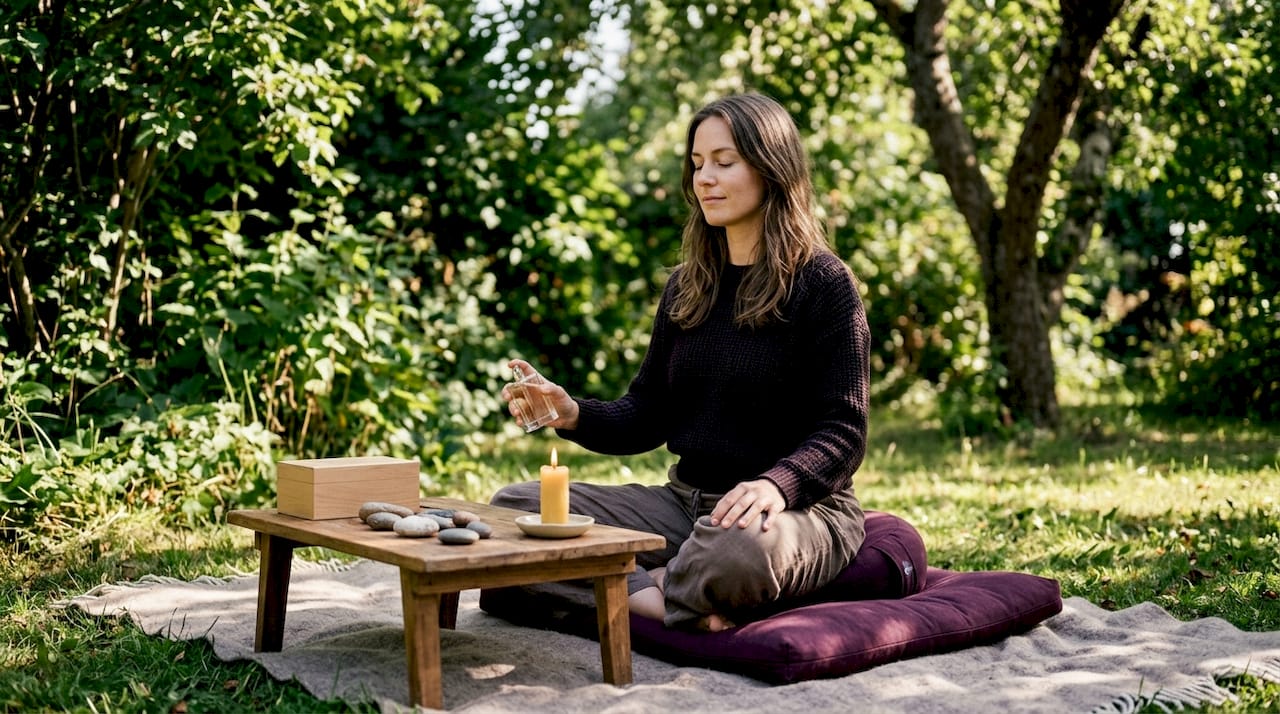
The mechanism starts in the nose. Scent molecules travel directly to the brain regions that control emotion, memory, and mood, bypassing the slower cortical processing that governs most other senses. That direct route to the limbic system is why a single whiff of sandalwood can shift your state faster than a deep breath alone.
Effective scent anchors share three qualities. They are:
- Simple. One clear, distinctive fragrance rather than a complex blend that shifts on the skin.
- Consistent. The same scent, applied the same way, at the start of every session.
- Repeatable. Repeat exposure to the same scent paired with calm practice creates strong sensory cues over time.
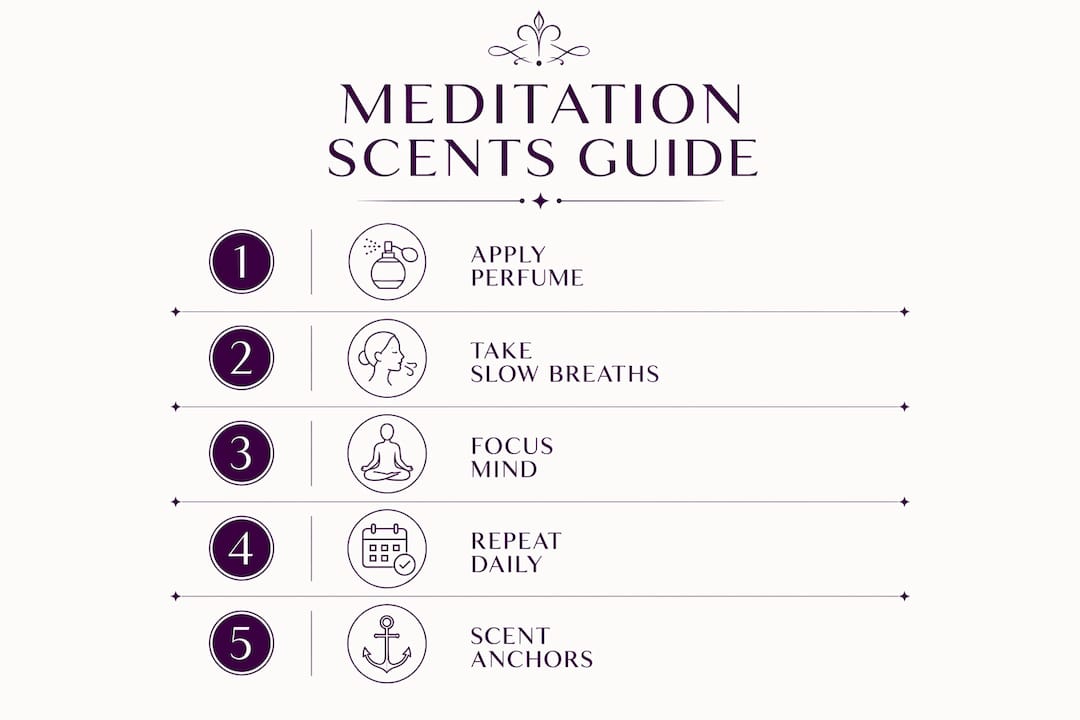
A basic scent anchoring routine looks like this: apply or diffuse your chosen fragrance, take three slow breaths while noticing the scent, then begin your meditation. That small ritual signals the brain that stillness is coming. The transition from ordinary awareness to meditative focus becomes shorter with each repetition.
Pro Tip: Reserve your meditation fragrance exclusively for practice. Using it at other times weakens the association. Treat it the way athletes treat pre-performance rituals: specific, intentional, and protected.
Which scents are most effective for meditation?
Fragrance families each carry distinct aromatic properties that influence emotional and cognitive states. Choosing the right one depends on what you want your session to do.
Woody and resinous scents
Frankincense, sandalwood, and cedarwood are the most established fragrances for meditation. These scents have over 5,000 years of documented spiritual use across Buddhist, Hindu, and Abrahamic traditions. Their slow, deep character evokes stillness and supports grounding. Ancient frankincense rituals combined sensory experience, breath, and intention to create a sacred space that sharpens mental clarity. That structure maps directly onto modern meditation technique.
Sandalwood carries a warm, milky depth that slows mental chatter. Cedarwood is earthier and more austere, useful for practitioners who want a clean, forest-like quality without sweetness. Frankincense sits between them: resinous, slightly citric on the top note, and deeply calming in the base.
Fresh and citrus scents
Fresh or citrus notes suit clarity-focused or energizing sessions. Bergamot, lemon, and green tea accords lift attention without agitation. They work well for morning practice or for practitioners who feel heavy or sluggish before sitting.
Matching scent to session intent
| Scent family | Primary effect | Best for |
|---|---|---|
| Frankincense | Deep calm, spiritual openness | Contemplative or spiritual practice |
| Sandalwood | Warmth, mental stillness | General daily meditation |
| Cedarwood | Grounding, clarity | Body scan or breath-focused sessions |
| Bergamot / citrus | Alertness, lightness | Morning or energizing practice |
| Lavender | Relaxation, tension release | Evening or stress-relief sessions |
Natural fragrances interact with the body’s chemistry in ways synthetic versions do not replicate fully. Essential oil-based perfumes and artisanal blends made with natural ingredients tend to evolve on the skin, offering a richer sensory experience across a session. Maisonvoyageurparfum crafts its fragrances with 98% natural ingredients, which means the scent breathes and shifts rather than sitting flat, a quality that rewards slow, attentive practice.
Pro Tip: Start with one fragrance for at least three weeks before switching. The anchor only forms through repetition. Rotating scents too early resets the conditioning.
How to incorporate perfume into your meditation practice
The method of application shapes how strongly the fragrance supports your session. These approaches move from most immersive to most portable.
-
Diffuse into the space. An ultrasonic diffuser or a candle disperses scent evenly through the room. This works best in a dedicated meditation space where the scent can build gradually. Keep the concentration low. Balanced, layered fragrances that gently mark space support focus rather than dominate it.
-
Apply a roll-on perfume or body oil. Roll-on application to the wrists or inner elbows places the scent close to the breath without filling the room. This method suits practitioners who meditate in shared spaces or travel frequently. A roll-on perfume creates a personal sensory boundary that reinforces the Pavlovian response regardless of the surrounding environment.
-
Inhale directly from the palms. Apply a small amount of oil or perfume to both palms, rub them together gently, and cup them over the nose for three to five slow breaths before sitting. This technique concentrates the scent signal at the precise moment of transition into practice.
-
Use a scented object. A small piece of fabric or a wooden bead held during meditation can carry a trace of fragrance. This works well for tactile meditators who benefit from a physical anchor alongside the olfactory one.
Common pitfalls to avoid:
- Applying too much. Overpowering scent creates sensory noise, not calm. One or two drops of a body oil is enough.
- Switching fragrances mid-session. Consistency within a session matters as much as consistency across sessions.
- Using your meditation scent casually throughout the day. That dilutes the association and weakens the anchor over time.
- Choosing a fragrance you find pleasant but not calming. Personal resonance matters. If a scent energizes rather than settles you, it belongs in a different context.
The benefits of intentional fragrance use extend beyond meditation into broader wellness routines, but the practice works best when the scent has one clear, protected role.
What role does environment and routine play alongside perfume?
Scent works best inside a structure. A dedicated meditation space amplifies the anchor effect because the brain receives multiple simultaneous cues: the familiar scent, the familiar setting, the familiar posture. Each layer reinforces the others.
Building that environment does not require a separate room. A consistent corner, a specific cushion, and a single fragrance are enough. The brain reads repetition as safety. Safety lowers cortical arousal. Lower arousal makes stillness easier to reach.
Pairing scent with other sensory and physical cues deepens the effect further:
- Breath work. Begin with three to five slow exhales before introducing the fragrance. This primes the nervous system before the scent cue arrives.
- Posture. Sitting in the same position each session adds a proprioceptive anchor alongside the olfactory one.
- Intention setting. A brief, silent statement of purpose before beginning links the scent to a specific mental orientation, not just a general state of calm.
- Consistent timing. Morning or evening practice at the same hour strengthens the routine signal. The body begins to anticipate stillness before you even reach for the fragrance.
Scent also serves a specific function for practitioners who struggle with silent or breath-focused meditation. Fragrance provides a friendly, nonverbal object for attention, reducing the frustration or anxiety that can arise when the mind resists silence. Rather than forcing the breath as the sole anchor, the practitioner can rest awareness lightly on the scent. This is a lower-resistance entry point, and it is particularly useful for beginners.
Subtle scent layers mark a mindful transition better than strong aromas. The goal is a scent that says “we are beginning” rather than one that announces itself loudly. Think of it as a threshold, not a statement.
Key Takeaways
Scent anchoring is the most direct and repeatable method for using fragrance to deepen meditation, because it trains the nervous system through consistent pairing rather than relying on any single session’s mood or effort.
| Point | Details |
|---|---|
| Scent anchoring works fast | Consistent pairing of fragrance with meditation can reduce stress within 1–2 weeks. |
| Limbic system is the mechanism | Scent molecules reach emotion and memory centers directly, bypassing slower brain processing. |
| Match scent to session intent | Use woody or resinous scents for grounding, citrus or fresh notes for clarity and energy. |
| Subtlety is non-negotiable | Overpowering fragrance creates distraction; one or two drops of a natural oil is enough. |
| Routine multiplies the effect | Pairing scent with consistent posture, timing, and intention deepens the Pavlovian response. |
Scent, stillness, and what I’ve learned from both
I spent years treating fragrance as decoration. Something pleasant to wear, not something to work with. The shift came when I started using the same sandalwood oil every morning before sitting. Within two weeks, the scent alone was enough to drop my shoulders. That surprised me.
What I’ve found is that beginners often overthink scent selection and underthink consistency. The fragrance matters less than the repetition. A simple cedarwood roll-on applied at the same moment every day will outperform an elaborate diffuser ritual done inconsistently. Start subtle. One fragrance, one application point, one session at a time.
The other thing worth saying clearly: scent supports meditation. It does not replace the fundamentals. Breath awareness, posture, and intention still carry the practice. Fragrance is the on-ramp, not the road. When practitioners treat it as a shortcut rather than a cue, they tend to become dependent on the scent rather than deepened by it.
My honest advice is to experiment slowly. Try a fragrance for introspection and notice what it does to your attention in the first three breaths. That immediate response tells you more than any scent profile description. Trust your nervous system. It knows what settles it.
— Celeste
Maisonvoyageurparfum fragrances for your meditation practice
Maisonvoyageurparfum crafts each fragrance slowly, with 98% natural ingredients, for practitioners who want more than a pleasant scent. The blends are built for introspection, not performance.

The Mediterranean fragrance collection includes woody, resinous, and fresh profiles suited to every meditation intent, from deep grounding to morning clarity. For practitioners who want a ritual object rather than a wearable, the personalized soy candle offers a dedicated scent anchor for a fixed meditation space. Each piece is made to be used with intention, not worn and forgotten. Real luxury, here, is time to explore within yourself.
FAQ
How quickly does scent anchoring work for meditation?
Practitioners typically notice stress reduction within 1–2 weeks of daily consistent scent and meditation pairing. The nervous system learns the association faster when the fragrance, setting, and timing remain the same each session.
What is the best fragrance for meditation beginners?
Sandalwood and cedarwood are the most accessible starting points because their calm, grounding character suits most meditation styles. Both have centuries of documented use in contemplative traditions and are widely available in natural essential oil form.
Can I use any perfume for meditation, or does it need to be natural?
Any fragrance can form a scent anchor, but natural perfumes and essential oil-based blends tend to evolve on the skin in ways that reward slow, attentive practice. Synthetic fragrances often stay flat, which reduces the sensory richness of the experience.
How much fragrance should I use during meditation?
One to two drops of a body oil or a single application of a roll-on is enough. Overpowering scent creates sensory overload and pulls attention away from the breath rather than supporting it.
Can perfume help if I struggle to focus during meditation?
Yes. Fragrance provides a nonverbal object for attention that many practitioners find easier to rest awareness on than the breath alone. This makes scent particularly useful for beginners or anyone who experiences frustration with silent practice.
Recommended
- How Fragrance Promotes Introspection: A Science Guide – Maison Voyageur
- Nature’s Role in Scent Therapy: A Science-Backed Guide – Maison Voyageur
- El rol del perfume en mindfulness: guía práctica – Maison Voyageur
- Benefits of Intentional Fragrance Use for Wellness – Maison Voyageur
Les sept fragrances Maison Voyageur
- Manifesting · unisexe (69,99 €)
- Intuition · femme (69,99 €)
- Certainty · femme (69,99 €)
- Expansion · femme (69,99 €)
- Release · homme (69,99 €)
- Presence · homme (69,99 €)
- Inner Fire · homme (69,99 €)
Nouvelle ici ? Commence par le Discovery Set · les 7 fragrances en format voyage (40 €).