
Start a Scent Diary: Apps or Paper, Templates, 3 Scents Worn Twice
A personal scent diary works best when it matches your temperament: choose an app like ScentShelf or ScentLog if you want searchable analytics and daily tracking, or a physical journal like My Scent Diary if you crave slower, reflective writing. Start with whichever format you’ll actually open again tomorrow. Both paths lead to the same place: a clearer sense of what you truly wear, and why.
TL;DR:
- App-based trackers offer automation, quick logging, and pattern recognition, but require careful attention to privacy and data export options.
- Physical journals provide deeper reflection and better memory retention, especially for complex layering experiments, but lack searchability and analytics features.
- Consistent entries should include fragrance details, context, weather, mood, longevity, and personal notes, with selective logging to avoid burnout.
- Reviewing monthly patterns, comparing intended versus actual wear, and tracking cost-per-wear deliver valuable insights into your scent preferences and habits.
- Starting with simple tools like a basic notebook or free app and keeping entries brief encourages habit formation before investing in specialized or premium formats.
Table of Contents
- What Is a Personal Scent Diary, and Which Format Fits You?
- What Should You Record in Every Diary Entry?
- Digital Trackers vs Physical Journals: What Actually Matters
- How Do You Turn a Scent Diary Into Real Fragrance Insight?
- A Slower Way to Write About Scent
- How Do You Build the Habit of Regular Entries?
- Is It Safe to Keep a Digital Scent Diary?
- How Do You Read Your Own Diary Once It’s Full?
- Can You Keep a Scent Diary Without Spending Money?
- A Realistic First Week With a New Scent Diary
- Testing Your Scent Diary With Samples From Maison Voyageur
- Where to See the Actual Product Pages
- Sources
- FAQ
What Is a Personal Scent Diary, and Which Format Fits You?
A personal scent diary, sometimes called a fragrance memory book or olfactory experiences journal, is simply a record of what you wore, when, and how it made you feel. The format matters less than the consistency. Some people need the friction removed entirely, tapping a log entry between meetings. Others need the opposite: a quiet page, a pen, and ten minutes of undistracted attention.
App or journal: a quick gut check
If you already track workouts, meals, or sleep on your phone, an app extension of that habit will stick. If your phone feels like the last place you want more notifications, a paper journal removes that friction entirely and turns logging into a small ritual rather than another task.
Below is how the leading options stack up.
| Option | Type | Key features | Best for | Pricing model |
|---|---|---|---|---|
| ScentShelf | Mobile app | Daily wear logs, photo cataloging, AI scent profile | Fast daily logging with AI-assisted pattern spotting | Free tier with core functions |
| Scent Library | Mobile/web dashboard | Weekly planner grid, weather-aware picks, cost-per-wear analytics | Planning ahead and tracking value over time | Not publicly listed |
| ScentLog | Web app | Context tags (weather, mood, occasion), searchable archive | Contextual, searchable wear history | Not publicly listed |
| My Scent Diary | Physical journal | Review sheets, layering experiment pages, wishlist section | Reflective, tactile writers who skip screens | One-time purchase |
ScentShelf leans hardest into automation. It logs what you wore each day, catalogs your collection with photos, and builds what it calls a scent DNA profile from your patterns, aiming to surface recommendations without much manual work from you.
Scent Library behaves more like a planning tool. Its weekly planner grid and weather-aware suggestions help you decide what to wear before you leave the house, and its cost-per-wear tracking turns an abstract “was this worth it” question into an actual number.
ScentLog organizes around context. Every wear gets tagged with weather, mood, and occasion, so when you’re deciding what to reach for on a stressful Tuesday in February, your own history tells you what has worked before.
My Scent Diary skips analytics entirely in favor of depth. Its structured review sheets and dedicated layering experiment pages give you room to write the kind of long-form notes that a phone screen discourages.
Who should pick which:
- Choose an app if you want low-effort daily logging and automatic pattern detection.
- Choose ScentLog specifically if searchable context tags matter more to you than analytics.
- Choose a physical journal if writing by hand helps you actually remember what you write.
What Should You Record in Every Diary Entry?
A useful entry answers the same questions every time, so patterns become visible after a month rather than staying buried in scattered notes. Capture these fields consistently:
- Fragrance name and house (be specific: the exact concentration, not just the brand).
- Date and occasion (work, date, errand, formal event).
- Weather (temperature and humidity affect projection more than most people realize).
- Mood before applying (this matters more than it sounds).
- Number of sprays and placement.
- Longevity rating (how many hours before it faded to skin scent).
- Notes perceived over time (opening, heart, dry-down, listed separately).
- Compliments or reactions received.
- Bottle level or stock remaining.
App-style entry example: “March 3, cold and dry, office day. 3 sprays. Felt sharp and citrus for an hour, then a soft woody base by 4pm. No compliments, but I felt put-together. 7/10 longevity.”
Journal-style entry example: “Wore this on the train into the city, the kind of gray morning that makes you want something warm. First hour: bright bergamot, almost too loud for 8am. By noon, sinking into something like cedar and old paper. It reminded me of my grandfather’s study, oddly. Would wear again on a day I need quiet confidence.”
Pro Tip: Don’t rate a fragrance until the dry-down finishes, usually well after the first hour. The opening notes are theater; the heart and base notes are the fragrance’s real character, and judging too early means you’re reviewing the wrong thing.
Digital Trackers vs Physical Journals: What Actually Matters
Apps win on searchability. A well-tagged history in ScentLog lets you filter by weather or mood in seconds, something no paper journal can match once you have fifty entries. Analytics features like cost-per-wear tracking turn vague guilt about an expensive bottle into a concrete number, and cross-device sync means your log survives a lost phone.
Physical journals win on attention and memory. Writing by hand slows you down enough to actually notice the sensory details, and the layering experiment pages in My Scent Diary give you space that no app interface offers for combining two fragrances and recording the result. Paper also never gets deprecated, hacked, or discontinued.
Before trusting either format long-term, check for these minimums:
- In an app: a stated privacy policy, a data export option, and at least basic analytics like wear frequency or cost-per-wear.
- In a journal: dedicated review sheets, a layering or experimentation section, and enough blank space for photos or pasted samples.
Skip any app that’s vague about what happens to your data, and skip any journal so rigidly formatted it leaves no room to write what you actually want to say.
How Do You Turn a Scent Diary Into Real Fragrance Insight?
Daily logging isn’t mandatory, and forcing it can backfire. Logging only the wears that carried real emotional weight, a first date, a job interview, a funeral, tends to surface clearer patterns than a dutiful daily entry made out of obligation.
- Set your cadence honestly. If daily logging feels like a chore, log selectively instead. A diary you abandon after two weeks teaches you nothing.
- Compare intended wears against actual wears. Note what you planned to wear each morning, then what you actually reached for. A gap between the two often reveals the difference between fragrances you wear for identity and ones you wear for comfort.
- Review monthly, not daily. Once a month, scan your entries for repeated notes or families. If cedar and vetiver keep showing up as your highest-rated dry-downs, that’s your scent profile emerging.
- Run simple cost-per-wear checks. Divide a bottle’s price by wears logged so far. A fragrance worn twice in six months is quietly expensive, even if the bottle itself was cheap.
- Mark seasonal gaps. If your diary shows nothing logged for cooler months, you likely need a fragrance built for that season, not another bottle for one you’ve already covered.
Tracking intended versus actual wear is the single most diagnostic habit in this practice. It exposes the aspirational bottle you keep buying but never reaching for, versus the reliable one you wear on autopilot because it’s simply comfortable. That gap tells you more about your next purchase than any recommendation quiz.
A Slower Way to Write About Scent
Maison Voyageur crafts each fragrance slowly, with 98% natural ingredients, meant to be noticed rather than merely worn. That philosophy shapes how we think about diary entries too: fewer words, chosen with more care, matter more than exhaustive daily logs.
Three prompts worth carrying into your next entry:
- Memory trigger: What moment, place, or person does this scent pull you toward?
- Sensory adjectives: Choose three words for the dry-down alone, no brand language allowed.
- Ritual association: When would you reach for this again, and why that moment specifically?
Small sampling routines, worn a few times before any full-bottle decision, pair naturally with these prompts. Let the diary tell you if the connection is real before the bottle arrives.
How Do You Build the Habit of Regular Entries?
The diaries that last share one trait: low friction. If opening the app or journal takes more than thirty seconds of setup, most people quietly stop after the second week.
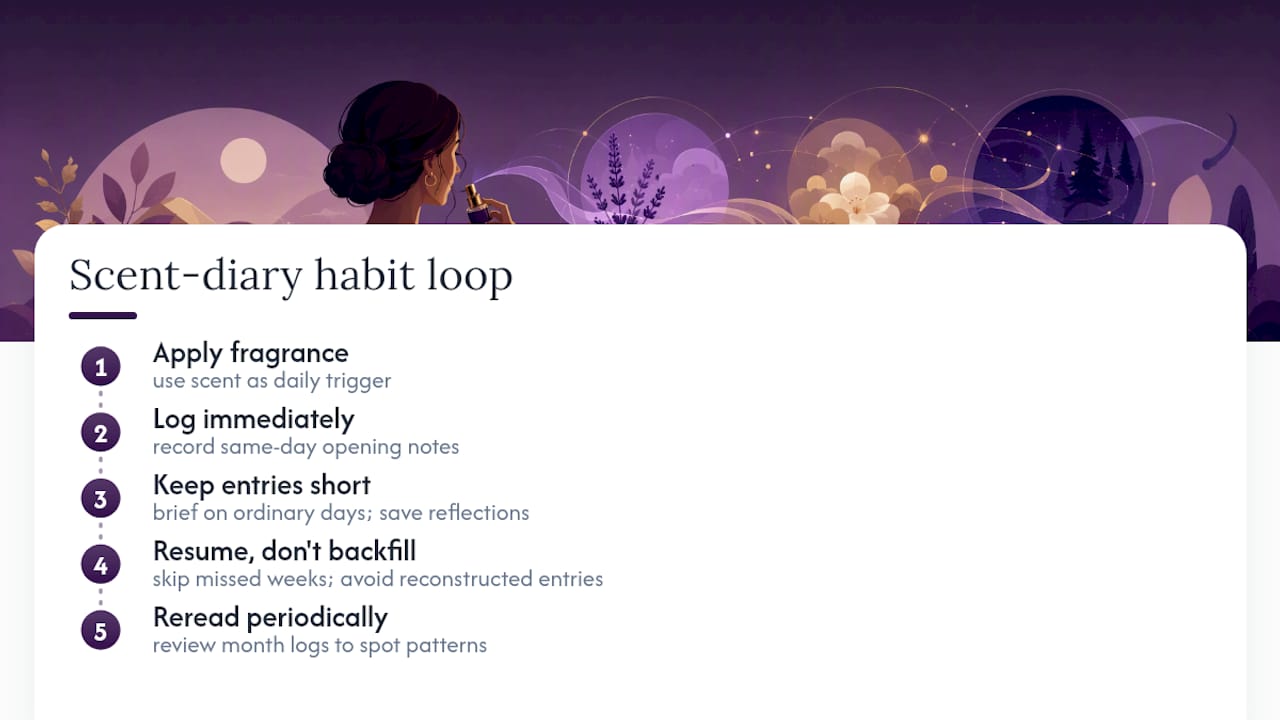
Anchor logging to something you already do daily, applying your fragrance itself is the natural trigger. Log immediately after spraying, not at the end of the day when the details have blurred. A same-day entry captures the opening notes accurately; a next-day memory rarely does.
Keep entries short on ordinary days and save longer reflection for fragrances that genuinely moved you. Treating every entry with equal weight is what burns people out, not the act of logging itself.
If you miss a week, don’t try to reconstruct it from memory. Skip forward and resume, since backfilled entries built on fuzzy recollection introduce noise rather than insight, corrupting the very patterns you’re trying to find.
Pair your diary with a visual cue. Some people keep My Scent Diary on their nightstand as a physical reminder; others set a recurring phone notification tied to their morning routine when using ScentShelf or ScentLog. The cue matters less than its consistency, and removing decision fatigue from “should I log this” is most of the battle.
Finally, revisit old entries occasionally, not just to add new ones. Rereading a month of logs is often what reveals a pattern no single entry could show alone, and that moment of recognition is usually what keeps people logging in the first place.
Is It Safe to Keep a Digital Scent Diary?
Any app holding daily personal data, including your habits, moods, and even your location patterns through weather tags, deserves the same privacy scrutiny you’d give a health app. Before committing your history to a platform, check whether it publishes a clear privacy statement and whether you can export your own data if you decide to leave.
App listings for trackers like ScentShelf typically include a stated data security section in their app store listing, worth reading before you input months of personal notes. Look specifically for whether your entries are stored locally on your device or synced to a company server, since that distinction determines what happens if the company shuts down or changes ownership.
Cross-device sync is convenient but expands your exposure. Every additional device logged into your account is another potential point of access, so a periodic check of connected devices is a reasonable habit, the same way you’d review connected apps on any other account.
If you’re logging sensitive personal reflections, mood notes tied to specific life events, for instance, consider whether a physical journal makes more sense for that particular content. Paper cannot be breached remotely, though it obviously carries its own risk of being lost or read by someone else in your home.
The safest approach treats digital fragrance data the way you’d treat any personal journal stored online: assume it’s more permanent and more visible than it feels in the moment of typing it.
How Do You Read Your Own Diary Once It’s Full?
A diary with fifty entries and no review process is just an archive. The value shows up when you actually analyze it.
Start by grouping entries by fragrance family, not by brand. If your highest longevity ratings cluster around amber and woody bases while your florals consistently underperform, that’s a signal worth acting on before your next purchase, not after.
Cross-reference occasion against rating. A fragrance that scores well “for the office” but poorly “for dates” isn’t a bad fragrance, it’s a context mismatch, and the fix is wearing it correctly rather than replacing it.
Pay close attention to compliments logged against your own self-rating. A gap between what others notice and what you personally love often reveals fragrances worn for external validation rather than genuine preference, an important distinction if you’re trying to build a wardrobe you actually enjoy rather than one built for other people’s reactions.
Watch for repeated language in your notes over time. If “warm,” “quiet,” and “grounding” keep appearing across your highest-rated entries regardless of brand or price point, you’ve found your actual preference, distinct from whatever trends or reviews initially drew you to a bottle.
Finally, treat contradictions in your own data honestly. If you rated a fragrance highly in the moment but never reached for it again, trust the behavior over the rating. What you actually wear tells you more than what you thought you’d wear when you wrote the entry.
Can You Keep a Scent Diary Without Spending Money?
You don’t need a paid app or a designer journal to start. A plain notebook, divided into the same fields covered earlier (fragrance, date, occasion, weather, mood, longevity, notes, compliments), does everything a premium journal does structurally. The difference is production quality, not function.
For a DIY digital version, a simple spreadsheet with columns for each field lets you sort and filter the same way an app would, and it costs nothing beyond time spent setting it up once. Google Sheets or Apple Notes, tagged consistently, can approximate what ScentLog’s context tags do, just with more manual effort on your part.
If you want app convenience without a subscription, ScentShelf’s free tier covers the core logging functions most people need before ever considering a paid upgrade. Test the habit itself before investing in a premium format. Plenty of people discover after a month that they’ve stopped opening whatever app or journal they chose, and no amount of design quality fixes an abandoned habit.
For a middle path, print a simple template and keep it in a cheap binder. You get the tactile ritual of paper without the cost of a bound luxury journal, and you can always upgrade to something like My Scent Diary once you’ve confirmed the habit sticks.
A Realistic First Week With a New Scent Diary
Start small. Days one through five: a thirty-second log after each wear, just fragrance, occasion, and one honest word about how it felt. Day six: pick your most memorable wear that week and write a longer reflective entry. Day seven: reread everything.
The most common beginner mistake is over-detailing early entries until the habit collapses under its own effort. The second is comparing your notes to what influencers say a fragrance “should” smell like instead of trusting your own nose. Adjust the template freely. Your diary should sound like you, not like a form.
— Celeste
Testing Your Scent Diary With Samples From Maison Voyageur
A diary is only as useful as the fragrances you feed it, and full bottles are an expensive way to discover what actually belongs in your rotation.

Try a structured sampling plan: three scents, worn twice each, across different contexts, a work day, a weekend, an evening out. Log every wear using the entry template covered earlier, paying particular attention to how the dry-down feels once the opening notes settle. After six logged wears, compare your notes side by side. The fragrance with the most consistent positive language across different contexts is usually the one worth committing to as a full bottle.
When a sample earns its place in your rotation, Maison Voyageur’s Full-Size 100ml Perfumes are available at a set one-off price, ready to become the next entry in your diary rather than another guess sitting unworn on a shelf.
Where to See the Actual Product Pages
For readers who want to inspect features firsthand before choosing a tool, the ScentShelf app page details its daily logging and AI scent profile functions directly. Scent Library’s site walks through its planner grid and cost-per-wear dashboard. For journal layout examples, including review sheets and layering pages, the My Scent Diary product page shows the physical format in full.
FAQ
What’s the best fragrance for daily wear?
The best daily fragrance is whichever one your diary shows you reach for consistently without regret, not necessarily your highest-rated entry. Look for scents that score well on longevity and comfort across ordinary, low-stakes days rather than special occasions.
What are the seven basic fragrance families?
Fragrance classification systems vary by source, but common groupings typically include floral, oriental (amber), woody, fresh, citrus, chypre, and fougère. Your diary entries will naturally reveal which families you gravitate toward once you’ve logged enough of your own notes.
What fragrance should I use for journaling or reflective wear?
Choose something with a distinct, layered dry-down, so there’s enough sensory detail to actually write about once the opening notes fade. Artisanal fragrances built slowly with natural ingredients, like those from Maison Voyageur, tend to offer more evolving character over a wear than mass-market scents designed for a single loud opening impression.
What are good ideas for a personal diary beyond fragrance?
If you’re building broader journaling habits, the same field-based structure used for scent (date, context, mood, honest notes) works for tracking sleep, mood, or daily reflections. The key ideas that transfer are consistency, honest short entries over sporadic long ones, and a periodic review to spot patterns.
Do I need both an app and a physical journal?
Not necessarily, though some people use an app for quick daily logs and a journal for longer reflective entries. Start with one format for at least a month before deciding you need both, since running two systems at once is often what causes people to abandon logging entirely.