
Chypre Fragrance Meaning: How to Sample It and Why Oakmoss Matters
Chypre, pronounced “sheep-ra,” is an olfactive family built on a single contrast: bright, sunlit bergamot resting above a warm, mossy, slightly bitter base of oakmoss, patchouli, and labdanum. The name comes from the French word for Cyprus. When sampling, the giveaway is the drydown. If the finish turns dry, resinous, and faintly bitter instead of sweet or clean, you’re likely wearing a chypre.
TL;DR:
- Modern chypres may smell less mossy and animalic than vintage versions due to reformulations, but the core contrast between citrus and mossy drydown remains essential.
- The dry, bitter, mossy finish is a key indicator that a fragrance is a genuine chypre, even if the opening feels brighter or more modern.
- When testing a chypre, wait at least twenty to thirty minutes before judging its true character, focusing on the drydown instead of the initial citrus burst.
- Chypres are best suited for cooler weather and sophisticated evening or professional settings, where their contrasting layers reveal themselves over time.
- Classic chypres like Coty’s original and Guerlain’s Mitsouko established the family’s signature architecture of bright citrus paired with a dry, mossy base that remains recognizable across stylistic variations.
Table of Contents
- What Is a Chypre Fragrance, Exactly?
- The Core Chypre Accord: Bergamot, Labdanum, Oakmoss, and Patchouli
- Where Does the Name Chypre Come From?
- What Does Chypre Smell Like From Start to Finish?
- Why Modern Chypres Smell Different From Vintage Ones
- How to Sample and Choose a Chypre You’ll Actually Wear
- Why Chypre Carries Cultural Weight in Perfumery
- When and Where a Chypre Actually Works
- Iconic Chypres Beyond Coty’s Original
- Maison Voyageur’s Perspective on Chypre and Natural Materials
- Find Your Own Chypre Moment
- Sources
- FAQ
What Is a Chypre Fragrance, Exactly?
A chypre is not one ingredient. It’s a structural idea, a deliberate collision between two opposing moods.
Perfumers describe this as clair-obscur, the French term for light and dark. The top notes stay bright and citrus forward. The base turns shadowed, earthy, almost somber. That tension between the two is the entire point. A rose or a jasmine can wander into a dozen different families depending on what surrounds it. Chypre is defined by the relationship between its layers, not by any single star ingredient.
This is why fragrance taxonomies sometimes struggle to label it cleanly. Classification systems occasionally file chypre under mossy woods instead, a nod to how modern formulations have reshaped the accord since regulators limited oakmoss.
What defines the classic chypre structure:
- A citrus opening, almost always anchored by bergamot
- A resinous, warm heart built around labdanum or cistus
- A dry, mossy base carried by oakmoss and patchouli
- A visible contrast between the top and base, rather than a smooth blend
- A finish that reads bitter or dry, never sweet
The Core Chypre Accord: Bergamot, Labdanum, Oakmoss, and Patchouli
Four materials do almost all the work in a classic chypre, and each one has a specific job.
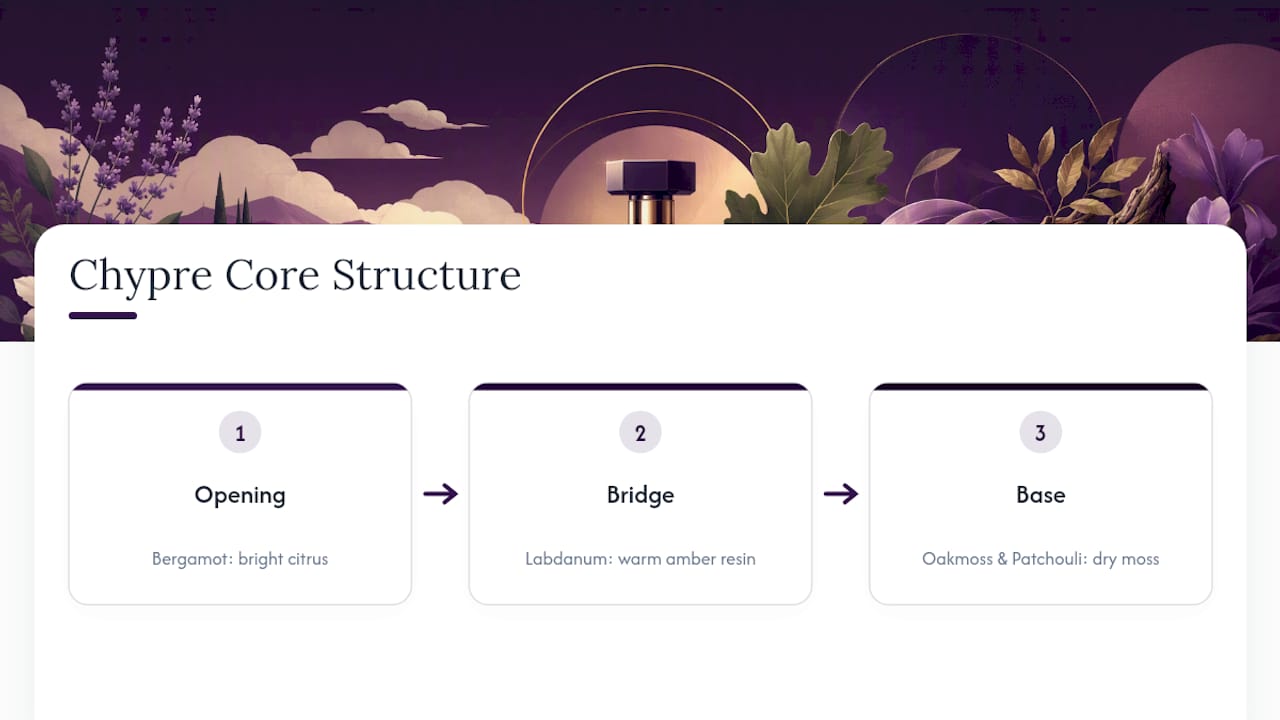
Bergamot opens the fragrance. It’s sharp, citrusy, and a little green, giving the first ten minutes their lift. Without it, a chypre would smell heavy from the first spray. Labdanum, sourced from the cistus shrub, arrives next. It brings a warm, amber-like resin that bridges the sharp opening into something rounder, often with a leathery or honeyed undertone. Some formulas add florals like rose or jasmine here to soften the transition.
The base is where chypre earns its reputation. Oakmoss and patchouli together create the dry, slightly bitter anchor that separates a true chypre from a standard woody floral. Oakmoss alone smells damp and forest floor green. Patchouli alone can feel almost sweet and dark. Combined, they produce something drier and more austere than either ingredient manages solo.
The interaction matters more than the individual notes. A chypre’s signature texture, that dry, mossy, almost dusty quality in the drydown, comes specifically from how oakmoss and patchouli chemically and perceptually reinforce each other. Swap patchouli for vetiver and you get something related but noticeably different in mood.
Where Does the Name Chypre Come From?
The word traces back to French, where “Chypre” simply means Cyprus. It has nothing to do with the cypress tree, a common mix-up. The connection to the island is historical rather than botanical, tied to Cyprus’s centuries-old role in the Mediterranean spice and resin trade, where labdanum and other aromatic raw materials moved through its ports.
The family’s modern identity, though, has one clear origin point.
- François Coty released a perfume simply titled Chypre in 1917
- It codified the bergamot, labdanum, and oakmoss structure as a recognizable commercial category
- The original formulation survives today thanks to the Osmothèque, the fragrance archive that preserves historical perfumes for scholars and perfumers
- Coty’s version became the benchmark against which nearly every later chypre was measured
The Osmothèque’s role here matters beyond trivia. Because the original 1917 formula is preserved and accessible to historians, perfumers today can compare modern reinterpretations against an actual reference point rather than secondhand description.
What Does Chypre Smell Like From Start to Finish?
The arc is predictable once you know what to track. Expect these three phases in order:
- Opening: A sharp burst of citrus, usually bergamot, sometimes joined by other citrus notes for extra lift. This phase is short, often gone within fifteen minutes.
- Heart: The resinous warmth of labdanum takes over, frequently layered with florals like rose, jasmine, or ylang ylang depending on the subfamily. The fragrance starts to feel rounder and denser here.
- Drydown: Oakmoss and patchouli settle in, producing that characteristic dry, faintly bitter finish that can last for hours.
Subfamilies shift the personality without breaking the structure. A floral chypre leans on rose or jasmine in the heart, softening the overall effect. A fruity chypre adds notes like peach or plum up top for sweetness against the dry base. A green chypre pushes galbanum or crisp herbal notes into the opening for a sharper, more austere character. A leather chypre dials up birch tar or suede-like accords in the base, and a woody chypre leans harder on vetiver or cedar instead of florals.
The easiest way to distinguish chypre from a standard woody floral or an oriental fragrance is the bitterness. Woody florals tend to stay smooth and blended. Orientals lean sweet and resinous without the dry, mossy snap. Chypre keeps that contrast visible from first spray to final hour.
Why Modern Chypres Smell Different From Vintage Ones
Oakmoss carries two compounds, atranol and chloratranol, flagged as allergens by fragrance safety regulators. That forced widespread reformulation across the category. Modern chypres often substitute filtered oakmoss extracts, synthetics, or reinforced patchouli and labdanum to recreate the mossy impression without the restricted molecules.
The result is a family that smells cleaner and less animalic than its 1970s predecessors, though the underlying architecture, that bright top against a dry base, hasn’t disappeared.
The tension between bergamot and moss is what makes a fragrance read as chypre. Even when oakmoss is dialed back for safety reasons, perfumers rebuild that same push and pull using vetiver, ambroxan, or dense patchouli accords.
Pro Tip: When comparing a vintage-style chypre to a modern release, focus on the drydown, not the opening. A modern version may smell nearly identical for the first hour, then finish softer and less mossy once the reformulated base takes over.
How to Sample and Choose a Chypre You’ll Actually Wear
Spray it, then wait. The opening bergamot tells you almost nothing about whether you’ll like the fragrance. Give it twenty to thirty minutes before judging the heart and drydown, since that’s where the real character lives.
Run through this checklist while you wait:
- Does the base turn dry and slightly bitter, or does it stay sweet?
- Can you separate a mossy, earthy quality from the resinous warmth of labdanum?
- Does the citrus opening fade cleanly, or does it clash with the base?
- Does the overall shape feel like contrast, or does it blend into a single uniform tone?
Be skeptical of marketing copy that calls something “chypre” purely for prestige without any dry, mossy finish to back it up. Pro Tip: Request a discovery set or sample vial before committing to a full bottle. Chypre’s drydown can shift dramatically over several hours, and a five minute sniff at a counter won’t reveal that.
Why Chypre Carries Cultural Weight in Perfumery
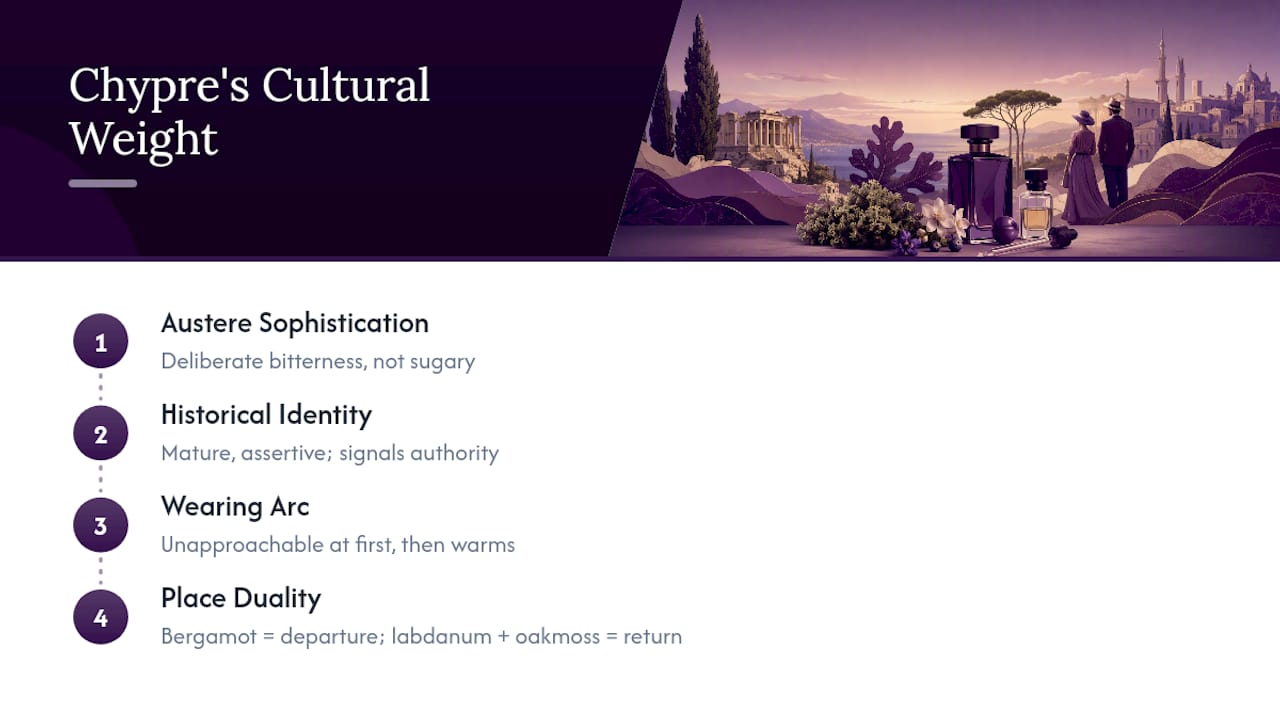
Chypre has long been read as a fragrance of sophistication rather than simple prettiness. Its bitterness is deliberate. There’s nothing sugary or immediately crowd-pleasing about a well-made chypre, and that austerity has historically signaled confidence rather than approachability.
Through much of the twentieth century, chypre fragrances leaned toward a mature, assertive identity. They were the scents worn by women who wanted to project authority in a room, not just pleasantness. That association still lingers. Reach for a chypre today and you’re often reaching for something that reads as composed and a little unapproachable at first, warming into something more intimate as it settles on skin.
The family also carries a symbolic weight tied to place. Cyprus itself sat at a Mediterranean crossroads of trade, resin, and ritual for centuries, and something of that layered, well-traveled quality survives in the accord’s structure. Bergamot evokes brightness and departure. Labdanum and oakmoss evoke grounding and return. Wearing a chypre can feel like tracing a small arc between the two, which is part of why the family rewards patience rather than impulse.
That duality is precisely why chypre continues to resonate with anyone drawn to fragrance as more than decoration. It behaves less like a finishing touch and more like a mood you commit to for the day.
When and Where a Chypre Actually Works
Chypre rewards cooler weather. The resinous heart and mossy base can feel heavy in high summer heat, though a citrus forward or green chypre handles warmth better than a dense, leathery one. Fall and winter are where most chypres come alive, when the air itself carries a bit of that same dry, earthy quality.
Occasion matters as much as season. Chypre suits settings where you want to be remembered rather than simply pleasant: a dinner where conversation runs long, an evening event, a meeting where quiet authority matters more than charm. It’s less suited to a gym bag or a casual daytime errand, where something brighter and simpler earns its keep.
Time of day shifts things too. A chypre applied in the morning will spend its brightest, most citrus forward hour before settling into the mossy drydown by early afternoon, which makes it a strong choice for anyone who wants a fragrance that evolves across a workday rather than staying static. Evening application skips straight to a fragrance that’s already warming by the time you’re out the door.
Layering with the seasons is worth experimenting with directly. A floral or fruity chypre can stretch into early spring. A leather or woody chypre belongs almost entirely to autumn and winter. None of this is rigid, but the family’s dry, resinous bones simply read more naturally against cold air than against heat.
Iconic Chypres Beyond Coty’s Original
Coty’s 1917 formula started the category, but several later releases defined what chypre became for successive generations.
Mitsouko, released by Guerlain in 1919, added a peach note to the bergamot and moss framework, creating one of the earliest fruity chypre interpretations and a fragrance still referenced by perfumers today. Miss Dior, launched in 1947, pushed chypre toward a lush, floral, distinctly feminine register that shaped postwar perfumery. In the 1980s, structured, assertive chypres with sharp mossy bases became a signature of that decade’s power dressing aesthetic, worn by women who wanted a scent that entered the room before they did.
Each of these releases kept the core bergamot to moss contrast intact while shifting emphasis toward fruit, florals, or amplified boldness. That’s the real lesson in surveying chypre’s history: the family tolerates enormous stylistic range as long as the underlying architecture, brightness against dry shadow, stays recognizable. A fragrance can smell fruity, floral, green, or leathery and still qualify as chypre, provided that drydown delivers the expected bitterness and moss.
Maison Voyageur’s Perspective on Chypre and Natural Materials
Chypre’s contrast between citrus brightness and mossy depth mirrors how Maisonvoyageurparfum approaches Mediterranean perfumery: nothing rushed, nothing one-note. It’s an architecture worth sitting with slowly.
— Celeste
Find Your Own Chypre Moment
Perfume compositions often involve natural Mediterranean materials chosen for how they layer over skin and time, not just how they smell off the shelf. If chypre’s contrast between bright citrus and dry, mossy depth speaks to you, that same principle of tension and warmth runs through several Mediterranean perfume compositions.

Rather than guessing from a description, start with a discovery set sized for exploration. Sampling a few scents side by side, at your own pace, tends to reveal far more than reading notes ever could. Visit the Maison Voyageur Mediterranean perfumerie to browse available scents and request a sample size suited to your own quiet exploration.
Sources
FAQ
What makes a perfume a chypre?
A perfume qualifies as chypre when it builds a clear contrast between bright top notes, usually bergamot, and a dry, mossy base of oakmoss and patchouli, often warmed by labdanum in the heart.
What does a chypre smell like?
Expect a sharp citrus opening that fades into a resinous, warm heart, then settles into a dry, slightly bitter, mossy-woody drydown that can last for hours.
How do you pronounce chypre?
Chypre is pronounced “sheep-ra,” borrowed directly from the French word for Cyprus.
What are examples of chypre fragrances?
François Coty’s 1917 Chypre established the category, followed by landmark releases like Guerlain’s Mitsouko in 1919 and Dior’s Miss Dior in 1947, each reinterpreting the bergamot and moss structure differently.
Is chypre the same as fougère?
No. Fougère centers on a lavender, coumarin, and oakmoss combination built for a fresh, herbal effect, while chypre centers on bergamot against a mossy, resinous base with a drier, more citrus driven contrast overall.
Les sept fragrances Maison Voyageur
- Manifesting · unisexe (69,99 €)
- Intuition · femme (69,99 €)
- Certainty · femme (69,99 €)
- Expansion · femme (69,99 €)
- Release · homme (69,99 €)
- Presence · homme (69,99 €)
- Inner Fire · homme (69,99 €)
Nouvelle ici ? Commence par le Discovery Set · les 7 fragrances en format voyage (40 €).