
Choose Fragrances for Mental Clarity: A Natural Guide
Start with citrus, mint, or rosemary. These three note families are the most consistently recommended by scent experts for supporting alertness and focused attention. To choose fragrances for mental clarity, pick 2–3 notes from this list and run a simple 3-day test: diffuse or apply to skin at the start of a focused task, then journal what you notice about your attention and mood. 62% of consumers experience difficulty concentrating several times a day and 85% believe fragrance can help; some designed fragrances are reported to have measurable effects for a limited time (with attention benefits up to 120 minutes). Maisonvoyageurparfum’s artisanal, slow-crafted fragrances use 98% natural ingredients, making them a considered starting point for this kind of intentional testing.
- Citrus notes (lemon, bergamot, grapefruit): invigorating, fast-acting, ideal for morning sessions
- Mint/menthol (peppermint, spearmint): sharp atmospheric reset, useful mid-task
- Herbal green (rosemary, basil, sage): grounding yet stimulating, supports sustained work
- Soft woods and resin (cedarwood, frankincense): calming focus, good for long sessions
- Eucalyptus: clears mental fog, pairs well with citrus
Pro Tip: Rotate between two or three notes across different sessions rather than using the same scent every day. Varied exposure supports better scent-to-focus conditioning over time.
Table of Contents
- How scent shapes your focus and why it works differently for everyone
- The scent notes most likely to support alertness and concentration
- Why natural botanical essences often work better for this purpose
- How to test scents and build your personal clarity library
- Safe use, dilution, and when to pause
- Quick blends and application methods to try during focused work
- Maisonvoyageurparfum: a natural starting point for clarity-focused scents
- Key Takeaways
- Scent is personal. Experiment with curiosity
- Useful sources
How scent shapes your focus and why it works differently for everyone
Scent influences attention by activating olfactory pathways directly connected to the limbic system, the brain’s center for emotion, memory, and arousal. Unlike other senses, smell bypasses the thalamus entirely, reaching emotional and memory centers almost immediately. This is why a single inhale can shift your mental state within minutes.
Electrophysiological research shows that fragrance inhalation alters spontaneous brain activity and cognitive functions measurable by EEG, including changes in alpha and beta wave patterns associated with alertness and relaxed attention. Effects tend to be immediate but short-lived without reinforcement.
Individual responses vary considerably. Your personal history with a scent, your genetics, and the ritual context around its use all shape how your nervous system responds. A scent you associate with stress will not support clarity, regardless of its chemical profile. Neurobiologists and scent consultants note that prior associations and individual scent history are among the strongest predictors of outcome.
| Measure | Finding |
|---|---|
| Consumers who find concentration difficult | 62% |
| Consumers who believe fragrance can help | 85% |
| Measurable effect window (certain designs) | Short period (up to 120 minutes) |
| Memory/learning gains from varied scent exposure | Significant vs. controls (Frontiers in Neuroscience, via HuffPost) |
The scent notes most likely to support alertness and concentration
Scent experts consistently recommend peppermint, rosemary, sage, and citrus for productivity and memory support. Here is how each family works and when to reach for it.
- Lemon and grapefruit: Fast, bright, invigorating. Studies cited by Air Aroma found that introducing lemon in a workplace setting measurably reduced errors and increased typing speed. Best for morning starts or before high-output tasks.
- Peppermint and spearmint: AromaPlan describes mint as an atmospheric reset that interrupts mental stagnation. Use a personal inhaler mid-afternoon when attention drifts.
- Rosemary and basil: Herbal, slightly sharp. Rosemary in particular is linked to reduced cortisol and improved recall. Diffuse during reading or writing sessions.
- Cedarwood: Stabilizing and grounding. DALUMA’s practitioner notes position cedarwood as a composition anchor that frees the mind from distraction, recommended as a pre-task ritual scent.
- Frankincense and vetiver: Resinous, meditative. Slower-acting than citrus, but useful for long, deep-focus sessions where overstimulation is a risk.
- Eucalyptus: Intensely clean. Pairs well with lemon for a quick clarity blend; AromaPlan notes its ability to reinvigorate a tired environment.
Try these simple pairings: lemon + rosemary for a morning diffuser blend; cedarwood + grapefruit for a grounding afternoon roll-on.
Pro Tip: Pair a brisk citrus or mint top note with a grounding base like cedarwood or frankincense. The top note delivers the initial alertness spike; the base extends calm, sustained attention without tipping into overstimulation.
Why natural botanical essences often work better for this purpose
Practitioners who work at the intersection of fragrance and cognitive wellness consistently favor natural botanical essences over synthetic aroma molecules for functional clarity work. The reason is chemical complexity. A single natural extract like bergamot or rosemary contains dozens of interacting compounds, each contributing subtly to the nervous system’s response. Synthetics are designed for stability, projection, and longevity, qualities that serve fashion perfumery but are largely irrelevant to cognitive effect.
Functional aromatherapy practitioners prefer natural botanical essences over synthetic high-sillage perfumes for cognitive or emotional effects, because botanicals provide a complex neuro-affective profile designed for presence rather than projection.
Synthetic molecules are not inherently harmful, but they tend to be optimized for how a fragrance performs on skin over time, not for how it interacts with olfactory receptors linked to attention. For readers focused on mental clarity, the functional intent of a natural-first blend matters more than sillage or longevity. Maisonvoyageurparfum’s formulas, composed with 98% natural ingredients, reflect exactly this priority: presence over projection, crafted slowly for introspection rather than display.
How to test scents and build your personal clarity library
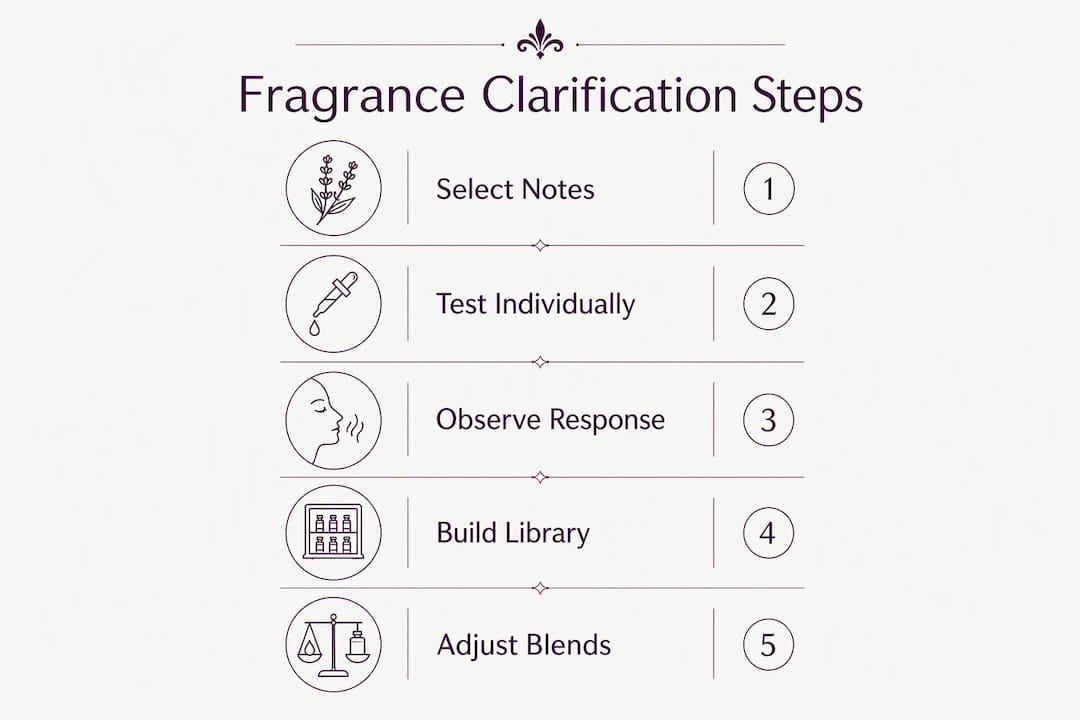
The most reliable method is a short, repeatable protocol. Select 2–3 candidate scents, test each across 3 consecutive sessions in the same context (same time of day, same task type), record your responses, then rotate and compare. Rotating between multiple pleasant scents also produced measurable learning and memory improvements in a controlled study, making variety a feature, not a distraction.
- Choose your format: diffuser for a room, personal inhaler or roll-on for individual use.
- Set your timing: test at the start of a focused task, ideally in the morning.
- Duration: 10–30 minutes of active exposure per session.
- Record outcomes: note alertness level, sense of calm, distractibility, and task performance immediately after.
- Wait between tests: allow at least one full day between different scents to avoid carryover and olfactory habituation.
- Run blind comparisons: mask labels, swap days, and compare notes afterward to reduce expectation bias.
This scent discovery process builds a personal library over two to three weeks. You will quickly identify which notes sharpen your attention and which leave you neutral.
Pro Tip: Request small samples or use travel sprays and roll-ons for testing. Keep concentrations consistent across sessions so you are comparing the scent itself, not the intensity.
Safe use, dilution, and when to pause
Most concentrated fragrances and essential oils require dilution before skin contact. A 1–2% dilution is appropriate for daily roll-on use in adults; drop to 0.5–1% for children or sensitive skin. Store oils and natural concentrates in a cool, dark place in tightly sealed bottles to preserve their chemical integrity.
If you experience skin redness, itching, or any respiratory irritation after applying or diffusing a fragrance, stop use immediately. Rinse affected skin with plain water. Seek medical advice if symptoms persist or worsen.
Common situations that warrant extra caution: pregnancy (consult your provider before using certain oils, particularly eucalyptus, rosemary, and peppermint in high concentrations); uncontrolled asthma or chemical sensitivities; shared workplaces with fragrance policies. For perfume concentration differences and format guidance, the Maisonvoyageurparfum resource library is a practical reference.
This article is general wellness information, not medical advice. Confirm safe use with a qualified practitioner for your specific situation.
Quick blends and application methods to try during focused work
Environmental diffusion suits shared spaces; personal inhalers and roll-ons work better for individual, discreet use. A light perfume application can serve as a ritualized focus cue, training your nervous system to associate that scent with concentrated work over time.
- Morning clarity blend (diffuser): 3 drops lemon + 2 drops rosemary + 1 drop cedarwood. Run for 20–30 minutes at task onset.
- Mid-session reset (personal inhaler): 3 drops peppermint + 2 drops cedarwood. Brief inhalations every 15–30 minutes.
- Long-focus roll-on (2% dilution in carrier oil): 2 drops frankincense + 2 drops bergamot + 1 drop vetiver per 5 ml carrier. Apply to wrists before sitting down to work.
- Quick refresh (room spray): 4 drops grapefruit + 2 drops eucalyptus in 50 ml water. Mist the air, not skin.
- Grounding pre-task ritual: A single application of a cedarwood-forward natural perfume, worn as a consistent pre-work signal.
Rotate blends across the week to prevent habituation. Keep dilution guidelines from the previous section in mind for any skin-contact application.
Maisonvoyageurparfum: a natural starting point for clarity-focused scents

Maisonvoyageurparfum offers something most clarity-focused routines actually need: artisanal fragrances composed with 98% natural ingredients, available in travel sizes and curated sets that make structured testing genuinely easy. Each scent is slowly made in Madrid, drawing on Mediterranean botanical traditions, and designed for introspection rather than performance or projection.
For readers building a personal clarity library, the Seven Archetypes guided collection is a considered place to start. It pairs fragrance archetypes with inner states, helping you identify which natural notes resonate with your nervous system before committing to a full bottle. Travel sizes keep your testing protocol consistent and your investment modest. Explore the collection and find the scent that belongs to your focused hours.
Key Takeaways
The most reliable way to choose fragrances for mental clarity is to start with citrus, mint, or rosemary, test each note systematically over three sessions, and keep a journal of your responses.
| Point | Details |
|---|---|
| Start with proven note families | Citrus, mint, rosemary, cedarwood, and frankincense are the most consistently recommended for alertness and focus. |
| Use a 3-day testing protocol | Test one scent across three sessions in the same context; journal alertness, calm, and task performance each time. |
| Rotate scents deliberately | Varied exposure supports better conditioning and avoids olfactory habituation that dulls the effect. |
| Dilute safely for skin use | Use a 1–2% dilution for adult roll-ons; lower for children or sensitive skin; store in a cool, dark place. |
| Maisonvoyageurparfum | Offers 98% natural artisanal fragrances in travel sizes and curated sets, suited to structured clarity testing. |
Scent is personal. Experiment with curiosity
The conventional wisdom around clarity scents tends to flatten something genuinely individual into a single recommendation. Peppermint works for many people. It does nothing for others, or worse, triggers a headache. The research is clear that prior associations and personal scent history shape outcomes as much as the chemistry does. What this means practically: no list of “best scents for focus” replaces your own systematic testing. The protocol matters more than the note family.
What I find compelling about the Maisonvoyageurparfum approach is its insistence on slowness. Fragrances composed without urgency, from natural materials, with introspection as the brief, tend to reward the kind of patient, curious testing that actually produces results. Pick two notes. Sit with them. Write down what you notice. That is where clarity begins.
Useful sources
- HuffPost Life: Aromatherapy and Productivity — Expert and neurobiologist perspectives on which notes support focus, memory, and individual variability in scent response.
- Scentmate: Fragrance Technology and Mental Focus — Consumer survey data and controlled-test findings on concentration difficulty and measurable fragrance effects.
- AromaPlan: Best Scent Notes for Focus and Productivity — Practitioner guidance on citrus, mint, tea, and woody notes for study and work environments, plus application method recommendations.
- DALUMA Nullpunkt Refocus — Plant-based, cedarwood-focused functional fragrance with practitioner notes on natural essences for cognitive presence.
- PMC / Frontiers in Neuroscience: Fragrances and Psychophysiological Activity — Peer-reviewed review of EEG studies on fragrance inhalation and its effects on brain activity, mood, and cognition.