
Apply Perfume After Shower: 15 to 20 cm and Two Sprays for Longer Wear
Spray two or three times on moisturized pulse points right after your shower, hold the bottle 15 to 20 centimeters from your skin, and let it dry in the air. Never rub your wrists together. Sensitive skin does better with the cloud technique or a light mist on your clothing lining. Store the bottle somewhere cool and dark, and the scent you chose will stay closer to the one you fell for in the store.
TL;DR:
- Applying perfume immediately after shower on slightly damp skin enhances longevity, especially when layered over unscented, lipid-rich moisturizer or oil.
- Spraying from 15 to 20 centimeters and avoiding rubbing wrists together prevents rapid evaporation and preserves the scent’s development.
- Vital pulse points include the inner elbows, behind the knees, chest, and clothing linings, which provide warmth for better diffusion without skin irritation.
- Sun exposure and alcohol-based sprays can cause skin irritation and discoloration, so use alternative application methods when in direct sunlight or with sensitive skin.
- Store perfume in a cool, dark place and check for formula degradation, such as cloudiness or color change, before use to ensure it remains true to its original scent.
Table of Contents
- The Right Way to Apply Perfume, Step by Step
- Where to Apply Perfume for the Best Projection
- When to Apply Perfume and How to Prep Your Skin
- Spray Distance and Technique That Actually Work
- What to Avoid When Applying Perfume
- Applying Perfume to Clothing and Hair Without Damage
- Storing Perfume So It Doesn’t Break Down
- A Simple Ritual Worth Repeating
- Perfume Etiquette: When and How Much Is Appropriate
- What I’ve Learned About Getting This Right
- Practice Application Techniques With Travel Sizes
- Sources
The Right Way to Apply Perfume, Step by Step
Before you walk out the door, run through this short sequence. It takes less time than checking your phone.
- Count your sprays by concentration. The number of sprays should be adjusted according to concentration: parfums require fewer sprays, eau de parfums a moderate amount, and eau de toilettes more sprays due to faster evaporation and lower oil content.
- Apply to skin that’s still slightly damp from moisturizer, not bone dry.
- Hold the bottle 15 to 20 centimeters away, spray once, and let it air dry rather than fanning or rubbing it in.
- Switch to the cloud method or clothing if your skin reacts to alcohol or fragrance.
- Check the bottle itself before you use it. Cloudy liquid or a color shift means the formula has started to break down.
Where to Apply Perfume for the Best Projection
The classic advice to hit your pulse points exists for a reason: your wrists, the base of your neck and collarbone, behind your ears, the inside of your elbows, and behind your knees all run warmer than the rest of your skin. That warmth pushes the fragrance’s molecules into the air gradually through the day instead of releasing everything in one burst.
The neck deserves a caveat, though. It’s one of the more delicate areas on the body, and dermatologist Ana Molina notes that it’s more prone to irritation, especially with sun exposure. If that’s you, consider these alternatives:
- Inner elbows and behind the knees offer the same warmth-driven diffusion with less sun exposure and thinner, more reactive skin.
- Chest, just above the fabric line, works well if you want the scent to rise toward you rather than announce itself to a room.
- Clothing linings and scarves hold fragrance without touching skin at all, which sidesteps sensitivity entirely.
Hair is trickier. Alcohol-based perfume can dry out strands and fade color treatments, so reach for a hair mist formulated for that purpose instead of spraying your everyday perfume directly onto your hair.
When to Apply Perfume and How to Prep Your Skin
Timing changes everything. The best window is right after a warm shower, while your skin is still slightly damp and your pores have opened a little. Moisture is, by a wide margin, the single most significant factor in how long a fragrance lasts. Dry skin pulls fragrance molecules apart faster, so what smelled rich in the bottle turns thin and faint within an hour.
Layer an unscented, lipid-rich moisturizer or body oil underneath. Think of it as a base coat: it traps the fragrance’s molecules against your skin instead of letting them evaporate straight into the air. If you’re loyal to a specific fragrance house, a matching scented lotion does double duty as both moisturizer and quiet first layer.
Concentration should guide your count. Parfum extracts carry the highest oil content, so one or two sprays go a long way. Eau de parfum sits in the middle. Eau de toilette, being lighter, calls for a few more sprays and probably a midday touch up.
Spray Distance and Technique That Actually Work
Distance matters more than most people assume. Fifteen to twenty centimeters gives the mist room to disperse evenly across your skin instead of landing in one wet, alcohol-heavy spot that fades unevenly.
- Test with a single spray first on one pulse point, wait a few minutes, and see how it opens up before committing to more.
- Pick two or three points, not every pulse point at once. Overlapping too many spots muddies the scent’s development.
- Consider the cloud technique when you want something soft and enveloping. Spray into the air and walk through the mist. It uses more product but distributes the scent with a gentler hand.
- Let it dry completely. Give it thirty seconds before you get dressed.
Pro Tip: Rubbing your wrists together feels instinctive, but it raises the skin’s surface temperature and speeds up enzyme activity, which breaks down the fragrance’s top notes before they’ve had a chance to unfold as intended.
What to Avoid When Applying Perfume
Rubbing your wrists together is the most common mistake, and it’s worth repeating why: friction generates heat, and heat accelerates evaporation and disrupts how the fragrance develops over the following hours. What you end up smelling is a compressed, flattened version of the scent instead of its intended arc from top note to base note.
Sun exposure is the other one people miss. Many fragrances, especially those built around citrus, contain compounds that react to UV light. Spraying directly onto sun-exposed skin, particularly the neck and chest, can raise the risk of irritation or discoloration.
If you notice redness, itching, or a rash after applying, stop using that fragrance on skin and switch to clothing or the cloud method instead. Persistent irritation is worth mentioning to a dermatologist, who may recommend an alcohol-free or hypoallergenic formulation.
Applying Perfume to Clothing and Hair Without Damage
Fabric holds a fragrance’s scent differently than skin does. Since it doesn’t have body heat or natural oils, the top notes tend to stay put longer, which is part of why so many people spray a scarf or a jacket lining for an evening out.
Before you commit, test an inconspicuous patch of fabric first, since delicate materials like silk and some synthetics can stain or discolor on contact with alcohol-based perfume. Once you’ve confirmed it’s safe, the inside lining of a jacket, a scarf, or a hem works well and keeps the scent off your skin entirely.
For hair, skip your perfume bottle and reach for a dedicated hair mist. These are formulated without the drying alcohol content of regular perfume, so they won’t strip natural oils or fade color treatments. Layering a hair mist with your usual perfume on pulse points builds a fuller, more three-dimensional scent trail without the risk.
Fabric application makes the most sense if you have reactive skin, spend the day in direct sun, or simply want a subtler, closer scent rather than one that announces itself from across a room.
Storing Perfume So It Doesn’t Break Down
A perfume that’s been sitting on a sunny windowsill or steamy bathroom shelf will smell nothing like it did the day you bought it. Heat, light, and humidity all speed up the breakdown of its more delicate compounds.
Keep bottles upright in a dark, dry space at a steady temperature, ideally between 15°C and 20°C. That rules out the bathroom cabinet, no matter how convenient it is, since shower steam causes constant temperature swings. Keep the cap on tightly when it’s not in use to slow oxidation.
If the liquid has darkened, turned cloudy, or the scent smells sharper or sourer than you remember, it’s likely degraded. At that point, replacing the bottle is the only real fix.
A Simple Ritual Worth Repeating
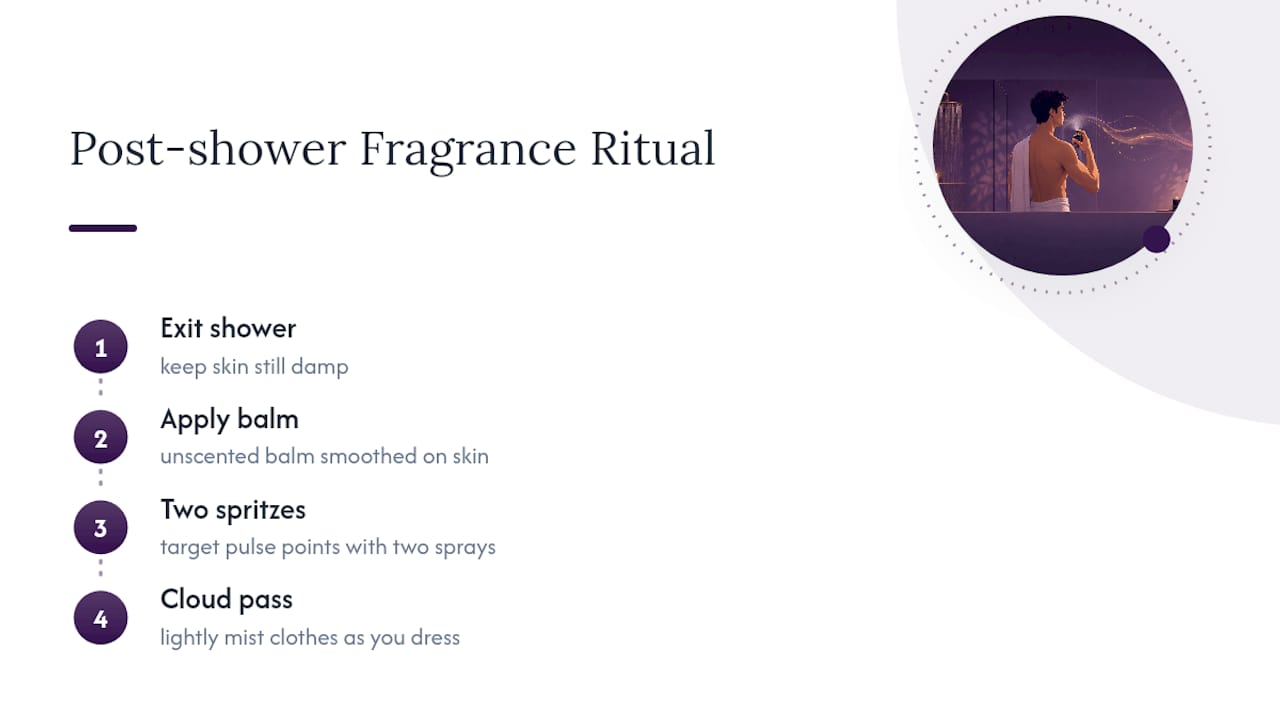
Some of the best guidance on fragrance comes less from rules and more from ritual. Here’s one worth adopting: step out of the shower, smooth on an unscented balm while your skin is still damp, then apply two targeted spritzes to your pulse points, followed by a light cloud pass over your clothes as you dress. It’s unhurried, and that’s the point.
If you’re deciding between a full bottle and a curated set, a travel or sample size is the lower commitment way to test which pulse points and layering combinations work for you. Maisonvoyageurparfum’s approach centers on slow-made compositions built from 98% natural ingredients, an emphasis on craftsmanship over mass production that shows in how a scent unfolds over the course of a day rather than fading within the hour.
Perfume Etiquette: When and How Much Is Appropriate
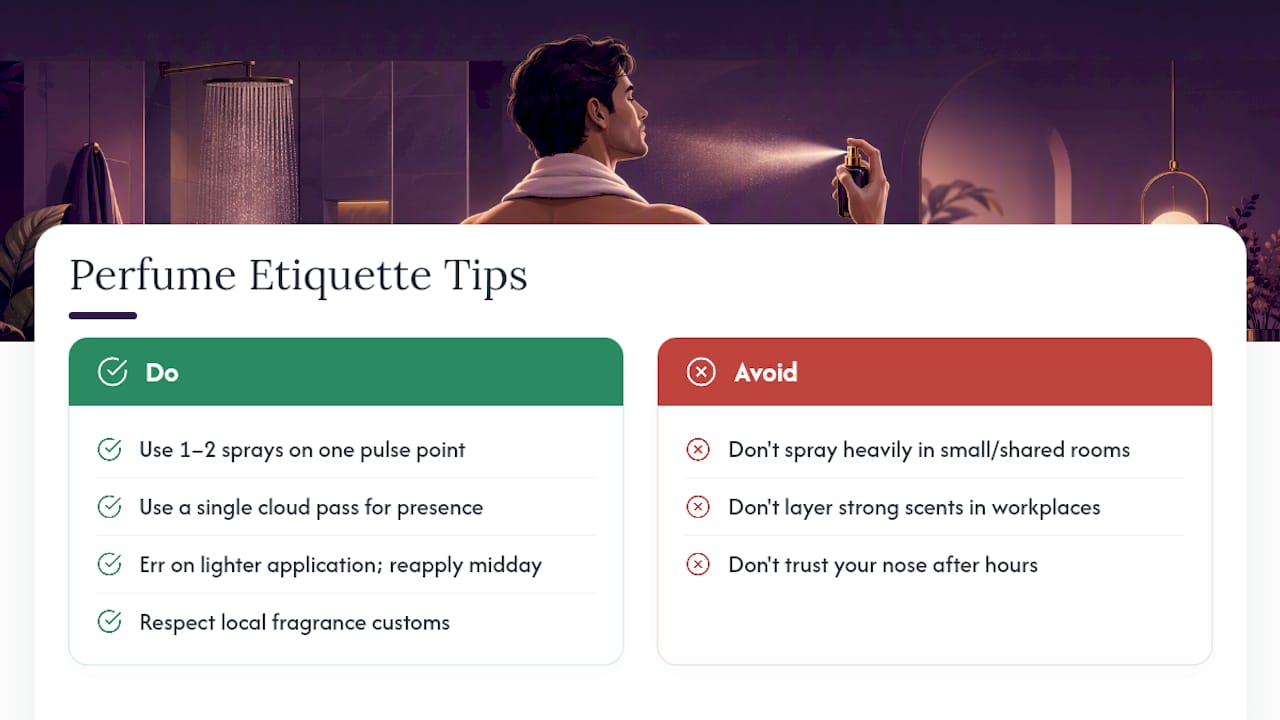
How much perfume is appropriate changes with the room you’re walking into. A scent that reads as inviting in an open-air setting can feel overpowering in a small meeting room, an elevator, or a shared office. The general rule that’s held up across cultures and settings: someone should notice your fragrance when they’re close to you, not from across the room.
Workplaces and formal settings call for restraint. One or two sprays on a single pulse point, or a pass of the cloud technique, gives you a quiet presence without competing with other people’s space. Save heavier application, layered scents, or the cloud method for evenings, dates, or events where a stronger trail feels intentional rather than intrusive.
Cultural context matters too. Fragrance customs that favor bold, layered scents in some regions read as excessive in others, where a lighter, closer-to-skin application is the norm in professional and social settings alike. When in doubt, err toward less. You can always reapply midday, but you can’t undo a scent that fills a room the moment you walk in.
One more thing worth knowing: wearers tend to stop noticing their own fragrance after a few hours, even though people around them still can. That’s olfactory fatigue, not a sign the scent has faded, and it’s the reason so many people accidentally overapply later in the day. Trust your original application rather than your nose hours later.
What I’ve Learned About Getting This Right
The advice around perfume application is mostly correct, but it undersells how much timing and restraint matter more than technique. Anyone can learn to spray from 20 centimeters. Fewer people build the habit of applying it once, immediately after a shower, and then leaving it alone.
My own routine is embarrassingly simple: two sprays on damp wrists, one at the collarbone, done before I get dressed. I don’t touch it again until evening, if at all. What surprised me most, once I stopped second guessing it, is how much clearer a scent reads on someone else’s skin than on my own. If you’re testing a new fragrance, ask someone close to you what they notice a few hours in. Your nose adjusts. Theirs doesn’t.
— Celeste
Practice Application Techniques With Travel Sizes
Learning where a fragrance sits best on your skin takes trial, not a single bottle you’re locked into for months. Maisonvoyageurparfum’s travel sizes and sample sets give you room to test pulse-point placement, layering, and how a scent evolves across a full day, without committing to a full bottle before you know it’s right.

Each composition is built slowly in Madrid from 98% natural ingredients, so what you’re testing on your wrist is close to the source rather than a diluted mass-market approximation. If you’re curious about how these fragrances are composed and want to explore the sample options in person, visit the Madrid Atelier page to see what’s currently available for discovery sets and travel sizes.
Sources
- Cómo aplicar perfurme correctamente ✔️ DOUGLAS
- Dónde aplicar el perfume para que dure todo el día y el gesto que destruye su aroma - Infobae
- La dermatóloga Ana Molina explica cómo se debe aplicar el perfume para que dure todo el día
- ¿Dónde debo aplicar el perfume? Los consejos de expertos para que el olor dure durante horas y tu piel no sufra las consecuencias