
Perfume Sizes Explained: A Practical Buying Guide
Perfume comes in ten common sizes: 5, 10, 15, 30, 50, 75, 100, 150, 200, and 250 ml. The rule that matters most: small formats (5 to 15 ml) for testing and travel, 30 ml for rotating scents, 50 ml for a fragrance you wear often, and 100 ml or more once a scent becomes your signature. If you fly, remember the EU cabin liquids limit caps carry-on bottles at 100 ml. Below, you’ll find the conversions, spray counts, and a short checklist to help you land on the right one.
- 5 to 15 ml — samples, vials, travel sprays
- 30 ml — testing, rotation, weekend bags
- 50 ml — daily wear, the retail middle ground
- 75 to 100 ml — signature scents, better cost per milliliter
- 150 to 250 ml — refill and collector formats, rarely stocked
Key Takeaways
The right perfume size depends on how often you wear a scent, whether you travel with it, and how confident you are before buying a full bottle.
| Point | Details |
|---|---|
| Match size to habit | Small formats (5 to 15 ml) suit testing and travel; 50 ml suits daily wear; 100 ml suits a signature scent. |
| Know your conversions | One fluid ounce equals about 29.57 ml, so a 100 ml bottle is roughly 3. |
| Expect these spray counts | A 30 ml bottle yields 300 to 450 sprays; a 100 ml bottle yields 1,000 to 1,200. |
| Mind the cabin limit | EU carry-on rules cap liquids at 100 ml, making that the practical travel ceiling. |
| Start small with Maison Voyageur | A 15 ml discovery size or travel atomizer lets you test before committing to a 50 ml or 100 ml bottle. |
Table of Contents
- What Do Perfume Bottle Sizes Mean in Milliliters and Ounces?
- Which Perfume Size Is Right for Your Habits?
- How Do You Choose the Right Perfume Size?
- How Many Sprays Do You Get From Each Perfume Size?
- Maison Voyageur: Sizes Built Around Discovery and Devotion
- Find Your Size at Maison Voyageur
- Sources
What Do Perfume Bottle Sizes Mean in Milliliters and Ounces?
Perfume is measured in milliliters almost everywhere outside the United States, while American shelves often show fluid ounces alongside. One fluid ounce equals roughly 29.57 ml, so the math is simple once you know the anchor point.
Here’s how the standard range converts:
| Size (ml) | Fluid ounces | Common name |
|---|---|---|
| 5 ml | 0.17 | Sample vial |
| 10 ml | 0.34 | Travel rollerball |
| 15 ml | 0.51 | Discovery spray |
| 30 ml | 1.01 | Testing / travel size |
| 50 ml | 1.69 | Standard everyday bottle |
| 75 ml | 2.54 | Mid-size format |
| 100 ml | 3 | Full/signature size |
| 150 ml | 5 | Value format |
| 200 ml | 6.76 | Refill / collector size |
| 250 ml | 8.45 | Rare large format |
A few terms are worth knowing before you shop. A sample is a throwaway-sized taste of a scent, usually in a vial or spray card. A travel size runs 7.5 to 15 ml and is built to survive a suitcase without leaking. A full size is anything from 50 ml up, meant to last months rather than weeks. And a value format, typically 150 ml or larger, exists mainly to lower the price per milliliter for people who already know they’ll finish the bottle.
Small sizes almost always come as rollerballs, glass vials, or mini atomizers, since travel formats are designed around portability and cabin rules rather than shelf display.
Which Perfume Size Is Right for Your Habits?
Size isn’t really about volume. It’s about how honestly you know your own habits.
Minis and samples (1.5 to 15 ml) exist for one job: letting you meet a scent before committing. They’re ideal for gifting a curious friend, testing on your own skin over a week of different weather, or dropping into a carry-on without a second thought. A 5 ml vial might deliver only 50 to 75 sprays, which sounds thin, but that’s plenty to judge how a fragrance ages on you by day three.
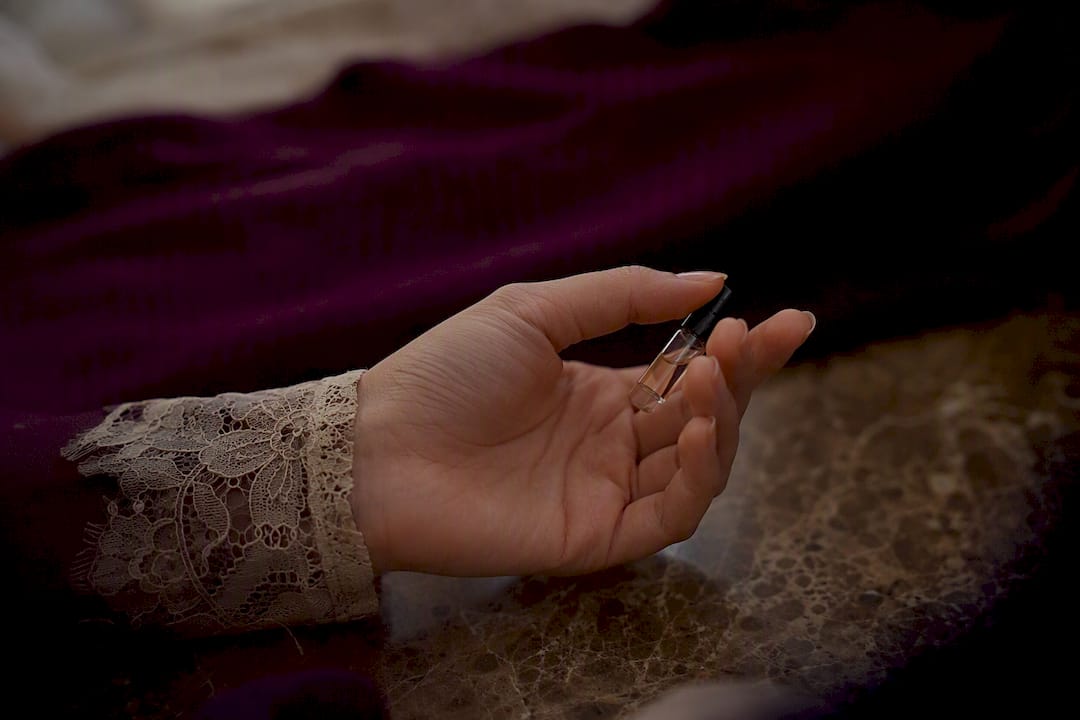
30 ml is the size for people who like variety more than loyalty. If you rotate between three or four scents depending on mood, 30 ml keeps things portable and low-risk. At a light rate, this bottle can run four to six months. At a heavy rate, closer to two.
50 ml is the sweet spot the industry keeps coming back to. Packaging researchers point to it as the core retail size because it balances shelf presence with buyer confidence. It’s the size for someone who has already decided a scent belongs in their daily rhythm.
75 to 100 ml makes financial sense once doubt is gone. The cost per milliliter drops noticeably at this range, but only if you’ll actually wear through it before the scent fades or your taste shifts. Buying 100 ml on a whim is how half-full bottles end up gathering dust on a shelf.
150 to 250 ml and refill formats are the quiet outliers. They’re less common because few people commit to a single scent at that scale, but collectors and habitual daily wearers of one signature fragrance sometimes buy in for the value.
Statistic Callout: A 30 ml bottle typically holds 300 to 450 sprays, while a 100 ml bottle can carry 1,000 to 1,200 sprays. That’s roughly triple the sprays for about double the price on most bottles, which is the real math behind “bigger is cheaper.”
Picture three people: the occasional wearer who sprays twice a week and is fine with a 15 ml lasting a year, the daily wearer who burns through 50 ml in four to six months, and the collector who owns eight bottles and rarely finishes any of them. None of them should be shopping the same size.
How Do You Choose the Right Perfume Size?
Answer four questions honestly before you check out, and the right size usually becomes obvious.
- How often will you actually wear it? Daily wear justifies 50 ml or more. Occasional wear rarely justifies more than 30 ml.
- Do you rotate between scents, or commit to one? Rotators do better with smaller formats spread across more bottles.
- Do you travel with it regularly? If yes, a travel-friendly 15 ml or a decanted atomizer avoids checked-bag risk and cabin restrictions.
- What’s your budget tolerance for a bottle you might not finish? If the answer is “low,” start small.
The cost-per-milliliter math is straightforward: divide the price by the volume, then compare. A €70, 50 ml bottle runs about €1.40 per ml. The same fragrance at 100 ml for €110 drops to €1.10 per ml. The larger bottle wins on paper, but only if the scent earns a permanent place in your rotation.
Watch for two red flags. Buying a large bottle for a fragrance you’re only mildly curious about almost guarantees waste. And storing perfume near heat, sunlight, or a steamy bathroom shortens its life regardless of size, so a bigger bottle just means a bigger loss.
Pro Tip: Start with a sample or a 30 ml bottle, decant a small amount into a travel atomizer for your bag, and only move up to 100 ml once you’ve worn the scent through at least one full season.
How Many Sprays Do You Get From Each Perfume Size?
Spray counts vary by atomizer strength and how heavy-handed you are, but the ranges hold steady enough to plan around.
| Size | Estimated sprays | Light use (2 to 3/day) | Heavy use (5+/day) | Typical €/ml |
|---|---|---|---|---|
| 30 ml | 300–450 sprays | ~4 months | ~2 months | Higher |
| 50 ml | 300 to 450 sprays | ~7 months | ~3–4 months | Mid-range |
| 100 ml | 1,000–1,200 sprays | ~13 months | ~6 months | Lower |
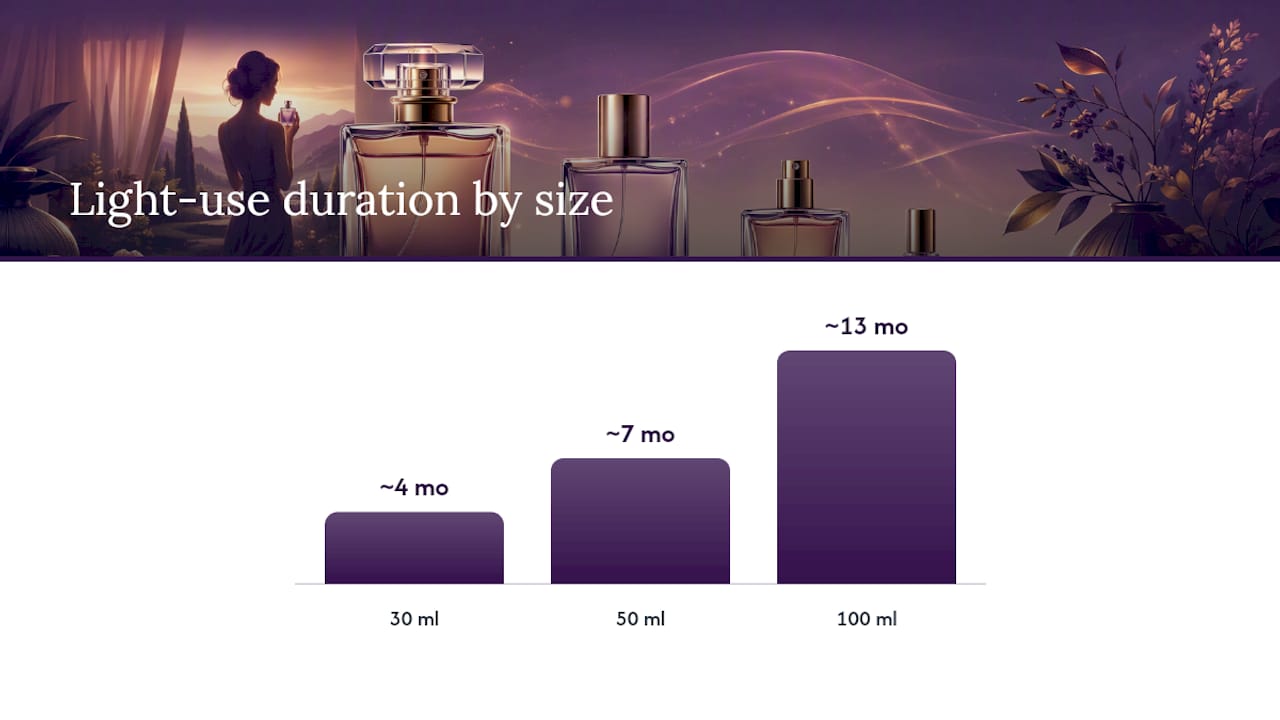
These numbers shift with concentration and atomizer design, so treat them as planning ranges rather than guarantees. A heavier eau de parfum concentration, storage away from heat, and a well-calibrated nozzle all stretch a bottle further than the low end of these estimates. If you’re flying, keep in mind that a 100 ml bottle sits right at the EU cabin liquids limit, so anything larger needs to go in checked luggage.
Maison Voyageur: Sizes Built Around Discovery and Devotion
Some perfume houses chase volume. We chase the moment someone finds the scent that feels like it already belonged to them, and we built our formats around that search.
Maison Voyageur offers a path rather than a single bottle: a 15 ml discovery format for the first meeting with a scent, travel atomizers for the days you carry it with you, and standard 50 ml and 100 ml bottles for when a fragrance has earned its place.
- Discovery (15 ml) for testing a new scent honestly
- Travel atomizers for portable, cabin-friendly carrying
- 50 ml for the fragrance you return to daily
- 100 ml for the scent that has become part of your story
A note on rotation
I keep two or three discovery sizes in a drawer at any given time. Not out of indecision, but because a scent that fits a rainy Tuesday rarely fits a summer evening. Start small. Let the bottle you refill become the one you trust.
Find Your Size at Maison Voyageur
Once you know your pattern, testing vs. daily vs. signature, choosing between our formats takes minutes, not months. Maison Voyageur is the alternative to guessing on a full bottle: you can start with a 15 ml discovery size, carry a travel atomizer on your next trip, and move up to 50 ml or 100 ml only once a scent has proven itself on your skin.
That consistency is exactly why buying larger once you’re sure makes sense rather than risky. Visit the Madrid atelier page to browse current formats and find the size that matches how you actually wear fragrance.
Sources
- Perfume Bottle Sizes 2026: 30ml vs 50ml vs 100ml Compared
- LaBelle’s Guide to Perfume Sizes: How Long Do They Last?
- Perfume Bottle Size Guide How to Choose 5ml, 10ml, 30ml, 50ml or 100ml for Your Target Customer | MUB Perfume Bottles
- The Ultimate Guide to Perfume Bottle Sizes 2025: From Travel to Full Size (With Video)
Les sept fragrances Maison Voyageur
- Manifesting · unisexe (69,99 €)
- Intuition · femme (69,99 €)
- Certainty · femme (69,99 €)
- Expansion · femme (69,99 €)
- Release · homme (69,99 €)
- Presence · homme (69,99 €)
- Inner Fire · homme (69,99 €)
Nouvelle ici ? Commence par le Discovery Set · les 7 fragrances en format voyage (40 €).