
Cut Emissions 65%: Sustainable Perfume Packaging That Works for Brands
The three highest-impact moves in sustainable perfume packaging are refillability, single-material design for recyclability, and verified bio-based or circular feedstocks. Together, these choices can cut greenhouse gas emissions by up to 65% across a bottle’s life cycle. What follows walks through the materials, formats, and sourcing questions that turn that promise into something a brand can actually ship.
TL;DR:
- Refillable formats combined with lightweight glass can reduce greenhouse gas emissions by up to 65 percent in a perfume’s life cycle.
- Using single-material bottles and external recycled or bio-based plastics enhances recyclability and minimizes environmental impact.
- Certifications like Cradle to Cradle and ISCC Plus verify material health and sustainable sourcing, but suppliers must provide proper documentation.
- Small-batch testing of moldable pulp or mycelium inserts helps ensure durability and aesthetic quality before larger production runs.
- Regulatory trends in the EU favor designs that optimize material recyclability and recycled content, making early adoption of verified sustainability claims advantageous.
Table of Contents
- What Makes Perfume Packaging Sustainable?
- Materials and Innovations Worth Evaluating
- Which Refill Formats Actually Scale?
- How Do You Keep Sustainable Packaging Looking Luxury?
- What Should You Ask Suppliers Before You Commit?
- A Small-Batch Case Study: Applying These Choices at Maison Voyageur
- Regulations and Standards Shaping the Category
- Where This Category Is Headed Next
- Explore Sustainable Packaging With Maison Voyageur
- Sources
What Makes Perfume Packaging Sustainable?
A single sustainable material does not make a bottle sustainable. The full life cycle does.
Evaluating packaging this way means tracing every stage: raw material extraction, manufacturing energy, transport weight, in-use durability, and what happens when the bottle is empty. Miss one stage, and a “green” claim can quietly fall apart. A biodegradable cap paired with mixed-material glass that can’t be recycled locally, for instance, solves nothing.
The stages worth scrutinizing:
- Material sourcing. Is the feedstock recycled, bio-based, or virgin fossil-derived?
- Manufacturing footprint. How much energy and water does molding or glass-forming consume?
- Transport weight. Heavier glass means more fuel burned per shipment.
- Recyclability at end of life. Can the bottle be sorted and processed by existing municipal systems?
- Reuse potential. Does the design support a refill, or does it end after one use?
Refillability changes the math more than any single material swap. A life-cycle assessment comparing a 100ml bottle paired with a 150ml refill against five separate 50ml bottles found reductions of roughly 65% in greenhouse gas emissions, 67% in water use, and 66% in energy consumption. That gap exists because the heaviest environmental cost in perfume packaging is usually the glass itself, not the fragrance inside it.
Lighter glass also cuts shipping emissions, but only if the bottle stays single-material. Mixed-material closures, metal collars fused to glass, or non-removable pumps often send an otherwise recyclable bottle straight to landfill because sorting facilities can’t separate the parts. Certifications work as a filter here, not a decoration. If a supplier can’t produce a third-party Cradle to Cradle result or an independent lifecycle assessment, the sustainability claim is worth treating with caution.
Materials and Innovations Worth Evaluating
Glass remains the industry default, and lightweighting it is the fastest lever most brands can pull. Reducing bottle weight by even 15 to 20% lowers both raw material use and transport emissions without touching the formula or the sensory experience of the fragrance.
Beyond glass, several material categories are reshaping what “premium” packaging can look like:
- Ionomer resins, such as Dow’s Surlyn REN and Surlyn CIR, offer near-glass clarity with far better refill durability and impact resistance, which matters when a bottle is designed to be opened, refilled, and closed repeatedly.
- Bio-based and chemically recycled plastics use mass-balance accounting, meaning the sustainable content is tracked through a certified supply chain rather than physically isolated in each unit.
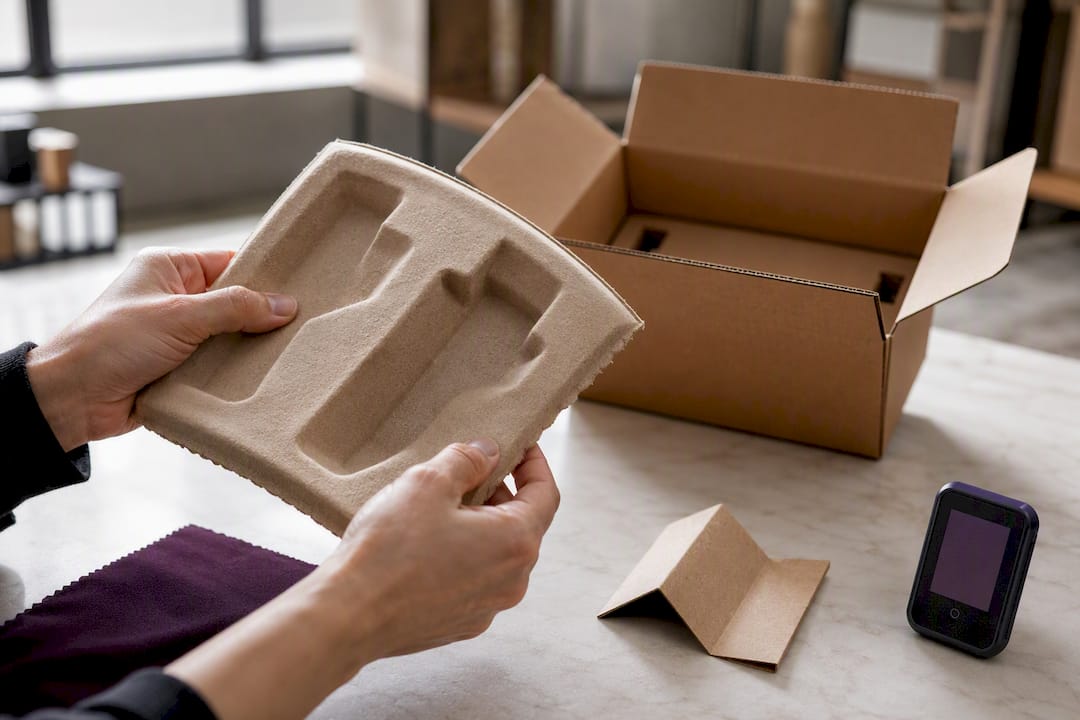
- Molded pulp, made from bamboo or bagasse fiber, replaces plastic inserts and outer casings entirely, and Knoll Packaging’s Ecoform clamshell shows it can hit a flawless luxury finish using a 60% FSC bamboo and 40% bagasse blend.
- Mycelium packaging, grown from agricultural waste, composts at home in 30 to 45 days and has a soft, tactile finish that suits inner packaging or gift inserts.
Market movement backs this up. Recycled or recyclable materials now make up 48% of new luxury fragrance packaging prototypes, up from 27% in 2020, with projections pointing toward 70% adoption of biodegradable or circular materials by 2030.
Pro Tip: Test mycelium or molded pulp inserts on a small production run before committing to a full SKU. Compostable materials behave differently across humidity levels, and a batch that performs beautifully in a climate-controlled warehouse can warp in transit.
Which Refill Formats Actually Scale?
Refill systems only work if the operational side matches the environmental promise on paper. Four formats dominate the current market:
- Cartridge refills, where a sealed insert slots into a durable outer shell, ideal for maintaining a consistent pump mechanism across uses.
- Pouch refills, lightweight and flexible, which minimize shipping volume but require compatible spouts.
- Bulk refill jars, used mostly for home fragrance and body products, filled by the consumer using a dosing tool.
- In-store refill stations, where customers bring their bottle back to a boutique or counter for a top-up.
The LCA data on the bottle-plus-refill model holds up regardless of format: roughly 65% lower emissions and similar reductions in water and mineral resource use compared to buying multiple single-use bottles. Operationally, the biggest failure point is pump compatibility. A refill pouch that doesn’t seal cleanly against the original pump mechanism creates leaks, returns, and a consumer experience that undercuts the sustainability pitch entirely. Fragrance pumps built with up to 67% post-consumer recycled resin now offer a way to keep dispensing quality high while lowering the plastic footprint of the mechanism itself.
Pilot programs should track one number above all others: reuse rate, meaning the share of customers who actually return for a refill rather than buying a new full bottle.
How Do You Keep Sustainable Packaging Looking Luxury?
Consumers associate weight and shine with quality, which is exactly why lightweight or fiber-based packaging needs deliberate design work to read as premium rather than budget.
Surface finish is the first lever. Water-based inks and coatings can achieve a matte or soft-touch feel that rivals traditional lacquers, and they keep the packaging within a single recyclable material stream instead of adding a plastic laminate that complicates recycling.
Tooling precision matters even more for molded pulp. The single biggest difference between a mass-market pulp box and a luxury one is whether the mold leaves a visible flange, the small ridge where two halves of the mold meet. Eliminating that seam requires multi-layer pulp construction and discrete paper hinges rather than glued joints, a technique Knoll Packaging’s clamshell design for Infiniment Coty Paris demonstrates well.
- Keep decorative elements (labels, foil accents) on the same material family as the base packaging whenever possible.
- Avoid adhesive-heavy labels on glass; they’re the most common contaminant that blocks glass recycling streams.
- Reserve mycelium or pulp inserts for smaller, high-touch elements like inner trays, where the tactile softness reads as intentional rather than cost-cutting.
Pro Tip: If you’re running a small-batch collection, test your matte finish under both warm and cool lighting. Water-based coatings can shift tone slightly under different retail lighting, and a bottle that looks rich under warehouse fluorescents can look flat under a boutique’s warm spotlights.
What Should You Ask Suppliers Before You Commit?
Certifications exist to answer one question: can this claim survive scrutiny? Three matter most in fragrance packaging right now.
- ISCC PLUS verifies that bio-based or recycled content in a resin supply chain is tracked through a certified mass-balance system, even when the sustainable material can’t be physically isolated in the final product.
- Cradle to Cradle certification assesses material health, circularity, and social fairness, and Coty’s refillable fragrance line achieved Cradle to Cradle Material Health Silver as proof a commercial-scale refillable can meet that bar.
- Third-party LCA reports put an independent number behind emissions and resource claims, rather than relying on a supplier’s internal marketing figures.
Mass-balance accounting trips up a lot of brand teams because it doesn’t work the way physical recycling does. A resin batch certified at 30% recycled content under mass balance means the supply chain purchased and tracked that percentage of recycled feedstock across its total output, not that each individual pellet contains exactly 30% recycled material. Ask suppliers for the certification documentation directly, not just a claim on a spec sheet.
Consumer appetite for this rigor is real. Multiple industry surveys aggregated by Safic-Alcan suggest a majority of luxury fragrance buyers prefer refillable packaging, and a meaningful share say they’ll pay a premium for verified recycled or renewable materials.
Red flags worth watching for: vague terms like “eco-friendly” with no certification attached, recycled-content percentages with no mass-balance documentation, and “biodegradable” claims with no stated timeframe or composting conditions.
A Small-Batch Case Study: Applying These Choices at Maison Voyageur
Maison Voyageur composes its Mediterranean fragrances in Madrid using 98% natural ingredients, a formulation philosophy that sets a natural expectation: packaging should feel as considered as what’s inside the bottle.
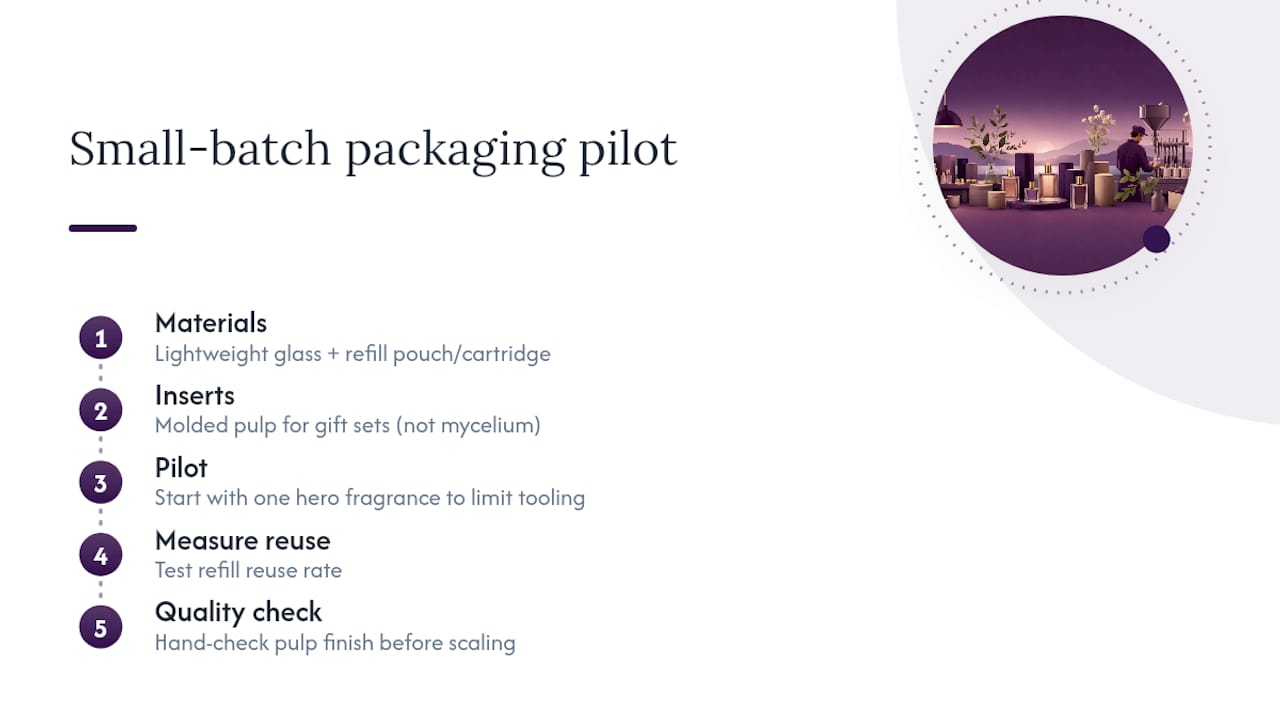
For an artisanal house working in smaller batch sizes, the most practical combination is lightweight glass paired with a refill pouch or cartridge, supplemented by molded pulp inserts for gift sets rather than mycelium, which better suits larger production runs than boutique quantities right now, as seen in examples like INIRD’s eco-friendly solid perfumes. Piloting on a single hero fragrance first, rather than the full collection, keeps tooling costs contained while the reuse rate gets tested. Small runs also make it easier to hand-check finish quality on pulp inserts before scaling.
Regulations and Standards Shaping the Category
Packaging regulation in the fragrance industry is tightening around two fronts: extended producer responsibility (EPR) schemes and recycled-content mandates.
EPR frameworks, already in force across much of the European Union, shift the financial responsibility for packaging waste onto the brand that puts it on the market, not just the municipality that collects it. That means a brand shipping into EU markets pays more for packaging that’s hard to recycle, and less for formats that are genuinely single-material and collected efficiently.
Recycled-content requirements are following a similar path. Several jurisdictions are moving toward mandatory minimum recycled-content thresholds for plastic packaging, which puts pressure on fragrance brands relying on virgin plastic pumps or overcaps.
Beyond binding regulation, voluntary standards fill the credibility gap. ISCC PLUS and Cradle to Cradle certifications aren’t legally required anywhere, but they’ve become the de facto proof point regulators and retailers look for when a brand makes a sustainability claim on-pack. Brands operating in Spain and the broader EU should treat these certifications less as marketing add-ons and more as a hedge against tightening compliance requirements that are still evolving. The safest approach is to design for the strictest plausible future rule now, rather than retrofitting packaging later.
Where This Category Is Headed Next
Material science in this space is maturing faster than certification adoption. Expect ionomer resins and molded pulp to reach cost parity with conventional plastics before mycelium does, simply because tooling and supply chains for the first two are further along.
For a brand deciding where to spend limited resources this year, the sequence that makes sense is: pilot one refill format on a single hero fragrance, and secure a third-party life-cycle assessment for that same SKU before expanding further. Trying to overhaul an entire catalog at once usually produces mediocre results across the board instead of one defensible success story.
The urgency here isn’t hypothetical. Regulatory pressure and consumer expectations are converging on the same timeline, and brands without a verified sustainability claim by the time recycled-content mandates tighten will be negotiating from a weaker position than those who moved early.
— Celeste
Explore Sustainable Packaging With Maison Voyageur
Maison Voyageur is the alternative to mass-market fragrance houses for anyone who wants packaging as considered as the scent inside it. Each fragrance is composed slowly in Madrid with 98% natural ingredients, and that same patience shapes how the house approaches materials and refill formats for its bottles and travel sizes.

Ingredient transparency is already central to how Maison Voyageur talks about its perfumes, and that same openness extends to packaging decisions as the house explores refillable formats and lighter glass for future collections. If your brand is weighing a pilot refill program or wants to talk through wholesale packaging options with a house that treats materials as part of the fragrance’s story, visit the Maison Voyageur collection page to start the conversation.
Sources
Les sept fragrances Maison Voyageur
- Manifesting · unisexe (69,99 €)
- Intuition · femme (69,99 €)
- Certainty · femme (69,99 €)
- Expansion · femme (69,99 €)
- Release · homme (69,99 €)
- Presence · homme (69,99 €)
- Inner Fire · homme (69,99 €)
Nouvelle ici ? Commence par le Discovery Set · les 7 fragrances en format voyage (40 €).