
Spot Real Sea Salt Perfumes: 4 Expressions and a Mediterranean Craft Alternative
Sea salt perfumes are fragrances built around a mineral, saline, or ozonic accord that recreates the feeling of sea spray, wet sand, and coastal wind on skin. They suit anyone drawn to fresh, mineral, understated scents over sweet or heavy ones. This guide walks through the scent family’s variations, how perfumers build the effect, how to choose and wear one, and where Maison Voyageur fits for those who want it made slowly, by hand.
TL;DR:
- Most salt-forward perfumes rely on synthetic ingredients like calone, algae extracts, and ambrox to mimic the mineral and saline qualities of the sea.
- The lasting power of sea salt fragrances typically ranges from three to six hours, depending on concentration and supporting notes, with moderate sillage.
- True saline notes are best identified in the heart of the scent after dry-down, so testing on skin and waiting is essential to assess authenticity.
- Choosing between pure marine, salty-woody, salty-gourmand, or citrus-ozonic expressions helps match your desired mood and environment.
- Artisanal brands like Maison Voyageur focus on natural, small-batch ingredients to create more nuanced, slower-drying coastal scents compared to mainstream mass-market options.
Table of Contents
- What Do Perfumes With Sea Salt Actually Smell Like?
- How Do Perfumers Create the Salt Effect?
- How to Choose the Right Sea Salt Perfume
- Wearing, Layering, and Caring for Sea Salt Fragrances
- Maison Voyageur’s Mediterranean Take on Sea-Inspired Scent
- What the Salt Trend Gets Wrong, and What to Trust Instead
- Find Your Sea-Salt Signature With Maison Voyageur
- Sources
What Do Perfumes With Sea Salt Actually Smell Like?
Close your eyes and picture standing at the shoreline right after a wave pulls back. That damp, mineral air with a faint edge of something briny. That’s the sensory target. A true sal marina note reads as clean, slightly sharp, and cool, closer to the smell of a wet rock than a bottle of table salt. Fragrantica’s own note archive catalogs “Sal” across marine, woody, and gourmand compositions, which tells you something important upfront: this isn’t a single scent. It’s a note that shifts personality depending on what surrounds it.
Four expressions cover most of what you’ll find on shelves.
- Marine or ozonic: the purest version, evoking sea air and breeze with almost no sweetness, often built on aquatic and algal molecules.
- Salty-woody: the same mineral edge softened into cedar, driftwood, or sandalwood, giving the salt a warmer, more grounded finish.
- Salty-gourmand: salt paired with vanilla, coconut, or amber, the “salted caramel” logic applied to fragrance rather than dessert.
- Citrus-ozonic hybrids: lemon or grapefruit layered over a marine base, which reads as bright and beachy even when the actual saline content is light.
That last category deserves a caveat. Some coastal-smelling fragrances lean almost entirely on citrus and ozonic topnotes to suggest the sea, without a genuine saline accord underneath. Yves Rocher’s Sel d’Azur is a clear example: lemon and grapefruit over marine freshness and a cedar base, marketed with cliffside imagery, but the “sel” in the name is doing more emotional work than literal olfactory work. If you want the real mineral bite, read past the marketing copy and look at what’s actually in the heart.
Companion notes change both mood and staying power. Coconut and driftwood, as seen in reviewer notes for salt-forward compositions, soften the mineral edge and extend wear. Pure ozonic accords fade faster and read colder. Reviewers describing Salt Air by Skylar note a saline topnote braided with green coconut and mineral facets settling into driftwood and sandalwood, with reported longevity around three to six hours for that style of composition.
Sillage tends to stay moderate across the category. These aren’t scents designed to fill a room. They’re designed to be discovered when someone leans close, which fits the quiet, reflective character the whole family carries.
How Do Perfumers Create the Salt Effect?
No perfumer is dissolving actual sea salt into a bottle. The saline impression comes from a careful blend of raw materials chosen for how they read on skin, not for chemical accuracy.
The toolkit usually includes:
- Calone and ozonic molecules, the backbone of most marine accords, producing that cool, watery lift.
- Seaweed and algae extracts, which add a green, mineral depth beneath the brightness.
- Ambrox, a synthetic ambergris substitute that grounds airy marine notes with warmth and lasting power.
- Mineral accords, often built from clay or salt-crystal facets, to suggest dried sea spray on skin rather than open water.
- Aldehydes, used sparingly to sharpen the topnote and mimic that first gust of coastal air.
The real skill is restraint. Push calone too hard and the result smells synthetic, almost like plastic or chlorine, the exact opposite of the natural coastal feeling most people want. Blend it against algae, ambrox, and a touch of warm musk, and it settles into something closer to real sea air drying on warm skin.
Concentration matters more than people expect. An eau de toilette lets the ozonic topnote dominate, since the formula is lighter and evaporates faster. An eau de parfum holds the base longer, which usually means more of the woody or mineral undertone comes through as the scent develops. If you tested a marine fragrance once as an EDT and found it thin, an EDP version of a similar profile might read entirely differently on your skin.
Retail copy for salt-forward blends often describes this arc directly. Laconicum’s Sel Marin listing walks through a citrus top note giving way to a marine and salt heart, resting on woody, musky bases, and the brand’s own advice is to test it on skin rather than judge it from the bottle.
Pro Tip: Spray on skin, not paper, and wait at least fifteen minutes before judging a sea-salt scent. The salt impression almost always lives in the heart notes, not the opening, and paper testing misses it entirely.
How to Choose the Right Sea Salt Perfume
Start by deciding which of the four expressions you actually want, since that decision filters out most of the wrong options before you smell a single sample. From there, weigh five criteria against each other.
- Expression type. Pure marine, salty-woody, salty-gourmand, or citrus-ozonic. Pick based on whether you want cold and clean or warm and rounded.
- Concentration. EDT for a lighter, more literal ozonic effect; EDP if you want the woody or mineral base to carry the scent through the day.
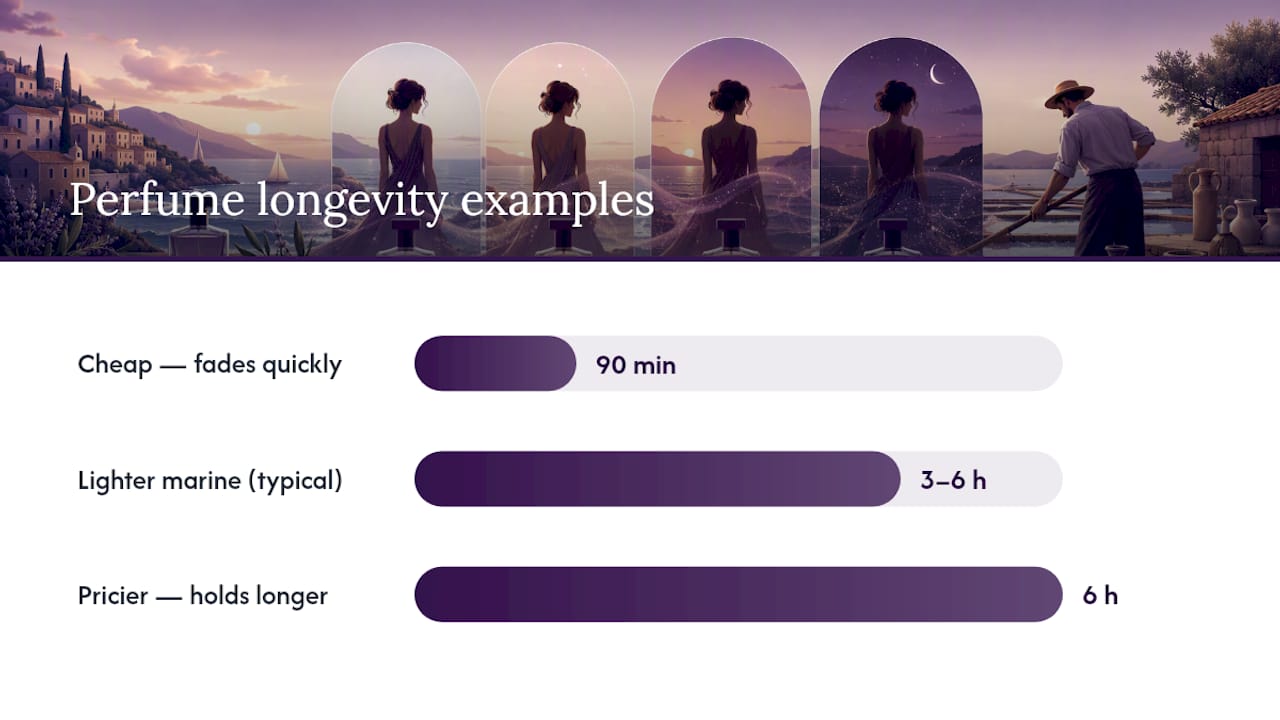
- Longevity. Ask directly how long the composition tends to last on skin. Three to six hours is typical for lighter marine styles.
- Natural versus synthetic balance. Some brands lean almost entirely on lab-built ozonic molecules; others blend in real algae extracts, seaweed, or mineral accords for more texture.
- Price against how it wears. A cheaper bottle that fades in ninety minutes isn’t actually a better deal than a pricier one that holds for six hours.
Before buying, run through a short testing checklist:
- Spray on your wrist or inner elbow, never on a paper strip alone.
- Wait through the full dry-down, at least an hour if you can manage it.
- Ask the retailer directly about the natural-to-synthetic ratio if it isn’t listed.
- Check whether the “salt” in the name reflects an actual saline accord or mostly citrus-and-ozonic marketing shorthand, as with several mainstream coastal releases.
- Walk away and come back to smell it again after thirty minutes; salt notes often reveal themselves late.
Red flags worth noting: a scent that smells sharp and chemical rather than briny usually has too much raw calone and not enough supporting warmth. And if a shop is hot or crowded, don’t trust your nose. Editorial guidance on sampling salt-forward fragrances consistently recommends testing in cooler, calmer conditions so the mineral nuance registers accurately instead of getting lost.
If you’re not ready to commit to a full bottle, decants, curated sample sets, and perfume bars are the more sensible starting point. They let you live with a scent across a few different days and temperatures before spending on something you might wear twice.
Wearing, Layering, and Caring for Sea Salt Fragrances
Less is genuinely more with this family. Mineral and ozonic accords read as overwhelming fast when overapplied, so one or two sprays at the collarbone and wrists is usually enough for a subtle effect. Save a third spray for the back of the neck only if you want something bolder.
Layering works well when you respect the structure. A light citrus-ozonic spray under a salty-woody or vanilla-based scent deepens the coastal feeling without turning it sweet or heavy. Avoid stacking two strong marine fragrances together, since the ozonic notes tend to compete rather than blend.
A few care basics protect these fragile accords:
- Store bottles away from direct sunlight and heat, since ozonic and citrus molecules degrade faster than heavier bases.
- Keep the cap tightly sealed between uses to slow oxidation.
- Reapply lightly rather than saturating, since salt accords lose their freshness faster than gourmand or woody scents.
Season-wise, this is largely a warm-weather, daytime family. Lighter EDT versions suit summer afternoons and beach settings, while an EDP salty-woody blend can carry into early fall evenings without feeling out of place.
Maison Voyageur’s Mediterranean Take on Sea-Inspired Scent
Maison Voyageur composes each fragrance slowly, in Madrid, drawing on Mediterranean influence rather than a generic idea of “ocean.” The brand’s approach treats a coastal note as something personal to sit with, not a mass-produced beach cliché.
What sets the artisanal path apart from mainstream marine releases includes a focus on natural ingredients, small-batch composition that allows subtler raw materials, guided scent discovery to help find the preferred expression, and the availability of travel sizes and curated sets for testing scents before committing to a full bottle.
| What changes with an artisanal approach | Why it matters for a salt note |
|---|---|
| Small-batch blending | Room for subtler algae, mineral, or ambrox facets instead of one dominant synthetic |
| 98% natural composition | Slower, more layered dry-down where the saline impression can shift naturally |
| Bespoke discovery process | Matches expression (marine, woody, gourmand) to personal preference rather than a single mass profile |
Customers describe the experience as less about buying a product and more about spending time with something made for them. That’s the difference a slower process makes. Explore Maison Voyageur’s Mediterranean fragrances if a handmade, coastal-inspired scent feels closer to what you’ve been looking for.
What the Salt Trend Gets Wrong, and What to Trust Instead
Most coverage of sea-salt perfumes treats “salty” as a single, interchangeable category. It isn’t. The gap between a genuine mineral-marine accord and a citrus spray wearing an ocean-themed label is the single most useful thing a shopper can learn before spending money.
The conventional advice, “look for ocean or marine on the label,” falls short because plenty of citrus-ozonic blends borrow that language without delivering the actual saline depth. Testing on skin, waiting through the dry-down, and asking directly about the natural-to-synthetic ratio matter far more than any name on the bottle.
What should come first isn’t concentration or price. It’s deciding which expression, cold and mineral or warm and woody, actually matches how you want to feel that day. A slower, more deliberate composition process tends to reward that decision better than a mass-market shelf full of near-identical ozonic sprays, because there’s simply more room for nuance in how the salt note is built.
— Celeste
Find Your Sea-Salt Signature With Maison Voyageur
If the citrus-ozonic sprays on department store shelves left you wanting something with more depth, Maison Voyageur offers the slower alternative: fragrances composed by hand in Madrid, built from 98% natural ingredients, designed for a personal connection rather than a shelf full of lookalikes.

Where mass-market marine perfumes often lean on one or two synthetic molecules to suggest the sea, a small-batch approach can leave room for subtler mineral, woody, and algae facets to develop over hours, not minutes. Guided scent discovery processes can help land on the expression, cool and marine or warm and salty-woody, that fits personal preference, rather than guessing from a store shelf. Travel sizes make it simple to live with a scent for a few days before committing.
Start your scent discovery and find the Mediterranean fragrance that matches the coastal feeling you’ve been chasing.
Sources
Les sept fragrances Maison Voyageur
- Manifesting · unisexe (69,99 €)
- Intuition · femme (69,99 €)
- Certainty · femme (69,99 €)
- Expansion · femme (69,99 €)
- Release · homme (69,99 €)
- Presence · homme (69,99 €)
- Inner Fire · homme (69,99 €)
Nouvelle ici ? Commence par le Discovery Set · les 7 fragrances en format voyage (40 €).