
What Are Luxury Botanical Perfumes, and Which One to Try First?
A luxury botanical perfume is a fragrance built from high-quality plant-derived raw materials, extracted with care, and dosed at a concentration strong enough to hold shape and depth for hours. It is craft over shortcuts. Maison Voyageur, composed in Madrid and formulated to be largely natural, exemplifies this approach for readers who want refinement without the compromise of synthetic filler. What follows explains the ingredients, the extraction methods, and the sustainability markers that separate real botanical luxury from a marketing label, then shows you how to start.
Before you read further, here is where to begin:
- Sample a discovery set before committing to a full bottle.
- Ask any brand for its INCI list and natural-origin percentage.
- Look for refillable packaging and traceable sourcing.
- Start your own exploration with Maison Voyageur’s discovery tools.
Key Takeaways
Luxury in botanical perfumery comes from verified ingredient transparency, thoughtful extraction methods, and honest sustainability claims, rather than from marketing language alone.
| Point | Details |
|---|---|
| Botanical is not natural-origin | Always ask for the full INCI list before relying solely on a “natural” claim on the label. |
| Extraction method shapes price | Enfleurage and CO2 extraction cost more than steam distillation because they preserve fragile notes. |
| Certifications beat self-reported claims | Look for certifications such as Cradle to Cradle or Cruelty Free International rather than vague eco language. |
| Test on skin, not just blotter | Give botanical top notes 20 to 30 minutes to settle into their true heart notes. |
| Maison Voyageur fits the checklist | Composed in Madrid with 98% natural ingredients, offered with discovery sets to sample before buying. |
Table of Contents
- What Defines a Luxury Botanical Perfume?
- Which Olfactive Families Define Botanical Luxury?
- Which Sustainability Signals Actually Matter?
- How Do You Choose a Botanical Luxury Perfume?
- How Should You Sample and Wear a Botanical Fragrance?
- How Does Maison Voyageur Deliver on the Botanical Luxury Promise?
- Where Do Botanical Luxury Perfumes Come From, Historically?
- Which Artisanal Brands Lead on Eco-Conscious Botanical Perfumery?
- Is Synthetic Always Worse Than Natural in Fine Fragrance?
- What Is the Environmental Cost of Sourcing Botanical Ingredients?
- When Does Botanical Luxury Make the Most Sense?
- Start Your Own Discovery With Maison Voyageur
- Where to Verify Botanical Luxury Claims
- Sources
What Defines a Luxury Botanical Perfume?
“Botanical” and “natural-origin” are not interchangeable, and the difference matters more than most shoppers realize. A botanical perfume is composed primarily of plant-derived materials. A “natural-origin” claim, by contrast, can include ingredients that started as plants but were chemically altered before bottling. Read the fine print, not just the label.
Extraction method shapes both scent and price. Here is how the three most common techniques compare:
- Steam distillation pulls volatile aromatic molecules through heat and pressure. It’s efficient and affordable, but it can flatten delicate top notes.
- Enfleurage presses fresh petals into fat over days or weeks to capture scent without heat. It’s slow, labor-intensive, and used almost exclusively for fragile flowers like jasmine or tuberose, which is why enfleurage absolutes command premium prices.
- CO2 extraction uses pressurized carbon dioxide to draw out aromatic compounds at low temperatures, preserving nuance that steam often loses.
Concentration determines how long a scent lasts on skin. Parfum (or extrait de parfum) holds the highest oil content, typically giving eight or more hours of wear. Eau de parfum sits in the middle. Perfume oils, alcohol-free by nature, tend to stay close to the skin and evolve slowly through the day.
Pro Tip: Ask for the full INCI (International Nomenclature of Cosmetic Ingredients) list before buying. A brand confident in its “percent natural” figure will show you the formula, not just the marketing copy.
Which Olfactive Families Define Botanical Luxury?
Botanical luxury perfumery draws mostly from four families: floral, citrus, resinous/woody, and green/herbal. Each carries its own emotional register, and understanding them helps you shop by feeling instead of guessing from a name on a shelf.
- Floral (rose, jasmine, neroli): warmth, memory, intimacy. Rose absolute alone can require an enormous quantity of petals to produce a small amount of oil, which is part of why it commands such a premium.
- Citrus (bergamot, bitter orange, mandarin): brightness, clarity, a sense of waking up.
- Resinous and woody (frankincense, olive leaf, cedar): grounding, stillness, depth.
- Green and herbal (fig leaf, basil, thyme): freshness with an edge, often used to cut through heavier florals.
The most compelling botanical compositions rarely rely on one note alone. A rose paired with olive leaf and a whisper of citrus, for instance, reads as both nostalgic and current, without needing a synthetic musk to hold it together. That balance, achieved with plant materials alone, is the technical challenge serious perfumers spend years mastering. It’s also what separates a composition worth remembering from one you forget by lunchtime.
Which Sustainability Signals Actually Matter?
Not every “eco” claim on a perfume box means what it implies. Some signals are backed by independent verification; others are just words a marketing team chose. Knowing the difference protects both your wallet and your values.
Certifications worth trusting include Cradle to Cradle Certified®, which assesses material health, circularity, and responsible manufacturing, and Cruelty Free International, a widely recognized signal that a product has not been tested on animals. The PETA cruelty-free registry offers a searchable second reference point if you want to cross-check a brand’s claim.
Beyond certifications, look for:
- Refillable bottles or take-back programs
- Recycled glass or minimal secondary packaging
- Traceable sourcing for key botanical ingredients, not just a vague “sustainably sourced” line
- A visible, checkable natural-origin percentage
A brand that genuinely stands behind its ingredients will answer a direct question about sourcing without hesitation. One that deflects, or offers only a percentage with no ingredient list attached, is asking you to take its word for something it should be able to prove.
If you have sensitivities, the EWG database lets you check individual ingredients for known concerns before you commit to a bottle.
How Do You Choose a Botanical Luxury Perfume?
Evaluating a botanical perfume takes a few minutes of real attention, not a glance at the bottle. Use this sequence:
- Ask for the INCI list. No list, no transparency. Move on.
- Confirm the natural-origin percentage and whether it is independently stated or self-reported.
- Ask about extraction method for the star ingredient. A brand that knows whether its rose is steam-distilled or enfleurage-extracted knows its own product.
- Check refillability and packaging. Does the brand offer a refill format, or is every purchase a new bottle?
- Request a sample before buying full size. A house confident in its formula will let you test it on your own skin first.
Watch for red flags: vague phrases like “made with natural extracts” with no percentage attached, ingredient lists that are simply missing from the product page, or sustainability claims with no certification behind them.
Pro Tip: Email customer service and ask one specific question, like “What percentage of this formula is natural, and can I see the INCI list?” How quickly and clearly they answer tells you almost everything about the brand’s transparency.
How Should You Sample and Wear a Botanical Fragrance?
Botanical formulas behave differently than heavily synthesized ones, and testing them the wrong way leads to false conclusions. A blotter strip gives you the opening notes honestly, but botanical top notes fade faster on paper than on skin, so always follow up with a skin test before deciding.
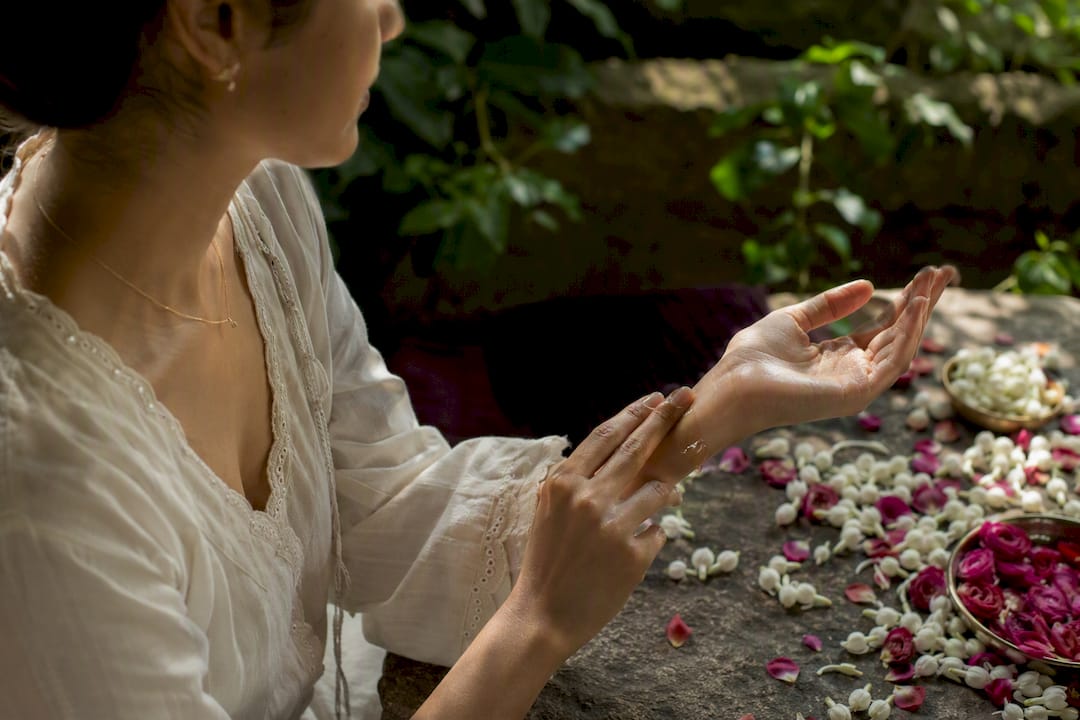
Apply a small amount to pulse points and wait. Give a botanical composition at least 20 to 30 minutes to move past its brightest citrus or green opening into its heart notes, where rose, jasmine, or resin typically settle in.
Perfume oils behave differently than alcohol-based eau de parfum. Oils sit closer to the skin and release slowly, so they reward patience and generally last longer in a subtle form. Alcohol-based formulas project further and evolve faster.
A few habits protect a botanical scent’s clarity:
- Apply to clean, unscented skin, not over heavily fragranced lotion.
- Avoid layering with a second strong perfume unless you know how the notes interact.
- Reapply lightly rather than doubling the initial dose. Botanical formulas concentrate character, not volume.
How Does Maison Voyageur Deliver on the Botanical Luxury Promise?
Everything above, ingredient transparency, extraction craft, and honest sustainability claims, is the checklist Maison Voyageur was built around, not retrofitted to.
Maison Voyageur composes its scents in Madrid, drawing on Mediterranean botanicals and a stated 98% natural ingredient content. The house works slowly by design. Each composition is meant to hold a memory or a feeling rather than simply announce itself in a room.
What that looks like in practice:
- A composition process rooted in one city, not outsourced across a dozen anonymous labs
- Discovery sets and guided scent tools that let you sample before committing to a full bottle
- Travel sizes and gift formats for readers who want to test a scent’s staying power in daily life before investing in the full experience
Real luxury, to us, is not the loudest scent in the room. It is the one that gives you time to explore within yourself.
The brand’s approach treats each fragrance as more than a product. It is meant to become part of how you remember a season, a place, or a version of yourself you are still getting to know.
Where Do Botanical Luxury Perfumes Come From, Historically?
Perfumery’s earliest history is entirely botanical. Ancient Egyptian, Persian, and Mediterranean cultures extracted resins, flowers, and woods for religious ritual, medicine, and personal adornment long before anyone thought to synthesize a molecule in a lab. Frankincense burned in temples. Rose water perfumed Persian courts. Olive oil carried scent across the Mediterranean trade routes centuries before “botanical” became a marketing word.
The shift toward synthetic aromachemicals in the late 19th and early 20th centuries changed perfumery permanently, and for good reason: synthetics made certain notes affordable, stable, and consistent in ways raw botanicals often cannot match. But that shift also created a gap, a nostalgia for the raw, imperfect richness of plant-based scent that mass production had smoothed away.
Botanical luxury perfumery today is, in many ways, a conscious return to that earlier tradition, filtered through modern extraction technology. Houses like Loewe have leaned into this narrative directly, building entire collections around botanical storytelling as a way to reconnect luxury fragrance with its plant-based origins. The cultural pull is real: a botanical scent carries a sense of place and season that a purely synthetic composition often struggles to replicate.
Which Artisanal Brands Lead on Eco-Conscious Botanical Perfumery?
The artisanal perfume world spans a wide range of approaches to eco-conscious botanical composition, and no single house owns the category. Small independent perfumeries built around slow, hands-on formulation have become the clearest counterpoint to mass-market fragrance, where speed and shelf life often outrank ingredient origin.
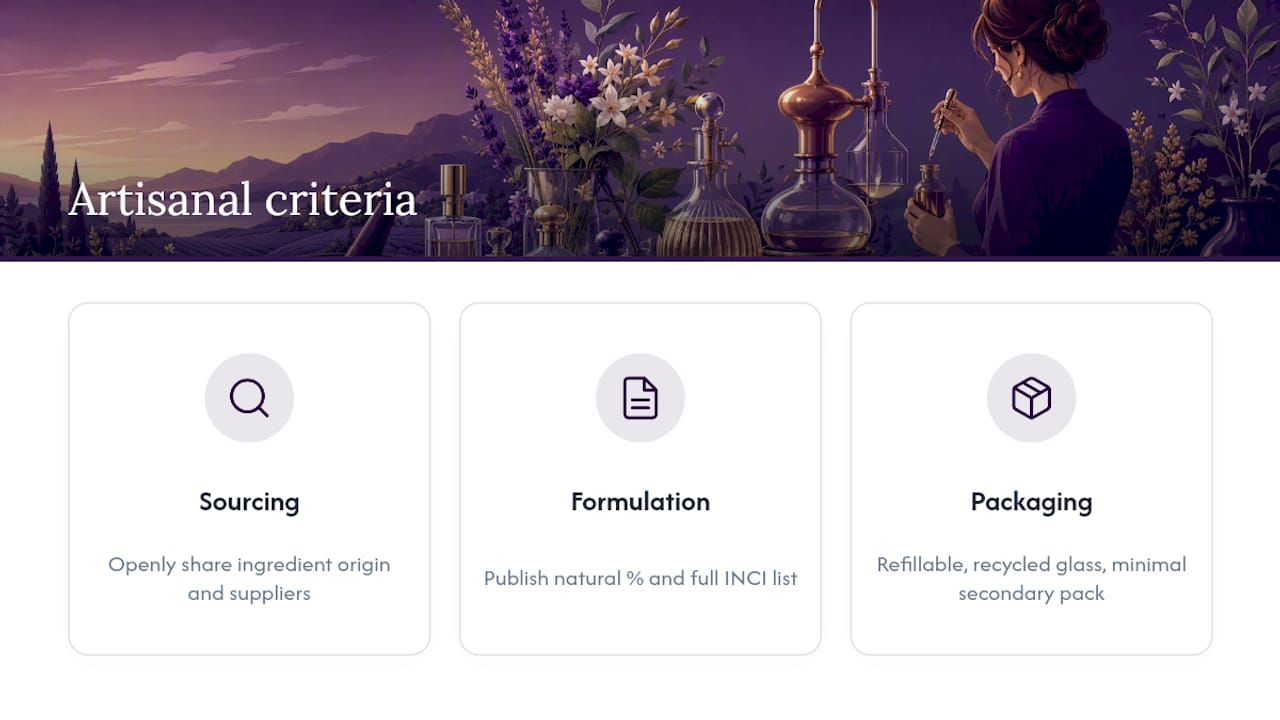
What separates a genuinely artisanal botanical house from one borrowing the aesthetic is usually visible in three places: how openly the brand shares its ingredient sourcing, whether its “natural” claims come with an actual percentage and INCI list, and whether packaging decisions (refillable formats, recycled glass, minimal secondary packaging) match the sustainability language on the label.
Larger luxury houses have also started building entire collections around a botanical narrative, layering plant-based storytelling onto their fragrance lines to meet growing demand from conscious buyers. That signals a broader shift in what luxury fragrance consumers expect, even from brands that were not built botanical from the start.
Independent perfumeries like La Fleurel, known for reimagining classic botanical signatures through small-batch composition, illustrate a similar creative instinct: treating a fragrance less as a finished product and more as an evolving interpretation of familiar plant materials. Maison Voyageur sits in this same tradition, built from the ground up around Mediterranean botanicals rather than adapting an existing formula to fit a sustainability trend after the fact.
Is Synthetic Always Worse Than Natural in Fine Fragrance?
The idea that “natural” automatically means better, and “synthetic” automatically means inferior, is one of the most persistent myths in fine fragrance, and it does not hold up under scrutiny. Some synthetic molecules exist precisely because certain natural materials are unstable, allergenic in high concentration, or nearly impossible to source sustainably at scale. Ambergris substitutes are a well-known example: synthetic ambroxan replaced a scarce, ethically fraught natural material without most wearers noticing a difference in the final scent.
Reformulating a rich, complex scent profile using almost entirely plant-derived materials is a genuinely difficult technical achievement, since natural materials vary batch to batch and behave less predictably than lab-stable synthetics.
The reverse myth is just as common: that any synthetic ingredient signals a lesser or “fake” perfume. In reality, a handful of synthetics used thoughtfully can extend the wear of a delicate botanical heart note without overwhelming it. The honest distinction luxury buyers should look for is not a blanket rule against synthetics, but transparency about what is in the bottle and why.
What Is the Environmental Cost of Sourcing Botanical Ingredients?
Botanical perfumery’s environmental footprint depends almost entirely on how, not just what, ingredients are sourced. A rose harvested through regenerative farming practices carries a very different footprint than one grown through intensive monoculture that depletes soil over successive seasons.
Water use is one of the least discussed pressures in botanical sourcing. Many prized perfume flowers, rose and jasmine especially, require enormous volumes of fresh petals to yield a small quantity of absolute or essential oil, which means water and land pressure scale directly with a brand’s ambition to stay “fully natural.”
Sourcing ethics extend beyond the environment into labor conditions. Hand-harvesting jasmine at dawn, when its scent molecules are most concentrated, remains a labor-intensive practice largely unchanged for generations, and fair compensation for that labor is not guaranteed just because a brand markets itself as artisanal.
This is where traceability earns its place on a buyer’s checklist. A brand that can name its harvest region, describe its extraction method, and explain how it manages ingredient scarcity is demonstrating something a vague “sustainably sourced” label cannot: accountability you can actually verify. Certification bodies and ingredient databases exist precisely because self-reported claims are not enough on their own, and a serious botanical luxury brand should welcome that scrutiny rather than avoid it.
When Does Botanical Luxury Make the Most Sense?
Botanical luxury rewards a particular kind of buyer: someone who wants a scent that changes subtly through the day, who values knowing what is actually in the bottle, and who is willing to trade a bit of raw projection for depth and nuance. If that’s you, a nearly all-natural formula will likely feel worth the investment.
A hybrid approach still has its place. People with certain allergies, or anyone who needs a scent to project strongly through a long workday, may benefit from a formula that uses a small percentage of stable synthetics to extend wear or reduce reaction risk. That is not a lesser choice. It is a different set of priorities.
A practical compromise many buyers overlook: choosing a composition with botanical heart notes, where the emotional character of the scent lives, paired with a longer-lasting base accord. You get the depth you came for without sacrificing staying power.
Botanical luxury does not need to be a rule. It should feel like the right fit for the moment you are trying to create.
— Celeste
Start Your Own Discovery With Maison Voyageur
Maison Voyageur is the alternative to mass-market luxury fragrance for readers who want to know exactly what they are wearing.

If the checklist in this guide matters to you (real INCI transparency, honest natural-origin percentages, and a composition process you can actually trace to a place), Maison Voyageur was built with those exact standards in mind. The brand offers individual bottles, curated sets for men and women, and travel sizes for anyone who wants to live with a scent before committing to a full bottle. Guided discovery tools help you match a fragrance to how you actually want to feel, not just how a bottle looks on a shelf. Start with a discovery set from Maison Voyageur and let the first sample tell you whether this is the scent you have been looking for.
Where to Verify Botanical Luxury Claims
- Check individual ingredients for safety concerns through the EWG database.
- Verify material health and circularity claims through Cradle to Cradle Certified®.
- Confirm cruelty-free status through Cruelty Free International.
- See how a major house presents natural-origin and refillable claims on Chloé’s Eau de Parfum Naturelle product page.
Sources
- EWG (Environmental Working Group)
- Cradle to Cradle Products Innovation Institute
- Cruelty Free International
- Chloé Eau de Parfum Naturelle 50 ml - Chloé
Les sept fragrances Maison Voyageur
- Manifesting · unisexe (69,99 €)
- Intuition · femme (69,99 €)
- Certainty · femme (69,99 €)
- Expansion · femme (69,99 €)
- Release · homme (69,99 €)
- Presence · homme (69,99 €)
- Inner Fire · homme (69,99 €)
Nouvelle ici ? Commence par le Discovery Set · les 7 fragrances en format voyage (40 €).