
Perfume Shoppers, Choose Day or Night: Orange Blossom vs Neroli
They begin as the same flower. Neroli is the steam-distilled essential oil of the bitter orange blossom, fresh and airy. Orange blossom absolute is the solvent-extracted version of that same flower, warm and sensual. The extraction method is what separates them, and knowing that difference tells you exactly which one belongs in your next fragrance choice.
TL;DR:
- Neroli is distilled from the flower using steam, resulting in a light, airy scent that emphasizes freshness and transparency.
- Orange blossom absolute is solvent-extracted, giving it a richer, honeyed, and more sensual aroma with greater longevity on skin.
- Neroli is commonly used in fresh colognes and chypres for its clean, crisp qualities, while orange blossom absolute suits warm floral and gourmand blends.
- Choice depends on the desired mood: neroli for daytime freshness, absolute for evening warmth and depth.
- Both materials are sensitive to heat and light, requiring cool, dark storage to preserve their quality and scent profile.
Table of Contents
- Orange Blossom vs Neroli: Same Flower, Two Different Journeys
- What Each One Actually Smells Like
- The Chemistry Behind Why One Lasts Longer
- Where Perfumers Actually Use Each One
- How to Choose Between Neroli and Orange Blossom
- An Artisan’s View on Sourcing Bitter Orange
- A Closing Note on Preference
- Explore Bitter Orange Through Maison Voyageur’s Compositions
- Sources
Orange Blossom vs Neroli: Same Flower, Two Different Journeys
Both materials trace back to Citrus aurantium amara, the bitter orange tree that lines Mediterranean streets and courtyards each spring. The blossom itself does not change. What changes is how it is coaxed into fragrance.
Neroli comes from steam distillation, a process that lifts only the lightest, most volatile aromatic molecules out of the flower. Orange blossom absolute is made through solvent extraction, or historically through enfleurage, a slower method that pulls out heavier, more complex compounds the steam simply cannot carry.
The bitter orange tree gives perfumers more than these two materials alone.
- Neroli — steam-distilled from the blossom, prized for its lightness.
- Orange blossom absolute — solvent-extracted, valued for depth and richness.
- Petitgrain — distilled from the leaves and twigs, sharper and greener than either flower material.
- Orange flower water (hydrosol) — the water-soluble byproduct of neroli distillation, gentle enough for skincare and even culinary use.
Four materials, one tree, four distinct roles in a perfumer’s palette.
What Each One Actually Smells Like
Close your eyes and imagine standing beneath an orange tree just after sunrise. That is neroli: fresh, green, with a metallic shimmer running through the citrus peel brightness. It is luminous rather than sweet, closer to crushed leaves and dew than to fruit.
Now imagine the same tree at dusk, blossoms warmed all day by the sun. That is orange blossom absolute: honeyed, jammy, faintly narcotic and indolic, with an animalic undertone that gives it a full-bodied, almost skin-like quality.
- Neroli reads as airy and transparent, the kind of note that opens a fragrance rather than anchoring it.
- Orange blossom absolute reads as dense and lingering, built to sit at the heart of a composition.
- Neither one tastes like the orange you would peel for breakfast. That eating-orange sweetness comes from the fruit, not the flower, and it is the most common misread of both materials.
The contrast is less about quality and more about character. One captures a Mediterranean morning grove in bloom, the other captures the same grove after hours of sun exposure has coaxed out its heavier facets.
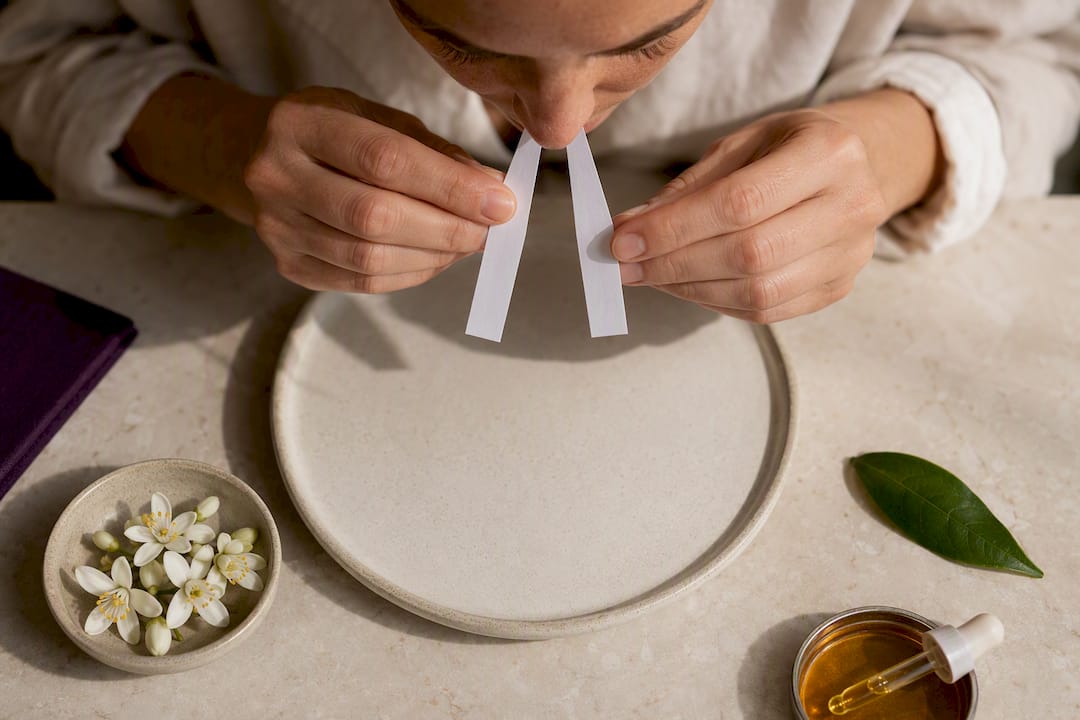
Pro Tip: Smell them side by side rather than one after the other. Your nose adapts fast to floral notes, and comparing them in the same breath is the only way to catch the shift from green to honeyed.
The Chemistry Behind Why One Lasts Longer
Extraction physics explain almost everything about how these two materials perform on skin. Steam distillation favors small, volatile molecules. Solvent extraction pulls in molecules too heavy or fragile for steam to carry.
- Neroli is richer in linalool, linalyl acetate, and specific neroli aldehydes, the compounds responsible for its bright, green lift.
- Orange blossom absolute carries more methyl anthranilate and indole, the molecules behind its honeyed, grape-like and animalic facets.
- Indole and methyl anthranilate are heavier and less volatile, which is why the absolute clings to skin longer than neroli does.
Yield plays into the price tag too. Distilling enough blossoms to produce even a modest quantity of neroli oil takes an enormous volume of flowers, and that scarcity shows up on the price list. Both materials are also sensitive to heat and light, so they belong in dark, cool storage away from a sunny bathroom shelf.
Where Perfumers Actually Use Each One
Neroli shows up constantly in colognes, fresh florals, and chypre structures where transparency matters more than weight. It has long been associated with clean, airy compositions, the kind meant to feel effortless rather than heavy. Orange blossom absolute, by contrast, earns its place in white floral bouquets, oriental accords, and gourmand blends that need warmth and staying power.
Pairing choices tend to follow the same logic:
- Neroli blends naturally with bergamot, lavender, and its cousin petitgrain, building a bright, herbaceous top.
- Orange blossom absolute deepens when paired with jasmine, vanilla, or amber, letting its indolic side lean into sensuality rather than fight it.
- Formulators often reach for the absolute in small doses. Perfumers dose it sparingly to avoid tipping a blend into something cloying, while neroli tolerates a heavier hand since it never carries that same density.
The choice between distillate and absolute often comes down to whether a formula needs lift at the top or richness at the heart.
How to Choose Between Neroli and Orange Blossom
Start with the effect you want, not the material’s reputation. Airy brightness points to neroli. Warm depth points to orange blossom absolute.
- Name the mood first. A daytime, energizing scent leans neroli. An evening, intimate one leans absolute.
- Consider the format. Absolutes behave differently in alcohol-based perfume than in an oil base, so test in the medium you actually plan to wear.
- Test on a blotter, then on skin. Note the sharp opening on the blotter, then apply to skin and wait through the full drydown, since body warmth changes both materials.
- Watch the transition. Neroli tends to fade toward a soft citrus whisper. Orange blossom absolute often deepens further as it warms.
- Patch test first. Both materials, especially the absolute, can trigger sensitivity in some people, so a small patch test before full wear is worth the extra day of waiting.
Pro Tip: Apply one to each wrist. By the second hour, you will smell the extraction difference more clearly than any description could give you, because your own skin chemistry finishes the story neroli and orange blossom absolute started.
An Artisan’s View on Sourcing Bitter Orange
Choosing between neroli and orange blossom absolute is not a technical decision made once. It is made composition by composition, depending on the hour a fragrance is meant to evoke.
A daytime accord asks for lift, something that opens like a window at dawn. An evening accord asks for weight, something that lingers the way memory does.
That distinction guides how Maisonvoyageurparfum approaches bitter orange in its own compositions, choosing distillate for brightness and absolute for depth rather than treating them as interchangeable. The decision is never about which material is better. It is about which hour of the day, and which emotional register, a scent is meant to hold.
A Closing Note on Preference
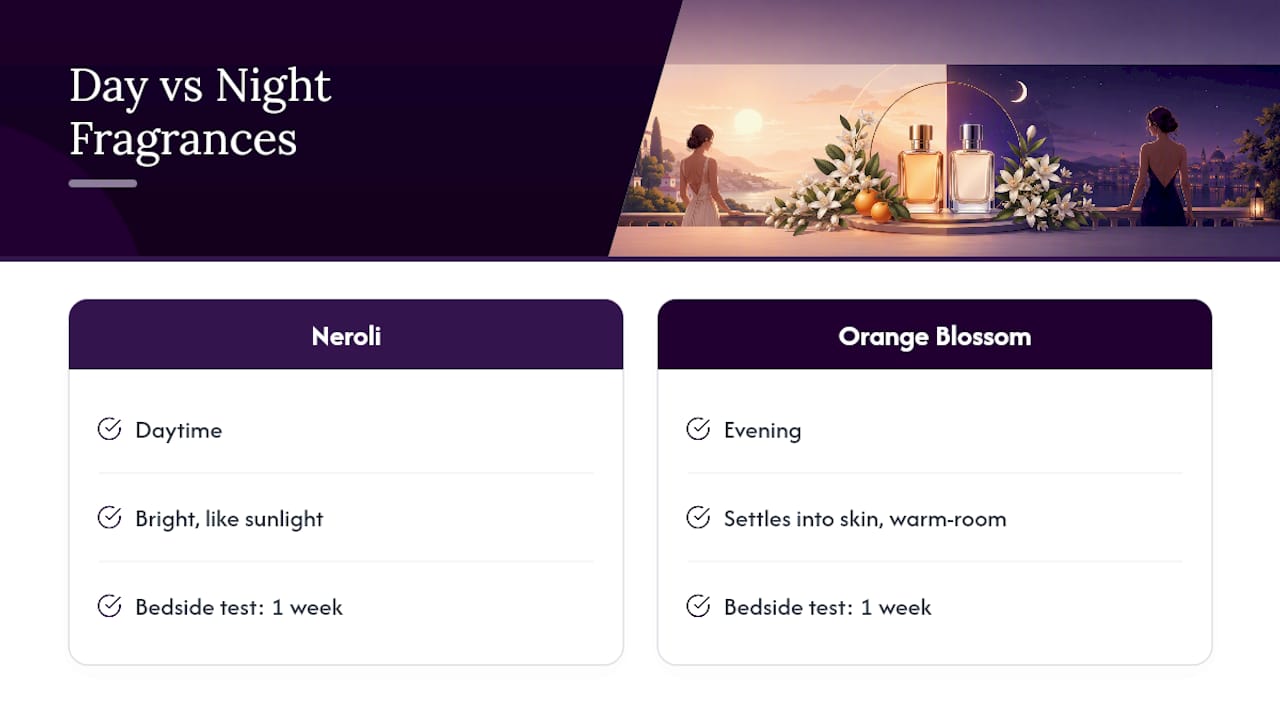
Daytime calls for neroli, something bright enough to wear like sunlight. Evening calls for orange blossom absolute, something that settles into skin the way a warm room settles into memory.
Keep a blotter of each by your bedside for a week. Notice which one you reach for without thinking. That instinct will tell you more than any description ever could.
— Celeste
Explore Bitter Orange Through Maison Voyageur’s Compositions

Each scent is crafted as an artisanal perfume, available in various formats such as individual bottles, travel sizes, or curated sets for gifting. If neroli’s brightness or orange blossom’s warmth speaks to you, the house’s guided scent discovery approach can help you find which register fits your own. Visit the collection, sample thoughtfully, and let the flower’s two faces guide what you bring home.
Sources
- Neroli
- Orange Blossom in Perfumery: History, Uses & Why It Matters - Fragrance Science
- Neroli vs Orange Blossom in Perfumery ~ Raw Materials (Fragrantica)
Les sept fragrances Maison Voyageur
- Manifesting · unisexe (69,99 €)
- Intuition · femme (69,99 €)
- Certainty · femme (69,99 €)
- Expansion · femme (69,99 €)
- Release · homme (69,99 €)
- Presence · homme (69,99 €)
- Inner Fire · homme (69,99 €)
Nouvelle ici ? Commence par le Discovery Set · les 7 fragrances en format voyage (40 €).