
Artisan Perfumer's Mastic Rules: Request GCMS and Dose 0.5–2%
Mastic is the resin of Pistacia lentiscus, a Mediterranean shrub, and perfumers prize it as a green-balsamic fixative that anchors a composition while adding coniferous freshness. It rarely leads a fragrance. Instead, it works quietly underneath citrus, herbs, or woods, stretching their life on skin. If you see “mastic” or “lentisque” on a note list, expect resinous depth, not sweetness.
TL;DR:
- Mastic’s green, coniferous smell transitions from piney and sharp to warm and balsamic, making it ideal as a fixative rather than a main note.
- The material is harvested as tree tears, with steam distillation producing essential oil at low yields and solvent extraction creating a more concentrated absolute.
- Origin influences scent profile and price, with Greek Chios mastic being sharper and more expensive, while North African sources are softer and more affordable.
- Use mastic in small amounts, under 2 percent, paired with citrus, herbs, or woods, and allow blends to rest for at least 48 hours for proper integration.
- Store mastic materials cold and sealed to slow oxidation, and verify provenance and chemical composition through GC-MS before purchasing.
Table of Contents
- What Does Mastic Smell Like in Perfumery?
- Resin, Oil, or Absolute: How Mastic Is Extracted
- How Perfumers Use Mastic in a Composition
- Where Does Mastic Come From, and Does Origin Matter?
- What to Ask Before You Buy Mastic Materials
- Working With Mastic in the Atelier
- A Quick Checklist Before You Work With Mastic
- A Perfumer’s Note on Mastic and Mediterranean Memory
- Experience Mastic in a Finished Mediterranean Fragrance
- Sources
- FAQ
What Does Mastic Smell Like in Perfumery?
Mastic opens sharp. The first impression is piney, almost turpentine-like, with a green bite that recalls crushed conifer needles more than any flower. That edge softens fast. Within minutes, the resin rounds into something balsamic and faintly smoky, then settles into a sweet-woody, creamy base that can sit under a composition for hours.
That transition, from bright and coniferous to warm and resinous, is what makes mastic tree resin so useful as a bridge note. It carries a fragrance from its brighter top accords into a grounded drydown without introducing a heavy, syrupy sweetness the way benzoin or vanilla might.
Material choice changes the story. Mastic resin and its distilled essential oil both skew green and piney, while the leaf oil of the same plant leans more herbaceous and slightly bitter, closer to rosemary or bay laurel. Origin matters too, which is worth remembering before you buy a bottle expecting a single, fixed smell.
Where mastic shows up in finished perfumes:
- Fragrance databases list the mastic or lentisque note across a mix of designer and niche releases, almost always as a supporting resinous accord rather than the headline.
- It tends to appear in compositions built around Mediterranean or maquis themes, alongside cistus, rosemary, and citrus peel.
- Niche natural perfumery uses it more assertively, sometimes as a co-star with frankincense or elemi in resin-forward blends.
Pro Tip: Smell mastic resin cold first, then warm a tiny amount between your fingers. The heat releases the balsamic base notes faster and gives you a preview of how it will read after 30 minutes on skin.
One detail that surprises newcomers: mastic’s longevity contribution isn’t really about its own scent lasting. It’s about how it slows the evaporation of lighter molecules around it, a mechanical fixative effect as much as an aromatic one.
Resin, Oil, or Absolute: How Mastic Is Extracted
Mastic starts as tree sap, not a lab process. Growers score the bark of Pistacia lentiscus in summer, and the wounded tree weeps a milky liquid that hardens in the sun into small, irregular pieces called “tears.” Those tears are hand-collected, sorted, and either sold as raw resin or processed further into essential oil or absolute.
Steam distillation of the dried resin produces the essential oil, and yield runs low. Expect roughly 1 to 3 percent oil by weight from the raw resin, which explains why mastic essential oil costs meaningfully more per gram than the chewing-gum-grade resin sold in Mediterranean markets. Solvent extraction, using a hydrocarbon solvent followed by alcohol washing, produces the absolute. It captures a heavier, richer aromatic body than the oil, including some of the deeper balsamic and slightly leathery facets that steam tends to leave behind.
Perfumers choose between the three forms based on how they intend to use the material:
- Raw resin works for tinctures, solid perfumes, or incense-style applications where slow, low-heat diffusion is the goal.
- Essential oil suits liquid perfumery where a cleaner, brighter mastic character and easier dosing matter.
- Absolute fits compositions that want the full, rounded resinous weight, often in smaller doses because of its intensity.
| Form | Aroma weight | Typical yield | Common use |
|---|---|---|---|
| Raw resin | Light, waxy, mild | Not distilled (used as is) | Tinctures, incense, solid perfume |
| Essential oil | Bright, piney, moderate | ~1 to 3% from resin | Fine fragrance, alcohol-based perfume |
| Absolute | Heavy, rich, balsamic | Lower than oil, solvent-dependent | Niche and natural perfumery, base accords |
Pricing follows this logic almost exactly. Resin is the cheapest entry point, essential oil sits in the middle, and absolute commands the highest price per gram given the extra processing and lower recovery.
How Perfumers Use Mastic in a Composition
Mastic almost never opens a fragrance. It lives in the heart-to-base transition, where its job is to bind the brighter opening accords to whatever base sits underneath. Think of it as connective tissue rather than a soloist.
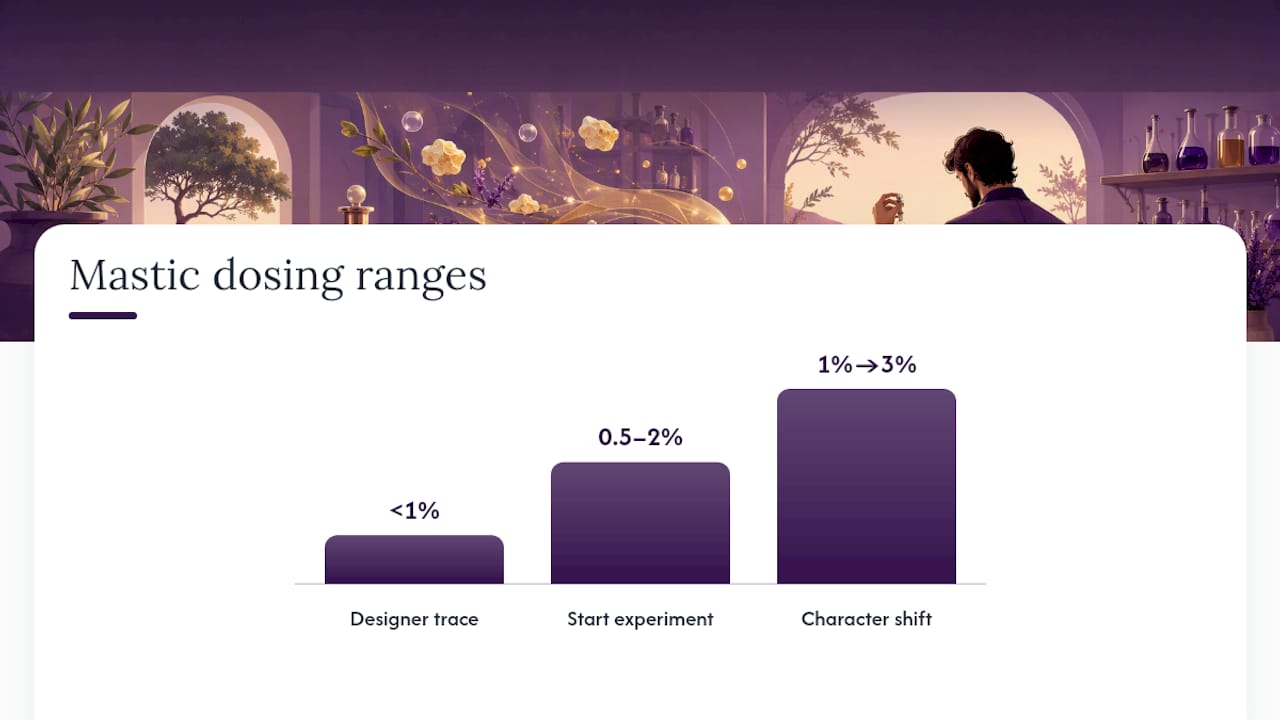
Typical dosing in a fine fragrance concentrate runs low, often well under 1 percent of the formula, since the material is potent and can turn sharp or medicinal if overdosed. Designer houses tend to use it in trace amounts purely for the fixative effect, barely perceptible on its own. Niche and natural perfumers push it higher, sometimes into moderate percentages, when they want the piney, resinous character to actually register as a note rather than just a structural support.
Here’s a practical way to start experimenting:
- Build your top accord first. Citrus (bergamot, mandarin) or aromatic herbs (lavender, rosemary) work well because mastic’s green edge echoes both families.
- Add mastic at 0.5 to 2 percent of the total concentrate and let it sit for a day before evaluating. Resins take time to integrate.
- Anchor the base with a complementary resin or wood. Cistus, benzoin, elemi, or dry woods like cedar reinforce mastic’s balsamic side without fighting it.
- Reassess after 48 hours. Mastic’s fixative effect is more obvious after the blend has had time to marry.
- Adjust in small increments. Because the material is concentrated, moving from 1 percent to 3 percent can shift the entire character of a base accord.
Frankincense makes a useful comparison point. Both are Mediterranean-adjacent resins with a coniferous opening, but frankincense tends toward a drier, more incense-like, slightly citrusy profile, while mastic reads greener and closer to fresh sap. They layer well together precisely because they don’t duplicate each other.
On safety, mastic-derived materials appear in EU chemical and ingredient inventories, and formulators should check current IFRA guidance and CosIng listings before finalizing leave-on concentrations, since oxidized resin materials can carry sensitization concerns at higher doses.
Where Does Mastic Come From, and Does Origin Matter?
Origin changes both the smell and the price tag. The island of Chios, in Greece, holds Protected Designation of Origin status for its mastiha, meaning only resin grown and processed there under specific conditions can legally carry that name. Perfumers chasing authenticity often pays a premium for verified Chios material and ask suppliers for provenance documentation to back it up.
The chemistry backs up why origin matters beyond marketing. Chios-variety mastic tends to run high in alpha-pinene, giving it that sharp, fresh-piney lift. Some North African sources skew toward higher beta-myrcene content instead, which reads more herbaceous and slightly softer, less like a conifer forest and more like crushed herbs. Neither profile is wrong. They’re just different creative tools, and the only reliable way to know which one you’re holding is to request a GC-MS analysis from your supplier rather than trusting a label alone.
A few practical notes on availability:
- Chios mastiha production is limited and tightly regulated, which keeps supply constrained and prices comparatively high for verified PDO material.
- Non-Chios Mediterranean and North African mastic is more widely available and generally cheaper, though quality and consistency vary more by lot.
- Because the resin is harvested seasonally by hand, year-to-year yield can shift, which shows up in spot pricing more than most synthetic aromachemicals ever do.
If your creative brief calls for that classic sharp, fresh, almost alpine-green mastic character, lean toward Chios-sourced material. If you want something softer and more herbal to sit under a lavender or rosemary accord, a North African source might actually serve the blend better, and cost less.
What to Ask Before You Buy Mastic Materials
A few questions separate a well-documented lot from a guess. Start every inquiry with these, whether you’re buying grams for a hobby project or kilos for production.
- Request a GC-MS batch report. A reputable supplier can show you the alpha-pinene to beta-myrcene ratio for the specific lot you’re buying, not a generic spec sheet.
- Confirm country of origin explicitly. If a listing claims Chios mastiha, ask for documentation supporting the PDO claim rather than taking the name at face value.
- Ask for a small sample vial first. Resin materials vary lot to lot, and a sample lets you evaluate before committing to a larger purchase.
- Check the certificate of analysis and packaging. Amber glass, proper sealing, and a batch date all suggest a supplier that handles oxidation-prone materials correctly.
- Cross-reference ingredient identifiers where available. Registries like the FDA’s Substance Registration System assign standardized identifiers that can help you confirm a supplier’s material claims match what’s actually in the bottle.
Form selection comes down to your project. Choose resin for tinctures and incense work, essential oil for cleaner liquid perfumery, and absolute when you want maximum resinous depth in a small dose. Absolute costs the most per gram but often needs the least of it.
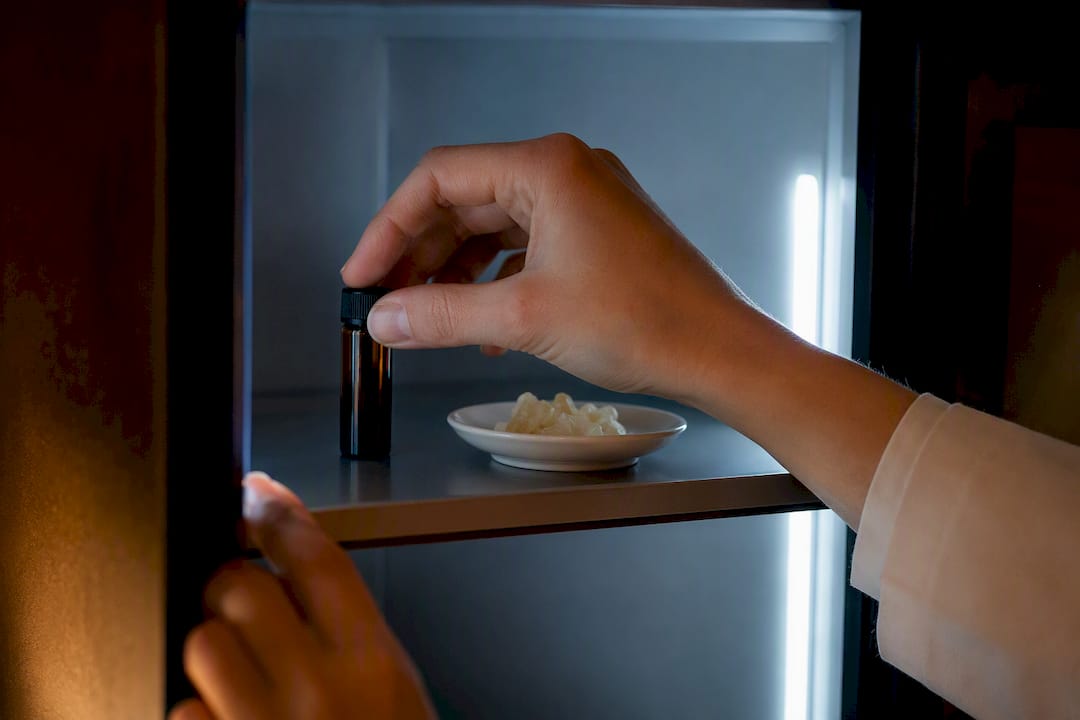
Pro Tip: Store mastic essential oil and absolute in the refrigerator, away from light, and always under a tight seal. Resinous materials oxidize faster than citrus or floral oils, and a stale mastic sample turns flat and slightly sour rather than aging gracefully.
Working With Mastic in the Atelier
Mastic earns its place because it delivers Mediterranean freshness without pulling a composition away from a high natural content. Synthetic fixatives are easy. A resin that fixes and smells like sun-warmed maquis scrubland is not.
The workflow stays deliberately unhurried. A mastic-led heart usually starts as a small trial batch, often no more than a few grams, paired against citrus or herbal top notes and a resinous or woody base. We let it rest for days, sometimes longer, before deciding whether the dose needs adjusting. Resins reveal themselves slowly.
A rough sketch of that process:
- Start with a citrus or aromatic top accord.
- Introduce mastic at a low, careful percentage.
- Anchor with cistus, dry woods, or a second resin for depth.
- Set the trial aside to age before evaluating again.
- Repeat with small adjustments until the balance feels right, not rushed.
This is slow work by design. Mastic doesn’t reward shortcuts, and neither does a fragrance meant to hold something personal.
A Quick Checklist Before You Work With Mastic
Mastic’s role in perfumery comes down to one line: it’s a Mediterranean fixative that adds green-resinous depth and stretches the life of whatever sits above it. Everything else is detail.
- Identify the form you actually have: raw resin, essential oil, or absolute, since each behaves differently in a blend.
- Request GC-MS data to confirm whether you’re holding a pinene-forward or myrcene-forward profile.
- Start low, around 0.5 to 2 percent of your concentrate, and let the blend rest before judging it.
- Pair it with citrus, lavender, rosemary, cistus, or dry woods to let its dual nature, both binding and grounding, come through.
- Store it cold, sealed, and away from light to slow oxidation and protect its brighter top notes.
A Perfumer’s Note on Mastic and Mediterranean Memory
Mastic feels like the Mediterranean condensed into resin. Sharp and green at first contact, the way sun hits pine needles along a coastal path, then it settles into something warmer and quieter. That arc, from alertness to calm, mirrors exactly what we hope a fragrance does for the person wearing it.
We don’t reach for mastic to make a scent louder. We reach for it to make one last longer, and to make it feel rooted somewhere specific. A resin that grows on rocky Mediterranean hillsides, harvested by hand, drying slowly in the sun. That patience shows up in the final scent, whether or not the wearer ever learns the material’s name.
It rewards attention. Not everyone will notice mastic directly, but many will notice the fragrance around it lasting longer, feeling more grounded. That’s usually enough.
— Celeste
Experience Mastic in a Finished Mediterranean Fragrance
Reading about mastic only goes so far. Maisonvoyageurparfum composes each fragrance slowly in its Madrid atelier, using 98 percent natural ingredients, including resinous materials like mastic alongside partner notes such as patchouli, cistus, and dry woods explored in depth by resources like Lunezia’s guide to patchouli. Where mass-market perfumes lean on synthetic fixatives for shelf stability, this house builds longevity from real resin, real time, and real restraint.

Every fragrance is built for introspection rather than projection, meant to be worn as a quiet companion rather than a statement. If mastic’s green-balsamic character intrigues you, the next step is simple: browse the current collection and request a sample or consultation to experience how it reads in a finished composition, not just in theory.
Sources
- Mastic tree resin note in perfumery | Fragsi
- Mastic or Lentisque perfume note | Silloria
- Essentialoils
- EC Inventory / ECHA
FAQ
What Does Mastic Smell Like?
Mastic opens sharp, green, and piney, almost like turpentine, then softens into a warm, balsamic, slightly sweet-woody base as it dries down on skin.
What Is Mastic Made Of?
Mastic is a hardened resin, or “tear,” harvested from cuts made in the bark of Pistacia lentiscus, then processed into raw resin, steam-distilled essential oil, or a solvent-extracted absolute.
Is Mastic Gum the Same as Frankincense?
No. Both are Mediterranean and Middle Eastern resins with a coniferous opening, but mastic comes from Pistacia lentiscus and reads greener and sappier, while frankincense comes from Boswellia trees and leans drier and more incense-like.
What Ingredients Should Not Be in Perfume?
Regulatory bodies restrict or cap certain allergens and sensitizers rather than banning entire ingredient categories outright; mastic-derived materials are listed in EU ingredient databases with guidance on safe concentrations, and checking current IFRA standards before formulating is the reliable way to confirm what applies to a specific material.
How Do Perfumers Use Mastic in a Blend?
Perfumers typically use mastic in the heart-to-base transition as a fixative, dosed under 2 percent of a concentrate, paired with citrus, herbs, or dry woods to extend the fragrance’s longevity.