
How to Choose a Natural Perfume That Fits Your Personality
The fastest way to choose a natural perfume is a four-step method: identify your scent family, test it on skin (never just a blotter), read the label for real botanical names and certifications, and accept that natural fragrance behaves differently from synthetic. It fades sooner. It costs more per bottle in many cases. It also smells like something alive, not manufactured. Natural doesn’t mean weaker. It means honest about its trade-offs.
- Identify the scent family that matches your mood and lifestyle
- Test on pulse points and wait, not on paper
- Read the INCI list and look for real certifications
- Set realistic expectations for how long it lasts
Key Takeaways
Choosing a natural perfume successfully requires matching scent family to personality, testing on skin for hours rather than minutes, and verifying real botanical ingredients on the label.
| Point | Details |
|---|---|
| Start with scent family | Match citrus, floral, woody, or oriental notes to your personality before testing full perfumes. |
| Test on skin, not paper | Wait 20 to 30 minutes to judge the heart note, then check back after three to four hours. |
| Read the INCI label | Look for named botanicals and certifications like COSMOS or Ecocert, and avoid vague “fragrance” listings. |
| Expect shorter wear | Natural formulas project less than synthetics; reapplication during the day is normal, not a flaw. |
| Maisonvoyageurparfum’s approach | Small-batch Mediterranean perfumes at 98% natural composition, formulated with transparent, named ingredients. |
Table of Contents
- How Do You Choose a Natural Perfume in a Store?
- What Are the Main Scent Families and What Do They Say About You?
- Is Natural Perfume Really Different From Synthetic Fragrance?
- How Should You Test a Natural Perfume Properly?
- Why Do Natural Perfumes Wear Differently Than Synthetic Ones?
- What Allergens Should You Watch For, and How Do You Store Natural Perfume?
- How Much Should You Expect to Pay for a Natural Perfume?
- How Does an Artisanal Perfumer Choose Natural Ingredients?
- What’s My Personal Rule for Choosing a Natural Scent?
- Find Your Scent Family With Maison Voyageur
- Frequently Asked Questions
- Sources
How Do You Choose a Natural Perfume in a Store?
Walk into a perfumery with clean skin. No lotion, no leftover cologne from the morning, nothing competing for attention. If you’ve been testing scents all day, your nose is already tired, and coffee beans at the counter exist for exactly that reason: sniffing coffee resets your olfactory receptors between tries.
- Limit yourself to two or three fragrances per visit. Beyond that, everything starts to smell the same.
- Spray on skin, not the paper blotter. Natural oils react with your body chemistry in a way blotters can’t replicate.
- Walk away for ten minutes before deciding anything. First impressions on natural perfume are almost always wrong.
- Take a sample home if the shop offers one. A single visit rarely tells you enough.
Once home, wear the strongest contender for a full day. Note when it changes, when it fades, and whether people around you comment on it or not.
- Check the label for actual plant names (rose absolute, cedarwood, bergamot) rather than the vague word “fragrance”
- Ask staff which natural fixatives were used, since these affect how long the scent lasts
- Write down your impressions at hour one, hour four, and before bed
Pro Tip: Look at what you already gravitate toward in candles, soaps, or body oils. If you keep buying lavender candles, you probably lean aromatic. That’s your starting family, not a random guess.
What Are the Main Scent Families and What Do They Say About You?
Perfumers group natural aromas into families based on their dominant character, and each one tends to attract a different kind of person. Knowing your family before you shop saves you from smelling through dozens of bottles that were never right for you in the first place.
- Citrus: bergamot, lemon, mandarin. Bright and immediate. Tends to suit people who want energy and simplicity, not a slow reveal.
- Floral: rose, jasmine, neroli. Romantic and expressive. Often chosen by people comfortable being noticed.
- Aromatic/herbal: lavender, rosemary, sage. Clean and grounding. Common among people who value calm over drama.
- Woody: cedarwood, vetiver, sandalwood. Warm and introspective. A frequent choice for people who prefer depth to sparkle.
- Oriental/amber: resins, benzoin, labdanum. Rich and enveloping. Suits people drawn to intensity and a bit of mystery.
- Gourmand: vanilla, tonka bean, cocoa. Comforting and soft. Popular with people who want warmth without formality.
- Fougère/chypre: oakmoss, coumarin, herbs. Structured and classic. Often favored by people with a more formal, traditional sense of style.
Instead of testing full perfumes right away, smell single essential oils at a health store or apothecary. Ten minutes with a vetiver oil tells you more about whether you’re a woody person than an hour in a crowded perfume shop.
Is Natural Perfume Really Different From Synthetic Fragrance?
Yes, and the difference goes beyond marketing language. A natural perfume is built from essential oils, absolutes, resins, and natural carriers, unfolding on skin in the classic top, heart, and base note structure that natural perfumery relies on. A synthetic fragrance often leans on lab-created molecules like Calone, the compound behind that “ocean breeze” smell in countless mass-market colognes. Calone doesn’t exist in nature. It’s built in a lab to mimic a marine note more efficiently than any natural ingredient could.
Natural formulas tend to be gentler on skin and lighter on the environment, but they also cost more and don’t project as far as their synthetic counterparts.
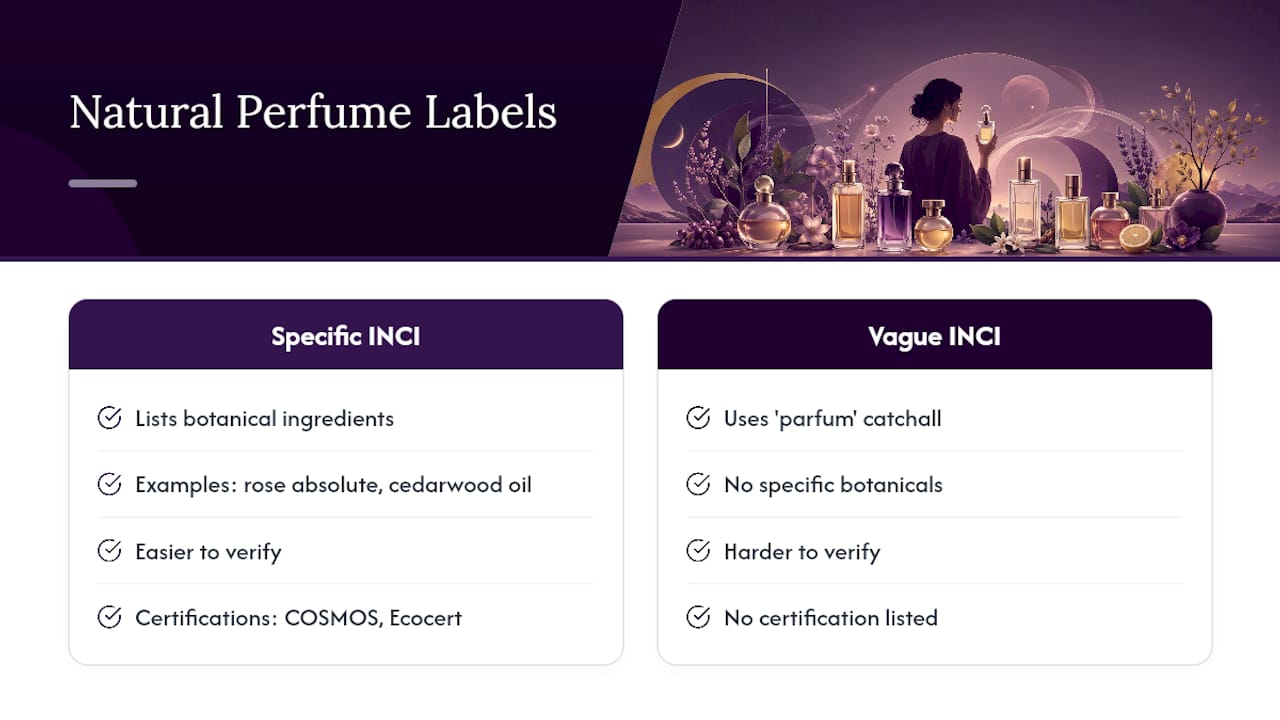
Genuine natural perfumes list actual botanical names on the INCI label. Vague terms like “parfum” or “fragrance” with nothing else behind them are the clearest red flag in the entire natural fragrance category.
Look for COSMOS, Ecocert, USDA Organic, or Leaping Bunny certifications, and know that “natural” and “vegan” aren’t synonyms. Some natural absolutes, like certain musks or civet-derived notes in older formulas, come from animals.
How Should You Test a Natural Perfume Properly?
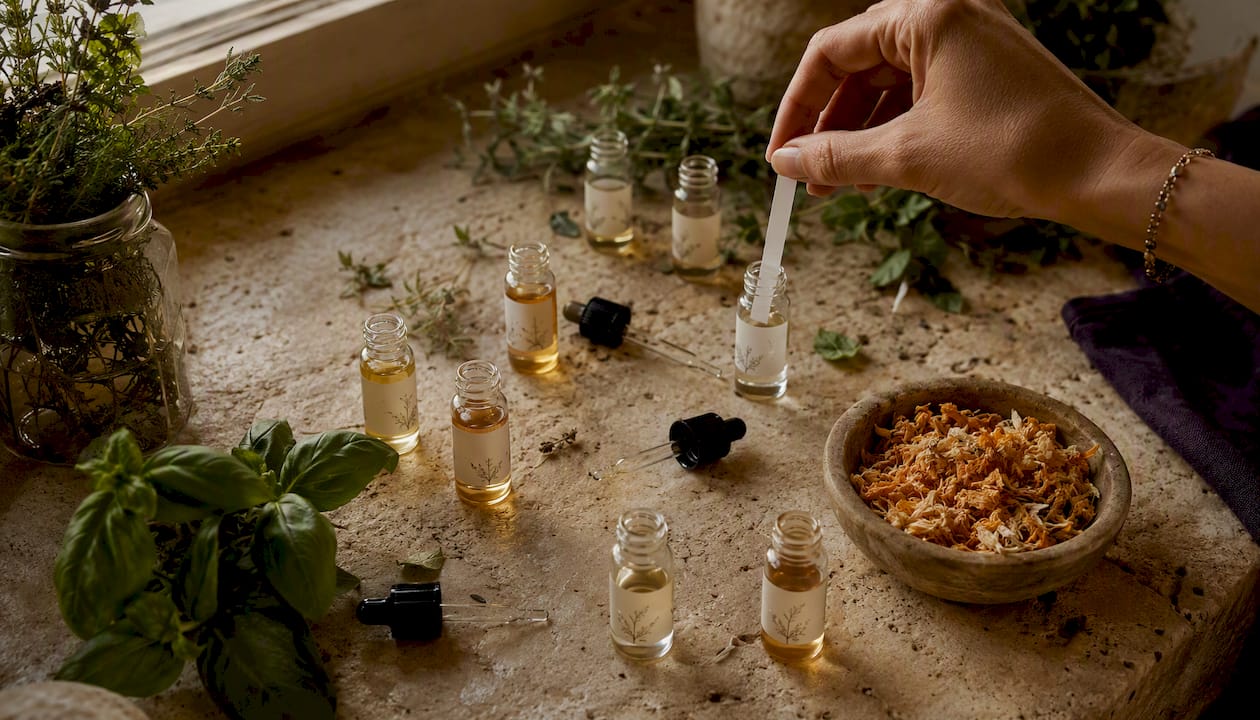
Skip the paper blotter entirely for your final decision. Natural oils change chemistry against warm skin in ways paper simply can’t reproduce.
- Cleanse a pulse point, usually your wrist or inner elbow, with unscented soap or water.
- Apply one spray or dab. Resist the urge to rub it in, since that breaks down the top notes prematurely.
- Wait 20 to 30 minutes before judging anything. This is when the heart notes emerge and the real character of the scent shows up.
- Check back after three to four hours to assess the base, the notes that linger closest to skin once everything else has faded.
- Write down what you notice at each stage, since natural perfume memory fades fast and you’ll forget details by evening.
If you’re comparing two scents, test them on opposite wrists and wait at least a full day between sessions. Body chemistry and skin conditions shift how oils read, so a rushed side-by-side comparison tells you very little.
Pro Tip: Order sample vials or travel sizes before committing to a full bottle. Testing the same scent across three or four different days, in different weather and moods, reveals far more than a single afternoon ever could.
Why Do Natural Perfumes Wear Differently Than Synthetic Ones?
Concentration labels (eau de toilette, eau de parfum, extrait, solid perfume) describe the ratio of aromatic compounds to carrier, and that ratio matters even more with natural ingredients. Extraits and solid formats hold onto natural oils longer than a light eau de toilette does.
- Layer a matching body oil underneath to extend wear on drier skin
- Apply to pulse points where body heat naturally diffuses scent throughout the day
- Choose a solid or extrait format if you need longevity over a full workday
- Keep a travel vial nearby for a midday reapplication
Natural perfumes often project less than synthetic formulas, a well-documented characteristic of botanical ingredients rather than a flaw in the formula. Reapplying once or twice during a long day is normal, not a sign of poor quality. Understanding why natural fragrance fades faster helps you set the right expectations before you buy.
What Allergens Should You Watch For, and How Do You Store Natural Perfume?
Certain natural compounds, including limonene, linalool, citral, and geraniol, appear in official allergen lists even though they come from plants, not labs. Natural doesn’t automatically mean risk-free for sensitive skin.
- Check the INCI list for these names before buying if you have known sensitivities.
- Patch-test on your inner arm and wait 24 to 48 hours before applying anywhere else.
- Watch for redness, itching, or swelling. Mild tingling that fades quickly is common; anything that persists or worsens warrants a dermatologist visit.
- Store bottles away from direct sunlight and heat, ideally in a dark glass container with a tight cap.
Essential oils are chemically active. Some, like citrus oils, are phototoxic under direct sun, and most degrade faster in heat or light than synthetic fragrance compounds do.
Expect natural perfumes to shift character over 12 to 24 months, since oxidation is part of how natural botanical formulas age when stored on the shelf.
How Much Should You Expect to Pay for a Natural Perfume?
Prices climb with raw-material intensity. Rose absolute and iris root, for instance, require enormous quantities of raw plant material per drop of oil, which pushes small-batch natural perfumes well above mass-market price points.
- Look for specialized boutiques and artisan perfumers who publish full ingredient sourcing
- Ask for samples before buying a full bottle, since return policies on opened perfume are rare
- Consider refill programs or solid formats to reduce both cost and packaging waste
Brands that disclose full INCI details and sourcing tend to be more trustworthy than ones hiding behind the word “natural” with no supporting detail.
How Does an Artisanal Perfumer Choose Natural Ingredients?
At Maisonvoyageurparfum, formulation starts with the raw material, not the marketing brief. Each scent is composed in small batches from ingredients we can name and trace, and our formulas run at 98% natural composition. That number isn’t a slogan. It’s a formulation constraint that shapes every choice, from which resin acts as a fixative to how long a batch needs to rest before it’s ready.
Balance matters more than intensity. A perfume that leans entirely on top notes fades in an hour. Natural fixatives like resins and woods are what carry a scent gently into its final hours on skin.
Pro Tip: Keep a small scent diary. Note the date, the weather, and how the fragrance evolved across the day. Patterns emerge after a handful of entries that no single test will ever show you.
What’s My Personal Rule for Choosing a Natural Scent?
Test fewer perfumes, not more. I limit myself to three candidates, then commit to wearing the front-runner for three full days before deciding anything.
Sustainability and transparency matter to me as much as how something smells in the first ten minutes. If a brand won’t name its ingredients, I move on, no matter how good the opening spray is.
Find Your Scent Family With Maison Voyageur
Maisonvoyageurparfum built its Seven Archetypes discovery method for exactly the moment you’re in right now: standing between several scent families, unsure which one actually reflects you. Rather than guessing from a counter display, the method walks you through your instincts and lifestyle before recommending a family to test first.

If reapplying once during the day sounds like a fair trade for something that actually smells like the plant it came from, explore the archetype method or read more on Maison Voyageur’s slow-luxury philosophy before choosing your first bottle.
Frequently Asked Questions
How do I know if a perfume is really natural and not just marketed that way? Flip the bottle. A genuinely natural perfume lists specific botanical ingredients like “rose absolute” or “cedarwood oil” on its INCI, not a vague catchall term like “parfum.” Certifications such as COSMOS or Ecocert add another layer of verification.
Why does my natural perfume disappear so much faster than my old one? Natural essential oils are lighter and more volatile than the synthetic fixatives used in most mass-market fragrances, so they project less and fade sooner. Reapplying once or twice during a long day is standard practice with natural formulas, not a sign of a weak product.
Can natural perfume still trigger allergies? Yes. Compounds like limonene, linalool, and geraniol are natural but classified as common allergens. Patch-test any new scent on your inner arm and wait 24 to 48 hours before wearing it more broadly.
What’s the best way to pick a scent family if I’ve never thought about it before? Look at what you already enjoy in candles, soaps, or body oils. If lavender candles are a constant in your home, you likely lean toward the aromatic family, and that’s a solid starting point for your first perfume test.
Sources
- Perfume sintético o natural: diferencias | CeroResiduo
- Perfumed Natural: The Timeless Art of Natural Fragrance - Natural Knows
Recommended
- Natural Perfume for a Health-Conscious Friend: Best Picks – Maison Voyageur
- Why Natural Perfume Smells Complex: The Real Science – Maison Voyageur
- Find Your Signature Scent · Maison Voyageur
- Offrir un parfum naturel : pourquoi choisir – Maison Voyageur
Les sept fragrances Maison Voyageur
- Manifesting · unisexe (69,99 €)
- Intuition · femme (69,99 €)
- Certainty · femme (69,99 €)
- Expansion · femme (69,99 €)
- Release · homme (69,99 €)
- Presence · homme (69,99 €)
- Inner Fire · homme (69,99 €)
Nouvelle ici ? Commence par le Discovery Set · les 7 fragrances en format voyage (40 €).