
Calabrian Bergamot in Perfumery: Why Spugnatura Matters
Bergamot is the hesperidic top note perfumers use for immediate brightness, complexity, and blending versatility. It opens a fragrance with a clean, slightly bitter sparkle, then quietly steps back to let heavier notes breathe. Three things explain its staying power: an aroma no other citrus fully replicates, an unmatched ability to bridge floral, herbal, and woody accords, and a role in perfumery history stretching back to the first colognes.
TL;DR:
- Calabrian bergamot from southern Italy remains the gold standard due to unique soil and microclimate that enhance aromatic oil quality.
- Genuine high-quality bergamot oil is scarce, with a low yield of about 85 grams per 100 fruits, contributing to its premium price.
- Most commercial bergamot is obtained through cold-pressing, but traditional sponge-pressing preserves more aromatic complexity and quality.
- Bergamot contains furocoumarins like bergapten, so rectified (“bergapten-free”) oils are safer for skin but may slightly alter the fragrance’s floral facets.
- Its demand is rising with artisanal perfumery, but scarcity and harvest variability mean sourcing transparency and origin are crucial for discerning consumers.
Table of Contents
- What Is Bergamot? Botany, Origins, and Calabria’s Reputation
- The Scent Profile: What Bergamot Actually Smells Like
- Cold-Press vs. Spugnatura: How Extraction Shapes Quality
- Bergapten and Photosensitization: What You Should Know
- Pairing Bergamot: The Fragrance Families Where It Shines
- How Maison Voyageur Works With Bergamot
- Bergamot’s Place in Perfume History
- Bergamot vs. Bitter Orange: What Sets Them Apart
- Sourcing Bergamot Responsibly: Sustainability in Practice
- Why Harvest Timing Changes the Oil in Your Bottle
- Bergamot’s Growing Demand in Modern Perfumery
- The Real Craft Behind a Bergamot Opening
- Experience Bergamot the Way Calabria Intended
- Sources
What Is Bergamot? Botany, Origins, and Calabria’s Reputation
Citrus bergamia is a small, bitter citrus fruit, likely a natural hybrid of bitter orange and lemon, grown almost exclusively for its peel oil rather than its flesh. The fruit itself is unassuming: yellow green, roughly the size of an orange, with a rind too sour and bitter to eat fresh. What makes it valuable sits entirely in that rind.
The world’s benchmark bergamot comes from a narrow coastal strip in Calabria, in southern Italy, where volcanic soil, sea air, and a specific microclimate produce oil that growers elsewhere have never quite matched. Perfumers treat Calabrian bergamot roughly the way winemakers treat Champagne: a place name that functions as a quality signal.
A few facts anchor why this region matters so much to fragrance history:
- Calabria supplies the overwhelming majority of the world’s perfume-grade bergamot oil.
- The region’s growing conditions concentrate the fruit’s aromatic oils in ways other Mediterranean climates struggle to replicate.
- Bergamot became one of the original components in early eau de cologne formulas, a role it has held for centuries.
That last point matters more than trivia. Bergamot didn’t arrive in perfumery as a trend. It arrived as a foundation.
The Scent Profile: What Bergamot Actually Smells Like
Bright. Green. Faintly floral, with a bitterness that keeps it from ever smelling like simple orange peel. That bitterness is the tell. Where sweet orange reads as sunny and uncomplicated, bergamot carries a sharper, almost sparkling edge, closer to green tea than to juice.
Two compounds do most of the work behind that character. Linalool and linalyl acetate, both present in significant concentration, give bergamot its soft floral undertone and help explain why it blends so effortlessly with lavender. These same molecules show up in several other naturals, which is part of why bergamot pairs so readily across fragrance families instead of clashing.
Bergamot’s opening effect on a composition:
- Adds immediate lift and clarity to the first seconds of wear
- Softens harder citrus notes like lemon or grapefruit
- Extends the perceived freshness of a top accord before the heart notes take over
- Creates a bridge between citrus brightness and floral or herbal notes that follow
The oil is composed of over 350 identifiable chemical constituents, which is unusually complex for a citrus essence. Most citrus oils run simpler. That density of minor compounds is why a good bergamot smells layered rather than flat, and why perfumers describe it as having “facets” rather than a single note.
Pro Tip: If you want to train your nose on bergamot, smell a bergamot-forward eau de cologne next to a plain sweet orange oil. The bitterness gap between them is the exact quality that makes bergamot indispensable in perfumery.
Cold-Press vs. Spugnatura: How Extraction Shapes Quality
Nearly all commercial bergamot oil comes from cold-pressing the rind, a mechanical process that avoids heat and keeps the oil’s volatile top notes intact. It’s efficient, scalable, and produces a reliably good oil.
Calabrian artisans still practice something older: spugnatura, a traditional sponge-pressing method where workers press the peel by hand against a sponge to draw out the oil. It’s slower and yields less. Perfumers who work with it argue it preserves subtle aromatic complexity that faster industrial extraction tends to flatten, because minimal heat and solvent contact protect the fruit’s more delicate top-note variations.
Three things separate a genuinely high-quality bergamot oil from an average one:
- Yield honesty. Roughly 100 bergamot fruits produce only about 85 grams of oil, so a suspiciously cheap “pure bergamot” is worth questioning.
- Color and clarity. Unrectified oil tends toward a deeper green gold; heavily processed or rectified versions often run paler.
- Aroma complexity on the strip. Quality oil unfolds over several minutes rather than smelling identical from first spray to dry down.
That low yield is exactly why bergamot commands a premium price relative to sweet orange or lemon oil.
Bergapten and Photosensitization: What You Should Know
Bergamot contains bergapten and related furocoumarins, compounds that create a genuine risk of skin photosensitivity when treated skin is exposed to strong sunlight. This isn’t a rare, theoretical warning. It’s documented enough that the fragrance industry built a standard workaround around it.
How perfumers and brands manage the risk:
- Rectified or “bergapten-free” (FCF) bergamot extracts remove most furocoumarin content before the oil goes into skin-contact formulas.
- Reputable perfumeries disclose when an oil has been rectified for safety.
- Consumers applying bergamot-forward fragrances should avoid direct, prolonged sun exposure on sprayed skin, particularly in the hours right after application.
Rectification isn’t a free fix. Removing bergapten slightly alters the oil’s fresh lavender facets, which is why skilled perfumers compensate with careful blending rather than simply swapping in a rectified oil and calling it finished. The safety trade-off is real, and so is the craft required to manage it well.
Pairing Bergamot: The Fragrance Families Where It Shines
Bergamot rarely works alone. Its real value shows up in how it behaves next to other materials, which is why it anchors entire fragrance families rather than a handful of niche compositions.
- Colognes and fougères: bergamot paired with lavender is close to the founding formula of modern men’s fragrance, a combination that has held for generations.
- Fresh florals: bergamot lifts neroli and orange blossom without competing with their sweetness, giving a composition lightness instead of heaviness.
- Chypre structures: bergamot’s brightness contrasts against mossy, woody bases, creating the tension that defines the category.
- Green and herbal blends: rosemary, basil, and green tea accords echo bergamot’s own slightly bitter edge, reinforcing rather than fighting it.
- Gourmand contrasts: a small dose of bergamot against vanilla or amber keeps a sweet composition from feeling flat or one-note.
On skin, a well-composed bergamot opening should feel sparkling and slightly bitter in the first few minutes, then soften gradually as it hands off to the fragrance’s heart notes. If the citrus vanishes within a minute or two, the formula likely leaned on a synthetic citrus accord rather than genuine bergamot oil.
How Maison Voyageur Works With Bergamot
Sourcing matters as much as formula. Maison Voyageur builds each fragrance around 98% natural ingredients, which means the bergamot in a composition has to justify its place on merit, not fill volume cheaply.
A luminous opening should not simply announce itself and disappear. It should linger just long enough to invite you inward, toward the quieter, more introspective notes waiting beneath it.
Pro Tip: When testing a Mediterranean-inspired fragrance, give the opening a full ten minutes on skin before judging it. Bergamot’s brightness is meant to fade into something deeper, not stay loud.
That transition, from citrus brightness to something more contemplative, is the artisanal approach Maison Voyageur brings to composing with bergamot.
Bergamot’s Place in Perfume History
Bergamot’s story in fragrance runs deeper than most top notes. It was one of the founding materials in eau de cologne, the citrus-forward formula that emerged in 18th century Europe and eventually gave its name to an entire fragrance category. That original cologne structure, built around bergamot’s brightness, shaped how perfumers thought about “freshness” for the next two centuries.
The fruit’s cultural footprint extends past perfumery, too. Bergamot flavors Earl Grey tea, a use that runs alongside its fragrance applications and probably did more than anything else to make the scent familiar to people who’d never opened a perfume bottle. That dual identity, tea shelf and perfume counter, gave bergamot a kind of cultural shorthand: sophistication without stuffiness.
Italian perfumery in particular leaned on bergamot as regional pride. Calabrian growers and Italian perfume houses have spent generations treating bergamot the way French houses treat rose from Grasse, as a point of origin worth naming on the label. That association has only strengthened as niche and artisanal perfumery has grown; single-origin bergamot now functions as a selling point in its own right, not just a raw material.
The result is a note that carries weight beyond its smell. Wearing a bergamot-forward fragrance connects, even faintly, to a lineage of citrus colognes that predates modern perfumery as an industry.
Bergamot vs. Bitter Orange: What Sets Them Apart
Bergamot and bitter orange share a family tree, literally. Bergamot is believed to be a hybrid descended partly from bitter orange, and the two oils overlap in some aromatic territory. But they read very differently on skin.
Bitter orange oil, pressed from the peel of Citrus aurantium, smells rounder and sweeter than bergamot, with less of that sharp, green edge. Where bergamot reads as sparkling and slightly bitter, bitter orange leans warmer and more straightforwardly citrus, closer to what most people expect from an orange peel, just less sugary than sweet orange.
The practical difference for a wearer comes down to function. Bergamot tends to lift and brighten an entire composition, working as connective tissue between citrus and everything that follows. Bitter orange behaves more like a standalone accent, adding roundness and a touch of warmth without bergamot’s structural versatility.
Chemically, bergamot’s higher linalyl acetate and linalool content gives it that soft floral quality bitter orange mostly lacks. Bitter orange oil also carries different furocoumarin levels, so photosensitivity guidance shouldn’t be assumed to transfer directly between the two oils. If a fragrance description says “bergamot” but smells rounder and less bitter than expected, there’s a real chance the formula leaned on bitter orange, or a blend of both, to fill the top note.
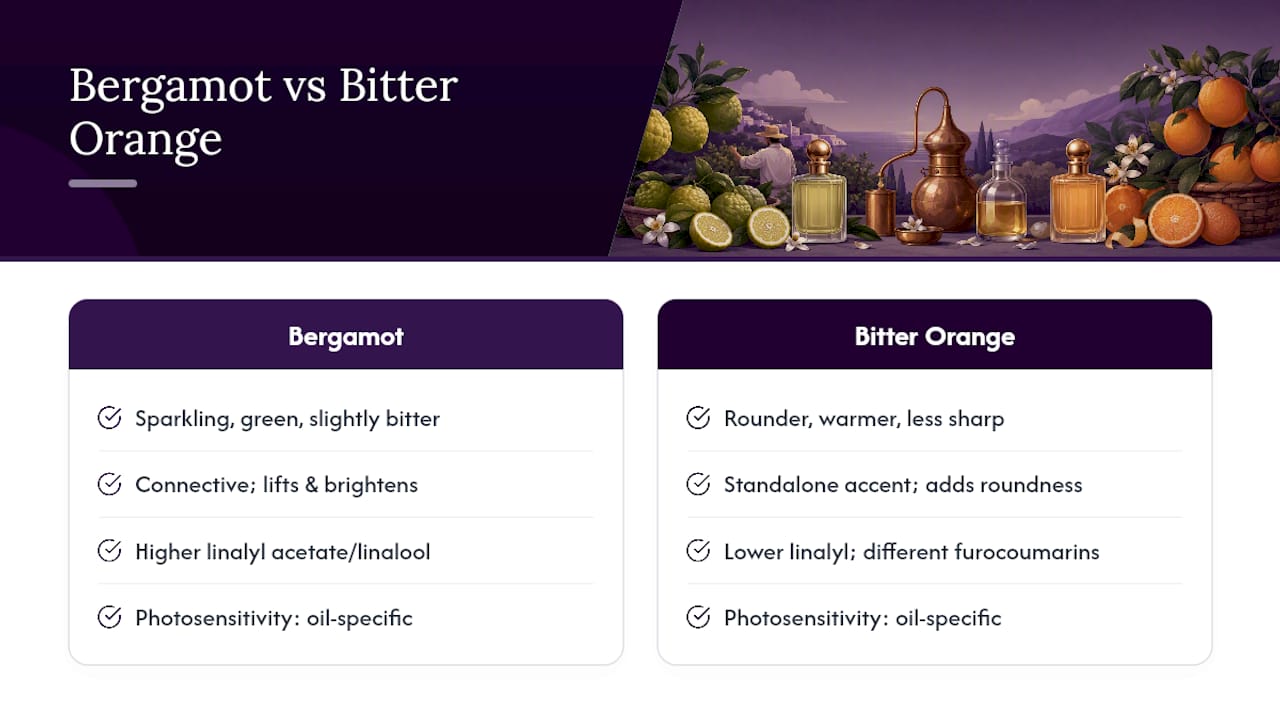
For a perfumer, the choice between them is rarely either-or. Many colognes use both, letting bitter orange add roundness while bergamot supplies the lift.
Sourcing Bergamot Responsibly: Sustainability in Practice
Bergamot farming in Calabria is small-scale by global agricultural standards, concentrated among family growers and cooperatives rather than industrial plantations. That scale cuts both ways. It protects a level of quality control large-scale farming often sacrifices, but it also means the supply chain is more exposed to a single bad harvest, price swings, or labor shortages than a diversified commodity crop would be.
Ethical sourcing in this category tends to center on a few concrete practices: paying growers fairly for a labor-intensive crop, avoiding pressure that pushes farmers toward faster, lower-quality industrial extraction, and supporting the smaller cooperatives that keep traditional methods like spugnatura alive. Perfumeries that publicize where their bergamot comes from and how it’s pressed aren’t just doing marketing. They’re making a real choice to pay more for a slower, more accountable supply chain.
There’s also an environmental angle worth naming plainly: citrus monoculture, if pushed too hard, degrades soil over time the way any single-crop farming does. Growers who rotate care and limit overharvesting protect not just this year’s yield but the tree’s productive life for decades. A bergamot tree can produce for a long time when it’s not pushed past a sustainable harvest rate.
For a reader choosing between fragrances, sourcing transparency is one of the few honest signals available. A brand that names its growing region and extraction method is giving you something to actually verify, rather than a vague “natural ingredients” claim with nothing behind it.
Why Harvest Timing Changes the Oil in Your Bottle
Bergamot harvest in Calabria runs primarily from late autumn into winter, typically November through January, and the exact timing inside that window shapes the oil’s final character more than most consumers realize. Fruit picked earlier in the season, when it’s slightly underripe, tends to yield an oil with a sharper, greener edge. Fruit picked later, closer to full ripeness, shifts toward a rounder, softer profile with less of that bracing bitterness.
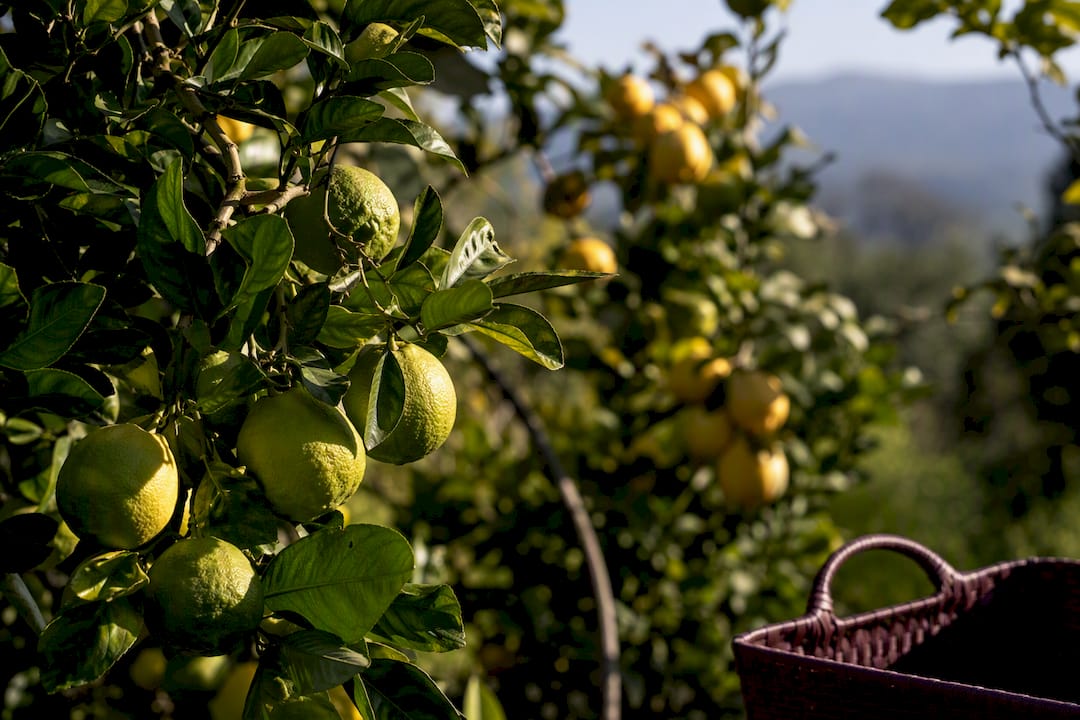
This isn’t a minor technical detail confined to growers. A perfumer sourcing bergamot for a specific composition needs oil with a particular balance of bitterness and sweetness, and that balance can shift from one harvest week to the next. Weather adds another layer of unpredictability: a cooler, wetter growing season concentrates certain aromatic compounds differently than a hot, dry one, which is part of why bergamot oil, like wine, carries real vintage-to-vintage variation even from the same grove.
That variability is precisely why serious perfumers don’t treat bergamot as an interchangeable commodity oil. A house that’s serious about consistency has to either blend across harvests to smooth out these differences or, more interestingly, lean into a single harvest’s character and build a limited composition around it. Either approach requires knowing the crop, not just buying it. For a reader, this is one more reason a stated origin and harvest transparency mean more than a generic “natural bergamot” label ever could.
Bergamot’s Growing Demand in Modern Perfumery
Demand for bergamot has climbed alongside the broader boom in niche and artisanal perfumery, where single-origin, traceable ingredients have become a genuine selling point rather than a footnote. Consumers who’ve grown skeptical of synthetic-heavy mass fragrances are actively seeking out fragrances built on real botanicals, and bergamot, with its centuries-old pedigree, fits that appetite well.
Perfumeries that highlight artisanal extraction and single-origin bergamot are increasingly positioning the ingredient as a craft differentiator rather than just another commodity top note buried in a formula. That shift matters commercially. Naming Calabria on a label, or describing spugnatura in a product story, has become a way to signal quality to a more educated buyer.
At the same time, that low, unchanging yield, roughly 85 grams of oil per 100 fruits, means bergamot can’t scale the way synthetic citrus accords can. As demand for genuinely natural fragrance grows faster than Calabria’s harvest, pressure builds either toward higher prices for authentic oil or toward more brands quietly substituting synthetic bergamot replicas without saying so. That tension, real scarcity meeting rising demand, is likely to define how the ingredient is marketed and priced over the coming years, and it rewards buyers who ask direct questions about sourcing before they trust a label.
The Real Craft Behind a Bergamot Opening
Most fragrance writing treats bergamot as a footnote, the thing every cologne “has” before the real perfume starts. That undersells it badly. The gap between a mediocre bergamot opening and a genuinely well-composed one is enormous, and almost nobody talks about why.
The conventional advice tells you to look for “bergamot” on an ingredient list and move on. That’s backwards. What actually matters is which bergamot and how it was pressed. A cold-pressed industrial oil and a spugnatura-extracted Calabrian oil can share a name and smell like distant cousins. One is efficient. The other holds onto the small aromatic inconsistencies that make an opening feel alive rather than manufactured.
If you’re evaluating a fragrance seriously, prioritize origin and extraction transparency over ingredient lists that just name-check bergamot without context. Ask where it was grown, how it was pressed, whether it was rectified, and why. A brand willing to answer those questions in detail is telling you something real about its priorities. One that can’t, or won’t, is probably working from a synthetic accord dressed up in botanical language.
— Celeste
Experience Bergamot the Way Calabria Intended

Where mass-market colognes lean on cheap citrus replicas to save cost, Maison Voyageur builds bergamot-forward openings meant to evolve, moving from bright, sparkling sparkle into quieter, more introspective base notes over the course of wear. That’s a different experience than a fragrance designed to smell the same from first spray to last. It’s slower to reveal itself, and it rewards the patience of actually sitting with it.
If the pairing logic and sourcing details in this piece resonated with you, the next step is simple: explore the Maison Voyageur collection and find the composition whose bergamot opening speaks to you, whether as a full-size bottle for daily ritual or a travel size to test the journey before committing to it.
Sources
- Phototoxic components in bergamot oil and their implications (PMC article)
- Ni limón ni naranja: el cítrico italiano que sigue marcando la alta perfumería más de un siglo después
- Bergamota (Citrus Bergamia), materia prima de la perfumería – OSMOZ
Les sept fragrances Maison Voyageur
- Manifesting · unisexe (69,99 €)
- Intuition · femme (69,99 €)
- Certainty · femme (69,99 €)
- Expansion · femme (69,99 €)
- Release · homme (69,99 €)
- Presence · homme (69,99 €)
- Inner Fire · homme (69,99 €)
Nouvelle ici ? Commence par le Discovery Set · les 7 fragrances en format voyage (40 €).