
Include perfume with a personal note: the ultimate guide
Accompanying a perfume with a personal note is the art of turning a fragrance into an authentic extension of who you are. In perfumery, this is known as olfactory personalization: the process of selecting, combining, or ritualizing scents to express your identity, emotions, and most intimate memories. A perfume with personal meaning is not just a pleasant scent. According to perfumer Lula Curioca, a personal fragrance inhabits you and becomes a living language that evolves with you. This guide explains how to achieve it, step by step.
What do you need to accompany a perfume with a personal note?
The process begins with simple materials and a basic understanding of olfactory families. You don't need a professional laboratory to start.
The essential elements are:
- Reference olfactory families: citrus (bergamot, lemon), floral (rose, jasmine), woody (sandalwood, cedar), oriental (amber, vanilla), and spicy (pepper, cardamom).
- Basic tools: precision dropper, paper scent strips, small dark glass bottles, and perfumery alcohol as a base.
- Logbook: record each mixture with the date, exact proportions, and your impressions at different times.
Before mixing, it's useful to understand the structure of a perfume. Every scent is built in three layers: top notes (the first thing you perceive, lasting 15–30 minutes), heart notes (the central character, 2–4 hours), and base notes (the lingering trail, up to 8 hours). This architecture determines how your fragrance evolves on the skin.
| Layer | Ingredient examples | Approximate duration |
|---|---|---|
| Top notes | Bergamot, lemon, mint | 15–30 minutes |
| Heart notes | Rose, jasmine, lavender | 2–4 hours |
| Base notes | Sandalwood, amber, moss | 6–8 hours |
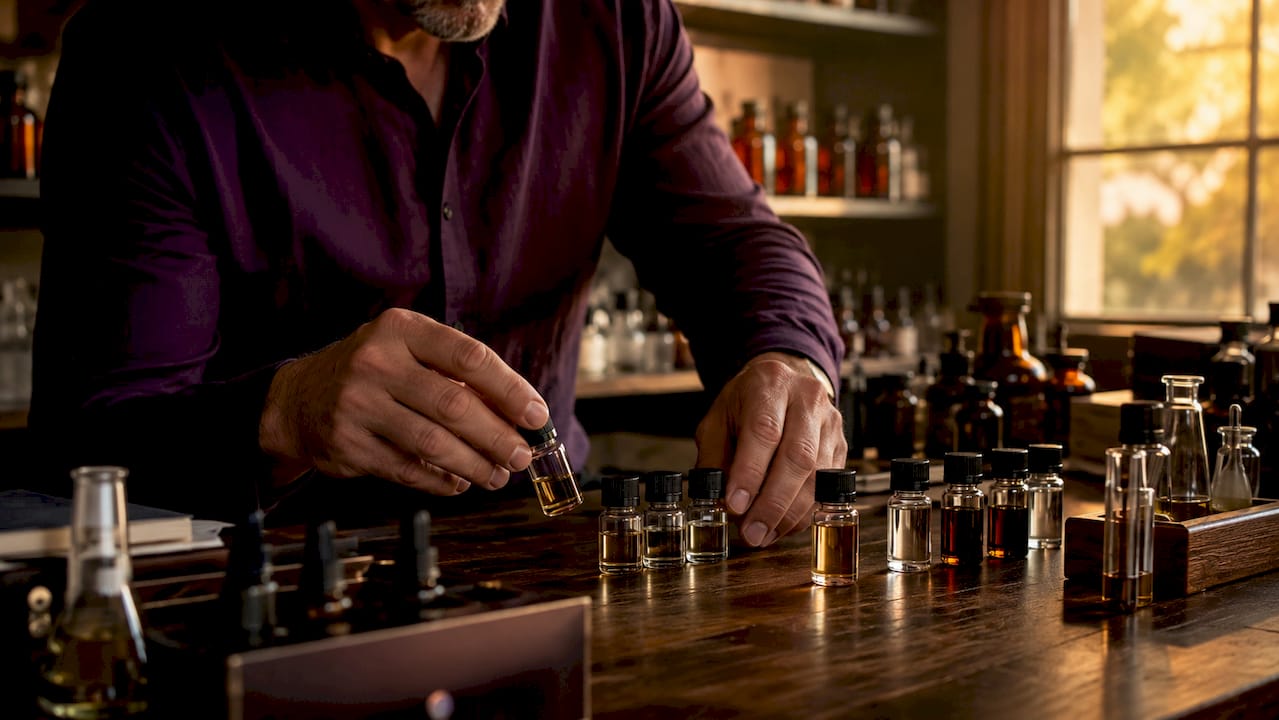
The artisanal method recommends using 5 to 10 drops in each test and allowing the mixture to rest for 48 to 72 hours before evaluating it. This resting period allows the ingredients to integrate and reveal their true character.
Professional tip: Always test the mixture on your skin, not just on the paper strip. Body heat activates the heart and base notes, and what smells good on paper can transform completely on the skin.
How to identify the notes that reflect your personality?
The choice of scents is not arbitrary. Olfactory preferences are linked to personality traits: empathetic people tend to choose soft floral notes, while more daring personalities lean towards oriental and spicy scents. Knowing your emotional profile is the first step to building a meaningful fragrance.
Follow this process to identify your notes:
- Define the emotion you want to project. Perfumer Verónica Kato points out that choosing perfume by emotion, not just by scent, is key to an authentic fragrance. Do you want to convey calmness, sensuality, energy, or nostalgia?
- Associate that emotion with an olfactory family. Calmness is well expressed with soft woody or aquatic notes. Sensuality, with oriental and spicy ones. Energy, with citrus and green notes.
- Identify a specific memory. What scent transports you to a significant moment? The sea in summer, wet earth, freshly baked bread. These sensory anchors are the core of your personal note.
- Use an olfactory questionnaire. Tools like Maisonvoyageurparfum's archetype test help guide the search according to your identity profile.
- Consider your body chemistry. Skin pH, diet, and body temperature modify how a perfume develops. What works for someone else might evolve differently on you.
Fragrance as an extension of identity facilitates non-verbal communication and creates an affective heritage when linked to personal stories. This is the true value of personalizing your perfume: it's not about smelling good, but about saying something without words.
Professional tip: Test fragrances at different times of the day. Skin changes with heat, stress, and diet. A note that seems too intense in the morning might become perfect in the evening.
Steps to create your fragrance with a personal note
The personalization process requires patience and method. Here is the protocol used by artisanal perfumers:
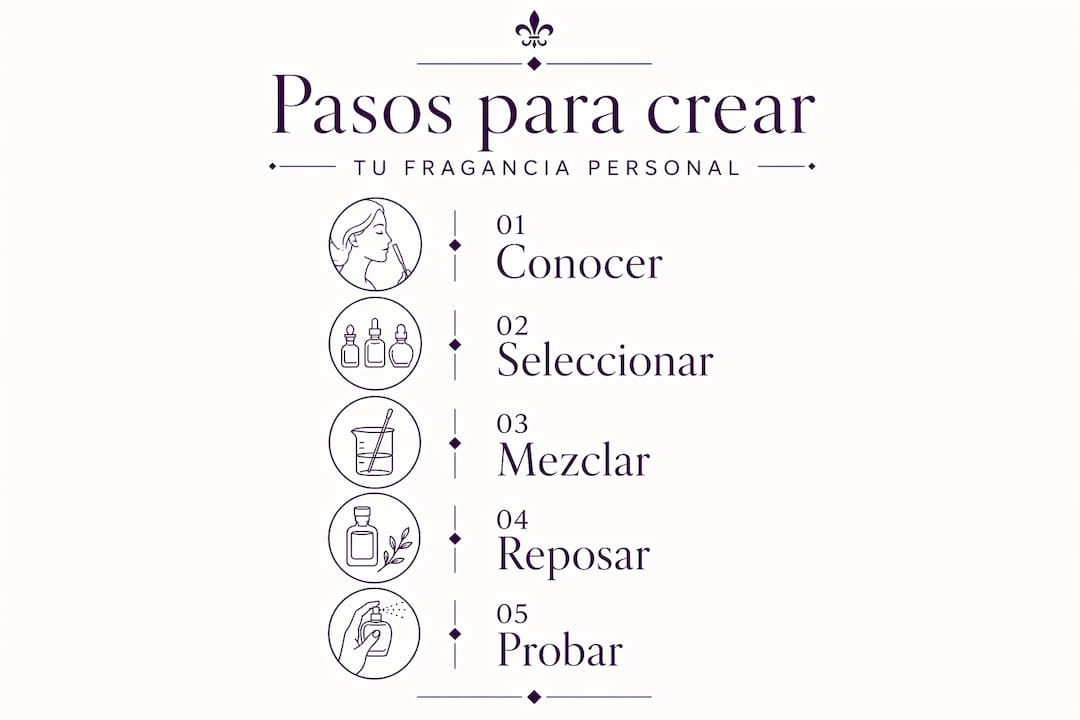
- Prepare your space. Work in an environment free of strong odors, with good ventilation and natural light. Have water and ground coffee on hand to cleanse your palate between tests.
- Choose two or three base notes. Start with simple combinations: a base note, a heart note, and a top note. Simplicity best reveals the character of each ingredient.
- Mix in small quantities. Use between 5 and 10 drops in total. Record the exact proportions in your notebook.
- Allow to rest for 48–72 hours. This step is the most overlooked and the most important. The mixture needs time to integrate.
- Evaluate at three different times. Apply the fragrance to your wrist and observe how it evolves at 1 minute, 10 minutes, and 24 hours. Each moment reveals a different layer.
- Adjust and repeat. If a note dominates too much, reduce its proportion. If it lacks depth, add a more intense base note.
- Document each version. Assign a name or code to each mixture. This record is your personal olfactory memory.
To ritualize the use of your fragrance, including narrative letters or playlists when applying it helps anchor the memory and imbue the fragrance with meaning. A scent associated with a song or a handwritten letter becomes a sensory object with its own story.
The most common mistakes when combining perfumes are:
- Mixing too many ingredients at once (more than four notes creates olfactory confusion).
- Evaluating the mixture freshly made, without respecting the resting period.
- Applying to clothing instead of skin, which prevents seeing the true evolution.
- Ignoring the context: fresh fragrances work better during the day and woody or warm ones, at night or in cold climates.
Professional tip: Store your mixtures in dark glass bottles, away from light and heat. Oxidation is the greatest enemy of an artisanal fragrance.
Artisanal blend vs. personalized fragrance: which method to choose?
There are two paths to achieve a perfume with a personal note. Each has clear advantages depending on your time, budget, and objective.
| Criterion | Own artisanal blend | Author's personalized fragrance |
|---|---|---|
| Cost | Low (basic ingredients) | Medium to high |
| Exclusivity | Total | High |
| Personalization | Maximum | Expert-guided |
| Time required | High (weeks of testing) | Low (one session) |
| Knowledge needed | Medium | None |
| Sentimental value | Very high | High |
Your own artisanal blend offers a deeper connection to the process. Every decision, every adjustment, is part of the fragrance's story. The result is entirely yours, but it requires time and some tolerance for error.
Author's personalized fragrances, like those offered by Maisonvoyageurparfum in its Madrid atelier, allow you to achieve the same result with the guidance of an expert perfumer. The experience is faster, and the risk of error is lower. The sentimental value remains high because the process includes a conversation about your story, your emotions, and your identity.
The choice depends on a simple question: do you want to learn the craft or do you want the result? Both paths lead to the same destination. A perfume that represents you.
Key points
Accompanying a perfume with a personal note requires knowing your emotions, respecting the artisanal process, and ritualizing its use so that the fragrance becomes a unique and lasting language.
| Point | Details |
|---|---|
| Perfume structure | Every fragrance has top, heart, and base notes that determine its evolution on the skin. |
| Mandatory resting | Allow the mixture to rest for 48 to 72 hours before evaluating its definitive character. |
| Emotion as a guide | Choose notes according to the emotion you want to project, not just the initial scent. |
| Body chemistry | Always test on the skin and wait at least 1–2 hours to see how the fragrance evolves. |
| Ritualization | Associating the fragrance with letters, music, or specific moments enhances its personal meaning. |
What no one tells you about personalizing your perfume
Celeste speaks.
For years, I've observed how people approach perfumery with a very specific idea: they want to find "their perfume." What they discover, if they have patience, is something more interesting. There is no definitive perfume. There is a continuous conversation between you and the scent.
The most common mistake I see is looking for the perfect fragrance instead of looking for the true fragrance. Perfection is static. Truth evolves. A perfume with a personal note is not the one that smells best in the bottle, but the one that inhabits you differently every time you use it.
I've also noticed that people underestimate the power of resting, both in mixing and in deciding. No one would choose a wine without letting it breathe. A perfume deserves the same respect. The 48–72 hours of resting are not a technical detail: they are the moment when the ingredients decide how they want to relate to each other.
Finally, and this is what matters most to me: don't be afraid to make mistakes. A failed mixture teaches you more about your sense of smell than ten fragrances chosen by recommendation. The process of turning memories into notes is, in itself, an act of self-knowledge. And that is priceless.
— Celeste
Create your fragrance with Maisonvoyageurparfum
Maisonvoyageurparfum is a Mediterranean niche perfumery based in Madrid, specializing in artisanal fragrances made with 98% natural ingredients. Each scent is born from a slow and conscious process, designed to evoke emotions and build a unique olfactory identity.

If you want to start your own olfactory journey, Maisonvoyageurparfum's archetype collection is an extraordinary starting point. Each fragrance is designed to resonate with a distinct identity profile. You can also explore the personalized Manifesting soy candle, a sensory object that complements any fragrance with an additional layer of personal meaning.
Frequently asked questions
What does it mean to accompany a perfume with a personal note?
It means adding or selecting olfactory ingredients that reflect your identity, emotions, or memories, turning the fragrance into an authentic expression of who you are. It's not just about mixing scents, but about building your own sensory language.
How long should an artisanal mixture be allowed to rest?
It is recommended to let the mixture rest for 48 to 72 hours before evaluating it. This time allows the ingredients to integrate and reveal their true character, avoiding decisions based on immediate impressions.
How do I know which notes correspond to my personality?
Empathetic people tend to prefer soft floral notes, while more daring personalities lean towards oriental and spicy scents. An olfactory questionnaire or archetype test, like Maisonvoyageurparfum's, helps guide the choice according to your emotional profile.
Is it better to mix it myself or buy a personalized fragrance?
It depends on your goal. An artisanal blend offers maximum personalization and connection with the process, but requires time and practice. An author's personalized fragrance, guided by an expert, achieves the same result with less effort and risk.
Where should I apply perfume for it to evolve well?
Apply the fragrance to pulse points: wrists, neck, and inner elbows. The heat from these areas activates the heart and base notes, and allows you to appreciate how the fragrance evolves during the first 1–2 hours of wear.